Long Term Market Cycles
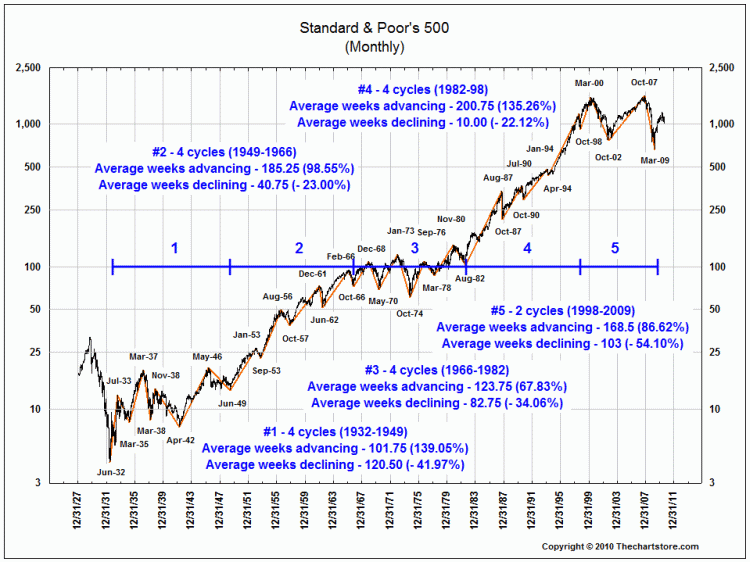
Ron Griess (The Chart Store) looks at the longer term market cycles of the last century. He divides them into 5 sections, 3 bears and 2 bulls.
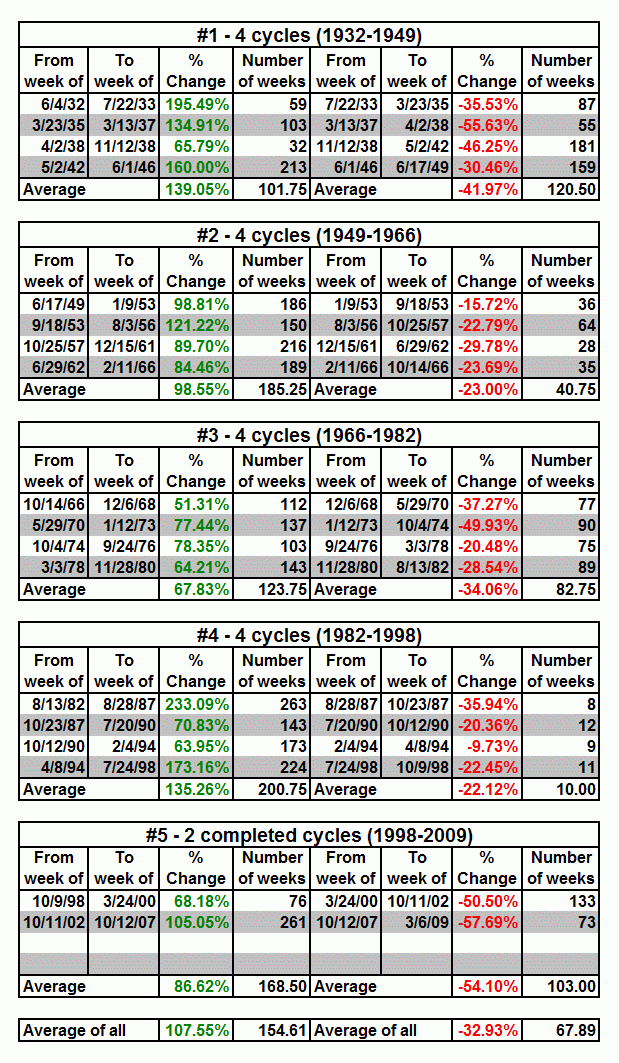
The table breaking the periods down further is after the jump . . .
Ron Griess (The Chart Store) looks at the longer term market cycles of the last century. He divides them into 5 sections, 3 bears and 2 bulls.
The table breaking the periods down further is after the jump . . .
Please use the comments to demonstrate your own ignorance, unfamiliarity with empirical data, ability to repeat discredited memes, and lack of respect for scientific knowledge. Also, be sure to create straw men and argue against things I have neither said nor even implied. Any irrelevancies you can mention will also be appreciated. Lastly, kindly forgo all civility in your discourse . . . you are, after all, anonymous.
August 17th, 2010 at 11:47 am
I get it: odds = stable, evens = growth.
Right?
August 17th, 2010 at 11:47 am
Clear trend from 1940 to 2000.
Otherwise, mere temptation to see patterns where non exist.
August 17th, 2010 at 11:50 am
The 1940-2000 trend was interrupted for 16 years — 1966-1982
August 17th, 2010 at 11:53 am
Nice chart but completely useless. When debt is added to the chart, it will become relevant.
August 17th, 2010 at 11:57 am
Looks like 5 should be labeled (1998-?).
August 17th, 2010 at 12:17 pm
i like your version from 2005, Barry. maybe it’s time to update it
http://bigpicture.typepad.com/comments/2005/12/100_year_bull_b.html
August 17th, 2010 at 12:17 pm
The second downward cycle in period #5 (present period) is the fiercest and steepest of the declines of all cycles within the 5 periods. Thats interesting.
So we might just be a little more than half way thru’ the 5th period.
Jan ’73 high was not eclipsed for more than 6 years, sometime in ’80. It would be interesting how long it takes before we reach the Oct ’07 high of the present period and what kind of downward pressure is observed when we hit the Oct ’07 high.
Interesting chart. It would be interesting to superimpose yield curve chart on top of this one.
August 17th, 2010 at 12:20 pm
Well OK then –
Looks like we have 6 years (avg) to go for the next real bull. And in the meantime we need to complete two more cycles –a bear and a bull (in that order)– with the next (really “current”) bear being a doozy.
2017 for the next big bull looks like –
Feels like forever.
.
August 17th, 2010 at 12:23 pm
1) re: the Y axis: is it logarithmic scaling or magical scaling?
2) Let’s assume there really is a pattern and a cycle. What is controlling it or is independent of all outside events … meaning it is a form of perpetual motion?
3) Let’s assume there really is a pattern and a cycle. Then cycles control our lives and nothing is random, at least if it involves the stock market. Stocks for the long run are a fact if this is true. BR, your ridicule of stocks for the long run and your belief in long run patterns and charts that display events that are controlled from beyond are in contradiction. Should we pray to the charts for guidance or are events so fixed that all nature is just playing a joke on us.
August 17th, 2010 at 12:26 pm
“Let’s assume there really is a pattern and a cycle.”
Wow.
August 17th, 2010 at 1:06 pm
So, what is supposed to mean? The cicada cycle? I see no logic whatsoever.
Stocks will go up when we have new growth, yes?
Stocks will go down when there isn’t any new new thing to create jobs and drive the economy.
And when bubbles are burst…
August 17th, 2010 at 1:10 pm
Actually, to me the chart above looks like the left half of a Batman configuration. If true, then beware his arrival. Wall Street is about to be taken down by the Dark Knight.
August 17th, 2010 at 1:14 pm
DH – Always a pleasure :-)
August 17th, 2010 at 1:20 pm
I see a big ol’ double top. Looks like the Grand Tetons.
August 17th, 2010 at 1:22 pm
‘Round and ’round she goes, where she stops nobody knows.
August 17th, 2010 at 1:32 pm
“Too keen an eye for pattern will find it anywhere.” ~ T.L. Fine
August 17th, 2010 at 1:51 pm
historic data is always very interesting and provide a ton of data points to ponder …
but – past performance does not dictate future results
August 17th, 2010 at 3:34 pm
Hello everyone,
Here is another interesting but less accurate
http://pragcap.com/secular-bears-tend-to-be-long-events
August 17th, 2010 at 4:57 pm
From this chart, I can conclusively state that the author likes the number 4. Everything else seems completely arbitrary. For example, if you want to use any kind of measure of gain as where the cycles change, then both 1974 and the 1978 lows would make much more sense than the 1982 low for the boundary between 3 and 4. The boundary between 4 and 5 is a low blip on the map, smaller than a dozen other non-significant drops that occured earlier. Boundary1-2 surely looks more appropriate set in 1942 (I can’t recall… anything economically significant happen that year?)
For that matter, why are the boundaries all marked by lows? that would seem to indicate a bias in processing the data right from the start.
In short… you wanna believe in 16.8 year economic cycles that render irrelevant all changes in economic and political philosophy, major wars, changes in technology and changes in lifestyles, go for it! big changes in 3 years!
August 18th, 2010 at 9:01 am
[...] we looked at Long Term Market Cycles dating back to [...]
August 18th, 2010 at 7:31 pm
Someone told me stocks pay dividends.
Lazy.