Hindenburg Omen = Recession Porn ?

Email this post Print this post
By Barry Ritholtz - August 25th, 2010, 9:00AM

Yesterday, we discussed the zeitgeist of the moment being bearish.  Try this on for size:

>

Recession Porn, anyone?

Comments

Please use the comments to demonstrate your own ignorance, unfamiliarity with empirical data, ability to repeat discredited memes, and lack of respect for scientific knowledge. Also, be sure to create straw men and argue against things I have neither said nor even implied. Any irrelevancies you can mention will also be appreciated. Lastly, kindly forgo all civility in your discourse . . . you are, after all, anonymous.

23 Responses to “Hindenburg Omen = Recession Porn ?”

  1. Jack Damn Says:

    For what it’s worth (FWIW), I created an alt screen cap of the chart above that includes the search terms:

    http://i.imgur.com/kzEOr.png (chart)

    Same search. Just capped in the Regions and title.

    =^.^=

  2. mark Says:

    And “Ground Zero Mosque = Xenophobia Porn?”

    http://www.google.com/trends?q=ground+zero+mosque&ctab=0&geo=all&date=all&sort=0

    People will google whatever is in the headlines. This is a variant on the “what is the media reporting” as you discussed in the Mark Cuban follow-up. It’s not an independent observation.

  3. IdiotInvestor2 Says:

    If anyone is thinking of using this is a contra-indicator, take a look at this
    http://www.google.com/trends?q=housing+bubble&ctab=0&geo=all&date=all&sort=0

    Searches for “Housing Bubble” were highest in 2005 – did not prevent the bubble fro bursting.

    Pay more attention to Durable Goods etc macro-indicators – the famous 2nd derivative is nose diving.

  4. Barry Ritholtz Says:

    Understand the nature of contrary indicators: They reflect crowd sentiment.

    At the time, the dominant thought was that housing was fine. Very few of us were arguing that housing (or in my case, credit) was a bubble. Hence, this is not a contrary indicator, as it reflects a minority perspective at the time on Housing.

    Today, recession porn is everywhere, and the sudden rise in searches for an obscure — and let’s be blunt, mediocre — technical indicator is a warning about negative sentiment.

  5. rktbrkr Says:

    Take a look at strategic foreclosures LOL

    http://www.google.com/trends?q=strategic+foreclosures&ctab=0&geo=all&date=all

    I listened to the Rosenberg interview on CNBC, of course they cut him off when he started drawing parallels to the 1930s

    meanwhile on the white goods front (not many are white anymore!)
    New orders for long-lasting U.S. manufactured goods excluding transportation equipment posted their largest decline in 1-1/2 years in July while overall booking rose far less than expected, pointing to a slowdown in manufacturing.

  6. WaveCatcher Says:

    Maybe it’ll fail, maybe it won’t. From what I’ve read, there’s a 75% probability that it won’t (to date). That’s the track record of the HO. Assuming the market re-enters bear territory and recovers, with the market down 10-15% from its peak already, the HO may be too late to avoid the majority of the move down.

    Regardless of whether this HO signal is recession porn or not, the underlying premise seems to have merit to me. When a large percentage of the NYSE common stocks are making both new highs AND new lows, the market is showing signs of schizophrenia and investors should be more cautious. This may become a self fulfilling prophecy if the HO gains enough prominence. Or the early public awareness may bleed off some of the pent up fear helping to avoid a cascading descent.

    Nothing is certain except the majority of people will be wrong at the turning point.

  7. mrd Says:

    Heres another indicator. Look at Wired Magazine (hard copy). Betcha if you measure the width of the binding or the weight of the magazine you will find a correlation to economic activity due to the amount of advertising contained. So grab that scale and go to the library! By the way the last issue is noticeably thicker than the preceding.

    Fairly sure other mags might have the same effect and likely a correlation to what it’s dominant readership is or is percieved to be by those who wish to sell something to them.

  8. rktbrkr Says:

    With RE heading south it’s doubly important for Fed to shore up the SM to prevent both major wealth effect things from going south together. BB needs to try something dramatic soon to keep things from getting out of hand – maybe public executions of strategic defaulters (unless it’s a financial firm defaulting)

  9. Petey Wheatstraw Says:

    The framework for any meaningful discussion of the status or direction of any aspect of our broader economy (of which, the SM is a component) has been twisted and stretched to the point of irrelevance, yet people seem to want to discuss our predicament as if that framework had not been distorted.

    We don’t have the metrics to determine what will happen next in any aspect of our economy (such is the nature of Corporatist controlled, command economies).

    We are off the charts.

    Here there be monsters.

  10. NoKidding Says:

    I’m with Wheatstraw. Discussion of the market must bear the qualifier: “Barring federal intervention”

    Doesn’t mean it isn’t worth discussiong tho-

  11. VennData Says:

    Take a look at Google trends of Google trends

    http://www.google.com/trends?q=google+trends&ctab=0&geo=all&date=all&sort=0

    As you can plainly see, the search for searches for Google trends has resulted in a surfeit of contrary to the contrarian comments… also see…

    http://www.google.com/trends?q=contrarian&ctab=0&geo=all&date=all&sort=0

  12. VennData Says:

    “…that the broad U.S. bond market never has seen a minus-20% return…”

    http://online.wsj.com/article/SB10001424052748703447004575449351409953886.html

    Sounds like something I might have said.

    – Lawrence Yun

  13. curbyourrisk Says:

    Let’s face it. We are in a depression. I really don’t give a rats ass about any government data that is massaged, manipulated and out right spun by the blow hards over at CNBS. The ONLY way we are going to get out of this mess is with rising wages. Take all the trend measurements you want.

    http://www.google.com/trends?q=blowjob

    That is a link the trends on blowjob…….. looks pretty pornish at the end of 2005, but what the hell does that spike mean????? NOTHING…..

    Wages….thats the answer.

  14. JSchmid Says:

    I hear the Hindenburg Omen has occurred twice in the last week or so. Is there any stats that show a double hit of the HO are any more accurate than a single occurrence.

    I hear that the HO has predicted 100 of the last 12 market dips. LOL

  15. rktbrkr Says:

    And the contrary to contrary to contrary indicator

    http://www.google.com/trends?q=%22barry+ritholtz%22&ctab=0&geo=all&date=all&sort=0

  16. mccarthy Says:

    while on goog trends …
    http://www.google.com/trends?q=bond+bubble

  17. wildebeest Says:

    I was trying to get search terms for Kingdom Foundation, funding terrorists, & Fox News ownership but this sums it up better:

    http://www.thedailyshow.com/watch/mon-august-23-2010/the-parent-company-trap

  18. Onthemoney Says:

    Being glib about sentiment is just one more route to the trading knackers yard. Every day on CNBS you can guarantee some bonehead will be on saying we should buy stocks because ‘everyone’s so negative’. Folks, sentiment can be negative – then get a whole lot more negative, as we saw in summer ’08. There’s only one way to check sentiment and that’s with objective indicators – long-standing investor sentiment surveys, put/call ratios, smart/dumb money indicators etc. etc. Used intelligently and as part of an overall picture, they work beautifully.

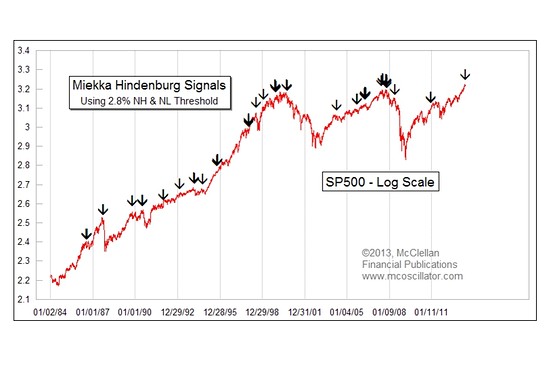
    And while we’re busy tying ourselves up in absurd contrarian knots, can I also suggest that anyone who’s happy to dismiss the H.O. as a ‘mediocre indicator’ first check out its history, which I did by looking back at all confirmed signals since 1965. Of 44 signals, only 4 failed to offer a decent – sometimes spectacular – downside edge. The charts are here:

    http://jamesgoodeonthemoney.blogspot.com/2010/08/stocks-hindenburgs-catalogue-of-carnage.html

  19. Google Trends – A fresh look at search frequency | The Big Picture Says:

    [...] Money manager Barry Ritholtz seems to agree, calling it an example of “recession porn” (Ritholtz). Now I am not so sure, given the data shown [...]

  20. mainstreetjournal Says:

    I think there’s an element of self-fulfilling prophecy to the Hindenburg Omen that is not unlike people’s current fears about a double-dip recession. The more people believe it, the likelier it will happen. It is this dynamic as well as some legitimately bearish data coming out of housing and market money flows that led me to blog this morning ‘Hindenburg Omen: Myth, Reality, or Both?’

    http://prooftrader.com/symbol/QID/643/Hindenburg-Omen-Myth-Reality-or-Both

    ~~~

    BR: You wrote:

    From historical data, the probability of a move greater than 5% to the downside after a confirmed Hindenburg Omen was 77%, and usually takes place within the next forty days. The probability of a panic sellout was 41% and the probability of a major stock market crash was 24%. Though the Omen does not have a 100% success rate, every NYSE crash since 1985 has been preceded by a Hindenburg Omen.”

    A 5% move to the downside is statistical noise!
    24% means it fails to have any prescience
    I have no idea what you mean by a panic sellout (41%)

  21. mainstreetjournal Says:

    Actually that part of the article is quoted from wikipedia. But I think if you focus in on that 24% – a market *crash is no common thing. And risk vs. threat, if you told someone, if you touch this wire, there’s a 1 in 20 chance you’ll die, 1 in 20 may not be very likely, but because the threat is so dire, they won’t touch it. Anyway I’ve seen the 24% number bandied about a lot, but you are right to point out that no one is defining it.

  22. Onthemoney Says:

    Barry, you know perfectly well that a 24% probability of a crash (defined in Robert McHugh’s research as 15%+) is orders of magnitude greater than random. Also, according to a recent study by Jason Geopfert at Sentimentrader, the median max. loss after a confirmed HO since 1965 was -9.2% over the following 3 months, and the max gain was 2.7% – a greater than three to one negative risk/reward. And that doesn’t even include the signal in June 2008…

    The technical principles behind its success are well known and entirely logical, so it’s amazing to me that there’s such antipathy to this indicator – as far as I can see it’s just a kind of traders’ snobbery, or maybe it’s Indicator Envy! “How dare such a simplistic, data-mined, populist confection with such a stupid name get so much publicity. It can’t be any good!” Well I’m sorry, the real-time record over decades is plain to see (link in my post above).

    In any case, the subject is now moot as whatever downside correction / crash we’re due is now underway, and those of us who took the HO into account were nicely positioned for it.

  23. Pop! Back Into the Trading Range | The Big Picture Says:

    [...] Robbin’s economic warnings, the excessive bearishness of Wall Street Analysts, or the the recession porn of the Hindenberg Omen, there has simply been too much negativity. Even the pushback on Leveraged [...]

77 queries. 0.220 seconds.