
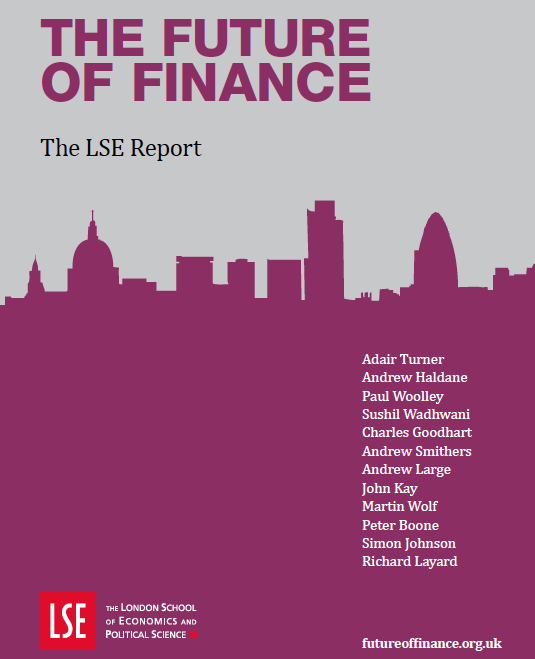
The Future of Finance
Did you know that the London School of Economics has a “Paul Woolley Centre for the Study of Capital Market Dysfunctionality?”
Me neither!
But I found out about them a few weeks ago via MIT’s Simon Johnson, writing in the NYT’s Economix blog about the LSE’s publication of The Future of Finance, and The Theory That Underpins It (London School of Economics Press).
The report has its own website: The Future of Finance: The LSE Report.
Here is an excerpt from the intro:
The financial crash of 2008-9 has been the most damaging economic event since the Great Depression – affecting the lives of hundreds of millions of people. The most immediate problem now is to prevent a repeat performance.
Much has been written about reforming the world financial system. But it is rarely based on a searching in-depth analysis of the underlying weaknesses within the system. Nor does it usually tackle the key question of what a financial system is for.
To correct this omission, we invited eighteen leading British thinkers on these issues to form a Future of Finance Group. They included journalists, academics, financiers and officials from the Financial Services Authority, the Bank of England and the Treasury. We have met twelve times, for what many of those present described as the best and most searching discussions they had ever participated in. The result is this book.
The issues at stake are extraordinarily difficult and profound. The central question is what the financial system is for? Standard texts list five main functions – channelling savings into real investment, transferring risk, maturity transformation (including smoothing of life-cycle consumption), effecting payments and making markets. But if we study how financial companies make their money, it is extraordinarily difficult to see how closely this corresponds to the stated functions, and it is often difficult to explain why the rewards are often so high. Any explanation must also explain why the system is so prone to boom and bust.
This is your weekend reading . . .


Tweet
Facebook
Reddit
Digg this!


August 13th, 2010 at 10:29 am
Thanks, for the heads up, good stuff . . .
August 13th, 2010 at 11:00 am
Interesting, though the titles for each chapter suggests an inherent bias “Why are financial markets so inefficient and exploitative”….. inefficient, to whom?
August 13th, 2010 at 11:03 am
Our financial system is almost the definition of dysfunction. For something to function you have to align the incentives with the goals (or functions). We have administered our financial system as if the goal was making money, when that actually was supposed to only be the incentive. On top of that we have allowed the thugs to gain complete control of the system such that the incentive of making money (by investing) was perverted into making money for the thugs in control rather than for the investors. Small investors have been boxed in to where they cannot use the power they theoretically have to make things right, and large investors are members of the same gang as the thugs.
August 13th, 2010 at 11:13 am
The Economist examined many of these questions recently and their conclusion, I believe, is simply that risk is mispriced in the modern financial system. I’d say that is spot on and has a lot to do with the evolution of the central bank from its original purpose of lender of last resort at high interest rates to the monstrosity we have today that has its tentacles in just about every damn corner of the economy.
August 13th, 2010 at 11:14 am
Can’t believe what these big brains need to do or have to convene to decide what to do when it is so painfully obvious.
The complexity of the global economic scene comes down to one single solution: It cannot be governed.
Like any organism once it reaches a certain size, it’s fate is all but sealed.
If it cannot be governed by humans or computers or any combination thereof, it must be dismantled and good luck with that.
Like the United States, which is 3.5 million square miles, and is filled with 350,000,000 people who don’t much like or care for each other, possessing a widely variant set of necessities and wants, needs to be broken up, well good luck with that, too.
Since perfect solutions that are obvious will not be made manifest, since a basic law of geometry which states that the shortest distance between two points is a straight line, and since Occam is being shown unceremoniously out the door, all other attempts to fix the global economic scene will be like cobbling together a disparate jerry rigged, Rube Goldbergian confection and we already know how piss poor that’s going to perform.
There really is no hope that an Escher drawing will ever make sense, cannot exist in the real world.
Be prepared to do what you can to make money on the distortions that will inevitably be built into any changes that these big brains attempt to implement.
Every man for himself.
There are no systems that will ever perform remotely as well as making one of us a benevolent dictaor who possesses the wisdom of Solomon, the strength of Hercules, the intelligence of a spectacular genius and the grace of Venus.
August 13th, 2010 at 11:14 am
super_trooper
The discussion of “inefficiency” refers to the formerly dominant, now widely recognized as flawed, Efficient Market Hypothesis
We have discussed this extensively in the past . . .
August 13th, 2010 at 11:22 am
What is the financial system for? It’s for diverting money into the pockets of those should-be mid-level bureaucrats who administer it. Nothing more.
August 13th, 2010 at 11:25 am
This course should be required study at Goldman Sachs. Abacus anyone?
August 13th, 2010 at 11:43 am
Chapters 9 and 10 have very good analysis and policy recommendations to align the financial system with the interests of the banks, shareholders, creditors and society.
Introducing the idea of “protecting the balance sheet” and different compensation plans into the equation would certainly help to solve some of the pro-cyclical incentive structure of driving up stock prices and artificial pumping of asset values that exists in the system today.
August 13th, 2010 at 11:59 am
Some prominent professionals, journalists and pundits have been brought together to discuss the financial system.
And yet, from what I can glean (without actually reading the entirety of the text) nobody finds it useful to mention the monetary system.
There cannot be a financial system without money and there cannot be money without a monetary system. That’s where we should be looking for problems and cures.
August 13th, 2010 at 12:37 pm
Barry,
Paul Woolley is a former partner of Jeremy Grantham’s at GMO. Jeremy always speaks highly of him, and his institute.
August 13th, 2010 at 12:51 pm
18 LEADING BRITISH THINKERS.
Did not know there were that many.
August 13th, 2010 at 5:24 pm
“The financial crash of 2008-9 has been the most damaging economic event since the Great Depression – affecting the lives of hundreds of millions of people. The most immediate problem now is to prevent a repeat performance.”
And the slow putrefaction of Western Civilization’s middle class is what, back page fodder?
August 14th, 2010 at 8:38 am
Remedies for everyone but the mortgagor who bears the entire risk of everyone else’s folly!
August 15th, 2010 at 1:10 am
flipspiceland,
Your comment was fun to read.
You got the beginning of your concluding paragraph right :” there are no systems that will ever perform…” but you should have put a period after ‘perform’ and called it a night.
I have. And tomorrow (and the next day..) I’ll wake up looking forward (not backward) to another system that will be proposed that promises to perform “as well as” your suggestion. My spawn (and theirs.and theirs..) will also wake up each day, looking forward to the same dream, till their kids are not human anymore.
August 15th, 2010 at 1:24 pm
The long term solution to the problems we are having with Capital is for Labour to also transcend the jurisdictional boundaries that Capital has moved beyond. When Capital and Labour again meet on the same playing field, the stability and general prospertity that we enjoyed before Capital became so nimble will be rekindled.
And yes, the formation of Global Labour will need to be followed by the formation of Global govenance. Someone has to play referee.