
Bond bubble: A Sterile Debate on Semantics
Much ink has been spilt over the question of whether government bonds are in a bubble or not. The bond bubble believers love to cite stats along the lines that bonds are witnessing inflows at the same pace as equity funds did during the TMT bubble.
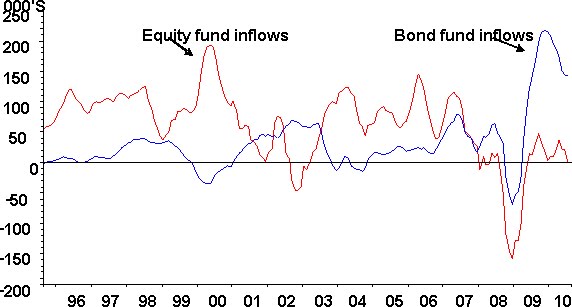
The bond lovers respond an asset with a finite life and no hope of limitless capital gain can’t really be a ‘bubble’, and beside they argue the ‘fundamentals’ warrant current valuations. (i.e. inflation is low and will remain so).
However, to me this is largely a sterile debate over semantics. The issue shouldn’t be whether bond are a bubble or not, but rather are bonds a good investment or not? Ben Graham defined “An investment operation is one which, upon thorough analysis, promises safety of principal and a satisfactory return. Operations not meeting these requirements are speculative”.
Do bonds offers long term investors a sensible level of return? I’ve always thought that in essence bond valuation is a rather simple process (at least one level). I generally view bonds as having three components: the real yield, expected inflation and an inflation risk premium.
The real yield can be measured in the market thanks to inflation-linked bonds. In the US, a 10 year Tip is trading at just under 1%. Expected inflation can be assessed in a variety of ways. We could use surveys, for instance, the Survey of Professional forecasters shows an expected inflation rate of just under 2.5% p.a. over the next decade. In contrast, the nominal bonds minus the TIP yields implies a figure of more like 1.5% p.a. The inflation swap market is implying a 2% p.a. inflation rate over the next ten years.
The inflation risk premium (a risk premium to compensate for the uncertainty of future inflation) is generally held to be between 25bps and 50bps. Given the uncertainties surrounding the impact of monetary and fiscal policy I’d argue that using the high end of that range seems reasonable.
Using these inputs a ‘fair value’ under normal inflation would be around 4%. Of course, this assumes that the current market 1% real yield is itself a ‘fair price’. This seems like a questionable assumption to me. In the UK we have a longer history of index linked bonds – introduced in 1986. The average yield since the introduction is 2.6%, in the last decade the average real yield has been 1.5%. Given this ‘parameter’ uncertainty is would be reasonable to say that ‘fair value’ for 10 year bonds is somewhere in the range of 4-5%.
The current 2.5% yield on the US 10 year bond is clearly a long way short of this. So unless you believe that Japan is correct template for the US (i.e. inflation will be zero for the next decade), government bonds don’t offer an attractive return as a buy and hold proposition.
Another way of looking at this problem is to ask how much weight the market is putting on a ‘Japanese’ outcome. Let’s assume three states of the world (a gross simplification, but convenient). In the ‘Normal’ state of the world bonds sit at close to equilibrium, say 4.5%. Under a ‘Japanese’ outcome yields drop to 1%, and under an inflation outcome yield rise to 7.5% (this assumes a 5% inflation rate).
The table below lays out my own estimates (kind of an agnostic view, with a prior biased towards the ‘Normal’ but cognizant of the other two risks), then bond should yield around 4.4%. I can then tinker around with the probabilities to generate something close to the market’s current pricing. In essence, the market is implying a 70% probability that the US turns Japanese.
| Bond Yield | JM Probabilities | Market implied | |
| Normal | 4.5 | 0.5 | 0.2 |
| Japan | 1 | 0.25 | 0.7 |
| Inflation | 7.5 | 0.25 | 0.1 |
| Expected Yield | 4.4 | 2.4 |
It is possible to build a speculative case for bond investment (i.e. riding the deflationary news flow down), however, as ever this leaves participants with the conundrum of Cinderella’s ball as described by Warren Buffett “The giddy participants all plan to leave just seconds before midnight. There is a problem though: They are dancing in a room in which the clocks have no hands!” Personally I prefer to stick to investment rather than speculation.


Tweet
Facebook
Reddit
Digg this!


September 2nd, 2010 at 11:44 am
I think it is important to put your analysis in the context of the spectrum of investment options available to investors. It may be that government bonds are a bubble (though I happen to think the Japan scenario has a very high probability of happening in the U.S. – certainly over 50%). But where else do investors go for return? Certainly not the stock market which is really a ponzi scheme – decent returns are only achievable by successfully trading it and I don’t like my chances vs. the “house” (and I used to run a trading desk on wall street so that’s saying something). Commodites? Highly correlated to the stock market and volatile. Corporate bonds (including HY) – yields are low but I contend that decent returns can be had at lower risk than stocks.
Bottom line is it’s very difficult to get decent returns these days and, with the crappy economic outlook, capital preservation becomes a significant factor.
September 2nd, 2010 at 12:08 pm
“The bond lovers respond an asset with a finite life and no hope of limitless capital gain can’t really be a ‘bubble’”
What’s the shelf life of a tulip bulb, again? A bubble implies irrationality almost by definition, particularly if one is using a long-term view. While participation may become less irrational if one’s time horizon is much shorter, that also means that the lifespan of the asset becomes largely irrelevant as long as it comfortably exceeds the holding period.
As to “limitless capital gain”, I’m not sure if there’s anything that has a realistic hope of that.
September 2nd, 2010 at 12:08 pm
Agreed on semantics. Bonds are now a safe haven due to a lack of other investment opportunities which cause funds to flow into bonds, which lower rates, which creates capital gains, which attracts more funds into bonds. At some point the froth from the feedback loop will subside and the blush will come off the attractiveness of bonds. I don’t think that will equate to a bubble burst. Rather, it will reflect a cycle that went up a bit and then down a bit. Will the US go Japanese? Probable as long as nobody applied any imagination towards fixing the problem.
That being said, I have a great idea that would kickstart the beginning of a recovery.
*** Reinstate the itemized tax deduction for personal interest for perhaps three years.
People won’t be forced to refinance their homes to get the deduction – which is substantially impossible now for most since their homes are worth squat compared to before. If you have personal interest and you itemize, you get the deduction. Period. To put it cynically, the more you spend, the more you save courtesy of Keynesian economics. The cost to the Treasury might even be offset by a supply side effect for a couple of years, given the depressed nature of the economy at this time.
For this small effort, you make supply siders ecstatic because they will have a real example of the theory actually working. You boost credit. You boost sales. You boost employment. You boost GDP. You boost the stock market without HFT shenanigans needed. There’s no downside. Nada. Not a single one.
Now, somebody with access and influence … please sell this idea. It should be an easy sale if it gets heard by the right people.
September 2nd, 2010 at 12:25 pm
“Personally I prefer to stick to investment rather than speculation.”
I guess that kinda rules out equities too…
September 2nd, 2010 at 12:32 pm
People who own bond funds now will be able to look back and wonder why they believed talk about bonds not being a bubble because someone on CNBC said INDIVIDUAL bonds will return your – notional – capital value. Bond fund holders will get creamed.
The US equity markets are not a Ponzi scheme. Furthermore trading is NOT the way to maximize your returns in equities; asset allocation with re-balancing is the way to maximize your share of the return, think Jack Bogle.
September 2nd, 2010 at 12:48 pm
Bonds look a tad rich right now …but if stocks break below the SP 1040 area–a quick run to the all time low yields at 2.00% (10yrs) could play out quicker than most believe. Long Bonds are volatile and always have been..Even in the current bull run over the past couple of years–it took some BIG nuts to hold long bonds as they swung from 2.50% to 4.80% and back now to 3.72%. Move duration down till you sleep well. Since the eighties, smart-rich guys like Jim Rogers have hated bonds. Smart rich guys can be wrong a long, long time.
Retail doesn’t own a lot of T-bonds. What would happen if the treasury–to spur retail demand made them tax free to individuals?
September 2nd, 2010 at 1:31 pm
I doubt retail investors are investing in bonds. More likely, bonds are perceived as a safe haven from the fear of a stock market crash brought on by recent experience. Bonds, not money market, are serving this function due to the reach for some yield. Retail investors are scrambling to lend their hard earned money to the US government, arguably the least credit worthy institution on the planet. Default will take place in the form of monetary inflation. I doubt many retail investors buying bonds today are expecting to hold them to maturity. How can they get out without tanking the price? I don’t see how this can end well.
September 2nd, 2010 at 5:12 pm
not all Bonds are offering single-digit Yields..
as ex.
United Refining Company has issued $350,000,000 of 10 1/2% Senior Unsecured Notes due 2012
http://www.urc.com/investor_relations/index.php
http://www.urc.com/media_center/press_release/pdfs/BearStearns07.pdf
above, merely, to point out that “the Bond Market’ is a diverse ecosystem..
~~
past that, iffin’ we have a “Bond ‘Bubble’” a’growing, anywhere, it’s to be found in ‘Sovereign’-debt ‘Market’ — now, fully wired by CB/Big Bank ‘intervention’..
September 2nd, 2010 at 7:34 pm
Not only are Treasuries richly priced, but also their pricing mechanism is suspect. There’s a monopoly issuer (exempt from SEC prospectus and disclosure requirements), a domestic official buyer (the Federal Reserve), and numerous foreign official buyers, on whose behalf the Federal Reserve holds a $3 trillion-plus custody account (presumably, the largest single account on the planet). Structurally, the US runs chronic trade deficits, which ensure continuing demand to ‘recycle’ dollars.
For all of these reasons, Treasuries could be considered a managed market, with some degree of artificial or nominal pricing.
Think about it: a commercial borrower, who amps up the supply of new debt issues because he HAS to, will face higher rates. By contrast, as the US borrows record amounts, interest rates fall. This is abnormal. It’s contrary to nature. It’s pathological. But so are zero-percent, centrally-planned overnight rates, at a time when credit concerns linger. This is a very strange ‘market’ indeed. No price signals from it can be taken at face value.
I strongly suspect that our systematically distorted Treasury market shares circular, Ponzi-finance characteristics with John Law’s Mississippi Bubble of 1718-1720. Then as now, a government issuer of fiat currency was believed to be ‘revenue unconstrained.’ But then rising gold prices blew the whistle on the unsustainable scam.
Does this rhyme with today, as gold rests a couple of dollars below its record high?
September 2nd, 2010 at 10:48 pm
Barry:
The Bubble argument against TIPS is weak as an agument in general. It can be said equally of TIPS that they are in a bubble, so comparing two things in a bubble to use one to prove that the other is bubblicious, is simply faulty logic. At best one can hope to prove is that bonds are relatively more expensive than TIPS, but not a bubble.
TIPS in a Bubble? If 5 year TIPS flirt between 0 and negative rates, what does that mean? Well folks, it means that the TIPS and Bond mkts are pricing in low to near zero, if not negative, growth for the US. And if TIPS have negavite yields, we can look at it and say we are faced with negative real rates in longer dated maturities.
The World of Negative Real Rates: This happens primarily under two circumstances. The first when there is a fear of return of principal. When there are banking crises and other credit crises, negative real rates can appear (a la Japan in the 1997 Asia Currency Crisis).
The second situation is under “financial repression”. This is when the central banks/govts/govt owned banks purposely keep rates artificially low relative to inflation. After 2 years of ZIRP and the recorded inflation rates, we have no doubt that the FED has kept shortterm rates negative. China in fact does the same thing by not keeping pace with inflation, leaving depositors with negative real rates. I wont get into the reason why they are doing this because it will just depress tha average citizen of either country.
The final point to make is that this isnt about simply inflation expectations. We are being financial repressed and their is a growing fear out there are the unkown. Fear can be a bubble, but its a different kind of bubble. Its not from greed and overleverage (people are NOT leveraging into this bond rally). It is simply fear making people take negative rates as an alternative to capital losses (and hey, if throwing out market to market for banks is fine, why cant investors just forget the market to market and be happy to get back their loan to Uncle Sam).
Thats whats going on here, fear and financial repression…what a combo.
September 3rd, 2010 at 4:18 am
Examining historical data on the bond market (page 29, see here: http://www.scribd.com/doc/36435273/Us-Japan) from 1900-2010, we witness a fascinating picture: we see that the New York Stock Exchange recovers its mid-1920s peak around the year 1955. But bond market yields do not recover their peaks last seen in the mid-1920s until 1968 — 14 years after the stock market regained its highs, and *just* around the time the London Gold Pool ended and West Germany, Switzerland, and France were financially hurting America by America’s-then refusal to abandon the gold standard.
However, then in 1971, when President Richard Nixon ends the gold standard (gold being the ultimate backer of dollar stability), we witness a dramatic change: bond market yields rocketing up, up, and up. Indicating people getting out of fixed income investments, great fears of and actual inflation, and, yet, the stock market (which should be the recipient of all this money from the bond market) does not go up, indicating flat-to-bad economic growth too. I would venture to guess the reason for this situation during the 1970s was indeed because of the perverse (and highly ineffective) form of U.S.-style economic over-regulation that began to be implemented in the late 1960s and early 1970s, which made the then relatively high 7% interest rate on taking out a loan (the aftershock of being *off* of the gold standard but not necessarily all that destructive), even more punishing on the U.S. economy. So, the result of early 1970′s regulatory insanity was historically anomalous (within the context of three decades) very weak economic growth, and that combined with shrinking U.S. government revenues, bad government deficits, and being off of the gold standard, inexorably formed a trend away from investing in U.S. debt markets, which made U.S. credit interest rates go up higher, which hurt the U.S. economy only more.
This dynamic ends, I argue, when relative bond market yields decisively leap pass equity prices around 1979. This is the moment when high bond yields stop helping to lubricate the credit system (creating inflation), and start hurting the credit system and concurrent money velocity (creating deflationary pressure), because just as artificially manipulated low interest rates can freeze banks from lending, interest rates at this high dis-correlated level make it cost-prohibitive for anyone to take-on a loan.
The decision by the Volcker-run Federal Reserve then to get bond market yields to surge even higher, and stay consistently around 14%, along with continuing to allow tepid inflation of the dollar (inflation by 112% or $1 in 1970 equals $2.12 in 1980) keeps the stock market’s nominal value constant as the economy is made, though, much weaker with greater economic under-performance.
1980-to-1983 should thus be seen as ‘*The Year Of The Saver*’: you could not have had it better, what with bare inflation and sky-high interest rates on your bank account. Of course, if you were a debtor, or a big business that needed liquidity, this would be a horribly difficult few years for you.
But from 1971-to-1983, ultimately huge debt burdens throughout the U.S. economy are destroyed, there occurs mass eradication of traditional ways of doing business (most of which were more private sector union-friendly), and it forces huge efficiency developments in big businesses. Coupled with President Ronald Reagan’s enormously economically-beneficial (and brave) de-regulatory initiatives, and the aftershocks of bond yields at 14% on the credit system, by the end of 1983, inflation is markedly slowed, and out-of-the-ashes there arises a whole new American economy, completely different from the one preceding it, free of much of the crushing debt burdens of the past, designed to optimally ‘match-over’ the ridiculous regulatory burdens of the Johnson-Nixon-Ford-Carter years, and with low debt burdens and bond market interest rates at around 6%-to-8%, thus ready to engage in a spread of differing varieties of leveraging, saving, and speculating.
From 1983-to-1987, what we see in the U.S. economy is tremendous growth because of these factors.
Then there begins to appear serious volatility in U.S. bond markets’ yields — they are on a downward slope but they are fighting it every step of the way, all while the stock market continues to move up. We know why — it’s because of the “*The Greenspan Put*” that in the name of ‘relative price stability’, whenever an economic crisis would appear, the Federal Reserve would inflate asset values through easy credit policies to ward the crisis off. Bond market yields wanted to go up because of numerous of these economic crises, and also because of debt over-leveraging, but the whole point of “*The Greenspan Put*” is to prevent that from occurring.
*Now* bond market yields are supremely low — they are in fact comparable to what they were during the years of the gold standard in economically-conservative and boom-time America, and **never before has there existed such a gap between bond market yields and equity prices**.
Something, clearly, will break.
We know, too, that this gap between bond yields and equity prices is artificial — created by the Federal Reserve’s destructive policy of artificially manipulating U.S. bond markets to suppress yields, which kills in slow-order the U.S. credit system, lowers money velocity, and clogs the economy with big inefficient companies that survive solely because of cheap loans available only to them (that some use to fuel mergers & acquisitions), beside from creating asset bubbles in emerging countries.
We also know that U.S. stocks are over-valued by 30% right now if the Bush Tax Cuts are allowed to expire (see here: http://www.everydaypaper.com/?everydaypapers-view/stocks-are-not-cheap-r…), that U.S. corporations have a horrible debt-to-equity ratio (collectively our companies have $7 trillion in debt), that the country itself could be anywhere from $42-to-$55 trillion in debt (either in negative equity by $5 trillion or positive equity by $24 trillion — see here: http://www.everydaypaper.com/?everydaypapers-view/debt-deep-freeze.html), that the Bush-Clinton-Bush years imposed enormous and numerous lunatic regulatory burdens on the economy, that economic cartelization (basing hiring decisions off of certificates and not ability or talent in order to drive up white collar jobs’ wages) has increased dramatically throughout the U.S. economy wrecking true economic efficiency gains, that our companies are slicing their R&D budgets to just focus on producing the same output with fewer workers, and that **the last time the difference between equity and bond prices was this comparably acute was from about 1920-to-1929 as compared to 1987-to-2010**.
So, since low bond yields like today’s never occur alongside mass inflation (at least in all of the very many inflationary episodes I’ve reviewed such as Germany’s and Argentina’s), I believe that the Federal Reserve by keeping bond yields low has both simultaneously changed the methodology on how the Federal Reserve could unleash inflation, and put America into a deflationary slide.
This bond market data shows that *the stress* under these circumstances is now on the already weakened (70% automated trading, high-frequency trading-compromised, $50 billion in outflows year-to-date) U.S. stock market.
This bond historical data makes clear that this large gap between bond yields and equity prices cannot persist.
Arguably, the sole job the Federal Reserve has right now is figuring out how to allow for some form of very noticeable dollar devaluation to occur, which will increase the stock market’s luster (this is the top goal now — even why they are now going after HFT) comparably to bonds and give the institution an opportunity to let bond yields rise to a more sustainable plateau. If the Federal Reserve cannot figure it out, without causing a collapse in inflated asset (primarily, housing) values too — it probably won’t — count me in the pot as saying this stock market right now is a short-seller’s delight.
September 3rd, 2010 at 8:16 am
Love your posts Barry but you are losing your edge. How can you take bond prices seriously. Interest rates have been manipulated for decades so they have no value for comparing their returns to equities or whatever. If there were truly “free market” with free market prices I would think the 10yr would yield at least 5%. I gnash my teeth every time the CNBC touts say that ‘stock yields are higher than bond yields.’
The bubble is in equities – S&P is worth 500 at most – the rest is froth.
When prices are manipulated they are no longer “market prices” and are useless in analyzing returns.
Cheers
September 3rd, 2010 at 8:56 am
Well if I take the 1.5% inflation, implied by TIPS, add the 25-50bps inflation premium, I get 1.75%-2.0%. So real yield is still 0.6%-0.85% from UST.
And why should I take the implied inflation of TIPS or swaps as the correct value of expected inflation?
I would say a Japan 70% probability does not sound so unrealistic, unless the U.S. can keep its population growth (which I doubt with the secular recession ongoing and maybe the mix is also detriorating, so the productivity per capital will drop).
Agree also with PhilB above to a large extent.