Comparing World Indices
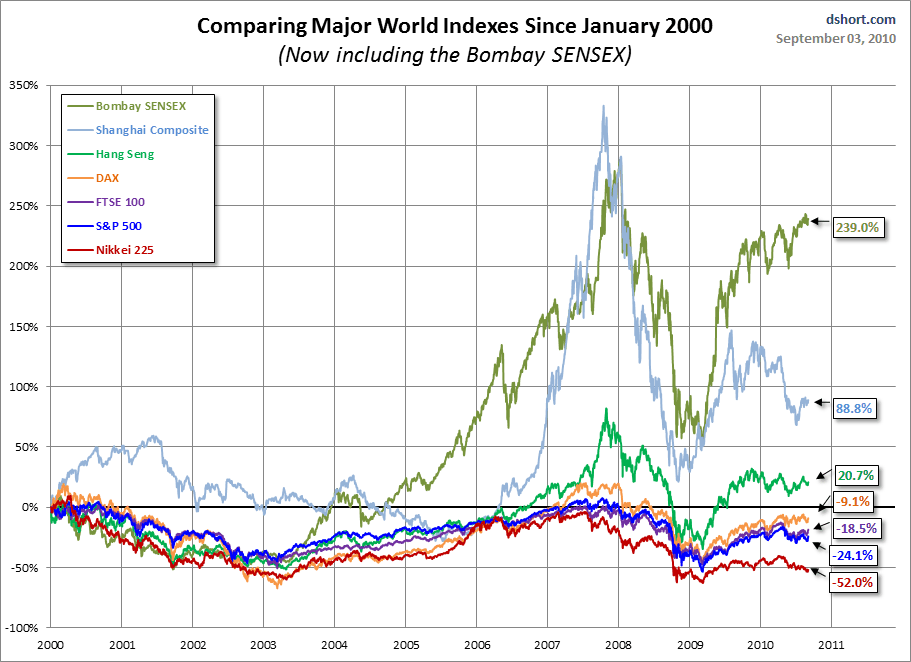
Today’s chart porn is a quick look at major world indices since January 2000, via the always excellent D-Short.
>
>
Hat tip Grant Williams
Today’s chart porn is a quick look at major world indices since January 2000, via the always excellent D-Short.
>
>
Hat tip Grant Williams
Please use the comments to demonstrate your own ignorance, unfamiliarity with empirical data, ability to repeat discredited memes, and lack of respect for scientific knowledge. Also, be sure to create straw men and argue against things I have neither said nor even implied. Any irrelevancies you can mention will also be appreciated. Lastly, kindly forgo all civility in your discourse . . . you are, after all, anonymous.
September 7th, 2010 at 11:45 am
US markets pay for expensive inovations.
Asian mercantilists implement cheap immitations.
European socialists consume in moderation.
Comfortably sustainable until US markets stop paying.
September 7th, 2010 at 12:27 pm
An even simpler version of this chart would be an emerging markets index vs. a developed markets index.
It would show the emerging markets up for the decade; rich countries down.
If this is a secular trend (and I think it is), we should all be making emigration plans. The US with $200/bbl oil (after the Devaluation) will resemble a better-armed Nigeria.
September 7th, 2010 at 12:39 pm
If there is any doubt that Asia has been the only true growth place in the world for the past decade, after seeing these charts, then lay that doubt to rest. And I’m not talking just about equities here. We’ve had two “jobless recoveries” in this country since this chart began, unlimited immigration basically, and college and training costs going through the roof. There simply is no need for more people in this country. No need for more educated people. No need for less educate people. Too much supply, and now, too little demand.
September 7th, 2010 at 1:16 pm
this looks like local-currency denominated.
I’m going to go get some numbers from the world federation of stock markets or whatever it’s called and see how they all measure up once dividends are included, and in a common currency.
September 7th, 2010 at 1:55 pm
It would be interesting to see a dollar-denominated chart similar to this, but of the dollar volumes being traded daily on the various exchanges. It would be a nice second view of the data, highlighting the years when the markets were percolating. I find that prices without volumes leave me with a vague uneasy feeling.
@machinehead: “… we should all be making emigration plans. The US with $200/bbl oil (after the Devaluation) will resemble a better-armed Nigeria.”
fuggedaboudit with the emigration plans. We’ll just abandon the volunteer army, and we’ll all be emigrating via blitzkrieg. Or maybe everyone will be working for the military whether we abandon the draft or not. Could be that they will be the only employer left standing.
@ashpelham2: 2 words: soylent green.
September 7th, 2010 at 2:30 pm
Barry:
Thanks for excluding Canada. Over the decade the TSX is up by 44% , not stellar, but still respectable (ahead of HK). Our banks are still in good shape, our economy is doing ok, although being next door to the “great Satan” which represents about 3/4 of all our trade business has been a challenge.
Canada kind of breaks your trend, that its all Asia all the time. Still very interesting chart
September 7th, 2010 at 2:48 pm
Anyone know the economics behind the Hang Seng? Real economy? Bubble? The rise is highly correlated with the credit bubble, as is the recovery. But the scale is impressive. Should we expect another kablam soon from them, or is something with real value at sustainable prices going on there?
September 7th, 2010 at 2:52 pm
Oops, my mistake. I was referring to the Bombay index and got the colors wrong. But, the Hang Seng is still a little frothy. Any explanations for either? Real or bubble? If we get another crash like March 2009 or similar, do you think they’ll bounce back? Are either sustainable?
September 7th, 2010 at 2:59 pm
Sri Lanka is another hot one.
September 7th, 2010 at 3:27 pm
We’ve been living with this story for a decade so I’m trying to think back to 2000 and what it would have taken to get out of U.S. large caps and into something like the Bombay Sensex.
September 7th, 2010 at 3:45 pm
@financial,
I would suspect because, comparatively, we are a pimple on the world’s backside. You’ll notice the chart also didn’t include Russia, Brazil, France, or Australia. You’ll find many world economic charts don’t include Canada. You’ll get used to it around here
September 7th, 2010 at 3:46 pm
Bombay Sensex. That would make a great name for a dandruff shampoo. WOW! Why does you hair look so good? It’s the Bombay Sensex baby!
September 7th, 2010 at 4:49 pm
@How the Comon Man Sees it:
Thanks I needed the humor on a quiet Tuesday afternoon.
September 7th, 2010 at 5:37 pm
What? No Brazil?
Come on…give LatAm a bit of credit here. If you but Brazil’s Ibovespa on the chart you will see the 400% return since 2000, handily beating everyone.
Brazil’s economy is larger than India and has way more developed financial markets. Excluding it and putting the Sensex is really unjust if not inappropriate.
Obrigado
September 7th, 2010 at 7:58 pm
Yep, Brazil needs some bubble love. We need to blow this sucker up down here in Rio, make things exciting. All this stability is boring.
Paz.
September 7th, 2010 at 8:57 pm
@ Common Man:
Too great a name to waste on anything except ED treatment. “Hey Mary, I just took one of those blue Bombay Sensex pills……LOOK OUT!!!”
On a similar vein (har har), some names would make a poor ED pill, like Hang Seng.
September 8th, 2010 at 11:15 am
If the Dow Jones company can’t hold a 30 stock portfolio that increase in value over a ten year period, how the hell am I going to any better?
September 8th, 2010 at 1:29 pm
How does one invest in an index fund of the 50 largest companies in India?