
Deleverage? No, Default!

Email this post Print this post
By Barry Ritholtz - September 20th, 2010, 1:30PM

Real Time Economics references the Fed’s Z.1 Flow of Funds Accounts released Friday. What some economists have been assuming was Deleveraging was in fact Defaults:

“The sharp decline in U.S. household debt over the past couple years has conjured up images of people across the country tightening their belts in order to pay down their mortgages and credit-card balances. A closer look, though, suggests a different picture: Some are defaulting, while the rest aren’t making much of a dent in their debts at all.”

There are two ways, though, that the debts can decline: Pay them or default. The total value of home-mortgage debt and consumer credit outstanding has fallen by about $610 billion, to $12.6 trillion, according to the Federal Reserve. Of that $610 billion, “banks and other lenders charged off a total of about $588 billion in mortgage and consumer loans.”

So much for the great deleveraging . . .

>
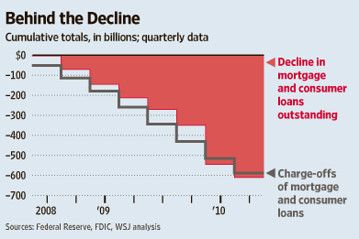

Chart courtesy of Real Time Economics

>

Sources:
Defaults Account for Most of Pared Down Debt
Mark Whitehouse
Real Time Economics, September 18, 2010
http://blogs.wsj.com/economics/2010/09/18/number-of-the-week-defaults-account-for-most-of-pared-down-debt/

Z.1 Flow of Funds Accounts of the United States
Flows and Outstandings Second Quarter 2010
Federal Reserve, September 17, 2010
http://federalreserve.gov/releases/z1/Current/z1.pdf

Comments

Please use the comments to demonstrate your own ignorance, unfamiliarity with empirical data, ability to repeat discredited memes, and lack of respect for scientific knowledge. Also, be sure to create straw men and argue against things I have neither said nor even implied. Any irrelevancies you can mention will also be appreciated. Lastly, kindly forgo all civility in your discourse . . . you are, after all, anonymous.

35 Responses to “Deleverage? No, Default!”

  1. Gatsby Says:

    Perhaps the last 10 years have made me unnecessarily cynical but my initial response is…so what?

    The banks can hide the losses on or off their balance sheets and the Fed will just keep pumping in liquidity to keep the party going.

    What is the incentive for people to even pay their mortgages. The can do a “strategic default” and open up the 50% of their income they used to spend on mortgage payments to rent (or not rent and wait years for the bank to kick them out) and keep buying more ‘stuff’. That should more than make up for the 20% of Americans who can’t find a job.

    Good lord, I have become a grumpy old man.

  2. ashpelham2 Says:

    Gatsby, if you’re a grumpy old man, what does that make me, as a 35 year old, gainfully employed white male? :D

    Seriously though, Mr. Ritholtz, are they saying that mortgage and consumer debt has dropped 610 billion, but banks have written off 588 billion? over 96% of the drop is people just not paying anymore? GOOD LORD!!!!!!!!

    Man, I’m gonna stop paying my bills too! Sad truth is, we don’t even have any significant outstanding debt other than our mortgage, which is no burden at all, even with us making half the income we were a year and a half ago. No serious credit card debt, that I couldnt pay off this month or next, and no auto notes/student loans/etc…..The other bills I have to pay or they’ll cut our lights off!

  3. obsvr-1 Says:

    so if this is true, then is the great deleveraging is still in front of us, will the public redirect discretionary spend to debt reduction ?

    With the foreclosure continuing then these writeoffs will also increase, feeding consumer anxiety and probability of more money towards debt reduction.

    The does not bode well for continued growth and more likely a stagnation in GDP

  4. Darkness Says:

    I’m with Gatsby, does it matter how we get there? We have to get there to start a real recovery.

    I’m not crying for the banks. They gamed the system through legislation on bankruptcy and thought they could make debt slaves out of college students. Too freaking bad if that plan didn’t work out quite as they wanted . . . They can use puppets to falsely cry victim about the mortgages, but no one but no one forced them to issue unsecured credit card and furniture and auto loan debt. All the debt they issued was for the same stupid short term CEO bonuses so they can eat all these write downs. They deserve them.

  5. Darkness Says:

    ashpelham2, sit down with the paperwork of someone who’s filed bankruptcy from credit card debt and add up their payments. Our close personal friend paid her debts more than three times over before throwing in the towel with balances higher than ever. It’s a rigged system designed for nothing but default as a way out once you are on the merry-go-round. There are a lot of English Majors who are bad at math . . . doesn’t make them bad people.

  6. Effective Demand Says:

    The easy money policies are doing their job of keeping peoples psychology towards spending everything they have as they get it. Then when people run out of rope they default and start again. The last thing the Federal Reserve wants is people deleveraging despite this being the greatest credit bubble in human history.

  7. curbyourrisk Says:

    Been arguing this for a year now. Glad to see someone mainstream agrees with me.

  8. carleric Says:

    I know that BR has been disparaging deleveraging for sometime and perhaps he is right in one sense but based on strictly anecdotal evidence, I think people are cutting back their spending…whether they are reducing debt or not I am pretty sure they aren’t opening any new credit accounts or moving up in the real estate market….I am with most others….if the banks made greed or stupid-based decisions (or both) too freaking bad and if their manqgments lose out of their undeserved bonuses I can’t gin up any tears

  9. Chrisbo Says:

    Having the household debt burden decreased by banks writing off loans will do little for the economy. These households will not be getting easy credit for some time, so their consumption can not exceed their incomes (unlike before). Welcome to the new normal. This could be as good as it gets for a while.

  10. How the Common Man Sees It Says:

    It seems those CEOs have taught people a thing or two

  11. bman Says:

    I’m with Darkness. Crocodile tears for the banks, damn the torpedos, and Gridley, you may fire at will.

  12. ashpelham2 Says:

    Good point Chrisbo. I’d counter that, or add to it, that with debt service reduced or minimized for those who’ve defaulted, there will be more expendable income to spend on other stuff, which i’m sure is going on. For a time, a lot of money was being thrown at paying minimums on increasing debt services.

    Trouble is, incomes aren’t rising, and more jobs aren’t coming on line. This is a dangerous, vicious circle we’ve entered, and hardly a way out.

  13. dead hobo Says:

    I’m just happy all this bad news isn’t affecting the stock market adversely.

    Loans go bad vs paid off and the market goes up. Woo Woo! This isn’t deleveraging. This is strategic buying. Smart! Not so good if you’re a bank but buy buy buy if you sell stuff and are a favored stock. It almost looks like it is national policy to buy and ignore your debt just to stimulate the economy. Since Uncle Stupid is backstopping the banks, this can only be considered as another bank bailout. And maybe 2010 bonus funding.

    Plus the recession ended almost as soon as it began. Woo Woo!!. The stock market has to make up for lost time and zippy up to 1200 asap.

    It looks like the Obama Economic Policies (c) have beat the crap out of this recession. And long before anyone realized the recession was over. They fixed the problem long before anyone realize the problem was gone!!! Suck on that one GWB. Happy Days Are Here Again.

    This news and the unstoppable rise of the markets should be proof positive that the Obama Economic Policies (c) are beyond exceptional and any stinking liar who says differently must not be paying attention.

    So rise little stock market, rise. The Obama Economic Policies (c) really work. The Fed will see to it by printing money at the most strategic times possible (every Monday is a given, the other days are all good possibilities and a safe bet if you are playing for over .5) The media will fall for it 200 times out of 100 tries. So will about 75% of wall street and 100% of politicians.

    Plus, the recession is over. Time to dance the happy dance.

  14. dead hobo Says:

    If the Fed sell to itself, under a different name (Fedd?) at a price and scale that pumps the market, is that illegal?

  15. ancientone Says:

    This is truly disappointing news. The one number that indicated that the American consumer had possibly become somewhat more debt responsible turns out to be nothing but defaults. When will they ever learn? Not yet, it seems.

  16. fubsy_cooter Says:

    Someone close to me took a “payment holiday” on two credit cards issued by major banks with debt totalling 60k. This, after attempting to negotiate interest rates for a little over a year that had increased to 27 and 29 percent after one late payment, only to have the reps repeatedly state there was nothing they could do for him. Payment history prior to that was stellar for over a decade. On advice from several friends and family, he stopped paying. Within weeks the companies were calling to negotiate. Within four months, he settled 60 k in debt for 15k. He is paid off. His credit rating is shot, and he is living stress free.

    You tell me, where is the reinforcement for adhering to agreements? The system is broken. Unfortunately, default is often the wisest/most practical way to play the game.

  17. Cdale_dog Says:

    from the little boy in the sixth sense “I see debt people”…….

    Come on, things are just now starting to wash out. It will take another 12 – 18 months for the sh*t to really hit the fan from all this. People are just trying to hang on as long as they can. Once they psycologicaly throw in the towel, then it is time to be a buyer. Too early yet, way too early….

  18. constantnormal Says:

    @daead hobo

    Legal? What is this thing you call legal? Is it some obscure or arcane religion, of which there are few if any practitioners?

  19. callistenes Says:

    BR,
    does this fit in in any way with the argument from earlier this year about how consumer spending was up do to the strategic default (and if I’m broke I’m going to go out in style) argument. If I recall there was a call for some empirical evidence, is this enough to qualify or even shift the argument?

  20. constantnormal Says:

    @dead hobo

    oh wait, you said ILLEGAL. That’s something quite different, a sick nation bird if I recall correctly.

    nevermind.

  21. willid3 Says:

    I am wondering if the consumer hasn’t take notice of how business deals with this. after all we have heard of many hotels where the company mailed in the keys, and where other commercial property has been done the same way?

  22. ashpelham2 Says:

    Well, we don’t have debtor’s prison in this country, and if it comes down to eating or paying mastercard, which one would you do? So, I suppose that’s why they call it “unsecured”.

    I’d pay mine off, except the rate is pretty low already, and I might need the cash if the crap hits the fan here at work.

  23. warrwim Says:

    CNNMoney reported on June 5th, 2010 that at the end of the first quarter, there were nearly 1.1 million homes in foreclosure, 3.3 million homes thirty days past due and 737,000 mortgages that were ninety days past due and not in foreclosure. I ‘m afraid that this “shadow inventory” or mortgages that have not been written off and are not being serviced by debtors portends to be the next so-called source of consumer “savings” or “deleveraging”. I’m not sure what is the technical defintion of “savings” but a year-old query to a former Merill Lynch economist– “Can i infer the inverse of your response (spending on debt service is counted as spending) and say “non-spending on debt service (via payment default) is counted as saving?”) –received a summary “No.” in reply.

  24. pintelho Says:

    Well the banks got bailed out…so this is the layman’s version of bailout…the big F’U I ain’t paying you.

  25. willid3 Says:

    wonder what this will do to the foreclosure problems
    http://www.nakedcapitalism.com/2010/09/gmac-stops-foreclosures-in-23-states.html
    http://www.nakedcapitalism.com/2010/09/more-on-gmac-and-foreclosure-fraud-mess-the-shit-is-hitting-the-fan.html
    seems there has been a bit of a problem with a few foreclosures

  26. NickAthens Says:

    So couple this with the awesome article on Greece in Vanity Fair. Fact is more and more of us look around and say if my neighbor is not having to pay why should I? It becomes a disease that feeds on itself.

    America’s imbalances are beyond “voting”. I fear only systematic bankrupcies at the City, State, and Federal level will correct them. This endless hoping for a better tomorrow is not working.

    As a CEO, I would never keep an executive who said he “hoped” to do better. I would ask for a “plan”.
    As a CEO, I would never keep an executive who said next years results would “change” from this year. I would demand an improvement.

    Until Americans demand “plans and improvement” over “hope and change”, we will continue to get the government we deserve.

    http://www.nickathens.com

  27. obsvr-1 Says:

    in regard to credit card debt and defaults:

    The money has already spent and counted in previous quarters GDP
    The balance is held on the banks books as accounts payable
    The interest (as high as it is, avg 14%) is revenue (close to 100% profit) for the banks

    The banksters must be loosing some sleep thinking about the number of strategic, tactical or bankruptcy based defaults considering the huge amount of debt that is teetering on brink ….

  28. willid3 Says:

    nickathens well we tried the GOP flavor for 8 years. that seemed to only get us an economy that looked really good, until easy credit fell apart at which point it collapsed. while we gripe that the current occupants aren’t doing a lot better, or having a lot more success in getting economy moving. we can’t forget how well the previous bunch did either.
    so unless we are going to create a new party, not tied to any of the current big ones, with little in common with them, just who do we want ? the previous bunch who couldn’t (or wouldn’t) or the current bunch who are at least trying?

  29. louis Says:

    Awesome- “I see debt people”…….

    It will be interesting to see how long they will allow citizens to be wiped out from their fraud and how long until those same citizens do something about it besides default.

  30. Captain Jack Says:

    That which cannot go on forever must stop.

    This suggests our preferred method of stopping is barreling headlong into a brick wall.

  31. subscriptionblocker Says:

    Where does this end?

    Once you get past the tragedy – it looks more and more like an armwrestle with no rules. Kinda like those gang infested cities where each outrage exists only for a short time before being “topped” by another.

    Pretty soon we’ll reach the point where no lending can take place without an informal but very real code of enforcement.

    Wall St has metathesized.

  32. victorberry Says:

    I agree with “curbyourrisk” because there is no way, no how Americans are all of a sudden putting aside money in savings accounts. I’ve been waiting for someone to publish this data which should put an end to the deleveraging lie. Thanks, BR.

  33. ashpelham2 Says:

    Another point is to keep in mind that there probably is a lot of deleveraging going on in households like mine, who’ve managed to keep income coming in, and taken on no new debt since 2006 or so. We’ve been on effective lockdown with regards to credit cards, car loans, personal loans, etc, etc, and certainly no new mortgage debt. I’d like to think that there are a lot of households like that, more than we even think or acknowledge. Yeah, we’ve deleveraged a lot. And we’ve gotten much less offers in the mail for credit cards or other needless things. All this while watching our credit scores go higher and higher.

    Sometimes, just sitting still and NOT CONSUMING goes a long way to deleveraging. We just eat, use gasoline, and pay the bills.

  34. Tuesday links: trust and confidence Abnormal Returns Says:

    [...] The great deleveraging is coming about via defaults and write-offs.  (Big Picture) [...]

  35. Retrospective Introspection « Baskerville Capital Says:

    [...] 8. Job creation soft: The 2nd economic headwind. Until this improves, there can be little better than modest improvement in retail, home sales, and deleveraging. [...]

95 queries. 0.418 seconds.