
Interest Rates: 60-Year Cycle

Email this post Print this post
By Barry Ritholtz - September 2nd, 2010, 12:30PM

Last week, we reviewed the History of US Interest Rates: 1790-Present via Doug Kass.

Following that, several of you pointed us to this fascinating 60 year cycle in interest rates. It is quite compelling, to say the least:

>
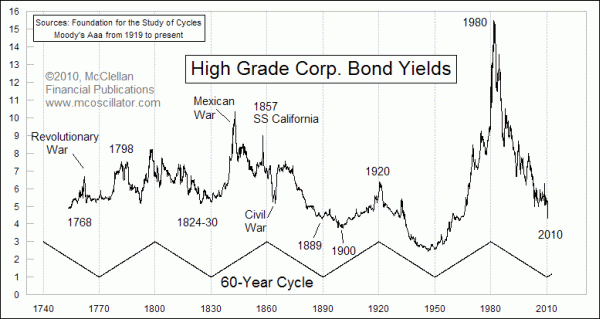

chart from McClellan Financial Publications

Comments

Please use the comments to demonstrate your own ignorance, unfamiliarity with empirical data, ability to repeat discredited memes, and lack of respect for scientific knowledge. Also, be sure to create straw men and argue against things I have neither said nor even implied. Any irrelevancies you can mention will also be appreciated. Lastly, kindly forgo all civility in your discourse . . . you are, after all, anonymous.

26 Responses to “Interest Rates: 60-Year Cycle”

  1. Jo Says:

    Nice chart.

    ‘Course the bottoming process could take a decade?

  2. VennData Says:

    Can someone find the link to the oil industry executives on CNBC earlier this week who said that Obama was being unfair to off-shore drillers who “know what w’re doing.”

    And can someone find a clip of Home Schooler Bobby Jindal foaming at the mouth about how competent the drillers are, and how Obama’s gulf oil drilling moratorium is going overboard?

    Oil Rig Explodes off La. coast.

    http://www.msnbc.msn.com/id/38973757/ns/us_news-life/

  3. diogeron Says:

    Couldn’t find the clip of Jindal foaming at the mouth on that issue because I’m busy looking for photos of the exorcism he participated in while in college. Now THAT is some documentation that is worth seeking out, especially if there is a 360 camera angle to catch the head of “the possesed one” spinning around like a top.

  4. gordo365 Says:

    It would be interesting to overlay a chart of P/E expansion/contraction.

  5. dead hobo Says:

    Anyone, show me how to predict magnitude from any point on the sawtooth. Show how the sawtooth tells you when up is done and down is done. Explain why it went substantially down from 1835 to 1950. And explain why the average rate was constant for 150 years from 1740 on to 1870.

    Thanks for the fun. I love to deconstruct crapola like this.

  6. dead hobo Says:

    I meant 130 years. Sue me.

  7. NoKidding Says:

    Stocks: Slow ramps up, sudden drops down.
    Bonds: Sudden jumps up, slow ramps down.

  8. The Curmudgeon Says:

    Nominal rates are nice, but real, inflation-adjusted rates would be more relevant. I can tell you that real rates went negative in each major conflict, and in other inflationary times (e.g., the late seventies/early eighties). For short term bonds and notes, they’re negative, or nearly negative, now. Which indicates we have inflation even during a time of overall price decline or stasis. Declining prices don’t always mean there’s deflation. It’s complicated, and I’ve explained it elsewhere, but basically, if prices don’t decline in the face of contracting demand, then you must have too much money. Which is inflation, a monetary phenomenon.

  9. WFTA Says:

    It’s a shame everyone didn’t get to buy their first home in 1981 like me. Dealing with 16%+ interest rates pretty much forces you to live within your means.

  10. jbmoore61 Says:

    Why are you stating that a 60 year frequency or cycle is compelling? It’s the average human lifespan. When I and my generation dies which is about 60 years on average, all of the knowledge, experience, and information I and my generation have accumulated dies with me and us unless that knowledge and experience is written down and institutionalized. Even then, such recordings and records are useless if no one accesses or reads them. Is not the current situation that we are in proof that our institutional and racial memories failed us in the United States, to a great extent? First off, Congress repealed Glass-Steagall under assurances that banking was safer this time around. Now we have a huge crisis due to rescinded or unenforced banking regulations and bad economic policies. We know how to fix the problems, but there is no public or private consensus or will to do so because a lot of “money” is at stake and a lot of sacred economic idealogical beliefs that make the scammers lives easier would be proven wrong and thousands of people who were deemed respectable citizens, part of a business elite, will go to jail or lose their fortunes because they were psychopathic fraudsters and looters. At best, they’ll never work again even if they don’t go to jail. At worst, they’ll rot in jail like Ebbers and Skilling.

  11. Steve Hamlin Says:

    @gordon365: here is a 100 year chart of E/P (earnings yield) less 10-yr Treasuries, to get an approximation of “real” E/P (i.e. factoring out base interest rates at the time)

    - http://econompicdata.blogspot.com/2010/07/things-that-make-you-go-hmmm.html

    S&P earnings yield vs. long-term interest rates:
    - http://econompicdata.blogspot.com/2010/07/on-relationship-between-earnings-and.html
    - http://econompicdata.blogspot.com/2010/08/yield-wins-in-long-run.html

    Doug Short could probably do just what you want. This is kinda close, there might be something with interest rates on his site:
    - http://dshort.com/articles/SP-Composite-pe-ratios.html

  12. ashpelham2 Says:

    I don’t follow along with the 60 year cycle in the first place. It could be 50 or 15 or 160, as far as I’m concerned. Furthermore, we are going back to the dawn of America here, which in and of itself is historic and unprecedented.

    I don’t think anything other than a satisfaction of historical curiosity can be taken from this chart. Boy, it sure does look like i missed out on the party around 1980 though!

  13. rfullem Says:

    saw this chart 13 years ago in the NYU library in A History of Interest Rates…. been investing in cash ever since. I am SHOCKED that it took 13 years for folks to pick up on this….by the way, there are cycles on a global scale as well…. 1920/21 was a global peak in rates, not just a US one. Furthermore, gilts yields moved above US for first time in 1920s, fell back below US in 1931/32 on safe have govie rally…then spent the next 60 or so years (expect mid 1980s) above US yields….

  14. algernon Says:

    Great chart. Like many, I conclude we are mighty near the trough.

    Inflation adjusted & PE overlay would both be interesting.

  15. Captain Jack Says:

    So, clearly, from this chart we can conclude that… uh… rates are clearly set to rise again, in, um, a timeframe of the next 10 years or so, though possibly more imminent, though also possibly another full 5 years away… unless of course, the ah, 1890 version of the cycle is replicated, in which case another 5 to 7 years of rate decline could be ahead before the, uh, clearly forecasted upturn ensues…

  16. wtlf555 Says:

    The reason this chart is compelling is because it nailed 5 out of 8 peaks/troughs. Its quite possible for a 30 year cycle to be meaningless but if everything is random its a million to one that you hit 5 out of eight. So its either an extraordinary coincidence or may have some validity. The 60 year lifespan and people forgetting the past and repeating expansion and contraction cycles is interesting but you’d think it would miss more than 3 out of 8 over time due to increased lifespans.

  17. sparrowsfall Says:

    Real yields please!

  18. Renn Says:

    I would love to see these rate trends in relation to the history of technologies. The 80′s began the introduction of the personal computer and in 1835, Samuel Morse proved that signals could be transmitted by wire. I wonder if we underestimate the effect of imagination coupled with the personal effects of technology on our markets. Those two events do correlate nicely with this chart’s significant downtrends, but perhaps this is too small a sample to be predictive.

  19. tonyhip Says:

    Is it safe to say to buy around 8% and sell around 4%?

  20. Captain Jack Says:

    The reason this chart is compelling is because it nailed 5 out of 8 peaks/troughs.

    – Five out of 8 is less than 63%, which I would argue falls short of compelling. (Would you trust a medical procedure with a 63% success rate?)

    – “Nailed” is also a relative term. If a window of plus or minus 5 years (or even plus or minus 2 – 3 years) applies, then the message of the chart is not helpful from a decision making standpoint — Act now? Act in 2013? — other than further underscoring the rather widely accepted notion that “Yes Virginia, rates tend to go up after having gone down a lot.”

  21. Andy T Says:

    Probably the most interesting chart I’ve seen here in awhile.

    Good one Barry.

    May be a good time to bring up the Kondratieff Wave….which follows a 54-60 year cycle.

  22. Andy T Says:

    Capt. Jack:

    Time cylce analysis should be used to help time cycle bottoms, not peaks. In that regard, that is a very interesting chart.

    As someone pointed out above….it can be a long bottoming period…5-10 years. However, if you told someone that every 60 years interest rates undergo a bottoming process that ends with much higher yields, is that not ‘interesting?’

  23. bmoseley Says:

    of course some periods match up with 60 years. but a lot don’t.
    examples: first down trend is not 60 years. so means nothing.
    how about from the Mexican war: looks like down trend all the way to 1900: not 60 years. and 1900 is not on a 60 year line.
    but the last 30 year periods match up: or sample of 3.

  24. Captain Jack Says:

    @ Andy T:

    Sure — I can certainly see how it might qualify as interesting in an anecdotal sense. Not to mention that subjective qualities (interesting, beautiful etc) are in the eye of the beholder.

    From a trading standpoint, however, the admitted “fuzziness” of the bottoming process (measured in years with large margin of error) gives the information a zero weighting in terms of probabilistic decision making inputs.

    And as others have pointed out, the notably small sample size and questionable hit rate (5 out of 8 ain’t great shakes) are both statistically problematic to say the least. (As Mr. Spock might say, “Captain, we have insufficient data.”)

    So — as some drive-by empty calorie food for thought? Sure, why not. Interesting!

    But from the perspective of a dedicated trader with a voracious appetite for information and insight that can actually apply to profitable decision making, not so much.

  25. Andy T Says:

    One of the biases of analysis is to assume that the analysis you’re conducting implies some sort ‘endpoint’ at the present time. That bias is evident in the chart. Why did the McClennan folks end the lows at 1890, 1950 and 2010? A stronger case can be made for the lows at 1900, 1960 and 2020. In fact, that is where I would have drawn the lows. (Remember, time cycle analysis is not good for timing highs…only lows.)

    In fact, if you had shorted bonds every 60 starting in 1780, you have made money for the following 10 years after the trade. In the world of trading on an hourly and daily basis, that is of little use. I grant you that. But if I told you that after 2020, interest rates would sky rocket for decade, would that information be interesting?

    That’s a rhetorical question….

    Agree that it’s really small sample size…but it did predict cycle lows 4 out of the last 4 times. Look for 2020 to be an ideal time be long gone from bonds.

  26. Captain Jack Says:

    “Look for 2020…”

    Ha! Thanks for that — replying with a big smile right now :-)

    You do realize that, a hundred years ago in 1910, nobody was exactly anticipating the events of Summer 1914.

    Not predicting WWIII here so much as gently reiterating the point that, when it comes to forecasting ten years on — or, heck, even five years on — nobody knows a goddamn thing. Except maybe Nostradamus or Miss Cleo, and neither of them are on my speed dial.

87 queries. 0.347 seconds.