Job Change Post-Recessions
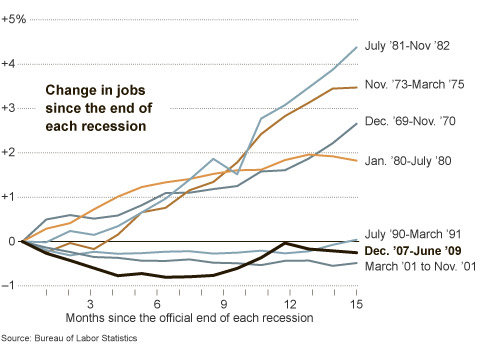
Nice chart comparing the post recession job recoveries going back to 1969, via NYT:
“After the last recession ended – determined Monday to be June 2009 – employment in the United States fell at a faster pace than after earlier recessions. And this recovery looks similar to the periods of little job creation after the 1990-91 and 2001 recessions.”
The chart below makes it clear that the post-2001 recession was an unusually long job recovery period. Post 2008-09 is likely to be even longer . . .
>
Source:
Recession May Be Over, but Joblessness Remains
CATHERINE RAMPELL
NYT, September 20, 2010
http://www.nytimes.com/2010/09/21/business/economy/21econ.html



Tweet
Facebook
Reddit
Digg this!


September 21st, 2010 at 12:28 pm
It’s obvious that the Liberals on The Left don’t care about joblessness.
What I don’t get is why the GOP supports tax cuts for the Liberal Elite …and will go so far as to hold up tax cuts for hard-working, heterosexual Republican manufacturing workers and truck drivers …and I’m still chewing over why my leaders in the GOP want the IRS to end that gay-marriage penalty when we give those people everything.
September 21st, 2010 at 12:33 pm
The lacking employment growth is another indication that the economic expansion phases of the business cycle since the 1980ies have largely been based on exponential debt growth (mostly of the private sectors). All three of the last recessions lie within the credit bubble. For the last three decades private debt has about doubled every decade. Debt can’t grow infinitively relative to income. Now, the question is will the cycle repeat, will there be another round of exponential debt growth, i.e., will private debt (w/o debt of financial institutions) double from about 25 trillion to 50 trillion this time, fueling another round of economic expansion, or has the mountain of debt in the economy grown too high now so that it inhibits more debt growth, in turn, inhibiting economic expansion? So far, it looks like we finally have reached the debt deflation phase of the credit cycle. The private debt to GDP-ratio hasn’t stopped shrinking since it peaked at around 300%. If this is the case indeed, then this is a good argument for that the “Great Recession” was likely only the first phase of a longer-term depression, which might look more like a modern day depression Japanese style with on- and off-recessions than the “Great Depression”, just on a much larger scale than Japan, more on a global scale, or at least including the center region of the world economy.
September 21st, 2010 at 1:37 pm
Recessions aren’t for everybody anymore.
September 21st, 2010 at 1:41 pm
Makes you wonder how much lower those paltry employment numbers would have been without the 2003-2007 credit bubble. We traded a little now for a whole lot of pain later. Like a giant five year consumer stimulus bill that largely ignored China’s surge from $1 trillion GDP to $6 trillion in record time. Sounds to me like we are lucky have lost only 5% of our jobs.
September 21st, 2010 at 2:08 pm
Pretty good article with lots of charts, debt, change in debt wrt GDP, deleveraging and the impact on jobs/unemployment.
Deleveraging with a twist
http://www.debtdeflation.com/blogs/
September 21st, 2010 at 3:00 pm
To me this chart screams “globalization”! Modern post-recession periods don’t produce jobs in this country at the rate they did prior to off-shoring.
September 21st, 2010 at 3:51 pm
gordo365 I think you have found the cause of the lack of job creation in the last decade. and why we will have real trouble getting the economy back to any where back to normal any time soon.
September 21st, 2010 at 4:19 pm
@gordo365:
It doesn’t explain growth of gross domestic product despite lacking job growth during these post-recession periods, though.
September 21st, 2010 at 6:00 pm
I’m no macroeconomist but I think offshoring our industry has been accretive to earnings, so to speak, in that we are more productive in “creating” wealth as importers rather than manufacturers.
Import a $1 item from China, sell it for $4, instead of mfr a $4 widget here with $3 in costs.
But the debt bubble 2002-2007 REALLY needs to be understood. Household debt went from $8T for 4Q01 to $14.4T in 2Q07. That was a $1000/mo PER HOUSEHOLD stimulus for years.
September 21st, 2010 at 9:47 pm
You can’t fix jobs without fixing the trade deficit, or just accepting it and going all-in on fiscal policy. Neither seems likely for different reasons. The result will be, through long corrosion, the end of legitimacy for the U.S. ‘elite’ and their meritocratic spokesmen; what political direction that manifests itself is unknowable.
September 22nd, 2010 at 11:30 am
I believe this is why some in the previous NBER – The Recession is Ovah! thread some were arguing that the charts may say so, but the reality on the ground, so to speak, says otherwise.
Or as Bob Dylan put it so well many years ago.
“You don’t need a weatherman to know which way the wind blows.”