Plosser says no mas for now

Email this post Print this post
By Peter Boockvar - September 29th, 2010, 1:14PM

Non voting Fed member Charles Plosser in a speech on the economy is saying, “Because I see little gain at this point, and some costs, I would prefer not to engage in further asset purchases at this time…Asset purchases in our current economic environment can do little if anything to speed up the return to full employment.” If one thing is for certain, the debate in the Fed leading into the Nov FOMC meeting will be heated over the decision whether to continue to push the envelope with monetary policy. While Plosser’s comments are welcome from my point of view, the voting members have a much more dovish slant.

The Story of Canada Bill Jones

Email this post Print this post
By Guest Author - September 29th, 2010, 1:04PM

Doug gives the Themis Boys some props, and he does the same to BATS.

Guest Post: The Story of Canada Bill Jones by Doug Clark of BMO

The Story of Canada Bill Jones by Doug Clark of BMO

Growing up my father used to tell me many a long tale of odd characters either from history or his own past. The old man had a way of telling the stories – employing funny voices, and giving vivid descriptions of events – that made them both entertaining and memorable. I have recently found myself retelling some of the stories to my own boys. In fact just last night I was regaling Matthew and Nicholas with the tale of Canada Bill Jones, when it struck me just how far ahead of his time he really was.

For those of you unfamiliar with Canada Bill Jones, he was an English born Canadian raised hustler. Not just any hustler, but perhaps the greatest hustler of all time. Bill perfected the art of ‘throwing’ (dealing Three Card Monte) in the Canadian west and – like so many talented Canadians (Alan Thicke, Celine Dion…) – he took his ‘talents’ south in search of riches. For those of you that have never come across a great thrower, the art is in seamless distraction and image projection. Bill perfected a look and patter that instantly assured any potential marks that he was both too nice and too stupid to possibly be hustling. His favourite feeding grounds were the Omaha to Kansas City trains, posing as a bored yokel looking to liven up the ride by betting on cards. Even after losing all their money, most marks were said to be too baffled to understand how they lost, and too confident they were miles smarter that Canada Bill to believe anything was amiss. Throughout the mid to late 19th century Bill would make millions off of unsuspecting rubes…big money today, unheard of money in the 1850’s.

It strikes me that if were Bill alive today his talents would be of great use to some of the market places operating globally. They too excel at distraction and image projection. Always claiming to have our best interests at heart, and when the likes of Sal and Joe object to some of their practices they claim with wide eyes and dumbstruck grins to be surprised. (“What, putting unique order numbers on the public feed is bad for investors? But we were all just trying to help out.”) Most recently I discovered that one global ATS – Chi-X – is still displaying internal order numbers on their public feed for new and refreshed trades, even after they went to great length to announce they had taken such order numbers off of any trades. (For those techies in the crowd Chi-X changed the CHIXMD feed – version 3.2 – such that tag 9 is always “0” for any trade, BUT they still populate tag 9 with an internal unique order number for all orders and refreshes – including pegged orders. So when your reserve (iceberg) bid is hit at $10.00 the refresh order is broadcast with the identical ‘unique’ identifier making it obvious to one and all that this is a reserve order…let the gaming begin). When I asked Chi-X if the protocol document I was reviewing was correct senior management replied that they were “curious to know” how somebody would trade off this information. Given the input these ATSs and Exchanges receive from some of the brightest members of our community, I am dumbstruck that such a venue could be unaware of the impact such information leakage would have.

This rube has – thanks largely to Sal and Joe – wised up. It is time the distraction game is put to an end. We need to set global standards for what can, and cannot be included on public data feeds – or failing that set disclosure standards to ensure we all know what is being disseminated. I have tried to reproduce Sal and Joe’s efforts in examining the data protocols of the biggest markets, and found it far too difficult to attain the official documents. (Although I will give full props to the group at BATS, who not only publish their spec in an easy to find area of their website, but also have a full section devoted to explaining how they prevent information leakage…including “When the displayed portion of the reserve order is refreshed, the order is assigned a new OrderID on the XXX feed.”….nice to see somebody is doing it right.

While Canada Bill was a great hustler, he is reputed to have been a terrible and insatiable gambler. As the story goes Bill’s longtime partner, George Devol, stumbled across Bill losing his shirt in a clearly rigged poker game. George tried to convince Bill to quit the game, arguing he couldn’t possible win. Bill famously retorted “I know it’s crooked, but it’s the only game in town”. I called my dad last night to tell him I finally knew exactly how Canada Bill felt.

Sal Arnuk
Themis Trading LLC
10 Town Square, Suite 100
Chatham, NJ 07928
973-665-9600
AIM : SalTheBroker
www.ThemisTrading.com

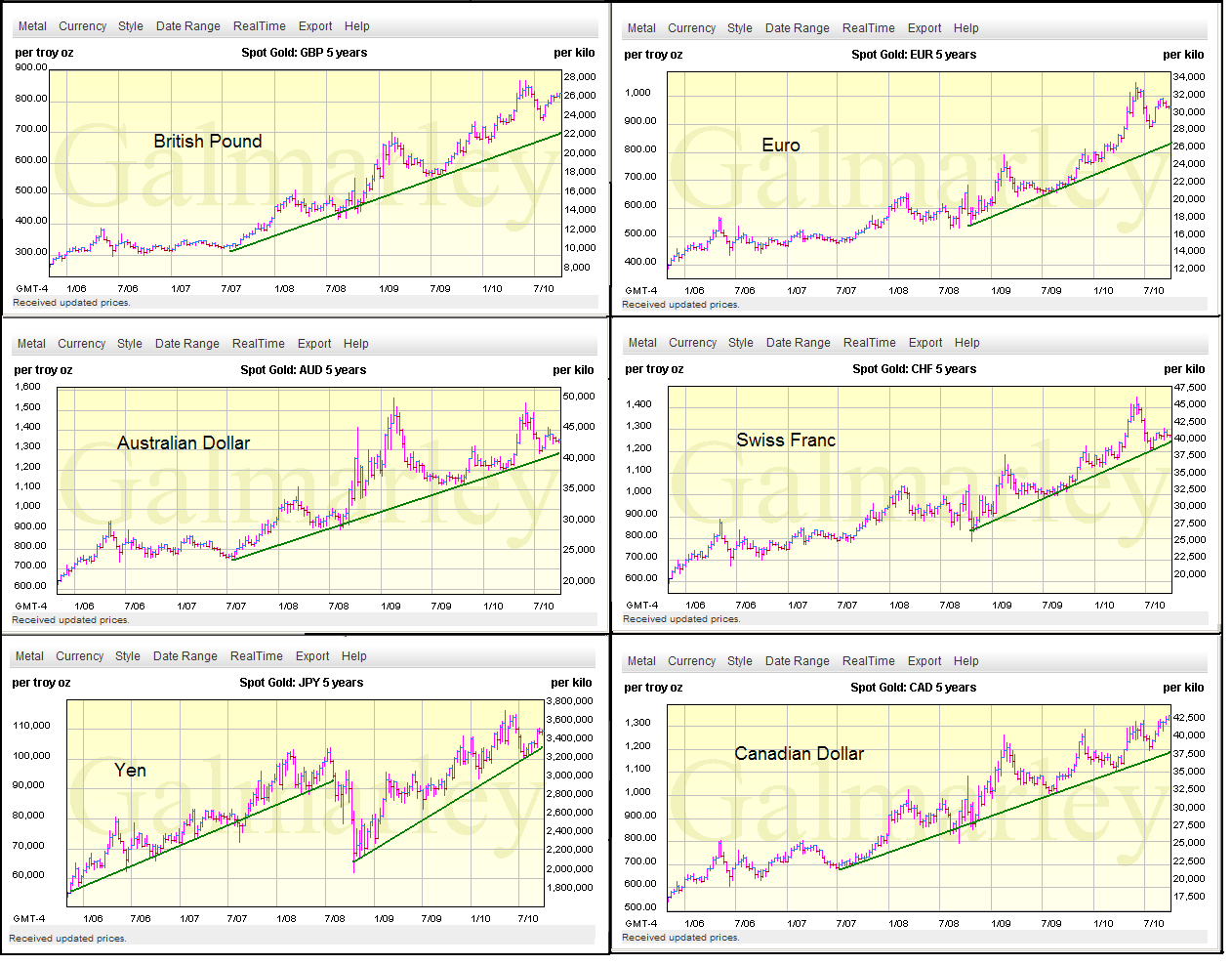
Is Gold a Dollar Phenomenon ?

Email this post Print this post
By Barry Ritholtz - September 29th, 2010, 12:00PM

Not so much, according to Jesse’s Café Américain:

“But the US dollar is not alone, not the only fiat currency in a bit of a crisis. Since one picture is worth a thousand words, here is the price of gold over the last five years in six of the world’s major currencies of the developed nations. Granted, the price of gold may be different in select currencies. One has to make their own investment decisions to suit their own particular circumstances.”

>

Gold Priced in 6 Major Currencies

click for larger chart

Whitney: States Are Next Credit Crisis for US

Email this post Print this post
By Barry Ritholtz - September 29th, 2010, 11:28AM

The financial challenges states face could be the next systemic risk within the financial markets, according to Meredith Whitney, CEO of the Meredith Whitney Advisory Group.


Housing Finance: “Understand What Broke, Keep What Worked, Discard What Didn’t”

Email this post Print this post
By Barry Ritholtz - September 29th, 2010, 10:52AM

Annaly Capital Management is a real estate investment trust (REIT) that manages a portfolio of adjustable-, floating-, and fixed-rate mortgage-backed securities. The REIT “represents the secondary market investors who have historically provided the majority of the capital to the $11 trillion mortgage market.” In that capacity, he recently provided testimony and documentation to the House Financial Services committee on “The Future of Housing Finance—A Review of Proposals to Address Market Structure and Transition.”

Michael A. J. Farrell is the Chairman and CEO of the firm. He lobs out sharp tongued commentary and critiques of mortgage, securitization and housing related issues in his blog, Annaly Salvos on the Economy and Markets.

I found his overview of the crisis succinct and informative:

“The liquidity that Fannie Mae and Freddie Mac provide, both through their MBS guarantees and through their own balance sheets, has been an important component of this system, and not just for the conforming borrower. Indeed, a conforming borrower has generally paid a lower rate than a jumbo prime borrower, but the conforming mortgage rate also serves as an effective benchmark for other mortgage rates.

It has not been a perfect system, however, and its flaws became most evident beginning in the first decade of this century. These flaws are well‐documented and include (but are not limited to):

• Fannie Mae and Freddie Mac, as private companies with public policy charters, served two masters. They pushed for profitability for shareholders to the detriment of their government charters by increasing their leverage and lowering their own underwriting standards. In the end, they achieved their charter objective, but they failed both masters.

• Mortgage originators ignored prudent underwriting standards and unleashed a flood of affordability products on unwitting and unqualified borrowers.

• Mortgage borrowers misunderstood or ignored the risks of the affordability products.

• The financial engineers on Wall Street created CDO and SIV structures that fed unprecedented demand and embedded leverage on leverage.

• Ratings agencies used flawed models, included perpetual home price appreciation assumptions, to improperly rate the different cash flow tranches.

• Investors in both the senior tranches (including the GSEs) and the junior tranches exercised poor judgment in trusting that others on the assembly line (originators, rating agencies, underwriters) did their jobs responsibly.

• The socialization of credit risk around the globe infected virtually every financial institution.

The key to overhauling housing finance in America is to understand what was broken, then keep what worked and discard what didn’t.

He obviously is not an unbiased participant, but he is knowledgeable, and provide insight. The full PDF is worth reading.

>

Source:
Input on Reform of the Housing Finance System
Michael A.J. Farrell, Chairman, Chief Executive Officer and President
Annaly Capital Management, Inc.
U.S. House of Representatives Committee on Financial Services, July 21, 2010
“The Future of Housing Finance—A Review of Proposals to Address Market Structure and Transition”
http://www.annaly.com/Admin/AttachmentFiles/1407.22.10AnnalyCapitalManagementInputonReformoftheHousingFinanceSystemfinal.pdf

Fastest Maserati: GranTurismo MC Stradale

Email this post Print this post
By Barry Ritholtz - September 29th, 2010, 10:30AM

If you are interested in owning the fastest production car Maserati makes, than its the MC Stradale:

>

>

via Classic Driver

America’s Rich Are Falling Behind The Super-Rich

Email this post Print this post
By Barry Ritholtz - September 29th, 2010, 9:37AM

Mark Thoma reminds me that I posted this back in 2007:


In The Know: Are America’s Rich Falling Behind The Super-Rich?

Black Ducks & EMH Origins

Email this post Print this post
By Barry Ritholtz - September 29th, 2010, 9:15AM

Two quick non MSM pieces worth reading this morning:

• The Reformed Broker:  Sometimes It’s Just a Black Duck

“The trouble with the Recency Effect is that everyone all of a sudden thought they were Nassim Taleb, orinthological experts on the spotting of Black Swans.  Every blip on the screen or blurb in the newspaper was fresh evidence of the next hundred years’ storm.  Forget being fooled by randomness, people have become obsessed with randomness.

But as we’ve learned, not every aberration is a Black Swan in the making.  Sometimes, it’s just an ordinary Black Duck.  A negative event or possibility that is processed and dealt with, that doesn’t necessarily lead to contagion, panic and meltdown.”

~~~

• Hedgeye Blog: The St. Petersburg Paradox:

“The mathematical expectation of the speculator is zero.” -Louis Bachelier was a French mathematician who was, well after the fact, credited with founding the Efficient Market Thesis. In 1900 Bachelier published his Ph.D thesis titled “The Theory of Speculation.” In his paper, Bachelier discussed the use of Brownian motion to evaluate stock prices. Unfortunately, his thesis was “not appropriately received”, which resulted in academic black-balling and the concept being buried for more than sixty years.

Almost sixty-five years later Professor Eugene Fama from the University of Chicago was officially credited with developing the Efficient Market Thesis after publishing his Ph.D thesis. His paper was titled “The Behavior of Stock Market Prices.” The core tenet of his paper and the Efficient Market Thesis is that an investor “cannot consistently achieve returns in excess of average of market returns on a risk-adjusted basis, given the information that is publicly available at the time the investment is made.”

Is it not somewhat ironic that the determination of who founded the Efficient Market Thesis was not efficient?”

All QE2, All the Time

Email this post Print this post
By Guest Author - September 29th, 2010, 8:30AM

Everywhere I turn is another article about Quantitative Easing Part 2. Will they or won’t they? My question last week was will it make any difference? After I sent my letter out, I came across this missive from the always fascinating Ed Yardeni. I like to read Ed because he is not afraid to take an out of consensus call. He is his own man, something of a rarity in the world of economists.

He highlights a report from the Fed on the problem with the money multiplier. It has gone away. (Really? You think?) If you took Econ 101 this was a basic staple.

He writes: “Fed officials are clueless about how quantitative easing is supposed to impact the economy. They aren’t even sure if it has any effect on the economy. The Fed study cited here confirms this known unknown.”

I include the rest of his letter to let you know what type of material he does daily, as some of you might want to take a closer look at his service. (www.yardeni.com). I really liked his take on housing. This is an excellent choice for Outside the Box.

I am starting to adjust from the travel. Have a great week!

Your ready for some NBA basketball to start analyst,

John Mauldin, Editor
Outside the Box


All QE2, All the Time

Why QE Doesn’t Work

By Ed Yardeni

September 27, 2010

BULLET POINTS: (1) Fed study buries textbook money multiplier. (2) The Treasury’s lap dog. (3) Kohn’s exit speech admits Fed is clueless. (4) In 1988, Bernanke questioned money multiplier model. (5) The fiscal multiplier is also baloney. (6) The administration’s stimulators are jumping ship. (7) Profitable companies, not bloated governments, create jobs. (8) No double dips in Earnings Month. (9) Double dip in consumer sentiment. (10) No recovery in housing industry.

I) MULTIPLIERS: Wow, there are Existentialists at the Fed! Two economists, Seth B. Carpenter and Selva Demiralp, recently posted a discussion paper on the Federal Reserve Board’s website, titled “Money, Reserves, and the Transmission of Monetary Policy: Does the Money Multiplier Exist?” (See link below.) The authors note that bank reserves increased dramatically since the start of the financial crisis. Reserves are up a staggering 2,173% from $47.3bn on September 10, 2008, just before the financial crisis began, to $1.1tn now. Yet M2 is up only 11.4% since September 10, 2008, and bank loans are down $140.2bn. The textbook money multiplier model predicts that money growth and bank lending should have soared along with reserves, stimulating economic activity and boosting inflation. The Fed study concluded that “if the level of reserves is expected to have an impact on the economy, it seems unlikely that a standard multiplier story will explain the effect.”

That not only repudiates the textbook money multiplier model but also raises lots of questions about the goal of the Fed’s quantitative easing policies. As I discussed yesterday, under QE-1.0, Bernanke & Co. offset the shrinking of the Fed’s emergency liquidity facilities with purchases of mortgage securities. QE-1.5 was adopted at the August 10, 2010 FOMC meeting when it was decided that maturing mortgage securities would be offset by purchasing Treasuries. If the Fed decides to implement QE-2.0, as was suggested by Tuesday’s FOMC statement, then it is widely presumed that the Fed would expand its balance sheet again by purchasing $1.0tn of US Treasuries.

The Carpenter/Demiralp study implies that QE-2.0 won’t be any more successful in boosting M2 growth and bank lending than QE-1.0. If so, then the Fed should be renamed “Feddie.” Like Fannie and Freddie, Feddie now owns lots of mortgages. If Feddie buys another $1.0tn of Treasuries, it is simply enabling the US government to continue down the road of reckless deficit-financed spending. The Fed then becomes the lap dog of the Treasury. No wonder that the price of gold is at a new record high this morning.

The Carpenter/Demiralp study quotes former Fed Vice Chairman Donald Kohn saying the following about the money multiplier in a March 24, 2010 speech: “The huge quantity of bank reserves that were created has been seen largely as a byproduct of the purchases that would be unlikely to have a significant independent effect on financial markets and the economy. This view is not consistent with the simple models in many textbooks or the monetarist tradition in monetary policy, which emphasizes a line of causation from reserves to the money supply to economic activity and inflation. . . . We will need to watch and study this channel carefully.”

Isn’t that wonderful? Fed officials are clueless about how quantitative easing is supposed to impact the economy. They aren’t even sure if it has any effect on the economy. The Fed study cited here confirms this known unknown. The Bank of Japan tried quantitative easing to revive their economy and avert deflation, but it didn’t work. By the way, Kohn’s March 24 speech was titled, “Homework Assignments for Monetary Policymakers.” (See link below.) He just retired after spending 40 years at the Fed.

Read the rest of this entry »

Stuff

Email this post Print this post
By Peter Boockvar - September 29th, 2010, 8:14AM

While most of us are expecting another round of Fed pump priming on Nov 3rd, non voting member Lockhart last night said “For me, personally, it is not a foregone conclusion that more accommodation is required.” The US$ and gold today think there is no doubt and believes it’s a fait accompli as long as Bernanke is running the Fed. The CRB RIND rose to a record last night for a 2nd day. According to the MBA, the avg 30 yr mortgage rate fell to a new low of 4.38% but refi’s fell for a 4th straight week to a 7 week low (otherwise known as, the law of diminishing returns). Purchases rose 2.4%. The private sector weighted Chinese manufacturing PMI rose 1 pt to a 4 month high but Chinese stocks were little changed. The Q3 Japanese Tankan manufacturing index rose 7 pts to +8, 1 pt above forecasts and the Yen is up for the 7th day in the past 8. II: Bulls 43.3 v 41.4 Bears 27.8 v 29.3, bulls highest since mid May, bears at 7 week low.

44 queries. 1.038 seconds.