
Tracking Bank Failures

Email this post Print this post
By Barry Ritholtz - September 27th, 2010, 3:00PM

As a follow up to our weekly FDIC bank closing charts, the WSJ has an article with accompanying interactive graphic (below) showing the progress of bank closings over the past 2 years.

They note that since WaMu fell, 279 lenders have collapsed; where the closings are concentrated was somewhat unexpected:

>

click for interactive graphic
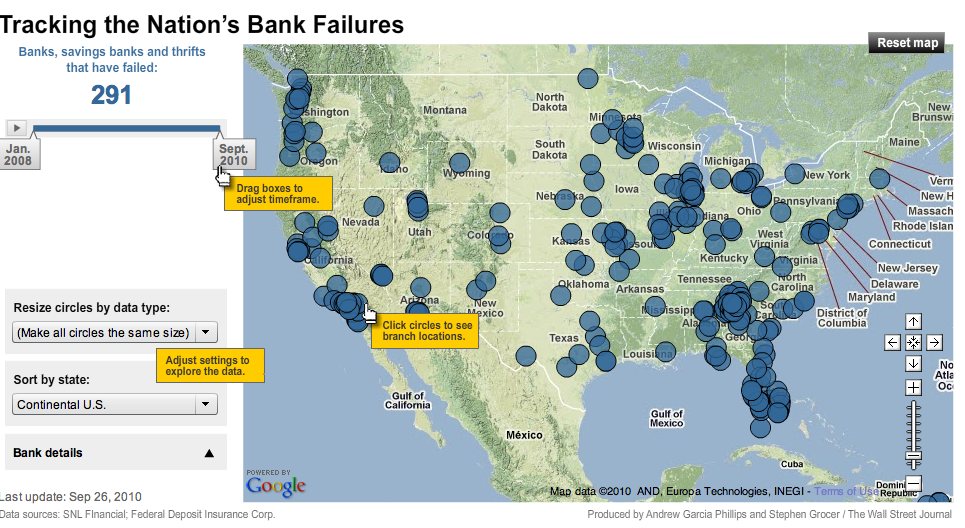
courtesy of WSJ

>

This is a static version that also shows the distribution of failures:
click for larger map
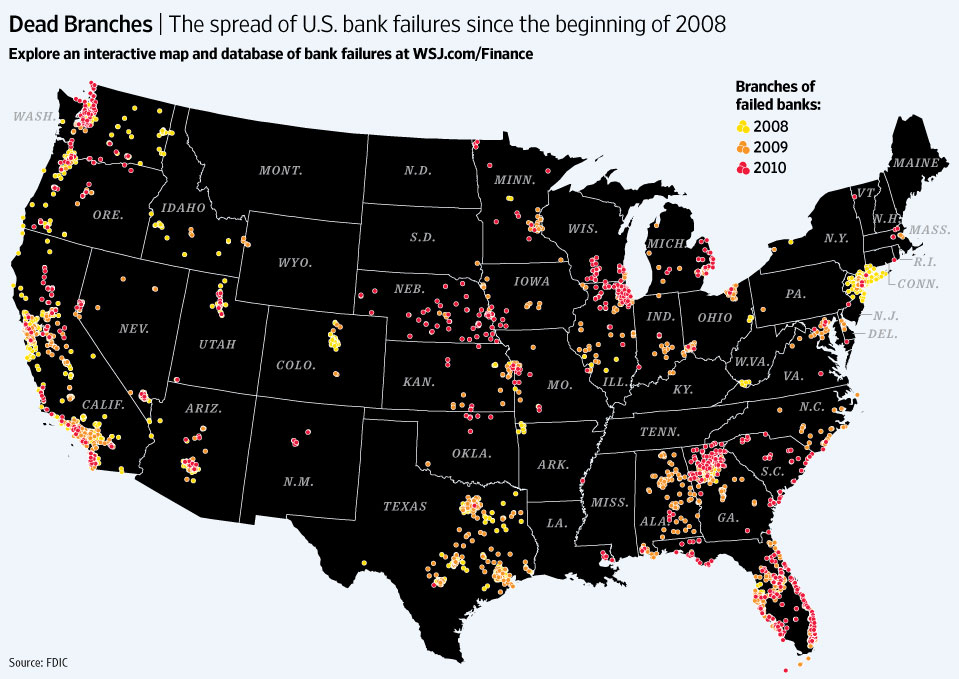
>

Source:
Banks Keep Failing, No End in Sight
RANDALL SMITH And ROBIN SIDEL
WSJ, SEPTEMBER 27, 2010
http://online.wsj.com/article/SB10001424052748704760704575516272337762044.html

Comments

Please use the comments to demonstrate your own ignorance, unfamiliarity with empirical data, ability to repeat discredited memes, and lack of respect for scientific knowledge. Also, be sure to create straw men and argue against things I have neither said nor even implied. Any irrelevancies you can mention will also be appreciated. Lastly, kindly forgo all civility in your discourse . . . you are, after all, anonymous.

10 Responses to “Tracking Bank Failures”

  1. rip Says:

    Interesting that bank failures do not correspond more closely to areas with real estate problems (Las Vegas, …). Seems they cluster more along state lines, suggesting poor regulatory oversight, banking laws or other factors.

    Would be interesting to dig into bank ownership: criminal organizations, disreputable firms intent on milking fraudulent situations.

    Knew an S&L once in IL that made an effort to go “public”. Clearly an attempt to max the value for a few insiders: pump, dump and run. And when too many of the depositors signed up for stock, they canceled the deal.

    I also suspect that, based on my limited knowledge, CRE and commercial loans may be more of a factor than RRE.

  2. Freddy Hutter - TrendLines Research Says:

    I always look to bright side of statistics. Two years ago Nouriel Roubini forecast “1400 banks will go bust in 2009″. By exaggerating how much realty prices would plunge (40% vs the actual 28%) and here potential bank failures, he and other McBears guarantee themselves frequent appearances on CNBC, MSNBC, CNN & Bloomberg to create controversy and volatility … the ingredients desired by the media to bump those ratings. It’s just another phase of tabloid-style journalism that continues to become more pervasive.

  3. Freddy Hutter - TrendLines Research Says:

    So what i forgot to say above is: I’m glad he and most McBears have been so very wrong in their musings…

  4. formerlawyer Says:

    Interestingly, the cost of bank failures and the rate of bank failures all appear to be in decline:

    http://www.longspliceinvest.com/econCharts.shtml#Closures

    As to the regional location, to the best of my recollection – the collateralization of mortgages resulted in instruments that would/could throw off higher rates of return and the artificially low Fed Rate made the competition for return on investment even more frantic. Coupled with local originated holder held mortgages having a lower return it is perhaps understandable that some banks in the beyond would jump on the collateralized mortgages.

    More significantly, what is the difference between say Maine and say Nebraska? Is it better regulation? Probably but I don’t know for sure.

  5. Darmah Says:

    The site lets you play the data by several factors, one of which is “worst loan portfolio.” Viewing that way shows that CRE was the worst portfolio for most of these failures.

    This is one of the better “dancing bubbles” graphics I’ve seen. Well done.

  6. Thor Says:

    What happened to the ZH post? I thought it was pretty good!

  7. rktbrkr Says:

    The TBTF banks pretty much dominate the market in bad mortgage lending so the small enough to fail banks had to find other markets in which to fail.

    If CITI or BAC failed as they probably should have that would have been a bigger deal than if 10x these 291 banks failed. The US has a 2 track system for banking regulation if you’re big enough to lose an enormous amount of money the government gives you more money to lose, if you’re smaller then the government closes the bank and transfers their assets to the bigger worse managed banks.

  8. retrogrouch Says:

    What the hell is going on in Nebraska? Look at the dead branches concentration. Odd. Is there an interestign story there?

  9. johnborchers Says:

    Looks like retiree communities and farmers.

  10. bman Says:

    Montana, the place to be if you’re a bank it seems.

65 queries. 0.408 seconds.