
Updated Housing Prices vs Rent, Median Income
As mentioned earlier this morning, courtesy of Ned Davis Research are these two updated charts, as of the end of Q2. (Click thru thumbnails for PDFs).
>
Median Income vs Median Home Price
click thru for larger graphics
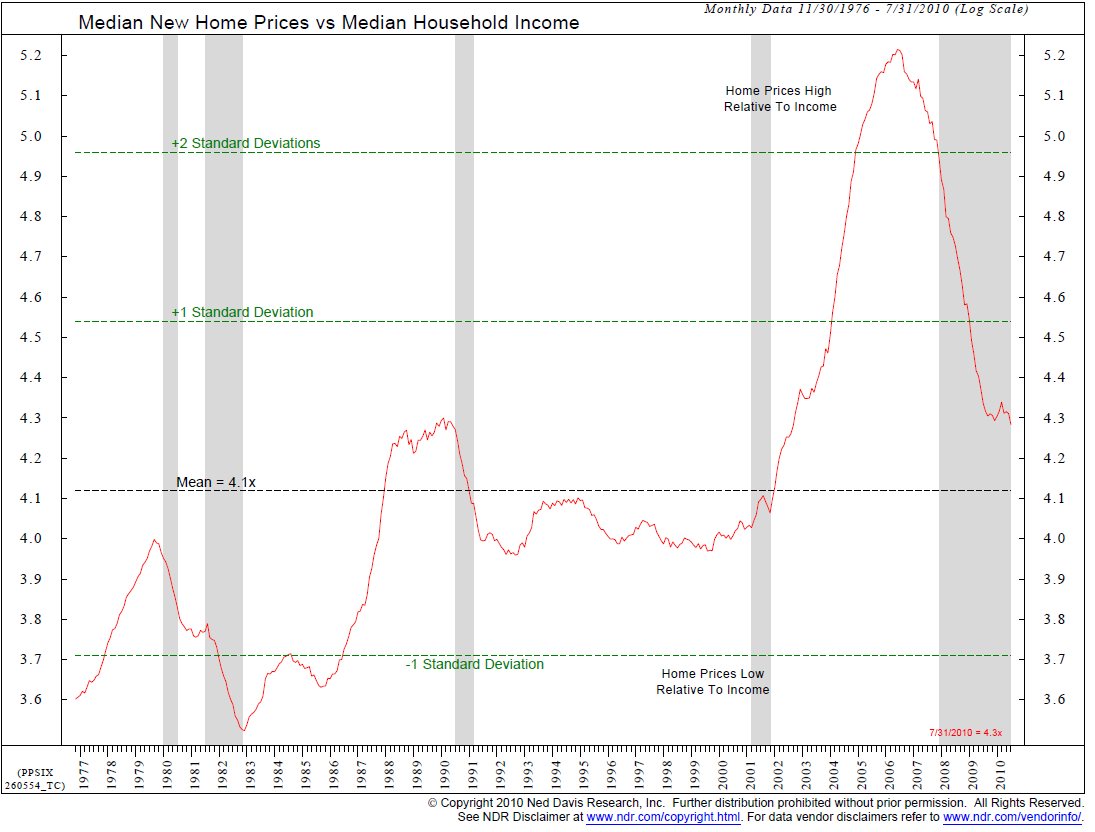
>
CPI Rent vs Homes
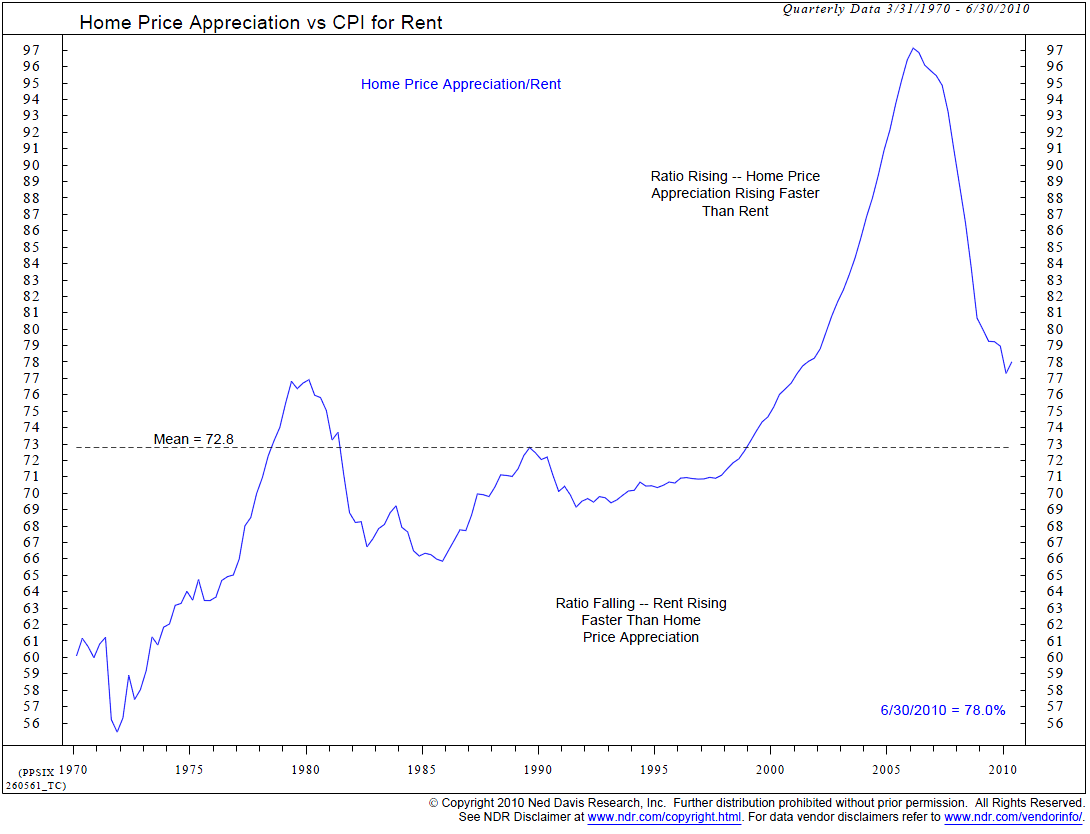
~~~
PDFs


Tweet
Facebook
Reddit
Digg this!


September 15th, 2010 at 12:36 pm
I wonder how NDR projects the median income data in calculating the median house price-to-income ratio – the Census Bureau won’t even release the data for 2009 until 10:00 AM EDT tomorrow.
September 15th, 2010 at 12:40 pm
The census bureau is releasing an annual report tomorrow: Income, Poverty, and Health Insurance Coverage in the United States: 2009.
The data for income comes from U.S. Department of Commerce each month on a one month delay. The July 2010 data came out August 30th
PLEASE CHECK YOUR FACTS BEFORE POSTING
September 15th, 2010 at 1:03 pm
IMHO, the “mean” line here does not mean much. this “mean” value includes the 2001-2006 mega-bubble, without offsetting mega-bust. in other words, i do not think that the “mean” on these charts represents where the “fair” value (if such concept exist) is. IMHO, that value is between the “mean” line and -1 Std. Dev. line, a bit closer to -1 Std Dev. than to the “mean.”
i’m betting on 20% down from here (25-30% with the “overshoot”) rather than 10%
September 15th, 2010 at 1:22 pm
That plot looks a heck of a lot like an inverse plot of mortgage interest rates.
I bet you a shiny nickel that if you plot: monthly mortgage payment on median single family house price payment/median salary
it will be about as flat as a pancake. Yep, it is.
September 15th, 2010 at 1:30 pm
See:
http://cavendish-experiment.blogspot.com/2007/03/analysis-of-us-census-bureau-for-sale.html
(March 2007)
September 15th, 2010 at 1:54 pm
If you ran the first chart from 1950 to 2002, what would the mean be? Lower than 4.1? And, once again, Ned Davis uses disposable income, not gross income. What is Davis’s latest figure for household income?
I will repeat once again my contention that the longterm ratio of median house price (all homes) to gross household income is sub 3 and under our dire economic conditions and in order to mean-revert, this ratio will dip to close to 2.5 which implies another 30% down in house prices.
September 15th, 2010 at 2:28 pm
You know what would be an awesome graphic? US median income heatmap overlayed with current on the market houses that are listed ±$8,000 median house price. Then we’ll see the dislocation of people, houses and income.
This: http://www.trulia.com/home_prices/
but instead the colors would be median income and little house icons for every listing in that narrow range.
September 15th, 2010 at 3:01 pm
So, after reading these comments, am I to believe that the data to produce chart one is biased toward less extreme of a change (of median income to median home price)? I don’t believe that. I think the fact that he uses disposable income instead of gross income is perfectly reasonable, considering the fact that while home prices have no doubt increased, other costs have increased as well, and gross income alone would not account for that fact. Those OTHER costs I just mentioned are not optional, in many cases (childcare, 60 bucks per month for broadband internet, higher cable/satellite bills).
Could someone post that chart that shows mortgage payment relative to income? I couldn’t get the link to open up all the charts properly.
September 15th, 2010 at 3:07 pm
In 2003-05, using my HP, I figured out I was saving 30%-40% by renting over owning. Tried to justify the high price of owning using afford. measures. Could not. Real wages were either flat or falling and 30-year fixed mortgage rate meandered between 5-6%. Meanwhile home prices were rising 7%-10% per annum and everyone that owned a home had a big party. (by the way, there were about 3 afford. calculators on-line at the time. They said I could “afford” a home 20-30% above my own calculation)
It seems price went up because loans were being sold and marked to ARM rates (or less). How does this happen? shouldn’t fixed and floating rates be comparable from a lending/credit perspective – unless of course credit is irrelevant? Hence, from my perspective, it was not rates or income that created toxic mortgages. “lax” credit standards and, more importantly, a complete failure (negligence) by the government to enforce the safety and soundness principles created the bubble. By the way, this is a crime.
Cutting rates to zippo, front-loading condo buyers, and using typical rent/own ratios does not apply. There are 2-5 years of toxic paper production out there causing personal credit downgrades irrespective of credit card balances/saving ratios. To fix, go back to the source of the issue – those “lax” lending standards. fix them and all is well. otherwise, in time, more sales than buyers will come to market. Time is not on your side.
September 15th, 2010 at 3:18 pm
good calls above on the f****d up mean in both series, most notably in the income / home price chart. if one can trace a straight line from interest rates at 17% in ’82 to 4.5% in ’10, what would be the expected change in home prices relative to income over the same time period??? shouldn’t take a rocket scientist to figure out the ratio will rise as the buyers purchasing power rises. since said time period makes up 75% of the data in the chart wouldn’t it make sense that the mean is at least marginally skewed to the high side relative the other forgotten 200 years of american history???
September 15th, 2010 at 4:00 pm
As alluded to by another commenter, I agree that, for the median owner (not median income earner – see below), the median mortgage payment is more important than the median price of the home. Except how price is considered relative to local fair market value, price isn’t terribly important to buyers who have to make mortgage payments. Most median buyers in “liquid” housing situations (i.e. not retirees buying their last home to live out their golden years) need to know if they can afford a payment, not an outlay of cash.
I’m not sure why we should expect the ratio of median income to median housing cost to remain constant in a country where the gap between rich and poor widens. The median income earner is not buying the median home. There are enough homes on the market to house roughly 2/3 of the population, and a majority of the remaining (renting) third are earning below median income. So it’s hard to see how these things are related. The median home buyer should be earning closer to the 67th percentile (assuming the bottom third don’t own, the bottom half of the home-owning population is made up of the middle third of earners). Of course some renters are not in the bottom third, but some homes are second homes owned primarily by the upper third, so these factors will likely even each other out to some extent. By this rough logic, the median earner is only buying the 33rd percentile home, not the median home. As income distributions change (which they certainly have over the last 33 years), this makes a difference.
September 15th, 2010 at 4:10 pm
I’ll piggyback on Brendan’s comment that it’s about the mortgage payment not the actual price of the home with a personal anecdote:
I live in the Bay Area and just purchased a condo (gasp!). The price on the unit I purchased had dropped approximately 30% since it was last sold (new) in 2004. According to some commenters here, it still has another 20+% to go. HOWEVER:
My (conventional) mortgage payment + HOA fees are about $50/month less than my rent for an apartment less than a mile away and 2/3 the size of the home I just purchased. Why not take the plunge? How is (possibly) losing equity value in a home you have purchased any different than paying rent, which has no upside?
So long as rates are hovering around 4% for a 30-year fixed, homes will remain very affordable and I really don’t know where another 20% drop would come from.
September 15th, 2010 at 5:13 pm
@Charles Says:
September 15th, 2010 at 4:10 pm
“I live in the Bay Area and just purchased a condo (gasp!). The price on the unit I purchased had dropped approximately 30% since it was last sold (new) in 2004. According to some commenters here, it still has another 20+% to go. HOWEVER:
Why not take the plunge? How is (possibly) losing equity value in a home you have purchased any different than paying rent, which has no upside? ”
So Charles lets say a year from now, your new home is worth %20 less and you get laid off and a new job pays %20 less. What is your plan then? Now lets assume that you also have to move. What’s your plan then?
September 15th, 2010 at 6:29 pm
@Robespierre
I’m not sure I follow. I’m living within my means so I could actually take a 20% pay cut and still make my house payments while living comfortably, where does my home value factor in? Playing with hypotheticals, you will always be able to come up with a situation where my home value drops, my personal and professional lives collapse, and I end up destitute. So I should live my life as though at any moment everything I’ve worked for will be taken away from me? That seems like a very glum approach.
The question I was really asking with my story was this: For various reasons, homes are finally affordable again for many people. If a person has confidence in their future employment, don’t the benefits of homeownership and building equity outweigh the risks of a decline in value? I’m not trying to cheerlead housing, and I definitely wasn’t trying to time my purchase at the housing nadir. I’m sure prices will drop further, but there are more benefits to owning a home than just asset appreciation, which I think frequently gets lost in discussions such as this one.
September 15th, 2010 at 8:24 pm
@Brendan: You’re right in your calculations, but I think the goal is to gauge whether a prospective person or household can afford a house, rather than determining whether buyers can afford the house they bought.
September 15th, 2010 at 9:12 pm
If you ever shopped for a house, you typically go to a realtor and they’ll ask you how much money you make. From that they figure out how much money you can spend, based on the usual income guidelines. (They were 25% in the 1930s, 33% in the 1980s; I have no idea of what the number is these days.)
Median house prices in the 50s and 60s worked out to about 600 hours at median wage. This went up in the 70s, then soared when the Fed spike interest rates to fight inflation back in 1979. It went over 1,000 hours before settling back down around 800. It went up over 900 during the bubble, but seems to be coming down again.
September 16th, 2010 at 3:51 pm
Great comments. I agree something is missing… interest rates?
If the mean is the crash line what happened in ’80 and ’82 and why did it’s it happen in ’87 – ’88? Again, something important (not the mean line) is missing from this graph.
September 16th, 2010 at 6:32 pm
[...] We will cover: Prices remain too high; [...]
