
Forget Pennies; Bring Back Nickel Price Increments

Email this post Print this post
By Barry Ritholtz - October 3rd, 2010, 8:15AM

The law of unintended consequences has made decimalization part of the problem. Once trade execution went from a profitable business to an all risk, no upside business segment, the carbon units were quickly replaced with much cheaper silicon. Once the (profitable) fractions were lost, robotization was inevitable.

In my wish list of “Impossible Wall Street Fixes,” I rooted for the return of fractions.

8. Decimalization: Give up the decimals, and return to fractions. This would allow investment houses trading desks to earn a decent profit. And that might reduce their need for reckless speculation.

Somewhere between fractions and decimalization is an even simpler fix: Nickel Increments.

Here’s Mike Santoli:

“Take, for instance, a gentleman named Jim Maguire, who began working as a specialist on the New York Stock Exchange floor 60 years ago, who acted for many years as the nexus point for buyers and sellers of Berkshire Hathaway (ticker: BRKA) shares, and who is now associated with Barclays Capital.

Jim recently refreshed his longstanding campaign to have stocks trade in increments of five cents rather than pennies, which could bring greater liquidity and order to the process. Trading has become faster and cheaper in recent years, but at the expense of squandering much of the public’s faith in how the stock market operates.

Barron’s featured Jim’s cause several years ago (“Meet Mr. Nickel,” April 25, 2005), and he just recently sent a letter articulating his position to Securities and Exchange Commission Chairman Mary Schapiro.

Schapiro, in turn, has lately given voice to the sensible notion that typical high-frequency traders, who profess with plenty of justification to be “de facto market makers,” should perhaps be subject to the traditional obligations of literal market makers—such as not being able to back away from bids and offers.

There aren’t many rigid principles Wall Street folks are obliged to follow. But one of them should be that a person who has spent six decades of his life advocating for the position that the public deserves a fair shot—and who has earned, and declined, the right to walk away from the market at a ripe age with a sense of a career well done—should be listened to.
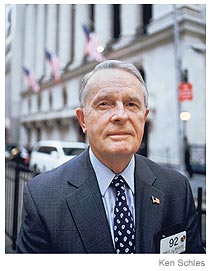
I like the idea a lot.

I wonder what unintended consequences would come out of reverting to 5 cent pricing . . .

>

Source:
Faster, Cheaper and Fairer
MICHAEL SANTOLI
Barron’s OCTOBER 2, 2010  
http://online.barrons.com/article/SB50001424052970204839304575520063527174210.html

Comments

Please use the comments to demonstrate your own ignorance, unfamiliarity with empirical data, ability to repeat discredited memes, and lack of respect for scientific knowledge. Also, be sure to create straw men and argue against things I have neither said nor even implied. Any irrelevancies you can mention will also be appreciated. Lastly, kindly forgo all civility in your discourse . . . you are, after all, anonymous.

35 Responses to “Forget Pennies; Bring Back Nickel Price Increments”

  1. peterpeter Says:

    > I wonder what unintended consequences would come out of reverting to 5 cent pricing . . .

    For starters, every investor will pay a much wider spread. For equities with current 1 penny spreads, the obvious result would be a 5x increase in spread paid.

    Less obvious is that existing equities that trade with wider than 1 penny spreads would also see their spreads increase, since the cost of doing any type of statistical arbitrage that shifts liquidity from one highly liquid equity to a less liquid one would increase to the extent the model ever relied on hitting the NBBO on the more liquid (but now 5 cent spread) equity.

    Also less obvious – volume would be greatly reduced. That in turn would mean that the fees that FINRA and the SEC charge per share traded would need to increase to reach the same target levels in their budget. This is currently a meaningless cost to most investors, but could revert back to something approaching a penny per share perhaps.

    And with the drop in volumes, we would see a shakeout in the number of trading venues. Many here would likely welcome that result as the US equity markets are the most complex in the world…. however the net result would be that exchange fees would eventually rise as well.

    So, Mr. Nickel would get to be somewhat competitive with the computers in making 5 cent spreads, but all investors would pay much more to transact equities.

    Since it is obvious that costs to investors would go up (although not obvious the full extent, just the spread increase), it’s hard to call this an unintended consequence. I think it is painfully clear that it would be a really bad outcome however.

    How literally anyone who understands markets and is not a human displaced in this food chain by a computer could favor such an outcome is beyond me.

    We could put lots of people back to work by materially increasing ATM fees so that people took out their cash in lines serviced by human bank tellers, which I think would be just about as poor of an idea as this one.

  2. peterpeter Says:

    > Once trade execution went from a profitable business to an all risk, no upside business segment, the
    > carbon units were quickly replaced with much cheaper silicon. Once the (profitable) fractions were
    > lost, robotization was inevitable.

    Outside of the increase in unemployment, I view this as quite positive. The carbon units were not exactly the best market makers for investors.

    The firm Mr. Nickel sold his seats to (LaBranche & Co) in 2000, was fined $63.5M in 2004 for trading viloations (http://www.bloomberg.com/apps/news?pid=newsarchive&sid=aDOzLYzt4Rqg).

    And of course there was the $1B settlement against Nasdaq market makers for collusions in 1996(http://www.justice.gov/opa/pr/1996/July96/343-at.html).

    How anyone (other than the displaced human market makers) could prefer to go back to that nonsense is beyond me.

  3. constantnormal Says:

    Without making other changes (banning/restricting HFT, illuminating dark pools to provide market transparency), all that moving from pennies to nickels will do is multiply the trading profits of the banksters five-fold. Costs for investors would go up, and straight into the pockets of those whom this is apparently aimed at. No behavior would be altered.

  4. constantnormal Says:

    @peterpeter

    “How anyone (other than the displaced human market makers) could prefer to go back to that nonsense is beyond me.”

    While I support the improvements in operating efficiency, and speed that came from automation, I can also see that under the regime of the old “carbon-based units” there was really quite a lot more in the way of rules to constrain conduct, the violations of which you note. But there are no violations to note in the era of automated trading, because there are no rules.

    Rules? In a knife fight? Ain’t no rules in a knife fight.

    Harvey Logan — Butch Cassidy and the Sundance Kid

  5. call me ahab Says:

    great one BR-

    I love this idea- savvy – and simple- you know- just overcharge everyone- guaranteed profit- everyone’s happy- and Wall Street won’t need to take risky bets-

    nickel increments? We can make it dime or quarter increments- just to make sure (that they’re happy)-

    it isn’t that they would take that gravy and leverage up to the extent allowed- and bet it all on black anyway (would they?)

    and the mores of a generation ago would fall right back into place (I can’t wait- just like the good ol’ times- you know- the way it use to be)

    and it’s not like the investing public is acting like a dog who give up (is it?)- rolling over and showing its soft exposed underbelly- with the hope it won’t have its entrails ripped out- because we know these folks can be trusted (right?)

    ~~~

    BR: It used to be quarter point increments — then 8ths, then teenies (1/16ths).

    If you have a better system in mind than specialists, I’m all ears. Its a trade off — a license to steal, vs guaranteed automated crashes — and after Friday, it seems we now get one every quarter!

    I’ll take the human (defined) thieves, cause the automated version sure as hell aint working

  6. RW Says:

    I’m not aware of any evidence that there was less speculation when stocks were priced in fractions. If there are to be fractions then let it be in the form of a tenth-penny transaction tax and enforcement of a rule that bids/offers must endure contractually for at least three seconds should stabilize the markets considerably.

  7. Barry Ritholtz Says:

    I don’t have any issue with that tax.

    The issue isn’t human speculation, its Silicon algo speculation. Today its the machines running the place.

  8. KidDynamite Says:

    I hate this logic:

    “Trading has become faster and cheaper in recent years, but at the expense of squandering much of the public’s faith in how the stock market operates.”

    The reason the public’s faith is being squandered is because mainstream media is TELLING them to be scared of “the computers,” of “SKYNET!” Because people keep writing sensationalized articles about how computers are stealing their money.

    Any retail investor can buy basically as much of any Russell 3000 stock that they need to while paying a 1c bid/ask spread. How can anyone not like that? Stop right there – that’s the point! ONE CENT spreads! it’s AWESOME!

    If you’re worried about The Machines “frontrunning” your buy order, then just lift the offer – the entire point of penny spreads is that the spreads are so tight that you don’t need to, as we used to say, “play Johnny Stockmarket” where you enter a bid and hope you get hit, to avoid paying a fat spread.

    Remember at the end of The Hunt For Red October, when the guy says “you killed US you idiot!” – that’s what retail investors who push for nickel instruments will feel like once they finally realize that they’re massively increasing their own trading costs.

    So back to the initial quote I used, traders would be wise to focus on the FIRST half: “Trading has become faster and cheaper in recent years” – there’s no reason for anyone to lose confidence – there has never been a better time for retail investors with respect to trading costs, execution speed, trading tools, and availability of information.

  9. KidDynamite Says:

    Barry – you need to explain this one:

    “The issue isn’t human speculation, its Silicon algo speculation.”

    why is it ok for YOU to speculate, but not for someone else or something else to speculate? Because computers aren’t human? So what – that’s a GOOD thing – if they do stupid things that allow you to capitalize and make money. Flash crashes are a GREAT thing for non-HFT mortals – it allows us to profit from the mistakes of others. Instead of trying to ban computers, silicon, or algos, we should try to ban DO-OVERS – ban the canceled trades so that those who screw up pay the price for it!

  10. Marc399 Says:

    I agree.
    I also think a 1/10th second quote/trade delay would be nice. HFT doesn’t add liquidity, it only adds revenue to the exchanges and those who can afford the set up.

  11. VennData Says:

    “…I wonder what unintended consequences would come out of reverting to 5 cent pricing . . ..”

    You’ll pay more. There’s no evidence increasing spreads is an improvement of any kind …and plenty that it’s not.

    “…Quote: Gus Sauter, chief investment officer at Vanguard, a big provider of low-cost tracker funds, said retail investors had benefited from lower trading costs due to the rise of automated trading in shares over the past decade. “Our transaction costs have been cut by more than 50 per cent.”

    Mr Sauter estimated that translates into an additional gain of more than 30 per cent, after returns are compounded over time for future retirees.

    “It is very meaningful to have lower transaction costs” he said…”

    Financial Times article: Contention Over Safe Speeds for High Frequency Trading

    http://news.morningstar.com/articlenet/article.aspx%3fid%3d339757&referid=A1598
    http://www.ft.com/home/us

    It was a human who caused the flash crash… NOT computers. There has always somebody trading faster than you, always will be. you can either have computers that take a thousands of a cent, or a floor trading taking a nickle.

    To slow down the technology and efficiency of markets because floor traders who are talking their book is nonsensical.

  12. Pete from CA Says:

    Let’s not kid ourselves, the “public” lost confidence in the markets because of the humans on Wall Street (and Washington), not because of the computers.

    You want to restore confidence? Show some decency. Bribing the scumbags with a wider spread will not fix the ethical shortcomings.

  13. The Window Washer Says:

    I think a more direct way of dealing with HFT is time. You can move the order time limit around until you find a spot that works and the public understands it.
    How do you fight for orders of less than a second when running for election?
    After that dig a little deeper into pricing, market making ec…

  14. Equityval Says:

    So it’s either the current system or back to the dark ages of humans answering the phones for 5 cents a share? That’s a false choice.

    We could implement some market making-like requirements on the quote sniffing, front running HFTs with their servers co-located at the exchange’s data center (that’s a privelege not afforded to every market participant after all). Imposing something like (simplistically) minimum share bids/offers for a stated period of time within a certain percentage of the last trade, instead of the kindof, sortof promise to provide liquidity, except ya-know, when things gets a little hairy and Waddell dumps a big futures order on the market doesn’t seem out of line or impossible to implement. Yes we’d lose some “liquidity” in a nominal sense, but as we’ve seen that nominal liquidity ain’t worth a bucket of spit when things get tough.

    One other thing – Barry have you forgotten how the human market makers had a tendency to not answer the phones when things got tough. Do you remember Aug/Sept 90 when large numbers of NASDAQ stocks were effectively untradeable because the MM wouldn’t answer the phone? Not so sure that the vaunted human element is worth so much when things get giggy.

  15. ACS Says:

    Seems to me the public lost confidence in the stock market because a decade of gains vanished when the big banks went crazy and caused a bubble and bust which was long before the so-called flash crash happened.

  16. Mark E Hoffer Says:

    while I do believe that ‘decimalization’ was, merely, for the benefit of ‘Cary, the Computer’, and his brethren ‘Silicon Sam/Sally’, I’m not sure “wider Spreads” will proffer the outcomes “We’re seeking”..

    I think charging (Fees/Commissions) on All Trades, ‘Cancelled’, or otherwise, will get us nearer the Mark “We’re aiming at”…
    ~~

    “Equityval”, here: “So it’s either the current system or back to the dark ages of humans answering the phones for 5 cents a share? That’s a false choice.”

    makes, one of the, (a) salient observation(s)..

  17. wally Says:

    Dump pennies is real life, too: the only remaining reasons for pennies are odd postage stamp values and sales tax rates. Put stamps at 45 cents and raise a nickel thereafter. Put sales tax at 5 or 10 percent and don’t fiddle with odd fractional amounts.

  18. Andy T Says:

    BR,

    I know that once your write something down in pixel form, you tend to stand by that idea for eternity, but you really need to back away from this one.

    This is really silly and non-sensical.

    Nobody as a “right” to make a living being a specialist in a stock.

    Crashes happen. Market dislocations happen. That is simply “the way of things.” Decimalization is part of the evolution of the markets. There is just no way around it.

  19. Barry Ritholtz Says:

    1) I frequently change my mind — in fact, i was originally IN FAVOR of decimalization. Devastating the specialist/market maker system was (with the benefit of hind sight) an error. Hence, this position is a reversal.

    2) Nobody suggested people have a right to make a living as a specialist — but it is obvious to the folks who don’t make a living running algo trading that the current system is structurally unsound.

    What I find “silly and non-sensical” are strawmen, unsupported arguments, ad hominem attacks, etc.

  20. Andy T Says:

    BR.

    What I suggested was not a “strawman” or “ad hominem” attack.

    On the contrary…

    Does the public have a “right” to a tight “bid/offer” spread? Yes or NO?
    Does the public have a “right” to liquidity? Yes or NO?

    The answer to both of those questions is, of course, NO. However, it’s SELF-EVIDENT, that efficient markets tend to towards tighter bid/offer spreads. To argue otherwise, would be illogical in the extreme.

    Otherwise, where does it stop? 1c bid/ask is good. 5c bid/ask is better? What about a 10c bid/ask spread? Why not go even wider?

    Why do you think that you, or Jimmy Maguire, knows the correct answer to that question?

    This is very similar to many “solutions” that you’ve suggested in the past. They all “assume” that you happen to know that exact degree to which something should be measured or executed.

    I.E. All of your rants on “Corporatism”….

    All of those rants beg one simple question: “At what point does a corporation become ‘too big’ and ‘evil?’”

    Afterall, Hewlett, Gates, Jobs, Packard, Allen, Woz…all started as individual entrepreneurs in the U.S. system of capitalism. According to many of your posts on the subject, you suggest “limits” and “restraints” of all kinds on corporations. The tricky question, of course, is when does an “individual” like Bill Gates become a “bad” Corporation like Microsoft?

    Tough to answer, I think.

    This is where “progressivism” tends to fail.

    Where does one draw the line?

  21. peterpeter Says:

    > What I find “silly and non-sensical” are strawmen, unsupported arguments, ad hominem attacks, etc.

    What I find silly and non-sensical is most of the unsupported and ad hominem attacks against HFT.

  22. The Window Washer Says:

    Peter
    How do you make an ad hominem attack against a method?

  23. RW Says:

    FWIW I agree that price discovery tends to be highly granular, probably much larger than a nickel in most cases, but that’s not an argument for increasing transaction costs and slippage it’s just an explanation for reversion to the mean.

    There appears to be some evidence that HFT is destabilizing (http://tinyurl.com/2e7uv7m – ht zh); if that is the case but it is otherwise a legal activity then structure and/or incentives need to change so that this impact is reduced. Increasing spreads to a nickel might do this although I personally see no reason to believe it will; e.g., if an HFT can provide very large order flow what desk is going to risk losing it by charging the extra nickel, they’ll save that for the retail trade.

    OTOH a small transaction tax and/or (enforced) rules for bid/offer duration and/or backing out a trade seem more potent incentives, at least to me.

    NB: Boundaries can be tough to navigate but allowing a corporation to continue to exist as a monopoly while it suppresses competition, extorts economic rents and regulates itself exclusively for its own benefit is where “conservatism” tends to fail. Progressive, liberal, conservative, libertarian, etc are moderately useful as categories but rarely as labels for people; there are points in between worth arguing about but the poles themselves are largely empty of habitation; no one really lives there, at least for very long, even if they believe they do. JMO

  24. philipat Says:

    I don’t agree that going backwards and increasing the cost of trading is the answer. Instead, it would be preferable to eliminate the Dark Pools and other off-exchange trading such that the additional (Now lost) volume would offset the lower margins. Further, more effective circuit breakers could also be implemented. I fear that any move back to higher margins would, with the active (Lobbyist-funded) support of Congress, NOT be accompanied by any other necessary reforms, as a result of which we would still have flash crashes but the margins would be higher.

  25. peterpeter Says:

    > How do you make an ad hominem attack against a method?

    I should have said “HFT practioners”.

    While we are nitpicking, HFT is not a method.

  26. RW Says:

    “…HFT is not a method”

    Umm, sorry to pick a nit on a nit, but if it is not a method then, by definition, it cannot have practitioners.

  27. Mark E Hoffer Says:

    not that anyone should be keeping Score, but “2 Points” for RW @20:57..

    http://www.thefreedictionary.com/Practitioner

    http://www.thefreedictionary.com/technique

  28. peterpeter Says:

    Mark,

    Easy on the allocation of those points.

    Practioner: One who does anything customarily or habitually. [1913 Webster]

  29. madgreek Says:

    Decimated by imbeciles at the SEC = Decimalization.

    http://open.salon.com/blog/dean_petkanas/2010/05/07/hey_k_you_ever_flashy-thing_me

  30. V Says:

    I thought the whole point of open markets is transperancy – you can see what the guy next to you is buying or selling and who that buyer/seller is.
    Therefore I do not see the point of dark pools. Why do these exist?
    Is it so a large seller can dump his huge position without anybody seeing and hence lowering the price? Shouldn’t someone seeking to dump a large position move the price lower (in the absence of a buyer), isn’t that the point of price discovery? i.e. a large holder selling their shares is providing information to the market that would otherwise be lost if it occurs in a hidden market

    On the issue of HFT, for starters lets make a bid a bid and an offer an offer. No cancelling of trades period. Sure have enough “Are you sure screens?” for the carbon based life-forms, but this would eliminate the sniffing out of orders that goes on. Perhaps in combination with a minimum order duration of 3 seconds.

  31. curbyourrisk Says:

    Forget nickels….let’s go back to 1/8ths…

  32. foxorrabbit Says:

    Keep it at pennies, or even go to tenths or hundreds of a penny. I don’t buy the “oh those poor traders, they’re not making money anymore” argument. As for argument #2, there are better rules you could institute to bring about the stability you are seeking.

    This is not one of them, and only marginally related, but I propose a federal transaction tax equal to the greater of:
    10 cents per share, or
    1% of the value of a transaction.
    No exemptions. Not even i-banks or specialists.

    Then goodbye Wall St, and good riddance. Send them out into the world to do something that actually adds value rather than being brokers of souls, feeding people their own future selfs, while they know not what they eat. As fun as it is, with all the bells & whistles and shiny lights and chart porn and power (oh, the power), it is a game shouldn’t exist. And you know this.

  33. madgreek Says:

    V… interesting concept of eliminating volatility.

    I will add perhaps a thirty seconds rule. One mississippi… two mississippi…, or better yet ~ one Wall Street… two Wall Street… until you get to 30 Wall Street, a place where you might find some white collar criminals bathing in a dark pool of money.

    On price discovery, its hard to catch a glimpse of a photon, especially one that has never been born to begin with. This is probably the most insidious factor in all of electronic trading. In my opinion, a price posted, no matter where in the marketplace, must be executable from a contra-party for at time certain for discovery and concomittant risk (contemporaneous cost) to have any merit whatsoever. In fact, I believe that layering would be best. For any price posted within 1% of the NBBO, time should lapse no sooner than 30 seconds. Add 5 seconds for each incremental 1% in bandwidth up to 10%. (thus a minute and a quarter for a full 10%. If you are more than 10% away from the market, it would be called a time out. If you time out, you must return to the trading universe for the issue within one hour or withdraw for the day.

    I believe this will go a long way towards eliminating the shadowy and irrational pressures and/or supports on a security. You may then find a dark band 15% below or above bid/offer to remain outside the 10% circuit braker rule.

    Any firm/trader using this hideaway technique (timeout) more than once a day will lose eligibility to trade the security for thirty days. More than three violations per year, the firm/trader will lose eligibility for a year. And so on.

  34. The Window Washer Says:

    @peterpeter

    My comment was one of those deadpan jabs I send across the table while having a beer with friends. Doesn’t come across on a comment.
    I guess I should resort to the horrid : )

  35. Deborah Says:

    NO, NO, NO, NO….

    We are a decimal society, get rid of pennies, nickels, quarters, make the dime the smallest coin and use a 50 cent piece.

    Going to nickels is poorly thought out.

85 queries. 0.405 seconds.