Troubled Asset Relief Program
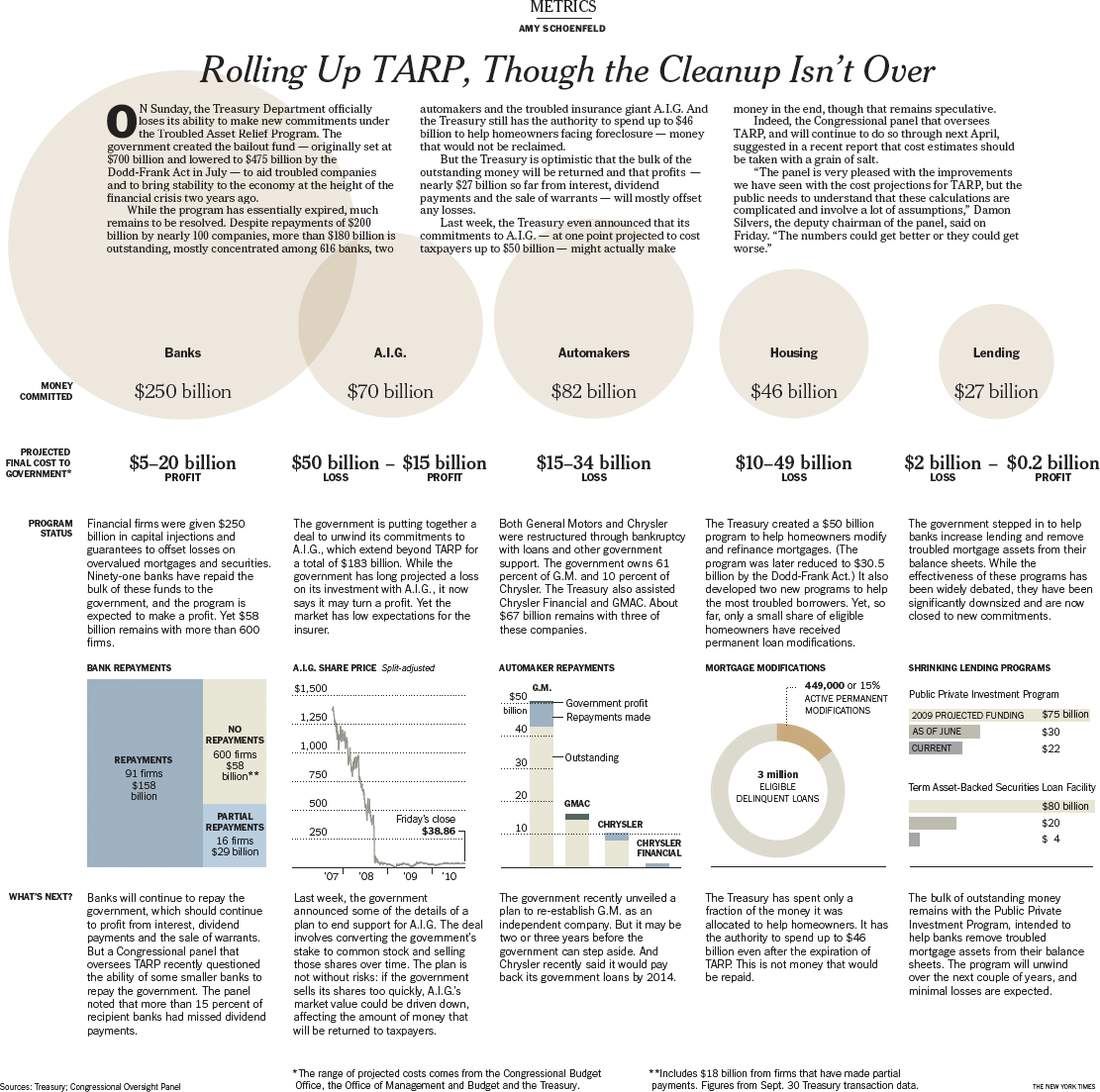
There was a great chart in Sunday’s NYT:
The government is pulling a sheet over TARP, the Troubled Asset Relief Program created during the panic of 2008 to bail out the nation’s financial institutions. With the program’s expiration on Sunday, we can expect to hear lots of claims from the folks at the Treasury that it was a great success.
Such assertions would be no surprise from a political class justifiably concerned about possible taxpayer unhappiness, the continuing economic turmoil and the midterm elections. But if we have learned anything during this crisis, it is that the proclamations emanating from the Washington spin machine must be taken with an extra-hefty grain of salt.
TARP Money
>
Source:
Count on Sequels to TARP
GRETCHEN MORGENSON
NYT, October 2, 2010
http://www.nytimes.com/2010/10/03/business/economy/03gret.html



Tweet
Facebook
Reddit
Digg this!


October 4th, 2010 at 3:08 pm
Let’s forget about TARP and get the Fed to mark-to-market their balance sheet (particularly all the MBS they undoubtedly paid top dollar for). And, while they are at it, let’s get a full accounting of the current positions in all their existing programs. The banks created the Fed in 1913 to control the money supply. Now that the debt fueled binge they created is unwinding, they are using the Fed’s balance sheet as a dumping ground. After all, who really has to cover the Fed’s losses? Of course, the taxpayer (even though the Fed is private). What a scam.
October 4th, 2010 at 3:20 pm
Feds losses/gains are attributed to the treasury (tax payer) as increase/decrease of the national debt.
The FED is not private it is the independent central banking system for the US:
The Federal Reserve System is considered to be an independent central
bank because its decisions do not have to be ratified by the President or
anyone else in the executive branch of government. The System is, how-
ever, subject to oversight by the U.S. Congress. The Federal Reserve must
work within the framework of the overall objectives of economic and
financial policy established by the government; therefore, the description
of the System as “independent within the government” is more accurate.
October 4th, 2010 at 3:49 pm
TARP is dead – FINALLY — But its legacy will live on in infamy
TARP will be paid back and make a profit ? Yeah right, pay no attention to the men behind the TARP.
BANKS: TBTF banks pay back TARP with back door bail out funds channeled through the myriad of other programs – AIG bail out and not to forget the biggest being the FED purchase of 1.2+ Trillion of MBS.
AIG — what a joke — this one is playing out to be a huge taxpayer heist. The latest round to convert preferred to common transferring all the market risk to the taxpayer for any recoup of funds, while the existing stockholders (although radically diluted) still hold on to a share and the debt / bond holders escape with full payout potential.
Automotive — GM pays back 6.5B loan with gov’t funds from the escrow account and taxpayers hold common shares, with the hope that IPO and subsequent offerings will return taxpayer funds (or profit). And to add a bit more to the outrage GM wants to issue more preferred stock at the IPO time because they need more $$ for operations — oh yeah lets let everyone else keep or take senior positions over the taxpayer.
Housing — we all know where this is going — all this money will be flushed with no expectation or hope of return or value from the distribution. A large portion of this $$ will go to the banks as incentives, fees and loss sharing.
The acronym TARP can take many forms, as in a literal TARP: covering up the FEDs improper use of the FRA Section 13(3) to channel money into an insolvent private company – under collateralized such that the FED would have lost money if the collateral had to be seized and liquidated if AIG failed.
TARP – Treasury Actions Reaming the Public
TARP – Treasury Actually Raping People
TARP – Time Americans Replace Politicians
TARP – TAR Paulson
…
October 4th, 2010 at 5:57 pm
Let’s face it Governments all over the world have learned how to play the placate game. Why should a public that is better off than their ancestors give a dam? When and if the ponzi unravels…that’s a different story.
October 4th, 2010 at 6:04 pm
obsvr-1,
@15:20, more Prood that good Agitprop is worth its Weight, in Gold.
“The System is, however, subject to oversight by the U.S. Congress.”
That a Good One!~
~~
TARP, by the end of this Episode, will look trifling..
http://cryptogon.com/?p=18042
“Via: Bloomberg:
The U.S. government will face pressure to bail out struggling states in the next 12 months, said Meredith Whitney, the banking analyst who correctly predicted Citigroup Inc.’s dividend cut in 2008.
While saying a bailout might not be politically viable, Whitney joined investor Warren Buffett in raising alarm bells about the potential for widespread defaults in the $2.8 trillion municipal bond market. She said state and local issuers have taken on too much debt and that the gap between public spending and revenue is unsustainable.
“People will think the federal government will bail these states out,” Whitney, 40, the founder of Meredith Whitney Advisory Group Inc., said in an interview on Bloomberg Television’s “In the Loop.” “It’s going to be an incredibly divisive issue.”…”
~~
among others of “The Greatest Hits” ..
October 4th, 2010 at 6:15 pm
from above: “more Prood” .. should have been ‘Proof’ ..as found in “Proofreading”, too ~
October 4th, 2010 at 6:38 pm
[...] Administration an “attaboy” is worth noticing. _________________ Update: As if on cue, Barry Ritholtz links to this article by Amy Schoenfeld in the NYT. $200B has been repaid, $180B is outstanding. At [...]
October 4th, 2010 at 7:14 pm
There is widespread belief the stimuli didn’t work. I am reminded of the man whose house was burning. His neighbor showed up with a garden hose and actually was able to reduce the flames, but only somewhat. The neighbor wanted to call the fire department, who would bring out the big hoses, but the man told him to stop, because my house still is burning. “Obviously, water doesn’t put out fires.”
Rodger Malcolm Mitchell
October 4th, 2010 at 8:21 pm
Roger, I don’t know where you shop for water, but round here it doesn’t cost hundreds of billions of dollars.
And if it did, we darn sure wouldn’t use it to save Lloyd Blankfein’s bonus.
October 4th, 2010 at 8:45 pm
Elizabeth Warren has gone on record stating that “we don’t know where the TARP money went” and that likely “we’ll never know”, great job Paulson/Geithner/Cox. As for Bush, what can one expect? I will reserve my comments about the stimuli for THAT topic.
October 5th, 2010 at 12:11 am
the fed maybe independent within government, but the actual shareholders are certainly private.
and all the benefits go to the owners. the private bankers.
since the fed printed trillions and bought trillions of shit assets from private bankers, anyone that thinks they paid us treasury back without debased money and without screwing the taxpayer is simply an idiot or a payed lobbyist.
barry, why don’t you expose the fed’s private money more. i think it is the story of the century.
like asking walmart to print our money. why do so many smart people not understand that they have been had.
October 5th, 2010 at 1:05 pm
tt and clawback,
TARP didn’t cost taxpayers one cent, since the federal government neither needs nor uses taxes to fund its spending. The reason: The federal government is monetarily sovereign (See: http://rodgermmitchell.wordpress.com/2010/08/13/monetarily-sovereign-the-key-to-understanding-economics/ )
The situation is different for Greece, Italy, Illinois, Cook County and Chicago, none of which are monetarily sovereign, and so do use tax money to fund spending. The mistaken belief that taxpayers pay for federal spending has given us reduced Social Security and Medicare benefits, a messed up attempt at universal health care and myriad other unnecessary problems. (See: http://rodgermmitchell.wordpress.com/2010/05/20/worried-about-your-children-and-grandchildren/ ).
Rodger Malcolm Mitchell
October 5th, 2010 at 9:42 pm
Rodger,
Let me put it this way:
In my neck of the woods, the monetary sovereign doesn’t have to create $700B in currency to buy water. But even if it did, we sure as heck wouldn’t use the powers of the monetary sovereign to save Lloyd Blankfein’s bonus.
(It’s a question of justice, not the ability to issue currency. Trust me, I get what you’re saying.)
October 5th, 2010 at 10:28 pm
c´mon Berry, look at the Big Picture; financial stimulus is a zero sum
game, just ask Japan! What financial stimulus does is,
yes put money into the real economy, but what most people overlook is
what it also does: it creates a lot of new treasuries that
banks buy and leverage up on and buy more bonds, taking potential risk
capital investments of the table for for normal business.
That is exactly what happened in Japan and what is now happening in
the US. Thats why on balance financial Austerity works better
then stimuly. Think of it as a three way pie that consist of hard
assets (oil, gold etc.), stocks and bonds with a fixed amount of
capital. Now you make more of the pie piece of bonds but you only
have the same amount of capital, of course the capital comes
from the stocks pie piece ie. business investments…
October 6th, 2010 at 10:14 am
clawback thinks of justice in terms of class warfare, where it’s bad that some people get rich and others don’t. Clawback doesn’t need proof, as his is purely an emotional response. Fair enough.
Prismatic thinks that removing money from the economy is more stimulative than adding money to the economy. Prismatic offers no proof, because there is none. And this is typical of economics discussions, today. Every man in the street considers himself an expert. In what other science but economics can one find so many people making so many positive statements devoid of any factual basis?
That lack of factual basis is the foundation of debt-hawk thinking, where deficits lead to inflation — except where they lead to deflation — and money destruction is beneficial. It would be humorous if it weren’t so damaging to our lives.
Rodger Malcolm Mitchell