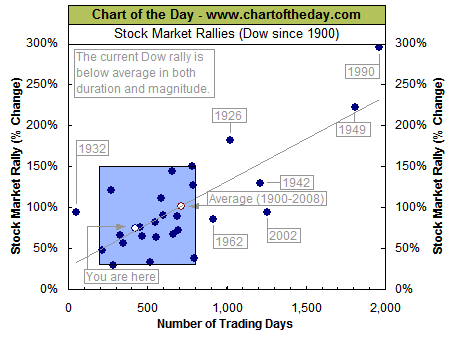
Current Dow Rally, Duration and Magnitude
Chart of the Day has an interesting view on the state of the current cyclical bull run.
They note that “most major rallies (73%) resulted in a gain of between 30% and 150% and lasted between 200 and 800 trading days.”
I would like to see that data sliced even finer. Rather than looking at the universe of all bull markets, I would want to break it down further into rallies during secular bull and bear markets. I suspect both the duration and magnitude might be different that way.
>


Tweet
Facebook
Reddit
Digg this!


November 6th, 2010 at 3:41 pm
We’re just getting started…
November 6th, 2010 at 3:44 pm
Earnings have consistently surprised to the upside (since q1, 2009). I suspect that continues and 1 yr from now were looking at roughly $100/shr in eps on SPX (should be $85-88 eps for 2010).
Where will the SPX be?
November 6th, 2010 at 4:08 pm
Certainly, the bull market has more to go.
I just want to know when the next 7% correction is coming.
November 6th, 2010 at 4:14 pm
basic question: I see that emerging markets all over, but notably Brazil and Peru, Colombia have started buying more US $ to lower their currency- I dont understand the corrolation how this works..in laymans terms, how does this lower their currency? Thank you
November 6th, 2010 at 6:23 pm
The regression line shows that, on average, the longer the rally lasts, the larger the % gain. The current rally sits right on the regression line. It’s misleading to say this rally is below average in duration and % gain. It ain’t over till it’s over.
November 6th, 2010 at 8:15 pm
The central banks intervene in order to affect the supply and demand for a targeted currency. In the case of Peru the BCR buys US dollars with Nuevos Soles, introducing +PEN and withdrawing USD.
http://en.wikipedia.org/wiki/Open_market_operations
November 6th, 2010 at 9:01 pm
cognos:
That doesn’t mean squat. If you give guidance that’s always very low, of course you can surprise to the upside. Or you can also lower guidance early in the quarter and then …. well you get the story. But lets face it, Bernanke is trying to pump up the market. He even admitted to it earlier this week.
November 6th, 2010 at 10:31 pm
thanks “white city” arequipa01
November 7th, 2010 at 6:41 am
To be clear, I use ‘Arequipa’ because I have a familial connection, not because of any other motive. As for the Ciudad Blanca, there are two schools on thought on that. The primary building material used there from its founding in the 1540′s (yeah you read right) to the early 1910′s is called ‘sillar’, a volcanic rock found in abundance in the area. It has an almost chalky white color. Hence the nickname. Unfortunately, there also exists a racialist undercurrent in the moniker. The particularities of racial discourse in Peru are too complicated to mention here, but allow me to note a few things:
1) my family got its start in this country as indentured servants-at least he could hold to the hope of fulfilling the terms of a contract over time. Many of you here reading were born prior to 1968- in Peru there persisted an effective slavery in certain areas of the country, hell some hacendados hunted campesinos-to say that I hate slavers and slavery (in that order) in an understatement
2) Arequipa is a wonderful city and region to visit if one goes to Peru go to Cau Cau II donde te permiten chaullar en la cocina…
3) My daughter calls me ‘panzaverde’- a zimbabwe dollar to the first one to name a song that uses that word.
November 7th, 2010 at 6:49 am
[...] Where does the current rally stand? (Chart of the Day, Big Picture) [...]
November 7th, 2010 at 8:56 am
To Barry’s point … it’s hard to tell without all the year labels present, but I would guess that rallies within secular bear markets (such as 1966-68 and 1970-73) are probably included in the blue box in the graph.
The median trough-to-trough market cycle runs about 4 years, with 3 years of rally and 1 year of decline into the low. The blue box, with its right-hand boundary at 800 trading days (3.3 years) illustrates the point.
Only six rallies were longer than 800 trading days. The two longest — 1949-57 and 1990-98 — both had cyclical pullbacks in the middle. A recession in 1953 caused a 13% decline in the Dow — not enough to trigger a minus 20% bear market criterion. Similarly, the bond bloodbath of 1994 coincided with a 9% decline in the Dow — again not enough to qualify as a bear market.
From a cyclical point of view, I would be inclined to break these two granddaddy rallies into two pieces each, even though a consistent 20% bear market criterion no longer would apply. On this basis, the 2002-2007 rally, which lasted exactly five years, was the longest rally that didn’t contain a cyclical pause within it.
November 7th, 2010 at 9:08 am
1) The theme of the above post is more magic chart BS. You may as well correlate the number of birds in the sky after a rainstorm and see more reliable predictions. At least birds can be explained with commonality after each rain storm. Each financial panic was different and each has different recovery attribute.
2) That being said, I am running into anecdotal evidence of more jobs being offered and filled due to business expansion. The temp to potentially perm route is the most common method being used and they’re in manufacturing. This correlates with the NFP. Another month or so should mark a trend or a disappointment. I think a trend is beginning and I have also noticed mall parking lots getting a little busier for no apparent reason.
3) I think QE2 will coincide with a lucky recovery being noticed. I think that after 12/31, the media will sense something and they will start a hype reminiscent of green shoots. If the jobs recovery is real, then the hype will have a positive feedback effect and , by late Spring when new job numbers start getting large, the markets will go vavooom, and S&P 1600 is possible by July or August before a sensible correction. $1T of QE2, HFT, and later, sidelines money that jumps in and climbs the worry wall (I finally understand the wall of worry … it dovetails nicely into the headline indicator) will be hunting for risk and return aggressively. The trader will get in early and the greater fool shall finalize their returns when the correction someday hits.
4) Over the long run, I suspect a more traditional market boom-bust rather than another credit driven hyper market. Even though the greater fool will always be around to support traders, this may be the beginning of a safe buy and hold time period for a couple of years, if you can stomach a few big dips along the way.
November 7th, 2010 at 10:14 am
Arequipa01
just finished Conversations in The Cathedral- great read.
November 7th, 2010 at 12:29 pm
Yes, but….
The chart makes no mention of the starting valuation levels of each rally. Many of the big rallies started from single-digit or low-double-digit P/E ratios (Q ratio, dividend yields would also correspond in very undervalued territoy). The 2009 rally started from only moderately undervalued territory and has gone deep into overvaluation. Does valuation still matter? In the long run, yes, I believe it does, although government intervention in the markets may temporarily mask its importance.. Bill
November 7th, 2010 at 4:25 pm
CTX-
A fine novel, although I will admit, I have a strong for preference for “El zorro de arriba y el zorro de abajo” by Arguedas. In the case of La Conversación and many other Peruvian novels, I would note one thing: the role of sex, ethnic/class roles and prostitution in relation to political participation/incorporation. If you take a look at Fermín’s driver, Ambrosio, and his function in the narration, I think that Vargas Llosa was (despite himself) trying to describe an illusion of achieving incorporation into the ‘República Peruana’ through ‘comunión’ with the occidental female.
En cuanto a MVLL, pobre diablo, lo abandonó, tiempo ha, su duende…
November 8th, 2010 at 9:04 am
As Barry said…. I would like to see that data sliced even finer. Rather than looking at the universe of all bull markets, I would want to break it down further into rallies during secular bull and bear markets. Then add bear markets under a debt/deflation cycle / QE2, QE3 …. Followed by a super bull market cycle like 1990 – 2000. I love extremes….
November 8th, 2010 at 12:31 pm
[...] looked at the Dow Rally, Duration and Magnitude over the [...]