
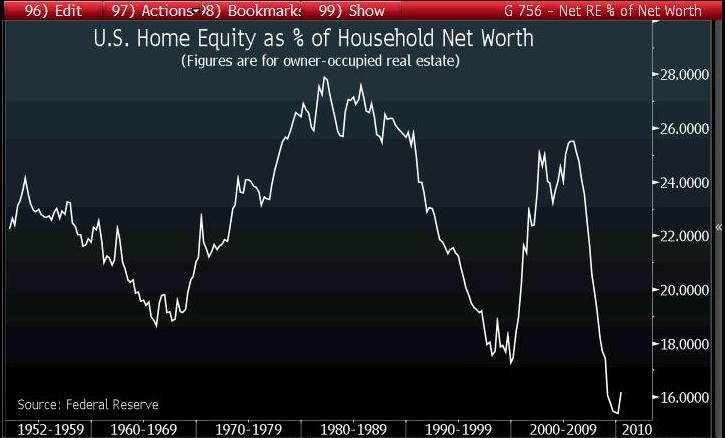
Home Equity as a Percentage of Household Net Worth

Email this post Print this post
By Barry Ritholtz - November 2nd, 2010, 12:00PM

>

I frequently find myself disagreeing with Tobias Levkovich of Citigroup. That’s not surprising, given his firm and their investment posture.

Where I really part ways is on anything housing related. Levkovich was part of the mainstream herd of strategists who, as the markets topped in October 2007, made the erroneous forecast that Housing would not derail the economy or equities. He was also part of the decoupling crowd, and thus was was bullish about 2008 as late as March of that year.

But it call comes back to missing the credit bubble and the Housing boom and bust. Most of the mainstream strategists were guilty of that, and Citi’s top dog was no different.  The big firm’s entire run of housing/market/economic calls were not exactly what you would call money-makers.

Which is why I am compelled the most recent comment of his that I disagree with: “The relative importance of housing to the consumer has been highly exaggerated.”

I find the above quantifiably false. From Bloomberg’s chart of the day:

“Levkovich drew the conclusion by tracking the equity in single-family homes and other owner-occupied real estate as a percentage of U.S. household net worth, using data compiled by the Federal Reserve.

As the CHART OF THE DAY illustrates, home equity accounted for 16.2 percent of net worth at the end of the second quarter, the Fed’s data showed. The first quarter’s figure, 15.4 percent, was the lowest in more than half a century.

Housing no longer has the effect on consumer confidence that it did when home prices were surging in the past decade, Levkovich wrote in an Oct. 29 report that included a similar chart. Equity in owner-occupied real estate peaked in the fourth quarter of 2005 at 25.5 percent of net worth.”

Um, no.

As that chart above shows, Housing as a percentage of Household net worth fell during the giant  Bull market in equities from 1982 to 2000.  The 2001-07 ramp up was artificially goosed by ultra low rates.

Two other factors to keep in mind when discussing the wealth effect:

1) The vast majority of Americans have very little money tied up in equities. The median family’s portfolio is worth well under $50k

2) The biggest investment remains real estate, with a median value of $200k. At 20% down, it still reflects 10 to 1 leverage.

Hence, why nationally, the wealth effects of real estate are far more than stocks . . .

>

See also:
COMPARING WEALTH EFFECTS: THE STOCK MARKET VERSUS THE HOUSING MARKET
Karl E. Case, John M. Quigley and Robert J. Shiller
COWLES FOUNDATION DISCUSSION PAPER NO. 1335
October 2001
http://cowles.econ.yale.edu/P/cd/d13a/d1335.pdf

Robert Shiller answers critics of housing “wealth effect”
Peter Coy
Bloomberg Businessweek July 06
http://www.businessweek.com/the_thread/economicsunbound/archives/2009/07/robert_shiller.html

Contra:
The (mythical?) housing wealth effect
Charles W. Calomiris Stanley D. Longhofer William Miles
VoxEU, 6 July 2009
http://www.voxeu.org/index.php?q=node/3734

Comments

Please use the comments to demonstrate your own ignorance, unfamiliarity with empirical data, ability to repeat discredited memes, and lack of respect for scientific knowledge. Also, be sure to create straw men and argue against things I have neither said nor even implied. Any irrelevancies you can mention will also be appreciated. Lastly, kindly forgo all civility in your discourse . . . you are, after all, anonymous.

15 Responses to “Home Equity as a Percentage of Household Net Worth”

  1. mcmaaaaath Says:

    There was a pretty good rebuttal of the VoxEU article in the WSJ:

    http://blogs.wsj.com/economics/2009/06/25/guest-contribution-housing-bubble-fueled-consumer-spending/

  2. wally Says:

    The total relative percentage might be important if we all shared wealth equally. However, the wealthy who own houses are in a very different situation than the less wealthy who are just a tiny little bit under water. That skews that chart into worthlessness because the chart has no connection to the number of persons affected by drops in equity value.

  3. Julia Chestnut Says:

    That’s true. Remember also that, in addition to the bull market, you also had an increasing shunt from traditional pensions into 401(k)s — involuntary stock ownership, if you will. I’m not sure if the value of (even a vested) pension was included in household worth before this shift, but I know that the value of my retirement accounts now that they are all “privatized” and “decentralized” count in my worth.

    So we may be looking at some other effects at work here. And I agree: the average value of the 401(k) is tiny. And they are talking about rolling back or gutting SS. It’s going to be cat food only on Sunday for my generation by the time we “retire.”

  4. Mannwich Says:

    Exactly my thoughts, wally. And think about what income (and wealth) bracket Tobias and his ilk are in. Of course it doesn’t matter that much……to THEM. Sometimes I think these idiots who drink each other’s bathwater conveniently forget that they are not representative of most of the country. Not even close.

  5. Long term Says:

    I would counter-claim: “The relative importance of housing to the consumer has not been emphasized enough.” The use-your-home-as-an-ATM national culture of the last 10 years drove consumer spending to a huge extent. What new source of asset-tapping could currently replace that much market demand? Maybe the gov’t offers a use-your-future-SS-benefits-at-a-discount-now payouts? I’m sure tons of Americans would go for that. Then we solve the SS crisis at the same time and get at least 3 more years of good feeling…

  6. Tuesday links: model uncertainty Abnormal Returns Says:

    [...] Real asset prices matter.  (Pragmatic Capitalism, Infectious Greed, Big Picture) [...]

  7. NoKidding Says:

    “Housing no longer has the effect on consumer confidence that it did when home prices were surging in the past decade”

    Then obviously consumer confidence and housing prices should be uncorrelated time series. Is that true?

  8. beaufou Says:

    I guess if you have the means, grab all the foreclosure you can right now, wait a few years until consumer confidence and the housing market comes back and sell at inflated prices.
    In the meantime, rely on the FED to keep things barely afloat and screw people who didn’t make it “call them losers”.

  9. AHodge Says:

    Thanks
    probably takes a modeling geek like me to appreciate your documentation
    i catch up on current debate in 5 mins beautiful
    I did not know of shiller etc at the time— but came up w same broad results at Global Insight in 2001 with Genio Steranczak
    we found housing wealth effect much stronger than stocks
    shiller doesnt talk lags– but we found housing wealth effect much less lagged than stocks, maybe folks only spend that after they keep it a while?
    while i respect calomiris… his stuff looks suspect.
    you should include some kind of sentiment or income expectation in consumption function modelling, but it may be cheating to define it as big future income gains (that overwhelm house wealth as they usually move the same). but he clearly looked at lags
    Tobias is a dope
    in this case because its not the equity and share you look at
    but the value of the housing stock.
    to keep this short.
    If there is a 5% house price decline, and equity is 15% of housing stock value, the equity goes down a third.
    if equity has been reduced to only 5% of assets the equity disappears.
    the DOLLAR wealth effect of a 5% decline in prices is the same, a 5%pt decline in equity
    even if the house equity— like now because prices fell— is lower.

    its true a % decline in prices means a little less in dollars now
    but not that much

  10. louis Says:

    These guy’s are all idiots Barry, nothing has changed, they have no concept of what everyone deals with after they try out their latest theory. But on the flip side they only do what we allow them to do.

  11. Petey Wheatstraw Says:

    Is this fellow related to Lawrence Yun?

  12. Lyle Says:

    In the old days a house was not an investment other than possibly providing for care in ones old age. (Typically for the second spouse to need it). As investments go houses are fairly poor needing more money poored at them all the time. Today we should tell people that before thinking about buying a house they should put their money in 401ks/Iras, as they are better protected. But of course the real estate industry would not want this exposed because it would put them out of business (agents, title insurance companies appraisers etc.)
    An alternative tax regime would be to treat houses for tax purposes as if they are leased , you get imputed income on the rent, but then can take depreciation, and maint expenses against the “rent” i.e. you file a second return as if you were a land lord.

  13. shinola Says:

    Um, well… Assuming the figures used to create the chart took into account “negative equity”, it’s not very surprising. Asking prices for homes in my conservative, midwestern, suburban neighborhood have dropped by @20% from their 2005-’06 peak. This has never happened before in the entire 50 yr+ existence of this community.

    This is a loss in net worth even to those with no mortgage. According to most accounts, there are millions of “homeowners” with mortgages who are underwater; thus the home is a net negative.
    Figure negative equity into the averages & voila.

  14. markp Says:

    There’s another explanation. The sample for the data is by definition skewed. Let’s broadly separate people to rich and poor. The primary residence is only a small percentage of the rich folks’ wealth, whereas it’s a multiple (due to leverage) of poor people’s net worth. After a lot of foreclosures, the poor people are excluded from the data, which brings this particular statistic down several points. This is what happened in the recent years.

  15. markp Says:

    continuing my previous comment, it’s exactly the poor people’s housing portion of wealth that matters as far as consumer demand goes. The rich people’s elasticity of demand with regard to their house value is much lower.

71 queries. 0.361 seconds.