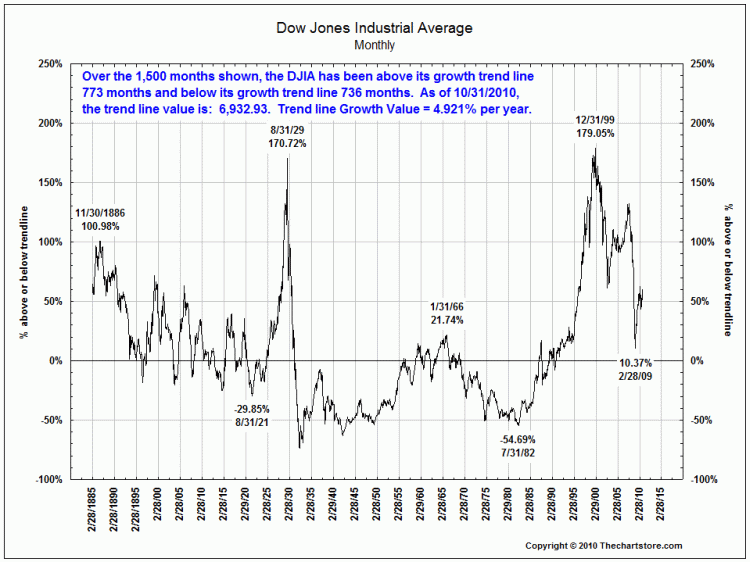
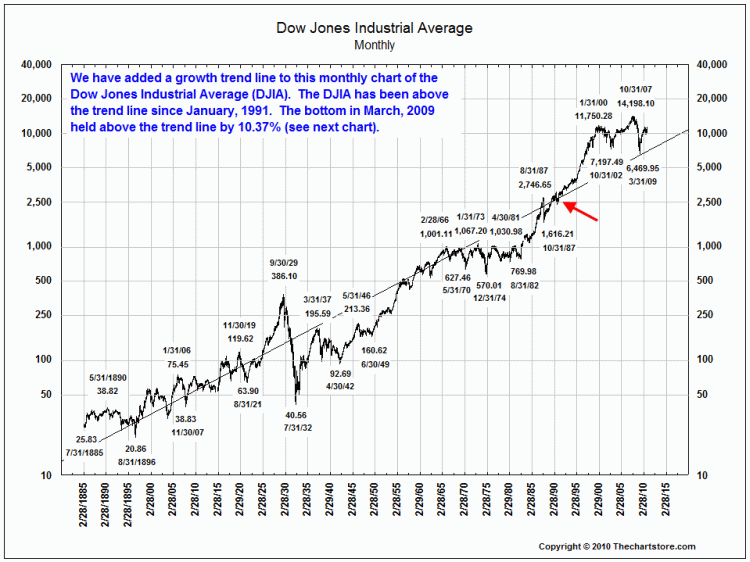
Long Term Growth Trend DJIA

Email this post Print this post
By Barry Ritholtz - November 1st, 2010, 11:30AM

A great pair of really long term charts from Ron Griess of The Charts Store, looking at the long term trend in the Dow:

>

click for larger charts
Comments

Please use the comments to demonstrate your own ignorance, unfamiliarity with empirical data, ability to repeat discredited memes, and lack of respect for scientific knowledge. Also, be sure to create straw men and argue against things I have neither said nor even implied. Any irrelevancies you can mention will also be appreciated. Lastly, kindly forgo all civility in your discourse . . . you are, after all, anonymous.

13 Responses to “Long Term Growth Trend DJIA”

  1. philipat Says:

    Seems to be inconsistent with the 18-year Bull/Bear cycles, which suggests we should be entering a new Bull market in around 2018? Unless, of course, the Mean/Upward slope trend is shifting.

  2. socaljoe Says:

    For long term trend charts to be meaningful, they must be adjusted for inflation… the definition of which has changed over the years.

  3. rdhall3637 Says:

    These charts are interesting, but what to they help with in terms of investment decisions? Would seem as though they are suggesting that buy and hold is still alive and well, which if you listed to CNBC is supposedly dead and gone.

    The only people that can buy and hold are those with zero investment of financial knowledge. The rest of use can’t overcome the desire to take profits or change investments periodically. The media influences everyone, yes even Barry, although he does not watch TV during the day. Nobody is immune.

    I prefer to go “all-in” and always be invested 100% either long or short. Take a look at the latest updates….

    http://stockcharts.com/def/servlet/Favorites.CServlet?obj=ID3274981

  4. Joe Retail Says:

    Yes! I’m delighted that someone has recognized the value of using a log scale for charts like this. Whether you think the chart is meaningful or not is up to you, but this makes for clearer interpretation.

  5. Marc P Says:

    The components of the Dow have changed dramatically over time. How can it be used for long-range statistical comparisons of anything?

    It seems to me the Dow has been specifically engineered to rise over time. If one of the 30 aren’t doing well, they are removed from the index. This type of analysis meaningless unless the same companies are used for the entire period, isn’t it?

  6. florited Says:

    Very interesting charts..they clearly show that there is more room for underperformance below the growth trend..in this respect we notice the 2008 – 2009 descent stoppend on the growth trendline and did not slice through it as in the 1929-1932 plunge. Assuming a “muddle through” economic performance during the next several years, we can expect a return of the index to the growth trendline or even below.

  7. joethewombat Says:

    This would be more informative if the author used two lines: a first line from inception through the Great Depression, and a second line from WWII onwards.

    The New Deal really did change things – in previous charts from the Chart Store, they’ve illustrated how the frequency and severity of recessions dropped dramatically when comparing the pre-Depression to post-Depression eras. This shows up not just when measuring recession times, but also in the Dow (above) and S&P data. Further, if you plot real GDP growth per capita on a log scale using measuringworth.com, you’ll see confirmation that there were significantly different economic growth rates before and after the Depression. (http://tinyurl.com/3yh32ay).

    A straight line starting from the 1940s is really more meaningful at predicting our current situation, and if you do that you won’t come away quite so bearish about the next decade. Of course, if we continue our laissez faire trend, perhaps we will have to draw yet another inflection point around today, and revert back to the poorer economic growth and investment returns of the pre-Depression era

  8. The Curmudgeon Says:

    “Of course, if we continue our laissez faire trend, perhaps we will have to draw yet another inflection point around today, and revert back to the poorer economic growth and investment returns of the pre-Depression era”

    What a quaint idea. Are you really Franklin 411? Exactly what laissez faire trend are you referring to? Obamacare? Tarp? Stimulus packages? QEI and soon, QEII? And you really believe that the New Deal response to the Great Depression made volatility go away (fewer recessions) while at the same time enhancing investment returns? Is that even possible, given the law that greater rewards must carry greater risks? Might victory in WWII and the ascendancy of American power and empire across the globe have had something to do with things after 1945?

    Wow. It’s hard for me to even fathom how someone could look at history with such a distorted perspective because of their political blinders. This era is quite a bit more closely analogous to the New Deal than any period of laissez faire we might ever have endured, even if the New Deal emphatically did not make us rich. Victory in WWII did.

  9. Lyle Says:

    What the chart shows is the importance of a long term perspective. Note from the breaking of the plateau in the early 1980s how fast the market went up for 20 years. One should expect a 20 year pause after this to get a reversion to mean. We had the zoom from 45 to 65, the snooze from about 65 to the mid eighties and the zoom and current snooze. Using the S&P we had 10.2 annualized return from Jan 1 1981 to today. The long term trend (1872 to present) is 8.82, so we have more sideways a head of us. It looks like in a lot of things we borrowed from the future, demand for houses stock prices…

  10. Marc P Says:

    Is it a coincidence that the Dow makes a sharp turn upward in 1982, when three things happened:

    * the Fed began its money-creation strategy, unabated through the crash;

    * the government began regulatory changes that expanded credit (home equity lines, usury laws pre-empted and eliminated by Congress, expansion of credit cards, etc.);

    * the demographics saw baby-boomers decide to have two-income families rather than one.

    All effectively created money or spendable household cash, thus increasing consumption across the board. Will these trends continue? Who knows, but keep in mind that median household income hasn’t changed for a decade, adjusted for inflation (with true inflation factors it’s actually gone down).

    To the extent that the Dow represents large companies expanding abroad, then it seems there would be growth to be had – for the Dow. However, does the growth for that subset of companies reflect the nation as a whole? It appears the rest of U.S. business is trying to sell to stagnant household demand.

  11. yassinemaaroufi Says:

    The trend seems to be continuing as shown in this up to date chart http://www.mibian.net/djia

  12. RW Says:

    Agree that the surge in the DOW is strongly related to liquidity and deregulation but the debacle of the past decade has put a somewhat different spin on that.

    1982 initiated one of the biggest bond bull markets in history as Volcker finished his effective work as Fed chair: inflation was broken and interest rates had a long, long way to fall. That and Reagan’s deficit spending were probably at least as potent economic drivers as Greenspan’s open spigot but the bigger punch bowl sure made for a more livelier party while also fostering the rise in power of financial, insurance and real estate corporations (AKA the FIRE economy). Regulatory capture and the ascendency of capital over labor increases over the next three decades as a result.

    In the latter vein, two-income families probably became obligatory rather than optional as wages failed to keep up with non-discretionary costs: Housing, insurance, transport, education and taxes. Elizabeth Warren’s research (e.g., http://tinyurl.com/24svwqa) shows pretty conclusively that while two-income families may have significantly more nominal income than their single-earner parents, most of that income is now claimed by non-discretionary expenses with bankruptcy literally a single furlough or downsize away. Any family that wanted to stay in the middle-class didn’t have much choice: Both spouses had to work.

    Warren summarizes her findings in this talk at http://tinyurl.com/5f9jhv for the curious (video is about 57 minutes, Warren’s presentation begins about 5 minutes in).

  13. joethewombat Says:

    I wrestled with whether I should respond to the Curmudgeon said, but what the heck. If he reads this, I’m curious what the response would be.

    My comment about laissez faire was in response to structural changes regulation, not to health care or social security or any other liberal ballywhick. We’ve had some cosmetic work done to the financial system with TARP, QE2, etc. But the financial reform bill had precious little real structural change to it. I apologize to Mr. Curmudgeon for not being clear on that in the first place.

    On the substance: It’s pretty clear from the data that economic growth in this country improved substantially after the New Deal. There may be some other cause, and I’m happy to hear suggestions as to what other system changes from that time period fit all the data. However, the difference is real, and it shows up in every economic data set I’ve seen so far. Go find the data for yourself; please prove me wrong if you can, because I have a fondness for reality.

    My original point, obscured by politics, was simply that treating the entire data set as if it is a single curve is incorrect. Some change around the time period of the Great Depression and WWII altered our economy at a fundamental, and this is true no matter what your politics. When you fit the curve with that premise in mind, the line you draw is not so scary. As long as we haven’t undone the changes that got us to the higher slope in the first place.

67 queries. 0.347 seconds.