
Mortgage Origination, Assignment, and Securitization Process
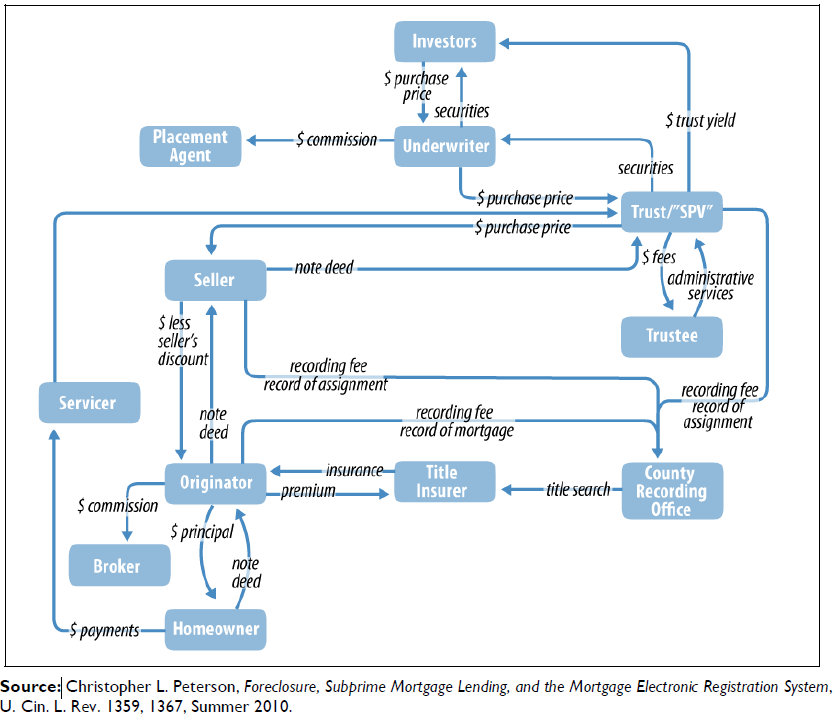
I hate when I do this: I grabbed this killer chart from somewhere — it looks like a Fed research paper — then I promptly misplace the PDF.
Anyway, here is a closer look at the entire loan to RMBS process:
>


Tweet
Facebook
Reddit
Digg this!


November 19th, 2010 at 10:04 am
I think this is the sanitized view and it could not possibly be a diagram of the current mortgage mess. This appears to be a simple limited partnership kind if mortgage backed security arrangement or something else that is as innocuous. It looks pretty clean.
From all the noise in the news, I would assume the step where the SPV records the mortgage is missing and MERS is argued to be a valid substitute.
November 19th, 2010 at 10:10 am
http://www.scribd.com/doc/20954805/Foreclosure-Subprime-Mortgage-Lending-and-MERS – is this the one you ere looking for?
November 19th, 2010 at 10:28 am
Speaking of sanitized views, if this was a plumbing chart, there’d be sewage coming out of the electrical fixtures (HT: The Three Stooges).
Apparently, the brokers and the placement agents are in the catbird seats — taking their cut when the deals get done and skimming the “system” with no future risk or responsibility. For everyone else, it’s a ClusterF.
November 19th, 2010 at 10:32 am
dead hobo:
Agreed. I don’t think this reflects reality (it still looks like a Rube Goldberg invention, to me). Where’s MERS?
November 19th, 2010 at 10:56 am
@Tahoe,
Thanks for the link. Seems to be a decent, if polemical, article. Keep in mind when you read it that $25-$50 would only cover the per-page recording costs of a mortgage, deed or assignment. In my state, and to my knowledge, all the others, there is a conveyance tax: Deeds are taxed at $1.00 per thousand of value, mortgages at $1.50, and mortgage assignments at $1.50 per thousand of the face value of the mortgage being assigned. These are not insubstantial sums, when median prices range in the hundreds of thousands.
Mers openly admits, and always has, that part of its purpose is to provide a means of assigning mortgages among its members that doesn’t require paying the tax associated with assignments in the public records. Does this deprive “local cities and towns of tax revenue”? Of course it does–that’s part of the point. Is it illegal? Absolutely not, and remember, the mortgage itself has already been taxed once.
There is no requirement that interests in land be recorded. If an interest in land is not recorded, it is still enforceable between the parties to it, but not against third parties that claim and record an enforceable interest. For example, if a mortgagee assigned a mortgage within Mers and the assignee did not have the assignment recorded, the original mortgagee of record could conceivably assign the mortgage again and the Mers assignee could not defend his claim via the public records.
It is hard for me to see how the mortgage securitization train could have ever left the station without Mers or something like it. The cost of assigning mortgages after their origination (in my state, an assignment filed with the original mortgage is not taxed, but all subsequent assignments are taxed at the original mortgage value) would have been a hefty impediment. Some way or another, the cost of the subsequent assignments would have ultimately been paid by the borrower–perhaps through a higher interest rate, but the transaction costs would have gone up.
November 19th, 2010 at 11:13 am
The Curmudgeon Says:
“There is no requirement that interests in land be recorded. If an interest in land is not recorded, it is still enforceable between the parties to it, but not against third parties that claim and record an enforceable interest. For example, if a mortgagee assigned a mortgage within Mers and the assignee did not have the assignment recorded, the original mortgagee of record could conceivably assign the mortgage again and the Mers assignee could not defend his claim via the public records.”
Isn’t this where the fraud, one way or the other, comes in?
__________________
“It is hard for me to see how the mortgage securitization train could have ever left the station without Mers or something like it . . . but the transaction costs would have gone up”
Agreed, in a model where the rules/laws are followed, ratings are realistic, and costs and risks honestly accounted for, MBSs would have been impossible. The sole purpose for the creation of the MERS enabled MBS system was to quickly foist known bad loans onto unsuspecting investors.
November 19th, 2010 at 11:46 am
“Isn’t this where the fraud, one way or the other, comes in?”
~Not really. Double assigning mortgages, though it surely has happened, is not much of a problem with Mers or with the public record system. Such things are illegal (you can only sell what you own), and so are quickly resolved when they happen.
“Agreed, in a model where the rules/laws are followed, ratings are realistic, and costs and risks honestly accounted for, MBSs would have been impossible. The sole purpose for the creation of the MERS enabled MBS system was to quickly foist known bad loans onto unsuspecting investors.”
~I don’t agree that rules/laws weren’t generally followed when the securitization model gradually evolved due to technological improvements making it possible. Residential mortgage securitization really got going in the latter half of the nineties, and it mostly represented a benign improvement in the manner with which mortgages were funded. It was only later, after 9/11 prompted an interest rate decline lasting over three years and the .com implosion made the stock market a tainted investment vehicle, that investors chasing yield started piling into MBS. That’s when all the rules were thrown out the window. The model wasn’t evil in its incipient stages. It went rogue when it became a crack whore for cheap money.
November 19th, 2010 at 1:41 pm
http://www.youtube.com/watch?v=VEX57VQYcWs
November 19th, 2010 at 3:24 pm
Yes hobo et al- the diagram has errors.
E.g. the “Seller” and “Trust/SPV” do not pay recording fees, under MERS.
