
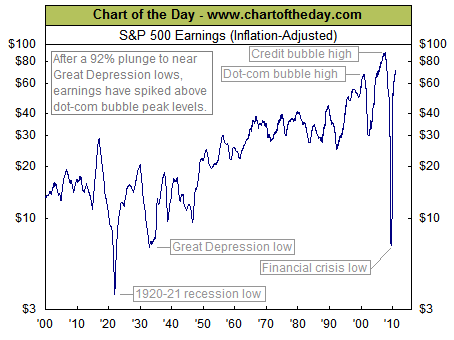
Q3 Earnings in the Books
With 96% of S&P 500 companies having reported for Q3 2010, the COTD provides some long-term perspective as to current earnings.
By focusing on 12-month, S&P 500 earnings 9as reported), the chart illustrates how earnings plummeted 92% from its Q3 2007 peak to Q1 2009 low. This brought inflation-adjusted earnings to near Great Depression lows.
Ahhh, how times have changed: Since its Q1 2009 low, S&P 500 earnings have surged 900%. They are now at peak dot-com bubble levels. The only time earnings have been higher than current levels for a 29-month stretch that occurred at the tail end of the credit bubble.



Tweet
Facebook
Reddit
Digg this!


November 19th, 2010 at 8:26 am
There wasn’t an S&P 500 in 1900. What’s being measured that far back?
From wikipedia: “Standard & Poor’s introduced its first stock index in 1923. Before 1957, its primary daily stock market index was the “S&P 90,” a value weighted index based on 90 stocks. Standard & Poor’s also published a weekly index of 423 companies. The S&P 500 index in its present form began on March 4, 1957.”
November 19th, 2010 at 1:21 pm
[...] The stunning rebound in S&P 500 earnings. (Big Picture) [...]
November 19th, 2010 at 2:47 pm
[...] Via Ritholtz, a chart showing the rebound in S&P 500 [...]
November 20th, 2010 at 12:51 am
foosion,
The chart looks like it came from Robert Shiller’s data. He has replicated a data series that is representative of the what the S&P 500 would have been had it existed further back. You may have heard of the Shiller P/E, Cyclically Adjusted P/E (CAPE) or Normalized P/E. It is this earnings and price data series from Shiller that I believe Barry is using.