4th Amendment Wear (Printed in metallic Ink)

Email this post Print this post
By Barry Ritholtz - December 3rd, 2010, 1:31PM

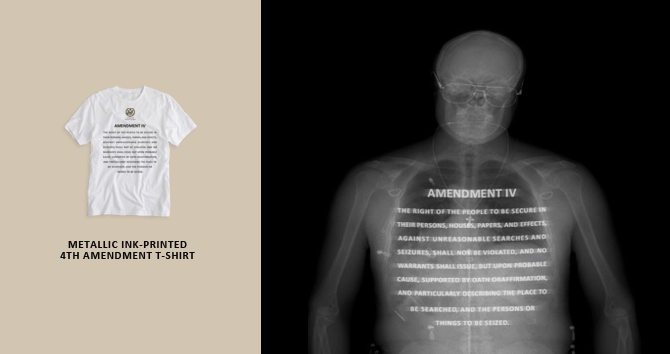
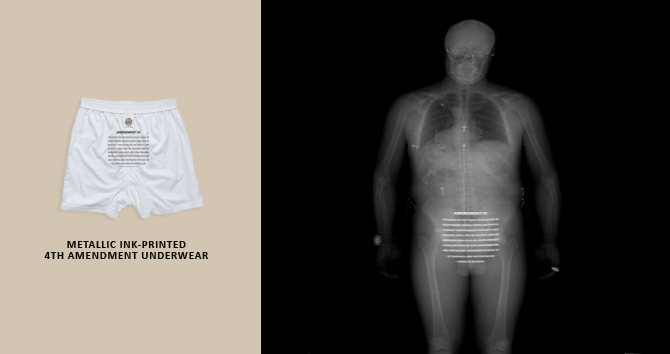
I love the concept of this: the 4th Amendment, printed in metallic ink, on T-shirts, Bras, panties, etc. showing up on TSA backscatter machines, from Cargo Collective:

UPDATE: These are SOLD OUT . . .


click for web page
~~~
Comments

Please use the comments to demonstrate your own ignorance, unfamiliarity with empirical data, ability to repeat discredited memes, and lack of respect for scientific knowledge. Also, be sure to create straw men and argue against things I have neither said nor even implied. Any irrelevancies you can mention will also be appreciated. Lastly, kindly forgo all civility in your discourse . . . you are, after all, anonymous.

One Response to “4th Amendment Wear (Printed in metallic Ink)”

  1. Mark E Hoffer Says:

    Review of the TSA X-Ray Backscatter Body Scanner Safety Report: Hide Your Kids, Hide Your Wife
    November 29th, 2010

    Via: My Helical Tryst:

    I am a biochemist working in the field of biophysics.

    According to the TSA safety documents, AIT uses an 50 keV source that emits a broad spectra (see adjacent graph from here). Essentially, this means that the X-ray source used in the Rapiscan system is the same as those used for mammograms and some dental X-rays, and uses BOTH ‘soft’ and ‘hard’ X-rays. Its very disturbing that the TSA has been misleading on this point. Here is the real catch: the softer the X-ray, the more its absorbed by the body, and the higher the biologically relevant dose! This means, that this radiation is potentially worse than an a higher energy medical chest X-ray.

    With that being said, because the scanners have both a radiation source AND a detector in the front AND back of the person in the scanner, it is actually possible for the hardware to conduct a classic, through-the-body X-ray. The TSA claims that the machines are not currently being used in that way; however, based on the limited engineering schematics released in the safety documents, they could be certainly be easily reconfigured to do so by altering the aluminum-plate (or equivalent) filter or by changing the software. So the hardware has the capability to output quite high doses of radiation, however a biological dose is a function of the time of exposure as well as the proximity to the source and the power of the power of the source. Unfortunately, it is difficult to determine which zones in the scanner are ‘hottest’ because that information is masked in the document. An excerpt of the safety evaluation from Johns Hopkins is shown below to give you sense of how much other information is being withheld. Ultimately my point is this: even though the dose may actually be low, these machines are capable of much higher radiation output through device failure or both unauthorized or authorized reconfiguration of either hardware or software.

    Which brings me to how the scanner works. Essentially, it appears that an X-ray beam is rastered across the body, which highlights the importance of one of the specific concerns raised by the UCSF scientists… what happens if the machine fails, or gets stuck, during a raster. How much radiation would a person’s eye, hand, testicle, stomach, etc be exposed to during such a failure. What is the failure rate of these machines? What is the failure rate in an operational environment? Who services the machine? What is the decay rate of the filter? What is the decay rate of the shielding material? What is the variability in the power of the X-ray source during the manufacturing process? This last question may seem trivial; however, the Johns Hopkins Applied Physics Laboratory noted significant differences in their test models, which were supposed to be precisely up to spec…”
    http://cryptogon.com/?p=18951

47 queries. 0.312 seconds.

