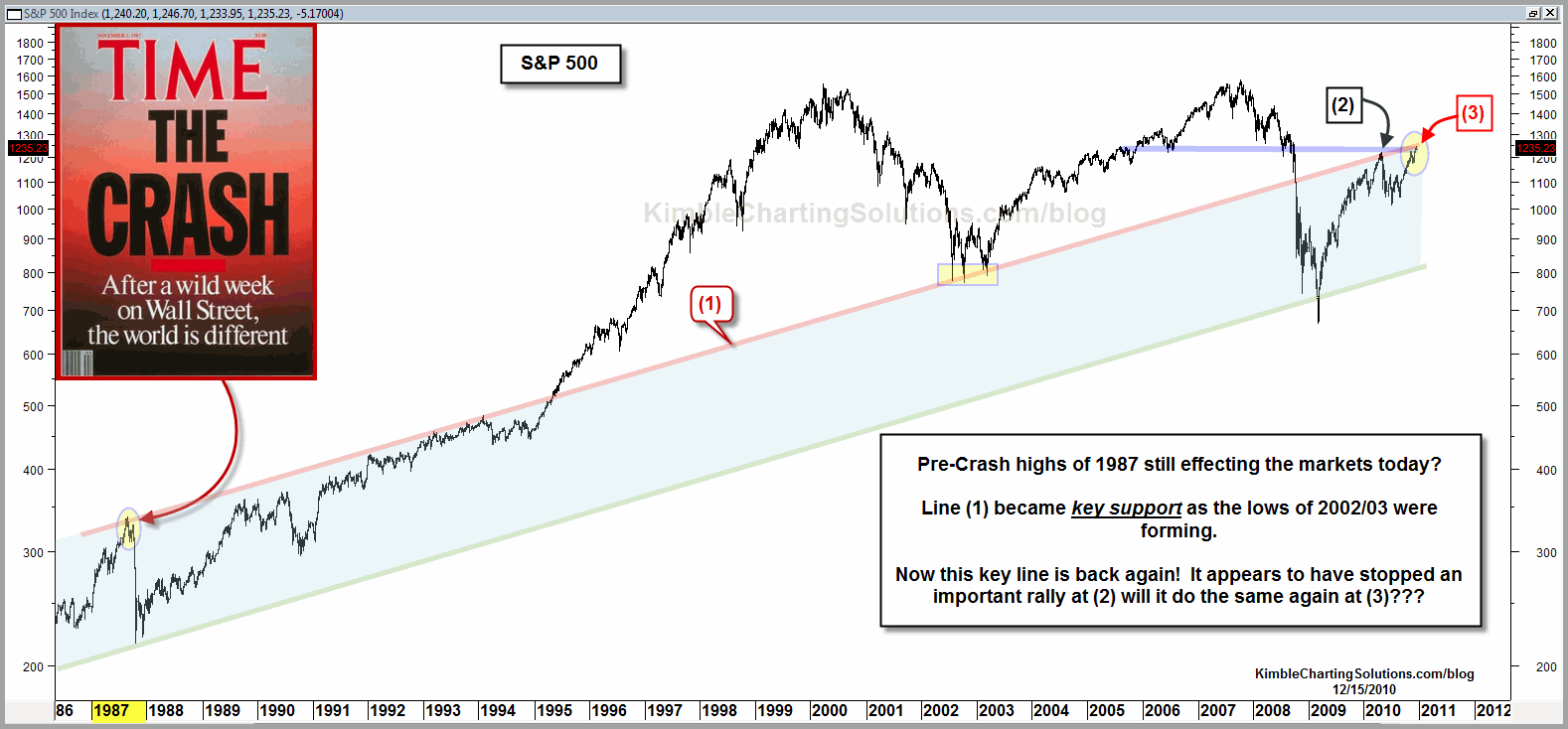
Is the 1987 Pre-Crash Highs Impacting Prices Today?
Chris Kimble writes: “Long-term support resistance dating back to 1987 looks to be at hand right now. This line stopped the rally back in April, this time going to be different?”
I am not sure why this line would be significant. In terms of supply and demand, I strongly doubt anyone is hanging around waiting for prices to return to that trend line to buy or sell.
The only explanatory that possibly works for me is the long term trendline in GDP, earnings and interest rates create an approximate fair value. And even that is a bit of a stretch.
Regardless, here is your chartporn of the day:
>


Tweet
Facebook
Reddit
Digg this!


December 20th, 2010 at 12:11 pm
Maybe a bit of mean line reversion?
December 20th, 2010 at 12:19 pm
This rally lives on the back of the Benanke printing press, when it reverses ratios and charts won’t mean much. Fundamentals are meaningless when a currency is being debased. QE is chinese handcuffs, easier to get into than out…
December 20th, 2010 at 12:44 pm
Chris Kimble writes: “Long-term support resistance dating back to 1987 looks to be at hand right now. This line stopped the rally back in April, this time going to be different?”
reply:
————–
OH MY GOD!!! WE’RE ALL GOING TO DIE!
December 20th, 2010 at 12:53 pm
As the numerologists reads their tea leaves it becomes clear that: “YES it will, if you can get enough market participants to believe that it will”. The tea leaves will create their own reality only if people believe that they predict the future (and therefore create the future predicted by the tea leaves).
December 20th, 2010 at 12:58 pm
It is easy to go back in time and draw lines on stock charts that make sense.
Drawing lines into future — not so easy…
December 20th, 2010 at 1:40 pm
The grammar n@zi in me can’t help cringing at the improper use of “effecting.” ;-)
It is an interesting question about how far back is it reasonable to use trendlines, and if trendlines can reflect generational changes well.
The upper line of the channel on the chart seems to be plausible, but I’d take it as useful guide to long term growth. I’d like to see it on a total return chart for that use, because I think it’s really the total long-term growth that would be consistent across generations (and this assumes that the fundamental productivity of the economy is constant, which is also a questionable assumption).
The bottom line of the channel seems rather randomly drawn. It doesn’t really connect any lows at all. The 2009 lows go right through it. I’m not sure what its value is, other than to look pretty.
December 20th, 2010 at 2:34 pm
Bruman, the bottom line is not randomly drawn; it is a channel line, i.e., parallel to the upper line and placed to touch the 1987 low.. technically, that lower channel line may act as support in the future.. but it didn’t prevent 666 from happening.. bets are it will be broken again.
December 20th, 2010 at 3:25 pm
What would Martin Armstrong say?
December 20th, 2010 at 4:28 pm
My understanding is that trend lines should be drawn connecting the lows and draw their authority from how often they serve as a level of support. The more lows they support, the more confirming they are. Channels are then formed by drawing a similar line across the highs.
But this chart identifies a line primarily by the highs of the 1980s, and then forms a channel by drawing a parallel at the 1987 low. Not only is this the reverse process, but it doesn’t actually serve as a support form anything. The early 2009 lows are sorta close, but not really, and the line gets touched only twice (1987 & 2009) throughout the whole period. So I don’t think this line is really all that reliable, but maybe our eyes and brains just want to see one there.
The top line may serve some use, but again, I think it’d be more relevant on a total return chart.
December 20th, 2010 at 4:30 pm
BTW, I’m not trying to tear anyone to shreds here; just thinking out loud. :-)
December 20th, 2010 at 4:47 pm
The scale is logarithmic so the so-called trend line is not linear but exponentially rising. Its nominal not real. …and so on. In summary: its nonsense.
December 21st, 2010 at 9:06 am
The thing I find the most annoying about (most) people in finance is that they tend to be very full of themselves and therefore lack the ability to make informed unbiased decisions. You critics would do well to go back and look at this guys track record.
I’ve followed him for a long time and use many of his trades and he is good, if not phenomenal, at showing turning points in markets AS they are happening. He was one of the only people I know that was actively buying the on Sept 1 of this year. Finding someone who doesn’t try and “prove” their theories about the direction of the markets is extremely difficult; I’ve rarely seen anyone else that is so untied to his philosophy of what makes the world go around.
So quit being so ridiculously opinionated and listen to someone that has been doing this since most of you were in diapers. Don’t believe me? Go back and read this guys blog and look how his trades turned out.
December 21st, 2010 at 2:55 pm
the chart highlights potential resistance… it could break through now… it could fail and fall apart… it could fail and just drift sideways to higher in the channel… Chart is interesting nonetheless..
I think the main point is that these lines can be relevant long after they are drawn, whether that is something inherent or if it is because of participants awareness of them is a different question…
December 21st, 2010 at 3:23 pm
For what it’s worth, if you turn of the log base chart and go with a linear, the trend line doesn’t set up the same.