
Flow of Funds Report Chart Porn

Email this post Print this post
By Invictus - December 10th, 2010, 9:15AM

The Fed released its quarterly Flow of Funds (Z.1) report Thursday.  Although the data is always somewhat stale (Q3 was released today), I find the Flow of Funds an interesting and informative read (how sad is that?  Note to self:  Get a life.).   That said, here are some nuggets I think are of interest (all data from Table B.100):

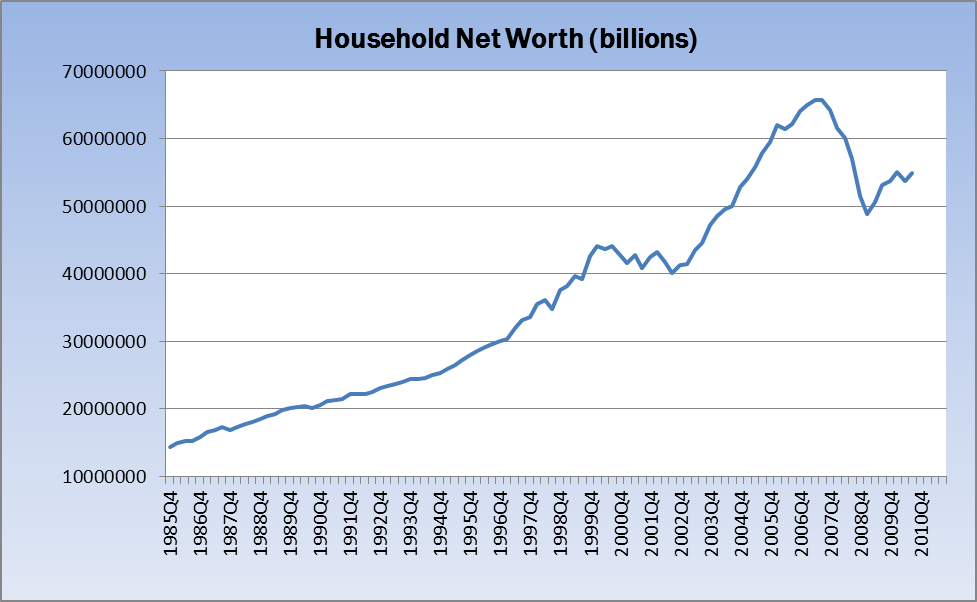
Household net worth rose to $54.9T, up $1.2T for the quarter but still down $10.8T from the $65.7T peak hit in the second quarter of 2007.  Corporate Equities rose by over $900B, and Mutual Funds by almost $400B, while Real Estate declined by about $650B.  All in, though, higher is better than lower (as always, click for larger charts):

>
>

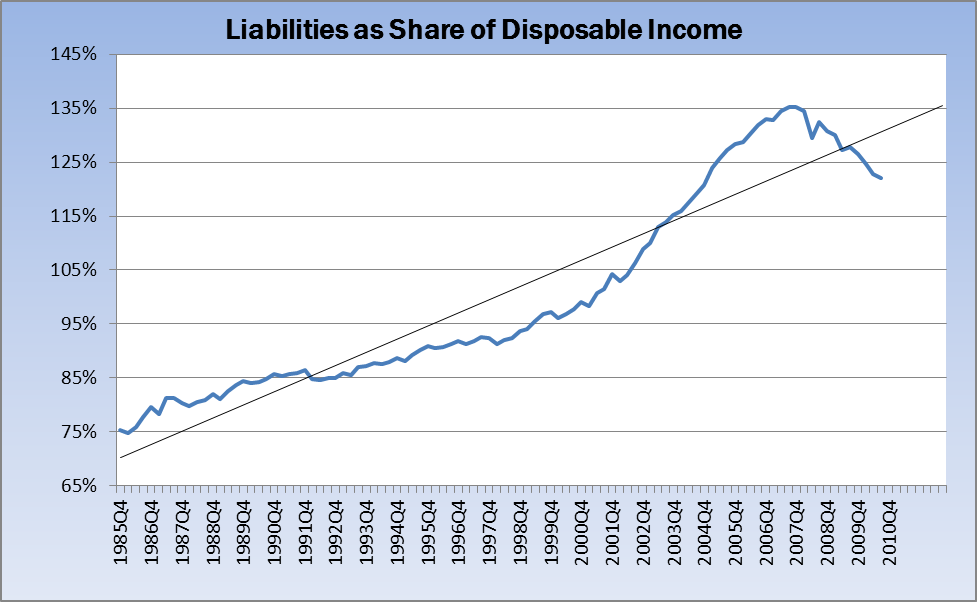
Liabilities as a share of disposable income continue to decline — now at 122%, down from 135%.  I suspect this will remain below the trend line for quite some time, and it speaks to the ongoing deleveraging.

>
>

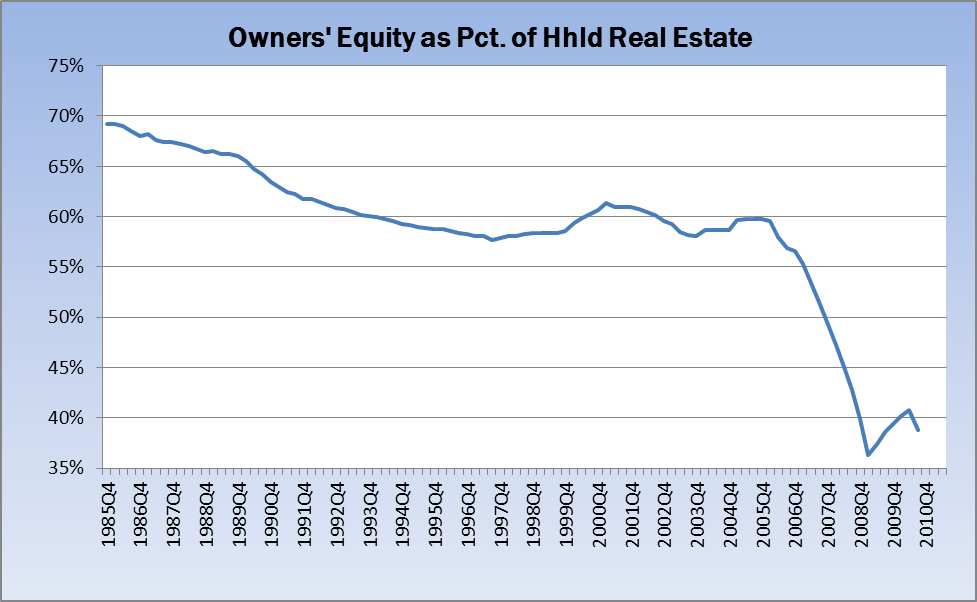
Owners’ equity as a percent of household real estate hooked down.  It took decades (trust me on this one) for this metric to go from about 80% to around 60%, where it hovered for quite some time (1992 – 2005).  All that changed in a few short, bubbly years, and we got down to what was hopefully a low at about 36%.  As Josh Rosner so perfectly put it (in 2001 no less):  A Home Without Equity is Just a Rental with Debt.

>
>

Last, but not least, a look at the changes over time in some — stress “some” — of the financial assets on the household balance sheet:  Deposits (Line 9), Credit Market Instruments (Line 14), Corporate Equities (Line 24), and Mutual Funds (Line 25).  I do not know the composition of the mutual funds (i.e. stocks, bonds, commodities, whatever).  I called Helicpoter Ben’s office today but no one got back to me, so take that category with a grain of salt.  This is essentially a time-series-view of the stocks/bonds/cash pie chart (with the unknown being the composition of the Mutual Funds category).

>

I’ll be crunching the numbers in this report a bit more, but don’t expect to find anything dramatic, as happened quarter after quarter during the recession.  Will revisit this report when it next prints on March 10, 2011.

Comments

Please use the comments to demonstrate your own ignorance, unfamiliarity with empirical data, ability to repeat discredited memes, and lack of respect for scientific knowledge. Also, be sure to create straw men and argue against things I have neither said nor even implied. Any irrelevancies you can mention will also be appreciated. Lastly, kindly forgo all civility in your discourse . . . you are, after all, anonymous.

14 Responses to “Flow of Funds Report Chart Porn”

  1. seekingdelta Says:

    Thanks for the analysis however, I find your comment that liabilities and % of disposable income “will remain below the trend line for quite some time” a bit misleading. Liabilities cannot continue to increase at this trend; it is impossible. At some point liabilities are too high relative to income servicing them. The trend will change and I would not be so quick to assume below trend for quite some time but then a reversion to this trend – as your statement seems to imply. The trend will alter its trajectory; it has too.

  2. rip Says:

    Nice info. I’m tired. Closing on a house at 1 pm. Smaller, but each bedroom has it’s own private bath. Still about twice as much house as I need.

    Relatives are already calling to visit.

    Someone used to post about debt as a % of GDP. Still true.

    Day traders can do what they’re gonna do.

    And you BR are a day trader. So bank your billions. Live in the Hamptons.

    And have some respect for me as someone that simply is trying to help the human race get it more right.

  3. Hondo Says:

    If you adjust the trend line to 1985Q4 to 1999Q4 (which I feel is more accurate than including the bubble into the trend) we would have a good deal further to go.

  4. Invictus Says:

    @seekingdelta

    At some point liabilities are too high relative to income servicing them.

    Not necessarily. The trend could be continued if income rises commensurate with liabilities and provides the means to service that increase. Unfortunately, since we know that income has (generally) been stagnant, your statement is correct. However, we must always keep in mind that movements in both the numerator and denominator matter — not just one or the other.

  5. DeDude Says:

    I don’t think you can put a trend line on liabilities as a % of disposable income and presume that it has a natural growth. In the long run I would expect a mean reversion on that parameter. The reason it got up to 135% was insanity on the part of both borrowers and lenders. If that same level of insanity came back we might get back to or even a little over 135% but 200, 300, 500% sometime in the distant future is not going to happen. The imploding happened at 135% last time and there is no reason to think that the next consumer credit bubble would make it substantially past 135% before it naturally had to implode.

  6. seekingdelta Says:

    Huh? It is a ratio: liabilities / income. If income rises, as you suggest, then the ratio would decrease. That was my point; the trend of an ever increasing liability to income ratio cannot continue at its upward pace forever as you seem to imply by suggesting mean reversion.

  7. tagyoureit Says:

    Why are non-profit orgs included with households?

  8. WyMi Says:

    Unless the liabilities are distributed similarly to the distribution of income and wealth I find this type of aggregate analysis LESS than informative. Averages and aggregates are used in directing policy decisions resulting in policies that are inappropriate for everyone and the correct policies for no one.

  9. WaltFrench Says:

    That owners equity % chart is indeed a shocker.

    Another that I saw recently was Total non-financial indebtedness (excluding loans between financials but of course including loans from financials to hholds, etc). Absolute stairstep since 1950′s, roughly, IIRC 120% stable since the 50′s until Morning in America got us (as a whole country, not just the govt deficit) up to 160%, and then again stable until the 03 tax cuts, where we just went ballistic, a trend that has some recent wiggles but no signs of reversal.

    So as a society, we remain extremely sensitive to high levels of fixed obligations, meaning that otherwise modest variation in valuations can make us feel much richer, or blow us out to the extent that we get margin calls and sell in a conflagration sale.

  10. azerosumgame Says:

    Invictus: I have been intrigued by why cash/debt and equity/capital looks so poor on a historical basis for nonfarm nonfinancial corps (B.102) but cash/assets has been more stable. Looking more carefully at assets I see that tangible assets have collapsed, thanks to a sharp reversal in the real estate category, but this has been offset somewhat by a rise in financial assets which have become an increasingly large portion of total assets over the past decade or so, driven primarily by the mysterious “miscellaneous assets” item. A very long way of asking, do you have any idea what is in this miscellaneous asset category? Perhaps it’s just a residual but it’s a rather big one. So far I can’t find any more detail online so I thought I would ask someone who has though a lot about Flow of Funds data. Thanks.

  11. FT Alphaville » Further further reading Says:

    [...] Chart porn from the flow of funds [...]

  12. Ted Kavadas Says:

    Excellent charts; thanks for posting…

    RE: “A Home Without Equity is Just a Rental with Debt”

    IMHO, “Strategic Defaults” are a key “wildcard” with regard to the future direction of the housing market…

  13. Invictus Says:

    @azerosumgame

    I sometimes run across items about which I’m unsure — just as I’m unsure what, exactly, is in the catch-all “Mutual Funds” category. When that happens, I typically just call the source — in this case the Fed — and try to get someone on the phone who’s knowledgeable about the issue. I have had remarkable success — with the Fed, the St. Louis Fed, the Chicago Fed, BLS, BEA, to name but a few. It takes a bit of perseverance sometimes, but I have found some very smart and helpful folks.

  14. Long term Says:

    charts tell me we are a mini japan at the consumer level. and they also tell me that consumers are doing the right thing; falling back a little despite crazy fed pressure to spend more. and also that the worst is over and in about 3 mos the public will realize that and, at that point, expect some bulls to run.

    Great series. Thanks BR.

64 queries. 0.380 seconds.