Long Term Stock Market Growth (1871-2010)
I was kicking around some of the outstanding charts at Visualizing Economics, when these two below leapt out at me.
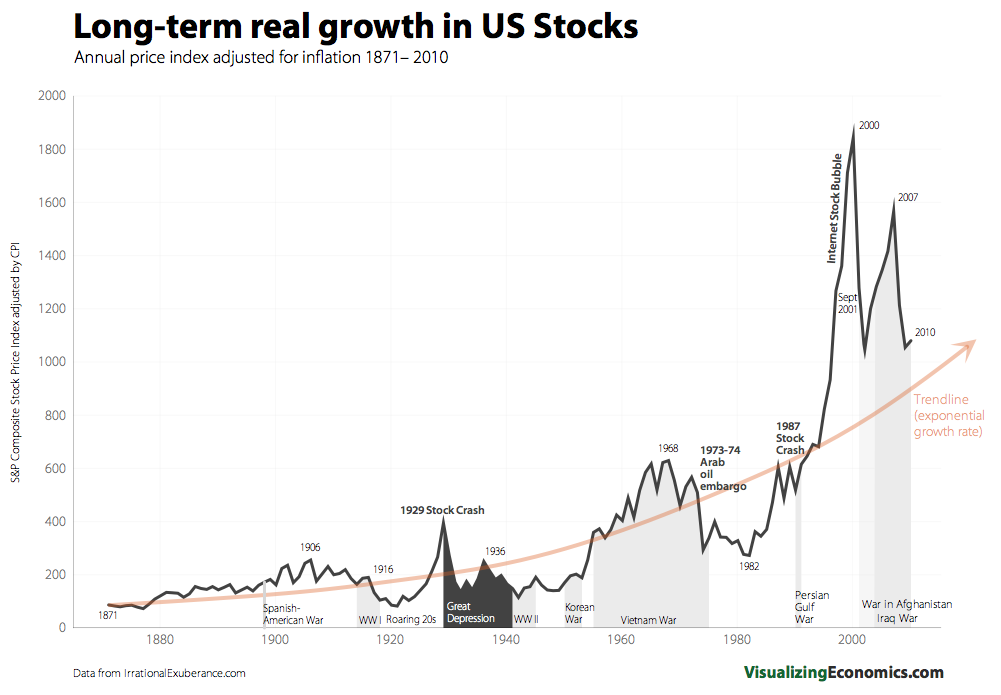
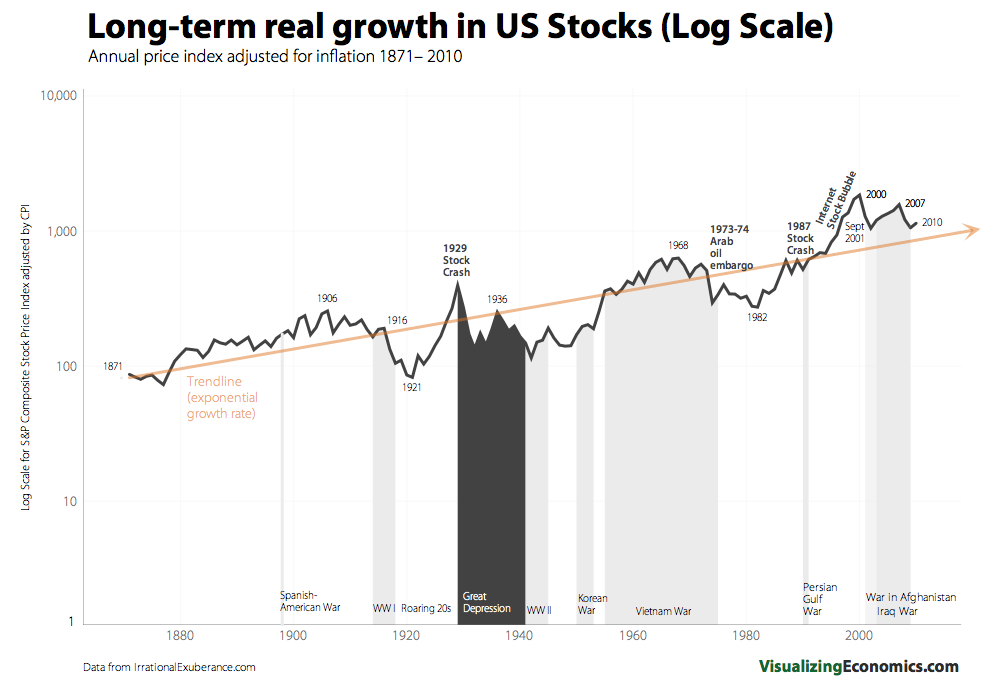
The first chart shows the long term growth of the US stock market, using a smoothed exponential trendline, while the second adjusts the overall chart using a log scale.
As I look at these two charts, a few things stand out to me:
• Mean Reversion cannot be denied;
• Growth Rates over very long periods of time are remarkably consistent;
• This consistency is likely controlled by a combination of numerous inputs, e.g., specific factors such as GDP, Population growth, Earnings, Interest rates, etc.;
• Stocks can remain above or below “Fair Value” for extended periods of time;• Reversion to the trend rarely occurs through sideways market action;
• Markets careen through their historical trend lines to levels far below and far above what seems “normal.”
Note that these are not the sort of charts that lead to an immediate trading decision; rather, they should color your long term expectations as what might occur in the intermediate future.
>
Charts via Visualizing Economics (here and here)
Data from Irrational Exuberance



Tweet
Facebook
Reddit
Digg this!


January 4th, 2011 at 11:44 am
Great charts. Hard to imagine that it’s going to be
straight up from here.
January 4th, 2011 at 11:50 am
Those two giant peaks put into perspective are incredible visually. How can our fearless leaders deny those two giant bubbles that were in progress when put into terms like this?
Makes me think they knew and didn’t care or that this was intended.
January 4th, 2011 at 12:19 pm
It would appear that we are at a transition point where the market will have a number of years below trend.
January 4th, 2011 at 12:26 pm
It is using this 5%+ mean compounded that you get the S&P traing near 100,000 by the end of the century. For dramatic effect the Dow approaches 1,000,000 !
January 4th, 2011 at 12:52 pm
Definitely some food for thought there. I really like the log version. That looks suspiciously like a text book population growth curve to me. And I would really love to see that plot overlaid with one for the US money supply.
I’ve often wondered about the effect 401k demand might have on valuation levels. I think legislation in 1984 opened 401k’s to a large chunk of the population, and 1998 expanded it to the masses. If so, that might explain the steep upticks following those years. I’ve never found data for number of 401k participants on a yearly level. Anybody know where something like that might exist?
January 4th, 2011 at 12:56 pm
- Still above trend is bad news.
- But, considering population growth from 1900 to 2010, you’d think the market would be higher.
January 4th, 2011 at 12:59 pm
@JohnnyVee: It would appear that we are at a transition point where the market will have a number of years below trend.
Either that or we will hang above the trend line for a while, then have a worse period below it in the farther future. Regardless of the more immediate timings, based upon that one chart, there does look to be a need to build some area below the trendline to balance out the recent area above the trendline.
January 4th, 2011 at 1:09 pm
Declining Oil has arrived and that trend line is about to reverse direction.
Long term.
January 4th, 2011 at 1:14 pm
these are outstanding charts. and hats-off to the recent long term thinking that BR has provoked here recently. a few observations:
* 1982 was a really advantageous starting point for investors. the economy was in the trash the computer age was about to take off
* amazing that even after the Great Recession, we are above mean. that is a sorry realization.
* the stable period between 1871 and 1916 looks great. i think markets were very tied to the real economy then. now, the financial sector is way to big to allow such slow and steady returns to unfold.
* i bet they didn’t have QE before 1900
January 4th, 2011 at 1:15 pm
Thus chart is every bit as illustrative as the NYtimes 2-dimensional gain-loss graphic from two days ago.
January 4th, 2011 at 1:24 pm
These charts illustrate the fact that randomness (short-term) is indeed a part of order (long-term). As Lau Tzu said 2500 years ago, “Turning back is how the way moves.”
January 4th, 2011 at 1:25 pm
Wow! That chart screams that the boomer exodus is going to be our mean reversion……and it’s going to be a MEAN mean reversion if history is any guide!
January 4th, 2011 at 2:07 pm
I love Robert Shiller’s work, I wonder if anyone knows what
he did for survivorship bias. As I understand it, the records of
stocks from a hundred years ago are pretty spotty, therefore much
of the market that went extinct may not be seen here. That would
overstate returns for pre-depression era.
January 4th, 2011 at 2:10 pm
Here’s my problem with these types of graphs. Many people
will extrapolate the last 100 years of returns and predict a
similar linear growth pattern over the next 100 years. Yet
considering over the timespan, we have seen the largest span of
growth and technological change in history, as the US rose to be
the world’s most spectacular success story. Does anyone truly
believe we have much longer to grow, let alone at this
unprecedented historical rate? Especially in light of a more
competitve global market, overhanging debt, unfavorable
demographics, and limits on technological improvement. This is what
troubles me about people claiming general stocks are a good long
term investment. Maybe certain companies but not broad
indexes.
January 4th, 2011 at 2:16 pm
Too bad real GDP isn’t keeping up with the trend!
January 4th, 2011 at 2:29 pm
@Long term: * the stable period between 1871 and 1916 looks
great. i think markets were very tied to the real economy then.
now, the financial sector is way to big to allow such slow and
steady returns to unfold. * i bet they didn’t have QE before 1900
Both events before the 1913 creation of the FED, stability after
the Civil War indeed was due to the real economy, some confuse the
inflation and minor boom/bust due to no central bank, however
because of the GDP growth those were good times. No FED = No QE.
After the FED is when the monetary manipulation, building of the
Military Industrial Complex and series of money elite (bankster)
bailouts have been repetitive, transferring trillions of wealth
from the taxpayers, lower, middle and upper middle class to the
money elite. It would be interesting to see the public (gov’t) debt
and private debt graphed in relation to stock growth
January 4th, 2011 at 2:34 pm
” Growth Rates over very long periods of time are remarkably consistent”
True, but Reinhart/Rogoff’s study shows that this very rate slows dramatically when the public debt exceeds a certain level. And if the market returns are tied to the growth rate, than in a few short years we’ll have to live with much smaller market returns.
January 4th, 2011 at 2:52 pm
It is worthwhile to compare this chart to one unadjusted
for inflation. Such a comparison makes it clear that the
significant periods of underperformance (1920s,1940s,1970s) reflect
the combination of inflation and a sideways stock market (contra to
Barry’s point regarding mean reversion not occurring due to
sideways market action).
January 4th, 2011 at 3:14 pm
Looks mean reverting, and mean averting……….
January 4th, 2011 at 3:41 pm
How would these charts be impacted by including dividends? I know that the total return would be astronomically higher, but I can’t begin to guess what the shape of this chart would look like.
January 4th, 2011 at 3:46 pm
I would argue that reversion to the mean is an illusion caused by the act of calculating the mean after you have the data. Thus the data is always clustered around the post-calculated mean. I’m a convert to the fractal nature of markets where all you know is that there are repeating patterns but you never know where you are on the edge curve. Are you experiencing an up trend that will last for ten minutes or ten years? No way to tell. You do know that the bigger the volume the bigger the possible fluctuations.
January 4th, 2011 at 4:01 pm
@jaymaster: Exactly!
I’ve long wondered the same question… how much of a ‘contribution’ 401(k) and 457(b) monies were to market averages. I have seen guess-timates that, “10 percent of the population own 95 percent of equities” but how does that relate to these funds?
I would suspect that most 401(k)/457(b) participants utilize dollar-cost-averaging, possibly providing a tertiary “floor” under the market. Or are these contributions an insignificant fraction of overall market monies?
It would be interesting to know the median and/or collective size of these contributions; the consistency and/or changes in contributions; and the median age of the individual and/or collective contributors. Also, any evidence of net ‘early withdrawals’ due to unemployment, housing, or other financial hardships? Or have net contributions actually increased due to concerns over future financial insecurity?
I think this opens up an even bigger question: Are we on the cusp of a generational factor coming into play? What factor might the retirement of Boomers contribute to the U.S. markets over the next decade? How do the ‘Millenials’ and ‘GenX-ers’ fit into this puzzle versus Boomers?
Also, is the aging of the Japanese population and the performance on the Nikkei in any way relevant for comparison? Probably not in ownership of equities, but what about changes in consumption/savings as they move(d) into retirement?
January 4th, 2011 at 4:01 pm
BR stated:
As I look at these two charts, a few things stand out to me:
• Mean Reversion cannot be denied;
• Growth Rates over very long periods of time are remarkably consistent;
reply:
————-
So is buy and hold forever dead, as you have stated in the past, or a good long term strategy for a young person entering the job market after college? The chart says you should buy into it since the slope is upwards.
Also, why are 2007 – 2009 above trend? According to reversion to mean theory, S%P 700 is in our future for a long period, we just don’t know when.
Personally, I look at 100 year charts such as this as idiot tests … and most comments above me ‘passed’ the test. In this case, ‘pass’ isn’t anything to brag about.
January 4th, 2011 at 4:12 pm
“Growth Rates over very long periods of time are remarkably consistent”
Also, there are periods that can occupy large chunks of a human being’s investing life, wherein growth is nonexistent (1906-1926, 1929-1960, 1968-1990, 2000-20??).
Buying at a localized top is a bummer. Buying and holding at a localized top is a catastrophe.
Luckily, we are some distance from anything that could be regarded as a “localized top”, I hope. Although one would expect this reversion to the mean process to dip below the long-term trend line by an amount approximately equal to the recent overages. Perhaps hope is unwarranted.
January 4th, 2011 at 4:30 pm
Please take look at the composite chart of the three major secular bear markets of the 20th century from Pring Turner Capital…page 3 of this pdf.
http://www.pringturner.com/newsletters/AreYouPreparedPTCG.pdf
January 4th, 2011 at 4:54 pm
@muwabi,
Many of those companies that make up the indexes have gone international so they are not really nation focused any more. Also, many of them trade in products and commodities that are traded on international markets that are not singular nation focused. Plus the fact that many of their workers don’t even work in the USA any more and how many of those indexes can you really call US dependent at all?
January 4th, 2011 at 5:03 pm
“Mean Reversion cannot be denied”
Well, yes, it can. The reason is that you have averaged the whole time period to calculate the mean line… that makes this is a circular argument.
Take for instance, the mean of the time from 1880 to 1950… that trend line will not match the overall trend line. That is, we have never reverted to that ‘old’ mean because the ‘new mean’ line is different.
Similarly, you can subdivide the chart into other time periods and show the same thing. It only APPEARS that we are reverting because the line was drawn after the whole data series was known. This is a fundamental logical flaw in almost all charting. Collect the data, draw the mean line and then say we are reverting to it. Well, duh.
January 4th, 2011 at 5:13 pm
One Percent of the World population owns 40% of the wealth.
Which would indicate that it’s not total population that will drive a market higher. I’d say the bottom 80% have no stake in the market. But, they do in the public market of goods and services.
So, why isn’t the market more closely correlated to population?
Does this chart make any modification for Companies that drive themselves bankrupt, like Enron or Worldcom? Is the market being held down by fraud?
January 4th, 2011 at 5:15 pm
Looking at the past periods of “reversion”, where the short-term trend was decidedly downward, and thinking about what is different these days and what periods we are similar to in one way or another, the demise of the employer-provided pension is going to make the boomers’ retirement pretty bleak — especially as Social Security is likely to be a constantly moving set of goal posts for much of their retirement, providing plenty of uncertainty even while they are collecting … probably similar in some respects (for that demographic cohort) to the periods of 1906-1021 and 1929-1950.
Granted, the retirees of those eras did not HAVE anything like Social Security, but neither did they have a health care system anything remotely like ours (and I say that not in a kindly way), and the social norms leaned toward the children providing some degree of care for their elders, unlike the social norms of today.
Just noting the differences, and how today’s society will likely fare in the coming Reversion Hard Times.
We are definitely headed back to the 1800s in our individual-to-corporation relationships.
January 4th, 2011 at 5:15 pm
@wally, you beat me to it. It’s easy to demonstrate, too. Take any 100 year period and any 20 year period and compare slopesof their means and you’ll see they are unrelated and certainly not predictive demonstrating the absolute inability of the trendline to predict “a reversion.” Not only that given variations in the sample until after WWII, the sample size isn’t even large enough to give confidence, even if could call the “samples” equivalent.
January 4th, 2011 at 5:19 pm
I wonder … if one were to make similar charts of other countries long-term stock performance, could one find a country with a reversion/expansion cycle that is pretty much aligned 180 degrees opposite from ours? It would help is that nation had a transparent system of markets, and was not averse to foreign investors.
China might possibly fulfill the 180 degrees out of phase relative to us part, but they are neither transparent nor friendly toward foreign investors.
How about Japan? They were certainly declining while we were rising, from 1990 onward …
January 4th, 2011 at 5:24 pm
@wally, Easyenough — you guys are spoiling a perfectly good fairy tale with your clear logic. Next you’ll be telling me that UFOs are, well, simply “unidentified”. How am I supposed to impose the illusion of order on a chaotic Reality with you pointing out stuff like that?
January 4th, 2011 at 5:27 pm
dshort has similar charts.
► Regression to Trend: Two Views of Market Performance
► http://dshort.com/articles/regression-to-trend.html
Good stuff.
January 4th, 2011 at 5:53 pm
constantnormal — as Barry has emphasized in several posts, everything is highly correlated these days. Correlation among global equity markets has been getting tighter and tighter over recent decades. The sole exceptions are local blow-ups like Zimbabwe, which aren’t really investible anyway.
The closest liquid market you’ll find which is between 90 and 180 degrees out of phase with equities is gold.
January 4th, 2011 at 7:05 pm
Jack,
You’re chart using the Alternate CPI seems to more accurately reflect market sentiment, being grounded in economic realities. The first chart would indicate market euphoria, being above trend.
The second chart, showing we are still under trend, seems to indicate the current mood: Cautious Optimism as we approach trend.
Interesting.
January 4th, 2011 at 8:50 pm
It seems good in theory that there is some type of “predictive” nature embedded in these graphics. If one were to simply change the starting point of the regression analysis the chart could elicit an completely different emotional response. It seems almost absurd that the starting point of 1871 becomes the tail wagging the dog and that stock prices 140 years ago have any bearing on the future behavior of prices.
January 4th, 2011 at 9:19 pm
‘wally’ has a very good point. This whole exercise is about using the data to make decisions about the future, having some confidence in the long term history. For me, the data leave some questions to be answered about survivorship, so I don’t believe the data points as they are drawn. wally points out that in 20 more years that trendline will be in a different place. And for ‘billdozer’ I think I remember reading in Shiller’s first edition of “Irrational Exuberance” the dividends are included in his data, so that part is good.
January 5th, 2011 at 8:42 am
The thing that struck me was the overvaluation that must have existed in 1906. Think about all the technological advances and economic growth to come!!
Then two world wars and a depression and share prices are still lower 50 years later. Wow
OK I know inadequate data reconstruction for the early period and dividend reinvestment would ameliorate this but even so that looks pretty stark
January 5th, 2011 at 12:30 pm
Someone above wrote: ” * the stable period between 1871 and 1916 looks
great. i think markets were very tied to the real economy then.
now, the financial sector is way to big to allow such slow and
steady returns to unfold. * ”
This is yet another example of fanciful thinking about “the good old days.” There was nothing “stable” about the 1871 through 1916. The “stable period” noted by the above commenter is an optical illusion created by the chart. In point of fact, we had three major financial panics during that timespan: 1873 (market collapse followed by five year depression), 1893 (market panic followed by horrific four year depression), and 1907 (followed by a roughly one-year contraction).
January 5th, 2011 at 3:16 pm
Thank you wally, thank you Easyenough.
January 5th, 2011 at 3:28 pm
Great charts. Implies that SP low of 666 in March, 2009 was not low enough. To reach a true bear market capitulation phase bottom PE of 10 using Schiller’s 10 year CAPE would imply about 550 for the SP which would be close to trend line. I can only be bearish using these charts.