
Ongoing Deceleration Case-Shiller Home Price Indices

Email this post Print this post
By Barry Ritholtz - January 25th, 2011, 10:00AM

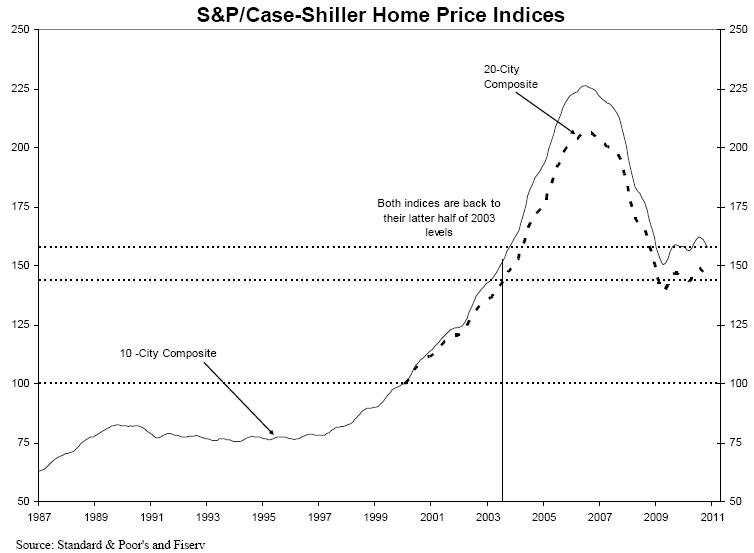
Data through November 2010 shows negative annual growth rates in 17 of the 20 MSAs and the 10- and 20-City Composites compared to what was reported for October 2010.

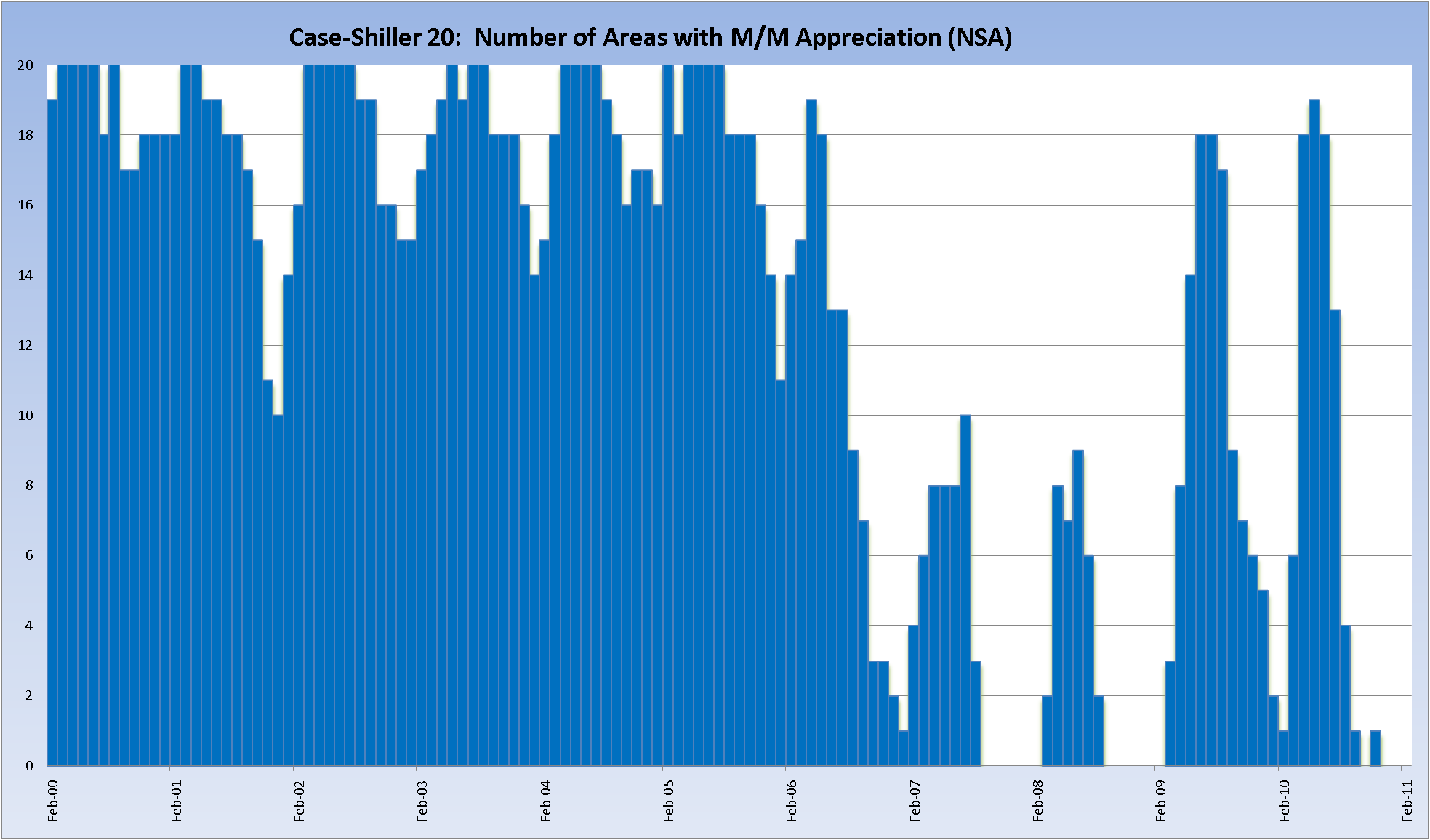
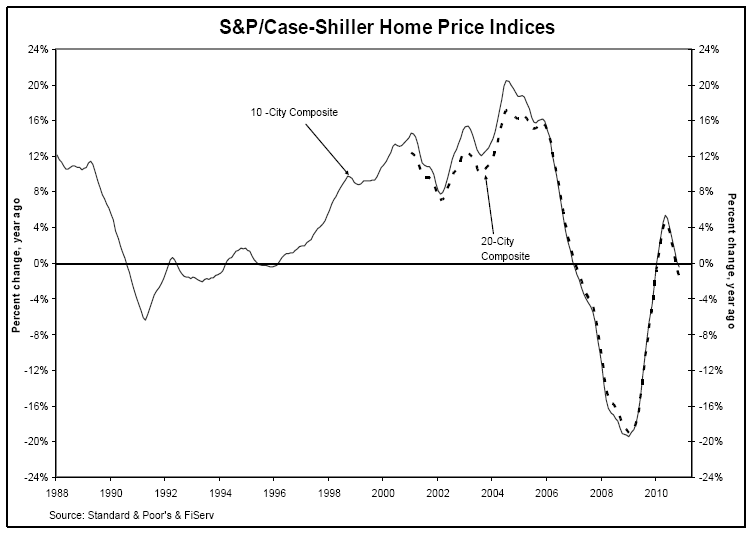
The 10-City Composite was down 0.4% and the 20-City Composite fell 1.6% from their November 2009 levels. Home prices fell in 19 of 20 MSAs and both Composites in November from their October levels.

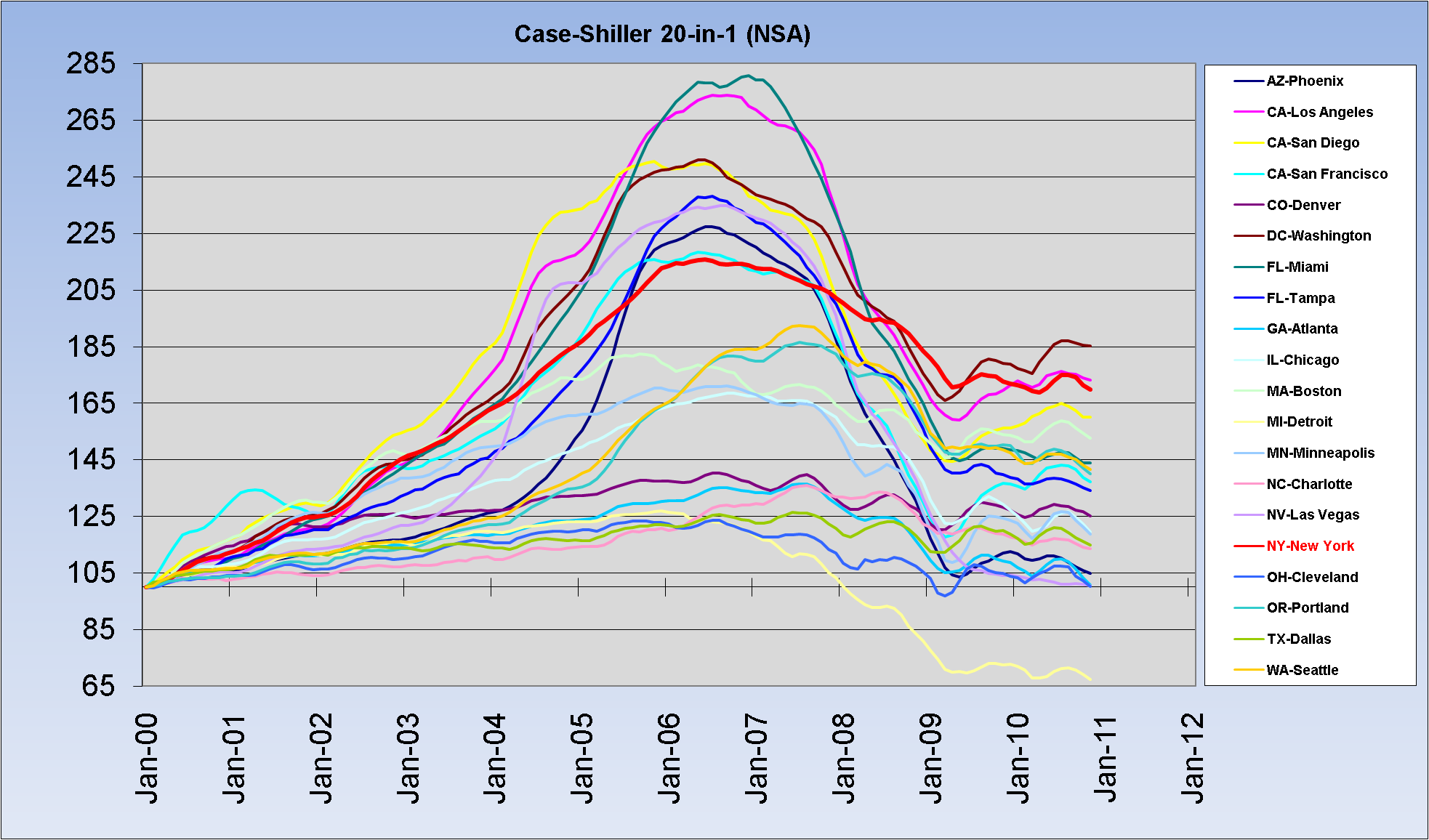
Only four regions – Los Angeles, San Diego, San Francisco and Washington DC – showed year-over-year gains. Eight markets – Atlanta, Charlotte, Detroit, Las Vegas, Miami, Portland (OR), Seattle and Tampa – hit their lowest levels since home prices peaked in 2006 and 2007, meaning that average home prices in those markets have fallen even further than the lows set in the spring of 2009.

Your CS Housing chart round up:

>

click for larger graphics:
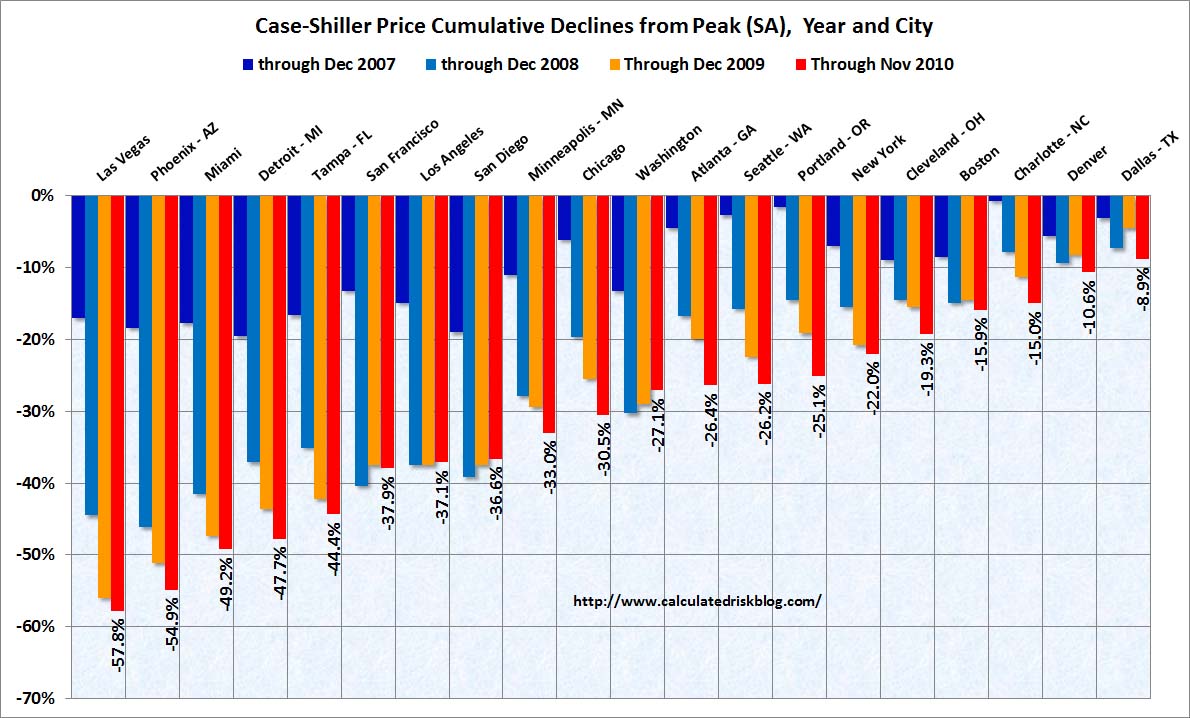
Chart courtesy of Calculated Risk

>

Invictus adds: One area — San Diego — eked out a miniscule month-over-month NSA gain, and was the only area that prevented all 20 from declining on a month-over-month basis. And yes, I will be pissed if Detroit eventually breaks below 65 and forces me to recalibrate my y-axis.

>
>
>
>
>

Source:
U.S. Home Prices Keep Weakening as Eight Cities Reach New Lows
S&P, January 25, 2011

http://bit.ly/erp5m0

Comments

Please use the comments to demonstrate your own ignorance, unfamiliarity with empirical data, ability to repeat discredited memes, and lack of respect for scientific knowledge. Also, be sure to create straw men and argue against things I have neither said nor even implied. Any irrelevancies you can mention will also be appreciated. Lastly, kindly forgo all civility in your discourse . . . you are, after all, anonymous.

14 Responses to “Ongoing Deceleration Case-Shiller Home Price Indices”

  1. rip Says:

    More evidence we are becoming a nation of a few hot spots fueled by the fed gov and certain technology, with the rest of the country joining the Rust Belt. It still contains great wealth, but not for the middle class.

    D. C. has never experienced a Depression nor a Recession.

  2. louiswi Says:

    The “average house” has all of the depreciating qualities of similar assets such as an automobile. That is to say, obsolesence and maintainance/up-keep. I repeat “average”. Why on earth would anyone ever think they should have done anything but go down in value. The unusual price appreciation from the 70′s to the 2000s was surely an aberation brought about by the real estate brokerage industry with duplicity from the lending institutions and the greedy public.

  3. call me ahab Says:

    OT-

    “Food, fuel prices unlikely to shake Fed from path”- Reuters

    makes sense- Food and Energy are only items people need to buy EVERY day

    The Fed . . . a man’s best friend . . .

  4. BennyProfane Says:

    And, yet, there’s still some “predicting” a double dip. I guess I was out sick for the wonderful recovery.

  5. The Curmudgeon Says:

    Does anyone have a chart that shows how much house an ounce of gold buys over the years? How about how much house a basket of SPX stocks would buy?

    Consider that housing prices are continuing to decline in the face of inflating assets in every other realm, and you can see the excess that needs wringing out.

  6. louis Says:

    Hurry up Ostrich, your on.

  7. Marc P Says:

    The first line needs amending. “Data through November 2010 shows negative annual growth rates in 17 of the 20 MSAs…”

    House prices don’t show “growth.” What you mean is house price inflation. The failure of Americans to distinguish between inflation and appreciation (improvements, sweat equity) is what got us into this mess.

  8. Halp Says:

    Just goes to show that the possibility of a double dip is definitely not off the table.

  9. Julia Chestnut Says:

    I’m a girl, purportedly among those who got the 64-box of crayons at birth, and I have a lot of trouble discerning the differences between several of the colors on that chart of the highs and lows among the cities. Interesting stuff, though – I don’t suppose it will ever get affordable to buy a house in the Washington DC area again, from the looks of it. Interesting to see the composite broken out several ways, because the markets really are faring extremely differently. Interesting.

  10. ashpelham2 Says:

    Honest to God, I don’t know why anyone would want to buy a house anywhere north of the Tennessee, Kentucky line, straight across the country, and anywhere west of New mexico. First, the weather this winter has been atrocious. Even here in Alabama, this winter has been f-ing miserable, by Alabama standards. Just a cold, 33 degree rain all winter long, with some places picking up an inch or 9 of snow twice.

    Second, all of those locales in those big, big cities in the midwest and northeast and west seem to bubble up so quickly, and then have to correct again, almost always too far to the downside. Buying your largest asset in price shouldn’t have this kind of volatility with it.

    I’ve pondered a move to California in the near future. Specifically, Santa Monica. But why, ON EARTH, I would ever PURCHASE a residence there is beyond me.

  11. bonghiteric Says:

    All these pretty pictures are nice and all but how do they relate to Davos?

  12. vine2wine Says:

    Bought my first house in San Diego in November after sitting on sidelines for a looong time. Weather right now is great too, I am employed but the middle class is almost non existent here as compared to other larger cities.
    Just waiting for the Big One to hit or some crazy 200 year tsunami. In the meantime I am going to enjoy our 70 degree weather while I watch Sam Champion create iced coffee on the sidewalk in NYC.

  13. gordo365 Says:

    I’m still napping. Wake me up when index breaks 100… Zzzz

  14. Ted Kavadas Says:

    The last chart is particularly interesting. Home prices, as depicted, have only fallen to 2003-levels. Based upon price trends, there would still appear to be substantial downside potential, unfortunately.

    For those interested, here is a blog post I wrote on the downside potential of housing:

    http://economicgreenfield.blogspot.com/2010/10/whats-ahead-for-housing-market-look-at.html

73 queries. 0.262 seconds.