
Goods vs Services: A Tale of Two Inflations

Email this post Print this post
By Barry Ritholtz - February 18th, 2011, 8:30AM

Today’s must read MSM piece is the WSJ discussion of Inflation:

“The pace of consumer price increases in the U.S. is quickening after being dormant for months. But a tug of war between the prices of goods and the prices of services, playing out beneath the surface, could keep inflation from becoming the worry it is in China, Europe and many emerging markets.”

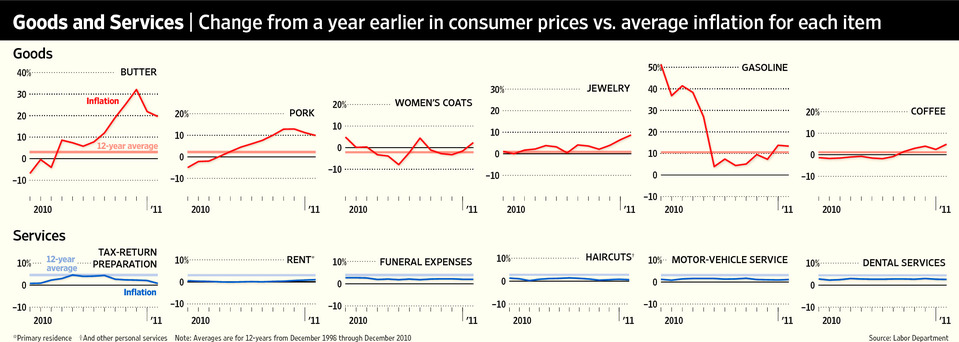
Prices rose 1.6% in January 2011 vs 2010 — the biggest increase in eight months. The key has been commodities — gasoline, cotton, wheat, coffee, and oil are all higher.

Labor, on the other hand is not. Wages are flat, unemployment is stubbornly high, and hence, prices for Services are flat to lower. That is keeping a lid on inflation.

Hence, the dueling deflation versus hyper-inflation commentaries:

“Soaring commodities costs world-wide are pushing up prices for many goods, while a slowly recuperating U.S. economy, soft housing market and a persistently high unemployment rate are holding down prices for U.S. services.

Goods prices were up 2.2% from a year earlier, paced by jumps in food and energy prices, according to the Labor Department’s January consumer-price index, and are rising faster than they did before the recession. But services prices were up only 1.2% from a year earlier, far below the 3.4% inflation rate registered for services between 2000 and 2008.

The opposing pull of prices for goods and services could have a big effect on the course of U.S. inflation. Federal Reserve Chairman Ben Bernanke is betting that rising prices for goods like gas and food will not spread into the broader economy. He and many private forecasters do not expect the U.S. to see the kind of rising inflation now plaguing China, India and other parts of the world.

Goods inflation has outstripped services inflation for long stretches since mid-2007, something that hadn’t happened since the 1970s. For most of the last 30 years, goods prices had been held down, in part, by cheap imports from low-wage countries like China. But recently, China and other developing markets have become huge consumers of commodities, which is putting upward pressure on American prices for many globally traded goods.”

Well worth reading in its entirety.

>
>

Source:
Split in Economy Keeps Lid on Prices
JON HILSENRATH And JUSTIN LAHART
WSJ, February 18, 2011
http://online.wsj.com/article/SB10001424052748703312904576146500586838290.html

Comments

Please use the comments to demonstrate your own ignorance, unfamiliarity with empirical data, ability to repeat discredited memes, and lack of respect for scientific knowledge. Also, be sure to create straw men and argue against things I have neither said nor even implied. Any irrelevancies you can mention will also be appreciated. Lastly, kindly forgo all civility in your discourse . . . you are, after all, anonymous.

35 Responses to “Goods vs Services: A Tale of Two Inflations”

  1. curbyourrisk Says:

    Maybe we should finally give in and re-define inflation to what it actually is. Inflation is not rising money supply, it is rising wages. What we are currently going through has nothing to do with rising wages and in the long run is NOT SUSTAINABLE. So, here is my definition of inflation: Sustained rising prices brought about by rising wages which are produced by the consumers bothi WILLINGNESS and ABILITY to pay.

    What we are seeing now is not INFLATION, but price spikes brought about by speculation. There are no supply and demand issues that are currently being created by production needs. When 60% of all demand for copper is by hedge funds, where is the Demand in that????? I am sorry, I call bullshit on the inflation arguement. Yes, the price increases are killing us…..we are even deciding what to buy, what we need vs. what we want. If you want to talk about inflation, go back and look at 1995-2005. That was true inflation, but no one cared because everyone thought they were doing better. No one saw rising wages, but we had redefined wages as we mistook wealth for wages. Everyone started measuring their income based on “expected” growth in assets, mostly housing assets. Everyone SPENT like they were future millionaires. No one cared that the prices of houses went up FOR NO GODDAM REASON, no one cared that the price of cars doubled, no one cared that asset prices went up and everyone needed to have a better car in their drive way. Everyone needed to have 5 flat screens. No one cared and everyone was willing, and assumed they were able topay higher prices. That is inflation.

    Trust me…..when these bubbles pop we will see where pricing should be. I predict somewhere about 40% lower than where things are now. Even the correction will probably not be brought about by supply and demand, it will be brought about by margin calls as people race to get out of trades before they lose money. No one seems to remember as far back as 2008. Yeah I know, “It’s differnet this time”

    No its not. Its the same shit, same people, same game.

  2. b_thunder Says:

    Yes, 80% of the wage earners and most people on fixed income are getting screwed. no wage increases, no COLA increases, no interest on your savings. WSJ correctly poins out that this is not 1970s, the wages will not keep up with inflation.
    At the same time, Obummer touts his “double the exports” theme, and the Helicopter Ben is 100% lock-step with the administration. The easiest way to achieve 50% gain in exports is, by the way, to devalue the USD by 50%. And Ben is hard at work to accomplish exactly that.

    This is an attack on the middle class from 2 fronts. Will people continue sit on their a$$es or will we have our own “Egypt” moment? Or will the GOP sweep 2012 elections and finish what Reagan and GW Bush started, i.e. deregulation, tax cuts for millionaires, union busting and privatization of social security – in other words the extermination of the middle class?

    I’m with Hugh Hendrey – he recommends that you panic.

  3. mark Says:

    So what’s one to do? Send the PIIGS to the slaughterhouse:

    Bini Smaghi Says ECB May Raise Rates on Price Risks

    http://noir.bloomberg.com/apps/news?pid=20601087&sid=a._5HAC.lajY&pos=1

    where do they get these people?

  4. rktbrkr Says:

    No inflation in services even though medical services are probably up double digits. The artificial calculation of rents distorts the core index too.

  5. mark Says:

    @rktbrkr

    1. If one strips out owner equivalent rent the result is a number little different from all the other measures of core inflation.
    2. Higher demand is causing rents to begin to rise and this is also being captured in the reported inflation numbers as one would expect.

  6. mark Says:

    This seems like a reasonable attempt to get at the issue of the influence of housing on recent official measures of underlying inflation pressure:

    http://dmarron.com/2010/11/28/is-housing-messing-up-inflation-measures-yes-but/

  7. ZenRazor Says:

    Wage increases in the countries that make a lot of the stuff that Americans buy are running at 5% to 15% (I’ve seen estimates for China’s major cities between 7% and 10% for 2011). Companies in these markets don’t have the margins to absorb these increases and will need to pass price increases through.

    While it is convenient to blame speculators for commodity price increases, rising prices in commodities that are not so easy to speculate in (e.g., coal, iron ore, potash) have generally been trending higher for the last few quarters. Asia is the marginal bulk buyer for many agricultural commodities and basic materials. If Asia has severe inflation, it may be unduly optimistic to think that we can avoid some derivative of their problem.

  8. SivBum Says:

    curbyourrisk is right on…

    Just this morning, the Bloomberg talking heads continue to press on that material cost amounts to 15% of goods while 50% of COG is labor with the rest marketing, sales and below the line blah-blahs. Well, news to the pundits is that the cost of material is fixed (except when they replace 24oz loafs for 20oz loafs, 11oz Fritos for 14oz bags etc). So is the food and gas costs for middel class households.

  9. curbyourrisk Says:

    SivBum: Becareful. Anyone who agrees with me on here is usually lambasted by a few of the everyday commentors.

  10. Irwin Fletcher Says:

    I have never understood why gas and food prices are excluded from inflation calculations. Can someone explain this to me?

  11. Sechel Says:

    Great piece!
    But I do wonder with the globalization of the world economy, how does a soft labor market keep the price down of a product that could just as easily be sold to a non-American as an American consumer(With all due consideration to shipping costs, etc)

  12. epupo Says:

    “I have never understood why gas and food prices are excluded from inflation calculations. Can someone explain this to me?”

    Long story short, the prices of gas and food were considered extremely volatile in the 1970′s and they decided to change the methodology in the late 70′s to account for this.

    General opinion is they did this to “mask” the true inflationary picture. I.E. if you dont like the result, change the equation.

  13. cswake Says:

    Irwin, official explanation for the removal of food and energy have to do with their volatility and screwing up future inflation forecasts for policy decisions.

  14. epupo Says:

    Great article, but then the bigger problem is:

    If wages are stagnant, but the prices of goods and services are rising, how in the heck is this good for the economy? Where does the consumer find the money to save and invest?

    I can understand consumers spending; they may fear their stagnant wages and weakening dollar wont be enough to buy the rising prices of goods and services, but I cant see how this type of policy helps consumers bottom lines or company profit margins

  15. curbyourrisk Says:

    Irwin: despite what cswake said, “Irwin, official explanation for the removal of food and energy have to do with their volatility and screwing up future inflation forecasts for policy decisions.”

    The real answer is so they can always control everything. They need to be able to control the cost of living increases that are required in government spending. THey could never be able to afford the increases if they actually included what people pay in order to live. They manipulate the rent input accordingly….minimize the effect in boom times and multiply the effect in decling asset periods. It is a ll a game, a rigged game. YOU WILL ALWAYS lose. Don;t try to understnd it, by time you do they change the rules again.

  16. curbyourrisk Says:

    By the way…the claim of stagnant wages is not really ture. They are declining and have been for 10 years. On top of that, our wages buy less and we are alos paying LOTS more into the system further reducing our real wage.

    I wish we could all earn Wall Street salaries, but then again…that is when we would have to deal with REAL inflation.

  17. epupo Says:

    Barry I am surprised you didnt also mention the WSJ editorial today on “deflation”

    http://online.wsj.com/article/SB10001424052748704657704576150501497853690.html?mod=WSJ_Opinion_AboveLEFTTop#articleTabs%3Darticle

    Even they took a shot at Bernanke – I hadn’t seen that coming:

    “Once again the Fed seems to have worried about deflation long after the threat had passed and even as price pressures from its easier policy were preparing to build. Let’s hope it turns out better than it did the last time.”

    ~~~

    BR: I am surprised you are surprised.

    I prefer reality based data to the dementia of those drunken blatherings.

  18. Robespierre Says:

    “Prices rose 1.6% in January 2011 vs 2010 — the biggest increase in eight months. The key has been commodities — gasoline, cotton, wheat, coffee, and oil are all higher.”

    “Labor, on the other hand is not. Wages are flat, unemployment is stubbornly high, and hence, prices for Services are flat to lower”

    “Federal Reserve Chairman Ben Bernanke is betting that rising prices for goods like gas and food will not spread into the broader economy.”

    So to summarize: Things that the poor and middle class must buy: Food and Gas are all increasing in price at a very fast pace. At the same time their wages (the money they need to pay for those things) is stagnant. Therefore, according to famine Bernanke all is well. The amount of BS spread around by the “experts” has reached biblical proportions. In the mean time our communist president has decided to eliminate poverty by well killing the poor (reduction of electricity subsides for the poor). Very soon between food inflation + freezing temperatures we will be able to reduce the number of poor people leaching from us taxpayers. Wasn’t that called in the past “the final solution?”

  19. ironman Says:

    Speaking of inflation expectations:

    … There’s another angle to consider as well. If the U.S. Federal Reserve is indeed using stock prices to assess how well their Quantitative Easing 2.0 program is going in setting future inflation expectations, stock prices running hot as they are today would be a signal to them that they need to take their foot of the QE pedal.

    That may also have a negative effect on stock prices in the current economic situation, especially if future inflation expectations fall as they did in the interval between the Fed’s QE 1.0 program and the current QE 2.0 program to near deflationary levels.

    Unless, that is, they’ve finally been successful in convincing everyone that inflation is here to stay.

  20. the bohemian Says:

    there appears to be a lot of inflation in silver lately- lol

  21. How the Common Man Sees It Says:

    ….and God gave them over to reprobate minds….

  22. Greg0658 Says:

    Robespierre – points taken – but Hope must prevail
    starvation will push the mother of invention for the masters to capture and propel growth
    or age old mechanisms take over ie destroy then things must be rebuilt with current techs
    I Hope NOT

  23. ashpelham2 Says:

    Once again, everyone here seems to “get it”, while the people on the street walking past us, heading to their TV’s at home to watch TMZ just seem to want to bury their heads in the sand about. Had a lunch with a very wealthy couple yesterday in Huntsville, AL, who are looking to invest some money with me and perhaps allow me to broker their retirement plan at the company they own as well. Their thoughts on where all of this is headed were DEAD ON to what I said on here a couple of days ago: this isn’t some bubble or short-term event. America is going through a seminal change right now, from the ONLY world power to less of a player. We are becoming not the market maker, but more of a participant in the market now. We don’t get to call the shots; we work with the rest of the world in lockstep, and we suffer when they suffer.

    This is globalization. Of course America isn’t going to benefit financially from this. We were at one time, a very short time ago, at the top of the food chain. Everyone else in the world saw us as the enemy and the milk-teet, at once. Globalization means bringing down our standard of living in line with the teeming billions of starving people so that they may be better off.

    Except they still hate us, still call us zionists, and still want our money. Who’s winning this thing?

  24. anonymous Says:

    “Had a lunch with a very wealthy couple yesterday in Huntsville, AL, who are looking to invest some money with me and perhaps allow me to broker their retirement plan at the company they own as well. Their thoughts on where all of this is headed were DEAD ON to what I said on here a couple of days ago”

    so…I have to ask . . .based on what you said- what is their investment plan?

    precious metals, farmland?

  25. wunsacon Says:

    Since the internet meant knowledge work could (in theory) be done anywhere, my investment thesis since 2000 has been “short American labor, long everything else”.

  26. How the Common Man Sees It Says:

    This is globalization. Of course America isn’t going to benefit financially from this.

    ===================================

    The power brokers will. I guess that is the point that John Q. Public hasn’t clued into yet.

    …or maybe they are waiting for tangible evidence to surface

  27. rip Says:

    What is going on right now is virtually identical to what happened during the “Great Depression”.

    Then, people with money were living the good life. Those without were having to compete with all the others for table scraps.

    Today, why hire someone for $8/ hr with benefits when you can hire someone for $7 and no benefits?

    Outside of that, the choice of words: depression, recession, recovery, wage stagnation, GDP growth, are pretty much irrelevant to what’s going on.

    The rich elites are feeling the wind at their backs and seeking the final conclusion of making labor and services cheaper for them than ever before.

    And their government servants are working mightily to renege on all the promises made, and pension contributions promised.

    The bloom is off the rose.

  28. The Curmudgeon Says:

    This is sort of a dog bites man story. Of course there’s inflation. That’s what Bernanke and Co. have been aiming for, and like he says, he can print as many dollars as he likes.

    What people also don’t get is that Bernanke and Co know full well that the best means of lowering the unemployment rate is lowering the cost of labor, i.e., reducing the wage rate. Guess what happens when “goods” increase in price and “services” don’t? The cost of labor/wage rates goes down as relative matter, thereby juicing employment rates. They can’t say that this is their strategy, but they fully well understand that lowering wage rates can be accomplished through outright cuts or through inflation. They are betting that people are too stupid to understand that if their wages stay the same yet everything else gets more expensive, then their wages, and thereby standard of living, have declined.

    Lower real wage rates will result in higher employment rates. That’s their aim. It seems to be working, and without the political fallout that would result if nominal wage rates declined.

  29. highside Says:

    I am surprised that people are surprised by all this but I guess it is easy to forget the global context when one is unemployed .

    Something around 2bn people have genuinely entered the global work force in the last 15 years and they have done so at wage rates far below those existing in the developed world. Furthermore these new entrants have a very high savings rate. Real wages need to fall significantly to for demand for labour in the developed world to return to historic levels where that labour competes with the emerging labour. In the absence of government policy broadly one would expect very very high unemployment in these areas to lead to falling wage rates in the developed world, significant compensation should come from large falls in the price of goods and services. However nominal wages are notoriously sticky and declines have a tendency to lead to social unrest so governments inevitable try to generate inflation so that real wages fall whilst nominal wages at worst remain stable. Unfortunately this denies people the benefits of the falling prices in goods and services. People are notoriously subject to money illusion.

    Of course one problem in the background is whilst we in the West talk about deficient demand and the need to pump up spending it probably fair to say that on a global basis a greater percentage of the worlds population is in productive employment than at any other time in modern history its just that for the first time we are the ones who are not competitive in a wide range of industries.

    These are of course broad generalisations, I am well aware there are many areas where the West has leading positions and skills, although this is not that much compensation to those not exposed to those areas.

  30. Robespierre Says:

    @The Curmudgeon Says:

    “Lower real wage rates will result in higher employment rates.”

    Sure that is why underdeveloped countries have such a great rate of employment… Go out of the country much?

  31. Frwip Says:

    Is this at long last this ill-defined, quasi-mystical beast they call biflation ?

    I was starting to shift my outlook from mild deflation to mild to moderate inflation. But I may be wrong, then.

    This biflation would prove that there is no transmission belt from prices to income for inflation to take hold. I can clearly see how this situation can end up affecting credit worthiness (strongly non-linear) then credit creation. Then, hello deflation again. And, given the structure of debt and international trade in the US, I would even start to believe in the possibility of an even more bizarre animal : deflation-depreciation.

    Wow. Interesting times, really …

  32. The Curmudgeon Says:

    “Sure that is why underdeveloped countries have such a great rate of employment… Go out of the country much?”

    That is why, exactly as I said, employment rates in developing countries (e.g., China, Brazil, India) are increasing, while employment rates in developed countries are stagnant or in decline–because labor is cheaper there than in developed countries.

    Would you like to argue the opposite premise–that employment rates increase in lock-step with wage rates? That the demand curve for labor, but for nothing else in the world, slopes upward”?

    Assuming you go abroad often, do you pay any attention to trends when you do? Then you should see the teeming legions of peasants leaving subsistence agriculture for jobs in the cities. That migration represents an increase in the employment rate in case you were unaware.

  33. Robespierre Says:

    I guess I didn’t elaborated enough. In your comment you implied that to lower employment salaries needed to go lower. If that was the case then it would be Africa the one taking jobs from the US (labor is cheaper there). That is not the case. China took jobs from the US (just like Japan did at its time) because government policies implemented there not just because cheaper labor. The countries that you mention have tow things:
    Very strong trade barriers and
    Large populations.

    Most companies didn’t go there because cheap labor. They went there to address the size of those markets without having to be penalized by the trade barriers that those countries impose. Once there, they realized that production could be shifted and the export the products to USA and Europe. You are wrong if you think that once the workers in the US get paid slave wages production will move back to the US. At this time I get the feeling that the unemployed in the US is being pushed to the said to be soon forgotten. Also, everyone thinks that the world needs the US consumer for the world to prosper. Was there always a US consumer? I think that just like jobs have migrated to other countries so have the addressable market

  34. wally Says:

    “prices for Services are flat to lower. That is keeping a lid on inflation”

    When the price of food goes up and wages go down an equal amount, that is technically not inflation.
    That pretty much sums up a lot of things about our present condition.

  35. budhak0n Says:

    This is globalization. Of course America isn’t going to benefit financially from this.

    That depends upon your definition of “America”.

    For me, her greatest strength has never been in a strict adherence to some calculated sense of overblown capitalistic priniciples ( although they exist in the heart of the matter) but in her ability to continue to adapt in the face of every overwhelming global wave of change.

    The “boomers” are hellbent on their way out to tear down those who they have to hand over their hard fought gains, and thus a short era of the inevitable wailing about how those who come next are not worthy, and shall sink the ship is in order.

    Pay no mind. We never have :-)

91 queries. 0.435 seconds.