
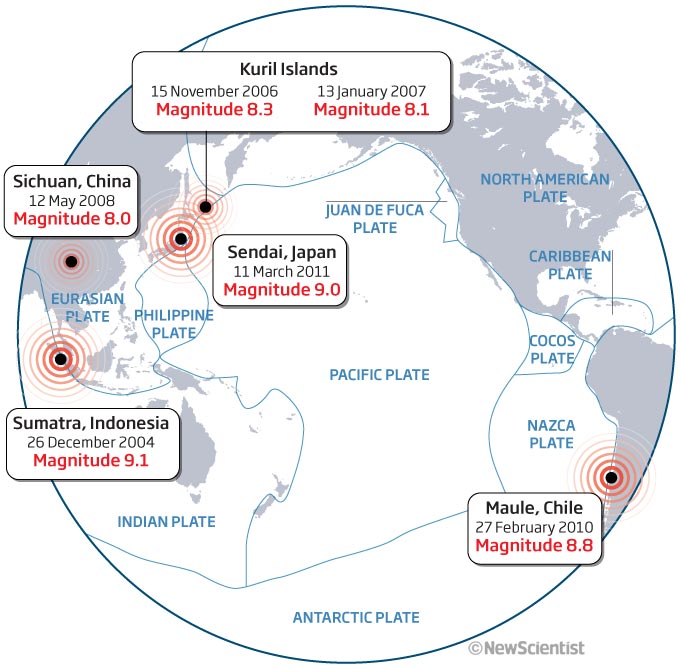
Are huge earthquakes linked?
>
New Scientist.com:
“What is clear is that for the 6.2 years since 2004, there have been more great earthquakes around the world than in any 6.2-year period throughout the 110-year history of seismic recordings.”
-Thorne Lay at the University of California, Santa Cruz.
>
Source:
The megaquake connection: Are huge earthquakes linked?
Catherine Brahic
New Scientist, 16 March 2011
http://www.newscientist.com/article/mg20928043.000-the-megaquake-connection-are-huge-earthquakes-linked.html



Tweet
Facebook
Reddit
Digg this!


March 22nd, 2011 at 6:51 am
Was there a correspondence between the Japan quake/tsunami and the Christchurch quake? They occurred very closely together, time-wise.
How about recovery times? In Haiti, it’s slow. The Christchurch recovery is on-going, but it may take a while before all the damage is fixed (or, more likely, enough of the damage to infrastructure is repaired to bring about some sense of normalcy and other, more cosmetic, projects will take longer). With a quake AND a tsunami AND the resulting loss of about 1/3 of the electrical generating power (not to mention damage to roads, water supply pipes, sewer system damage, and water treatment facilities caused by both natural disasters) i’d expect this Japanese recovery to take quite a while (again, just due to the sheer size of the effected area).
Your thoughts?
March 22nd, 2011 at 6:52 am
Difficult to know when 110 years is a mere fleabite in the scale of geological time.
March 22nd, 2011 at 6:56 am
That sample size is far too small to draw any conclusions.
March 22nd, 2011 at 7:44 am
the next big one–the de Fuca fault–and we think picking tops and bottoms is hard!
http://www.youtube.com/watch?v=xQXDt4VdS0E
http://www.raymondjames.com/images/inv_strat/110321_1lg.gif
~~~
BR: Thanks! I have been meaning to post that
March 22nd, 2011 at 8:11 am
I’ve often wondered that, particularly after the Haiti and Chile and Turkey earthquakes in 2010.
I was a bit frustrated by the long article that basically said “well, maybe, but we don’t know”. I do love New Scientist magazine, though.
March 22nd, 2011 at 8:29 am
Just get it over with……I knowyou all want to say…..
It’s Bush’s fault.
March 22nd, 2011 at 8:52 am
As far as I can tell, all earthquakes are linked—by the movement of earth’s tectonic plates.
So as the Buddhist said to the hotdog vendor, “Make me one with everything.”
March 22nd, 2011 at 8:55 am
This is a seemingly simple question. Assuming you are not flat earther and you believe in evolution, it’s not called the platetectonic SYSTEM by accident. As with any system, of course the are linked, its just a matter of how closely. In theory, the release of built up pressure between plates in one location is likely to build up pressue elsewhere. To oversimplify, its a little like squeezing one end of a balloon. The pressure doesn’t disappear, it spreads itself elsewhere. See Earthquake Storms:
http://en.wikipedia.org/wiki/Earthquake_storm
March 22nd, 2011 at 9:11 am
Out of all 6.2 year periods. ONE of them must have the greatest number of earthquakes.
It should be obvious that tectonic movements are related… but it also seems obvious that the relationship is not linear, may not be direct and is not likely to be discernable on a human timescale.
In other words: maybe, but not in a way that has any predictive value for us.
March 22nd, 2011 at 11:04 am
“Wally” nails it today!
March 22nd, 2011 at 11:12 am
Interestingly, if you look at the top ten list of earthquakes since record-keeping began, you see that the early 1960′s had four really big earthquakes, including two of the largest ever measured (#1, #2, #8 and #16) and if you stretch that window to a touch more than 6.2 years, you have five (#11)
http://earthquake.usgs.gov/earthquakes/world/10_largest_world.php
You could also say
“What is clear is that for the 4 point whatever years between 1960 and 1964 there have been more great earthquakes around the world than in any 4 point whatever period throughout the 110-year history of seismic recordings.”
March 22nd, 2011 at 11:12 am
Is there any relation between relative size of the plates / plate size.
March 22nd, 2011 at 11:51 am
Things have been quiet in California. “Too quiet” if you know what I mean…
March 22nd, 2011 at 6:26 pm
some body was claiming that that Japanese quake was going to cause one in California
http://news.yahoo.com/s/livescience/20110321/sc_livescience/bogusclaimjapanearthquakewonttriggeracaliforniaquake
evidently not
March 22nd, 2011 at 7:08 pm
There wasn’t just one New Madrid quake in 1811 in Tennessee. There were three, the second came five weeks later, the third three weeks after that. Not sure that Japan is out of the woods yet….
March 23rd, 2011 at 12:21 am
Patrick said it. I’ll bet on that too.
There are a bunch of correlated data available to the Immortal who can take the time to gather the data for their thesis. other then that it’s all a bunch of wow that seems related but who can tell..
One thing a few years ago I had an argument about tidal and gravitational effect on earthquake frequency… My friend said no there’s no correlation.. I dug a bit and founf a paper about the shallow sea surrounding taiwon or somesuch place , and the discernable effect of the tides.
Hunches sometimes are closer to the mark then one might think.
March 23rd, 2011 at 2:06 am
Interesting article by Richard Black and Jonathan Amos (BBC News)
” The massive Sumatra quake in 2004 was followed by many others above Magnitude 7.0, including two above Magnitude 8.0 in 2005 and 2007.
Some generated tsunamis that claimed more than 100 lives; and it is thought they occurred because the original earthquake, on 26 December, increased stresses along the tectonic plate boundary that lies to the west of Sumatra and Java.
So what is the outlook for Japan now, especially for the great city of Tokyo and the Kanto plain on which it sits?
This is home to one-quarter of Japan’s population, as well as being the country’s administrative and commercial centre.
Big quakes struck the area in 1703, 1855 and 1923, with the last claiming the lives of 100,000 people.
Were any one of these events to occur today, the economic losses alone would be expected to top $1 trillion (80 trillion Yen). ”
http://www.bbc.co.uk/news/science-environment-12792943
I saw a video showing a Tokyo building swaying in the 11 march 2001 earthquake, from quite a distance and filmed by a cellphone, you clearly see the building swinging back and forth.
So I’m not sure Tokyo’s buildings would fare well against a closer hit of that magnitude.
May 12th, 2011 at 11:49 am
I agree with Chad. The time frame is so small in the great scheme of things as to be insignificant. Not to mention that our records only extend so far back. This may not be an anomaly.