
Case Shiller: Dismal Start to Home Prices

Email this post Print this post
By Barry Ritholtz - March 29th, 2011, 10:12AM

Excellent news: Despite the best efforts of misguided government policies (tax credits, mortgage mods, foreclosure abatements) and the Fed (ZIRP), Home prices are falling towards normalized levels. (Yeah!)

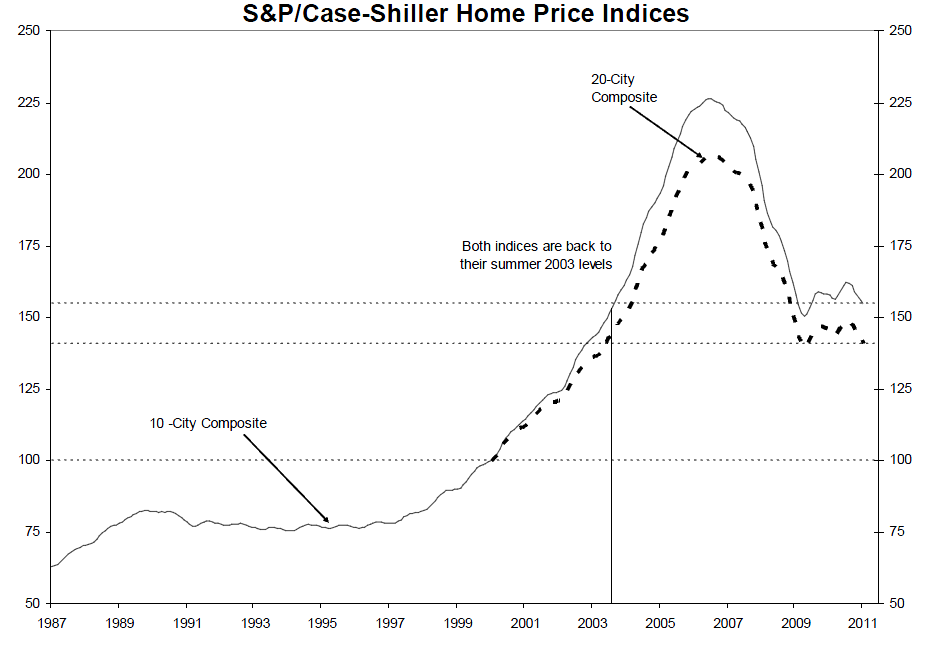
That is the result of the latest Case Shiller data for January 2011: “The 10-City Composite was down 2.0% and the 20-City Composite fell 3.1% from their January 2010 levels.”

The chart below shows that we have now reverted back to price levels where housing markets launched into their vertical 3 year price rise.

What we have yet to erase is the excess speculation from the 2002 to 07 mania. Until that gets wrung out of the market, I doubt you will see a healthy Real Estate sector. That will only take place through a combination of lower prices, better holders and the elapsing of time.

The good news is that is happening. The bad news is its a slow painful slog . . .

>
(As always, click for ginormous chart)
>

One of 20 areas (D.C.) rose last month, preventing another shutout (one of 20 rose in each of December (Cleveland) and November (San Diego); all 20 declined in October).

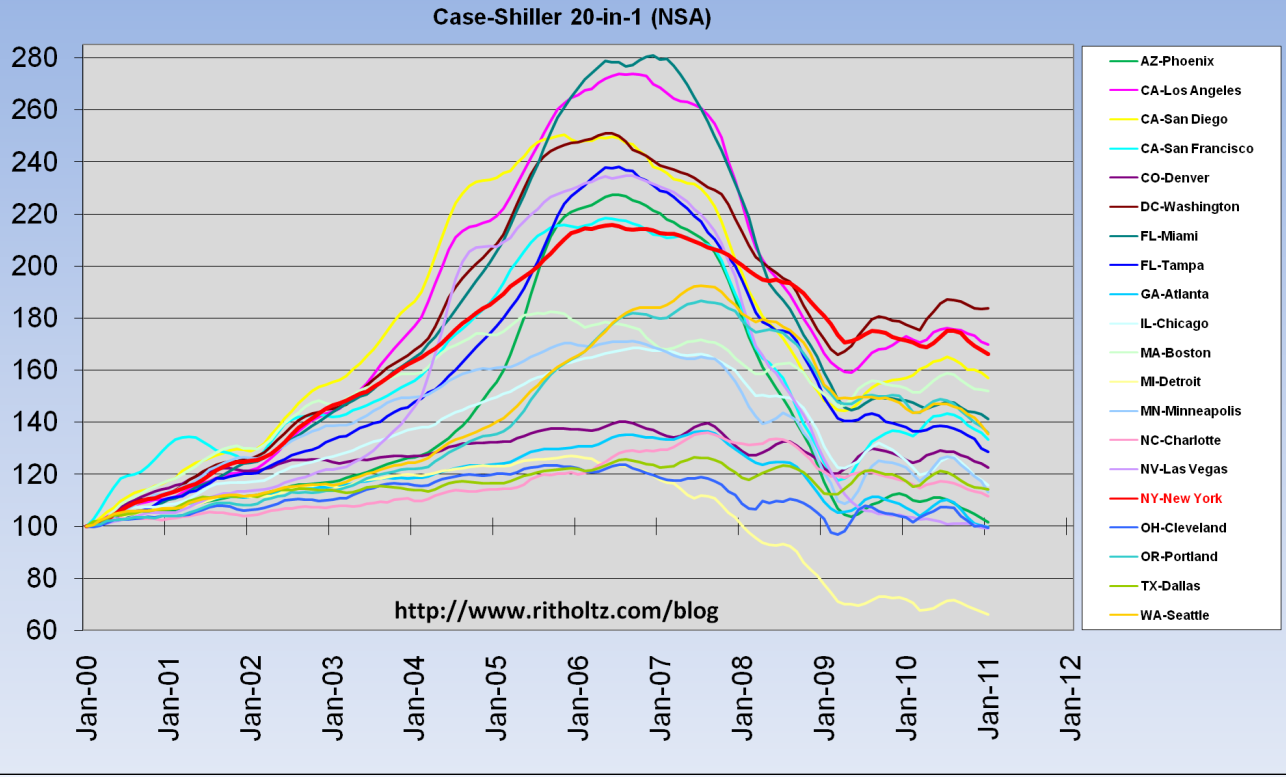
Here’s how far back each of the 20 areas (and the 10 and 20) have fallen:

>

And all 20 metro regions on one chart:
>

More charts after the jump
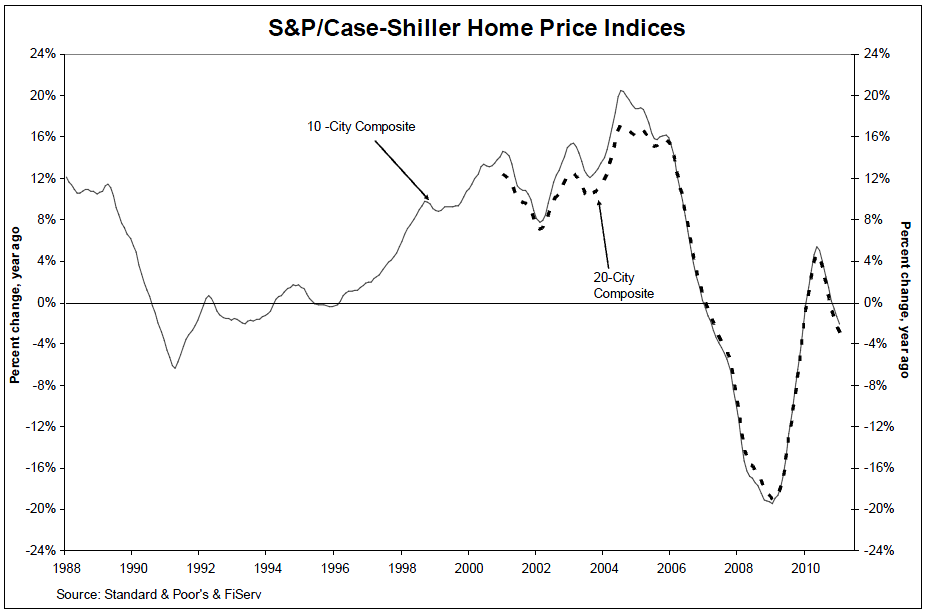
A summary of the monthly changes using the seasonally adjusted (SA) and non-seasonally adjusted (NSA) data can be found in the table below.
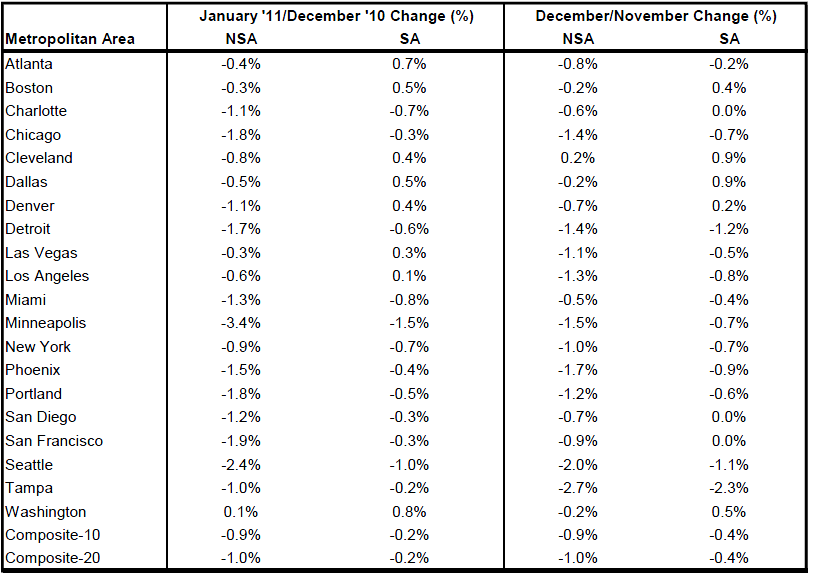
Source: Standard & Poor’s and Fiserv;  Data through January 2011

Comments

Please use the comments to demonstrate your own ignorance, unfamiliarity with empirical data, ability to repeat discredited memes, and lack of respect for scientific knowledge. Also, be sure to create straw men and argue against things I have neither said nor even implied. Any irrelevancies you can mention will also be appreciated. Lastly, kindly forgo all civility in your discourse . . . you are, after all, anonymous.

29 Responses to “Case Shiller: Dismal Start to Home Prices”

  1. franklin411 Says:

    Who says that Federal policy was designed to spur a rapid rebound in housing prices? If that had been the goal, then Federal policy would have been a lot more aggressive–torch vacant housing inventory, force banks to accept cramdowns, government-issued 0% interest home loans.

    None of that happened, precisely because Federal policy was not designed to spur a rapid rebound. Instead, the goal was to put a parachute on an imploding housing market. It is important that housing return to an affordable level in this country, but it serves no one to have this process occur precipitously–especially if that process becomes a negative feedback loop that exaggerates price declines far beyond what ought to occur. In the goal of stabilization, Federal policy dramatically succeeded.

  2. BennyProfane Says:

    Speaking as a proud American, I’m so happy that the poor cilvil servants who work so hard are weathering this housing crash so well in Washington. They all deserve our continuing support.

  3. DeDude Says:

    Yes BennyProfane; our men and woman in uniform, serving the military-industrial complex, deserve a market with overpriced houses – that is the least we can do for them.

  4. Thatguy Says:

    Yay DC! As a long suffering holder of real estate in this area, I’ll take it.

    BTW, metro DC is a hell of a lot more than just civil servants and I can guarantee you that they aren’t the ones driving up real estate prices. The cynical among us would point to the lobbyists whores in the area, as that has been one hell of a growth industry and most of them are probably employed by the banks in NY. The rest of us would point out that you have a decent tech industry here along the Dulles corridor, biotech in Bethesda, among other industries, so don’t just assume that all of us here near the capital are suckling on the gov teat.

  5. Chief Tomahawk Says:

    “The chart below shows that we have now reverted back to price levels where housing markets launched into their vertical 3 year price rise.

    What we have yet to erase is the excess speculation from the 2002 to 07 mania.”

    ?

    Why is the speculation date drawn at 2002? The chart looks pretty level at around 1997. Especially since corrections often overshoot, why aren’t 1997 prices in the cards?

    What I’m seeing first-hand here (working class and middle class Chicago suburb) is decimation. Several condo properties have taken 14%-16% price cuts in the last two weeks. Anotherwords, they’re in free fall (or price discovery mode.) With $4 gas and higher food prices, banks probably looking for 20% down (given the rapid decline of real estate prices), and many folks down-sizing to cut costs, it’s no wonder my community of 60,000 currently has around 800 distressed properties on the market (pre-foreclosures, foreclosures, short sales and bankruptcies.)

  6. SivBum Says:

    It’s not clear if the prices reflect just the cities per the report or a greater metro area. e.g. San Francisco (SF) as shown in the report included San Francisco, Oakland and Fremont. It makes no sense to me as Fremont is as far away from downtown SF as Palo Alto inside Santa Clara County. Wonder if S.F. included the cities in the following adjacent counties to SF:
    › Alameda, CA
    › Contra, CA
    › Costa, CA
    › Marin, CA
    › San Francisco, CA
    › San Mateo, CA

  7. BennyProfane Says:

    @Thatguy

    You should stop and ask yourself – Why did all of these companies decide to locate near DC? Tech? hmmmmm…..Does our defense industry use a ton of tech? Jeez, such a short drive to the Pentagon…….

  8. dead hobo Says:

    BR opined:

    The good news is that is happening. The bad news is its a slow painful slog . . .

    reply:
    ——————
    The bottom is closer than you think. The cost to build a new home as risen because all input prices have risen. While the glut of used homes is depressing prices, when they are sold or have been on the market so long they can’t be sold, the chart will look much like today’s. Prices will continue to fall only if commodity regulation somehow drives commodity prices down to levels from 10 years ago. Otherwise, you are expecting prices for new construction to fall far far below the cost of production.

  9. Petey Wheatstraw Says:

    dead hobo Says:

    “Otherwise, you are expecting prices for new construction to fall far far below the cost of production.”
    _____________

    No supply/demand relationship? Regardless of input prices, the market will only pay so much for an oversupplied commodity. Housing, or cars, or apples — if supply is too great, the price will drop.

    The real questions are why are the builders adding to the oversupply, and where are they getting the money to do it?

  10. BennyProfane Says:

    @Petey Wheatstraw

    “The real questions are why are the builders adding to the oversupply, and where are they getting the money to do it?”

    Maybe the same place that auto dealers are getting their nearly free money to move cars.

  11. robertgrumbles Says:

    Barry, why would prices have to revert to their pre-2000 levels? Inflation at 3% a year should take the index to around 134 as of the end of 2010. Seems to me we’re about in the right spot. http://robertgrumbles.blogspot.com/

  12. SivBum Says:

    As the old real estate saying goes: It’s location location location. There is no oversupply in job centers. e.g.

    http://www.movoto.com/statistics/ca/palo-alto.htm

    At the bottom, see the pricing for 2 year chart.

  13. DeDude Says:

    Houses are not quite the same commodity as cars and apples. You cannot move them around at will when local supply is in excess or needed. So the building of new homes will not be driven down to zero. There will always be small local markets where the demand makes it possible to build with a profit and certain individuals will refuse to purchase a “used” house because they want to have it according to specs and brand spangling new.

  14. Ted Kavadas Says:

    “Price action” in real estate remains poor. I think that the weakness in housing prices is particularly disturbing given that the economy is in a (albeit weak) recovery.

    For those interested, today I wrote a post that discusses the consensus estimates for real estate prices through 2015 as well as a few of my comments on the potential remaining “downside.” It is found at the following link:

    http://economicgreenfield.blogspot.com/2011/03/macromarkets-march-2011-home-price.html

  15. The Window Washer Says:

    “The cost to build a new home as risen because all input prices have risen.”

    is just a false statement.
    Labor cost haven’t gone up and there’s fewer imputs in the new houses being built. What’s the price per square foot of the CS? You can build a house for under a $100sf.
    Also land prices have dropped through the floor, here in Denver you can get lots for a 1/4 or less of what they were price at in the boom.

  16. Mike in Nola Says:

    Petey:

    “The real questions are why are the builders adding to the oversupply, and where are they getting the money to do it?”

    It’s because humans are creatures of habit. They made good, easy money for much of a decade and it takes a 2X4 up the side the head to convince many of them things have changed. I still see lots of McMansions beind worked on and priced in the high hundreds of k here in Houston even though the market is glutted with them. My cousin back in La. says there’s no way a builder can compete with the REO prices, so he is doing remodling for those stuck in their houses.

    There is a little pickup in sales at the moment which I am personally thankful for. After my mother’s death last fall, my father’s Alzheimer’s got much worse and we had to put him in a nursing home. Fortunately, they had some cash in the bank which could have carried him maybe a couple of years, but we had to do something with the house. Priced it realistically in Feb. and sold it last Friday. Had multiple offers, so some have said that it was priced too cheaply, but it was at what both my cousin and the agent independently suggested. And I’ve seen too many chasing a falling market. The agent did say that business had picked up over the last couple of months. My guess is it is those who have cash and don’t plan on moving anytime soon, like our buyer, or those who have been convinced to try to catch the falling knife.

    I thought Charles Hugh Smith had a good article on the shape of the house price decline and why you get these level spots. Pretty much what I have thought but couldn’t articulate.
    http://www.oftwominds.com/blogmar11/phase-shift-housing3-11.html

  17. daf48 Says:

    Just one problem. Too many unemployed customers with lower incomes and rising prices.

  18. rfullem Says:

    Clear a market? just wondering how losing a good portion of my 20-years of hard-earned savings from wages (a large downpayment on first house) because SIMPLY bought a house in 2007 as opposed to anytime between 1776-and 2005 is considered a good thing? mortgage banker, Freddie mac kids to to college, mine do not and my losses have an inverse relation to work and saving and positive one with crime. That is very CLEAR to me.

  19. Mike in Nola Says:

    F411:

    If you don’t think the Feds are out to goose the market at our expense, take a look at the latest regs from the FDIC. Banks will have to retain risk on loans with less than a 20% downpayment EXCEPT if the loans are sold to Fannie or Freddie. (It’s buried in small print in the middle of the article.) That means they can write all the risky loans they want, pocket the fees and stick us with the risk.

  20. Petey Wheatstraw Says:

    De dude:

    While Houses are not quite the same commodity as cars and apples, the supply and demand relationship is what it is. Now, if you’ve got a very rare car or species of apple (in relatively short supply and of a quality or brand that can be easily discriminated from others), someone would probably buy it at the asking price.

    True, there will always be new housing built, but the market will not (because it cannot) return to the days of spec tract/community development. Nonetheless these spec communities are still being financed and built (I’d chalk it up to developments already in the pipeline when reality set in, but that’s getting to be a pretty long timeline). I personally know of a small regional bank currently lending to a home builder to develop rental units (something I advised the builder to do in ’05, when they said that their flagging sales were a “bump in the road”). The bank is apparently diversifying out of CRE and into the real fire, as a consequence, the builder is a day late, but not a dollar short. We will all keep eating this shit.

  21. Orange14 Says:

    If the Republicans wind down Freddie and Fannie sooner rather than later and the government is completely out of the risk assurance business, who will step in? Maybe there are suckers out there who will buy mortgage backed securities absent an implicit government backing (are you going to trust Moodys and S&P to do the research on these securities?) but they will be few and far between. Given this, what will the bank’s response be? The model in the past is make the mortgage and get it off the books as quickly as possible. This may no longer be possible. I suspect ARMs and perhaps 15 year mortgages will be the rule of thumb. I can’t see banks wanting to make 30 year fixed rate loans and having to keep them on their books particularly if interest rates get jerked around (remember Paul Volker and how many S&Ls couldn’t cover because they loaned money out much below what the emerging cost of funds turned out to be). We are in for tough times in the housing market for a considerable period of time.

  22. derekce Says:

    After 14 years in Japan’s real estate bust, some prime property in the financial district of Tokyo was down 99% and residential property in Tokyo was down more than 90%. That’s a really long, slow, painful slog.

  23. Keith Jurow Says:

    As someone who has been posting in-depth articles on the housing debacle on this site as well as MINYANVILLE, SEEKING ALPHA, REAL CLEAR MARKETS, and PRAGMATIC CAPITALISM, I’d like to add some specifics that are really important.

    Case Shiller and other indices are of limited use because they hide so much. The first issue of my new Housing Market Report will reveal data showing that Miami-Dade County has 25% of all first liens in either serious delinquency or in pre-foreclosure (default) but not yet repossessed. Broward County in Florida and Clark County (Law Vegas) are not far behind.

    Previous articles of mine have shown historical charts indicating that 95-98% of these seriously distressed properties will be forced onto the market as either foreclosures or short sales. How soon is anybody’s guess, but make no mistake, they will be dumped on the market in the next few years.

    Prices seemed to level off in 2009 and early 2010 because banks started withholding the vast majority of repossessed homes from the market. The 1.7 million mortgage modifications last year (HAMP and bank initiated) artificially lowered delinquency rates. So investors were fooled into thinking that perhaps we were nearing a bottom. Fat chance.

    Let’s not forget that in the worst bubble markets such as Las Vegas, Phoenix and Miami-Dade, all-cash buyers have literally kept these markets from totally collapsing. Nationwide, 33% of all home sales were to all-cash buyers. Not exactly a sign of a healthy market.

    These are the kind of relevant numbers that give you a better picture of where we are heading. It could get really ugly.

  24. DeDude Says:

    Petey; I would never suggest that supply and demand does not work, just that it is a very local phenomenon when the product is immobile. So even in the midst of a national excess of houses there can be small local areas where demand is in excess of supply. I am not surprised that builders are moving into making rental units, after all their skill is building – they cannot just close shop and open an investment bank. Sort of the same thing with banks; they can only do what they always did – if we let them.

  25. rktbrkr Says:

    Keith , Any idea how many homes are in shadow inventory? If the banks start unloading them rapidly it’ll pull down prices especially FL,AZ and NV where so many are in arrears already and provide added incentive for those with serious negative equity (already) to just walkaway. How many years can the banks and F&F just sit on these vacant properties?

  26. ilsm Says:

    Outside Boston 128 Beltway.

    Prices here remain above 2003 levels, which are too high for me!!

    I bought first time in this market in mid 8o’s early in that run up, sold up in late 80′s, early in that slump, sold on divorce in late 90′s. Bought condo, sold on geo move few years later made good margin, just before the rocket took off.

    Have rented/cohabbed since.

    Will buy at around 1996 price level, which last slump early rise.

    Otherwise cohabbing has obvious perks, is cheaper, better, and a lot less mowing.

  27. louis Says:

    What is considered normal demand now?

  28. Keith Jurow Says:

    In response to rktbrkr’s comment, the shadow inventory is very real, growing and scary in the top 25 major metros. Miami-Dade is the worst, but Broward (Ft. Lauderdale) is nearly as awful. The Florida coast east of I-95 is in a meltdown plain and simple.

    The banks are simply not selling repossessed homes and they are reducing their foreclosure actions. How’s this one — 30% of all homeowners in pre-foreclosure (default) across the country have not made a mortgage payment in over two years. The average number of days that all defaulted properties have been delinquent in payments is an amazing 537 days according to Lender Processing Services. Two years ago, that number was only 319.

    Can the banks keep this up indefinitely? I doubt it. But the largest servicing banks will certainly try. Reality has a way of overwhelming these attempts. Bernanke will certainly attempt to bail out the big boys. I doubt it can work.

    I suggest tuning in to my new Housing Market Report which will launch this Monday, April 4 on Minyanville.com.

  29. Doug Smith: A Stiletto In The Back Of Sane Housing Markets « naked capitalism Says:

    [...] ➢ Home prices are projected to continue falling somewhere between an additional 20 to 30 percent – meaning even more will go under water. [...]

85 queries. 0.406 seconds.