
Housing Market Cycle: Much Worse This Time
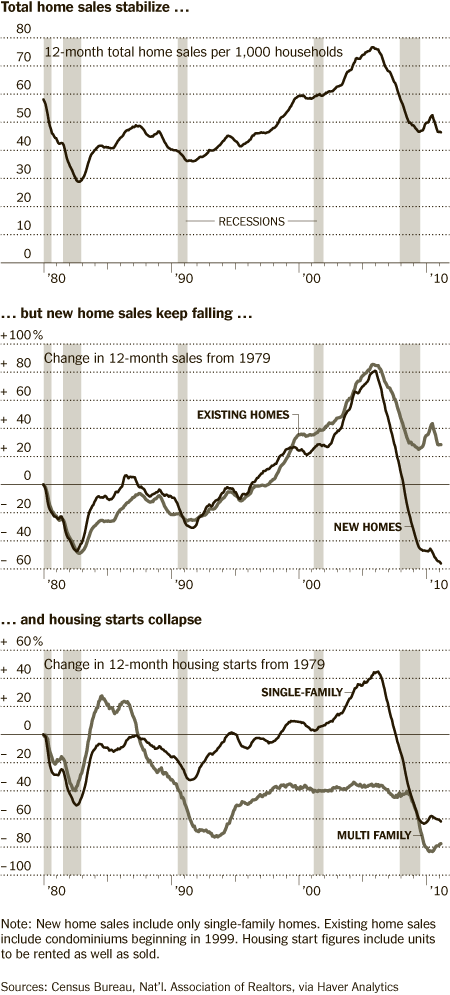
Floyd Norris gives us the no nonsense take on Housing: Yes, Housing remains moribund; No, this is not getting better any time soon. The charts at right (click for larger version) should make that clear to anyone:
“As can be seen in the accompanying chart, during the 12 months through February, about 46 homes were sold for every 1,000 households in the country. At the peak of the housing boom, that figure rose above 75, but the current level is significantly higher than the lows reached during the recessions of the early 1980s and early 1990s.
The sales rate for existing homes — about 4.9 million over the last 12 months — is virtually the same as in mid-1999. Yet sales of newly built single-family homes have plunged to the lowest levels seen since the government began collecting statistics on such sales in 1963. The Census Bureau reported this week that only 17,000 new homes were sold in February, for an annual rate of 250,000 after taking seasonal factors into account. Both of those numbers are the lowest on record.”
Why? As low as rates are, they cannot make up for the lack of wage gains, the massive deleveraging, and the ongoing foreclosure activities.
>
Source:
A Housing Market Cycle Different From Others
FLOYD NORRIS
NYT, March 25, 2011
http://www.nytimes.com/2011/03/26/business/26charts.html


Tweet
Facebook
Reddit
Digg this!


March 26th, 2011 at 5:36 pm
“Why? As low as rates are, they cannot make up for the lack of wage gains, the massive deleveraging, and the ongoing foreclosure activities.”
Not to mention a major paradigm shift in the idea of housing being an investment.
For the young and the smart, housing is an anchor in a jobs market that demands mobility.
March 26th, 2011 at 5:54 pm
So, I pick up Barrons today, and, for what seems to be the thousandth time, I read that what will cure this “housing mess” is jobs. WTF. Just 6 or 7 years ago, many many people were given incredibly large loans, sometimes totaling in the seven figures, for basically free (no money or pocket change down), and absolutely no verification of income. That was the grand finale of two decades of credit addiction on all levels of our society. So, now, if Americans suddenly all go back to work at average or even somewhat above average pay, the market will magically “revive”? I don’t think so. As far as I’m concerned, and many who didn’t get caught in the game, the market is “reviving” if it goes down another 20% to affordable levels, which it will, so that the average American can actually spend a reasonable amount of their income on shelter and still have some left over for Xmas presents.
This is not a housing crisis, this is a credit crash. Today it’s housing, a few centuries ago it was tulips. And, I never read that Tulips went back up to their manic pricing. Don’t expect one bedroom condos in Florida to be worth a million bucks or crappy little ranches in California to be priced in the high six figures anymore, either. At least in your lifetime.
March 26th, 2011 at 6:49 pm
…and the housing ETF (XHB) keeps chugging along.
March 26th, 2011 at 7:47 pm
Time to end the mortgage interest deduction, the deferral of capital gains and get the final wash out.
We need to invest in productive assets, not McMansions. We’ve just built enough McMansions for a generation of absorption by bourgeois hyper- consumers, so why continue to tax-favor them?
Oh and let’s use the added revenue to increase tax cuts for the rich. …something everyone loves (though I do not understand why, except they believe the marketing the “conservative” think tanks design.)
March 26th, 2011 at 9:15 pm
@BennyProfane
great point — and as many have stated the outstanding debt based on those inflated (bubble) prices needs to be restructured.
Also, the next wave of purchasers are already saddled with $1T+ in student loan debt.
This is going to be a long and painful ride.
March 26th, 2011 at 9:56 pm
For what it’s worth, crappy little ranches in my neck of CA still go for over a million.
A VC just dropped $75 million (that’s not a typo) on a trophy house here.
http://www.mercurynews.com/business/ci_17701335?source=most_viewed
Tech companies are throwing all kinds of perks at new grads to come work for them:
http://www.nytimes.com/2011/03/26/technology/26recruit.html?src=me&ref=homepage
and yet, the foodbanks can’t keep up with the demand. Crazy times.
March 26th, 2011 at 10:03 pm
Low new home sales is what is needed to get the supply and demand back in line. Housing is universally hated as an asset right now, I’m just waiting on the Time cover story trumpeting the end of the single family home to signal the bottom.
March 26th, 2011 at 11:15 pm
Imaginary prices are not going to bring back the economy, or any printing or millions spent for the Huff Post for that matter.
Playing big bucks at the top is cool but the bottom, the large majority, is broke…fucking broke…is there anybody out there?
Financial institutions don’t need a real economy, they can just bankroll they way through mystical bullshit and derivatives, and so do corporations, GE makes more out of financial ”products” than they do out of making things, who cares?
It will only get worse as long as the financial expansion to infinite through this exotic secondary market does not come to an end.
What’s next, selling your own house to yourself for a profit?
March 26th, 2011 at 11:23 pm
“What’s next, selling your own house to yourself for a profit?”
I think Dick Fuld already did something like that, didn’t he?
March 27th, 2011 at 9:32 am
BennyProfane has it exactly right. Housing will revert to trend, that’s a given. Everyone can try all the props they want, all the talk they want but it comes down to salary and prudent loans now with “old fashioned” standards.
Housing is the first manifestation of why there cannot be a classic “inflationary cycle” this time around, whatever anyone says. Wages aren’t going anywhere but down. Therefore there is absolutely no way costs can be passed on to consumers, which means there is no wage adjustments to compensate, which means companies have to back off from pushing through the increases. Witness the airlines. Food will be the same. P&G says it will raise its prices. Gas is up. Tell me, if a household’s wage take-home is finite at 3200 a month, the increase has to come from somewhere. It won’t come from credit any longer, it won’t come from wage increases, so it has to come from other spending. The shell game of credit substituting for wage increases just ended with a bang. And if 3200 a month is the average income, no matter how you slice it, only a certain percentage of that can be used to calculate the mortgage. That means that he’s right: there will be no more crappy capes going for 500k in the near to mid-long future.
So if this continues, this is just like squeezing a balloon…the air only goes to other parts at the expense of where the squeeze happens. Housing is dead for a long time to come. Jobs there are minimal for a long time to come. Consumers aren’t getting more wages. Prices will NOT be passed along, or will be at the peril of anything discretionary (restaurants, travel, clothing, etc). So where is growth and jobs coming from? Where is “inflation” coming from? If a household has to spend more in gas and food, they’ll spend less in other areas exactly equal to the increase. Sounds like Japan for the last couple of decades huh? Wait and it will happen in China too. History repeats.
March 27th, 2011 at 10:18 am
Your bad is my good. Funny how this works out.
I had my house appraised for real estate tax purposes. The value is down, so my assessment went down. My tax bill will be about 25% lower next year even if rates and equalizers offset it. I will be saving 5X the cost of the appraisal this year and maybe more next year. Assessments here are normally based on the 3 year average market value and are adjusted annually. So my new assessed value should go down because all real estate around here is falling in value.
March 27th, 2011 at 10:34 am
1) House construction is a low barrier to entry business. All it takes is skill, licensing, and capital which can be borrowed. When the inventory of existing homes is reduced, new construction will quickly appear in configurations demanded by consumers.
2) The economy has already adjusted to low new home sales. Lower sales can’t hurt it since expectations of low sales are common.
3) Given some of there ads I’ve seen in the papers, existing real estate is in a bottoming process. Factoring out high rise buildings in ruins due to non-completion, this is probably the last year for cheap real estate that is any good. Next year only crap will be left.
March 27th, 2011 at 10:51 am
dead hobo I refer you to this chart: http://cr4re.com/charts/charts.html?Home-Prices#category=Home-Prices&chart=CSDec2010.jpg
Everything I’ve thought about real estate since 2004 is pretty much validated and summed up nicely in this chart. We have a ways to go on housing…I say this is at least another three years as people like you adjust their attitudes to a new “low low” on price and volume. This isn’t over by a long shot, as there isn’t enough money around to suck this up and wages are going nowhere for the foreseeable future. As I said in my post above, if lending standards require more down, if the average household wage stays flat or even erodes, who will qualify to buy up this excess? The only way people will is if the price falls further to meet the new reality.
It seems the masters of the universe have created a conundrum for themselves: to keep wages low, offshore and build up profits they have sacrificed the people who buy their goods. The upper 10% can’t consume enough to keep this all going, and emerging markets are going to turn out to be a place of horror for many (if you don’t think China will toss Western companies off the land once they learn what they need to from us, you haven’t spent time there). Housing is the first manifestation of this, but it won’t be the last. Again, if people’s wages are flat to declining, and credit is cut off, where does increased spending come from? Immigrants? New people entering the workforce that can’t find jobs? Baby boomers cutting back to preserve retirement? The long slow grind begins.
March 27th, 2011 at 11:09 am
econimonium,
You might be right. I’m the eternal optimist. That being said, unless foreclosures continue at a high rate, only junk will be left in another year. Would you buy a house that’s been unoccupied for two or three years? Can you imagine the mold or the waterworks from the leaking pipes?
Also, if regulators continue allow society to stratify between commodity speculators and commodity consumers, then incomes will prevent a meaningful recovery. While eventually commodities will be high priced due to population and demand, it’s impossible for me or probably anyone except idiotic and/or corrupt regulators to think that oceans of money flowing into long only index funds isn’t creating a permanent asset bubble in commodity prices. The coming laws on position limits might help if they aren’t crippled from the onset.
Housing will never be as robust as it was in the bubble. Using that as a recovery metric is foolish.
March 28th, 2011 at 11:22 am
[...] http://www.ritholtz.com/blog/2011/03/housing-market-cycle-much-worse-this-time/ [...]
March 28th, 2011 at 10:26 pm
At least US houses have dropped to sensible levels. Australia is still in the midst of a crazy bubble, and as a result more and more Aussies are giving up on this overpriced country and buying overseas. It’s no surprise Aussies are buying real estate in the USA. American, UK, Ireland, Spain – houses have fallen back to sensible levels all over the world while Australia is still in the midst of the greatest ponzi bubble known to man. House prices in Australia are beyond ridiculous, though that will change as the property crash unfolds over the next year or two. You just need to read AustralianPropertyForum.com to see how overpriced homes in Australia really are. They have exceeded all sensible valuation criteria and are now the most unaffordable homes on the planet according to Demographia and the Economist. Check out the charts below to understand how overpriced Australian houses really are, and especially compared to American houses
(Australian House Price Chart Gallery)…
http://australianpropertyforum.com/pages/gallery
Make no mistake, the Aussies buying in American towns like Aspen are the sensible ones. Those still buying homes in any of the overpriced Australian cities are the greatest fools alive! Over the next 2-3 years Australian house prices will collapse back to normal levels, but it will be too late for the over-leveraged speculators buying right now, at the peak!
Revert2Mean
Bubblepedia Property Crash Forum