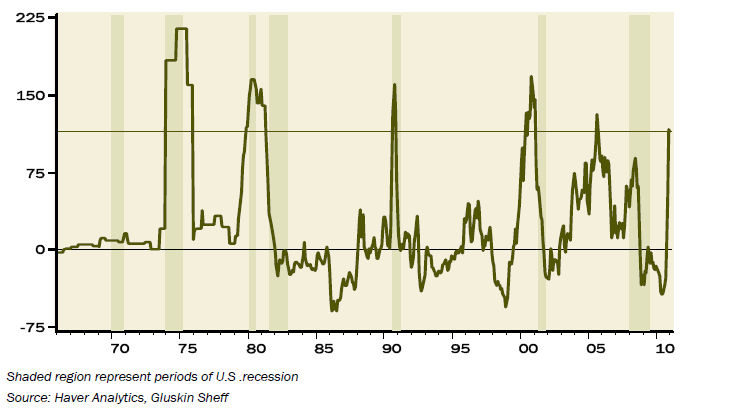
What Does Oil Doubling in 2 Years Mean?
David Rosenberg of Gluskin Sheff calls the current doubling in the spot price of oil a “game changer:
“There have been only five times in the past 70 years when this has
happened within a two-year time frame: January 1974, November 1979,
September 1990, June 2000, and August 2005. And now, December 2010. . . .Of the five instances cited above, all but one involved a recession for the U.S.
economy and that was in 2005 during the height of the credit and housing
boom, which acted as a huge offset. But oil prices did keep rising and managed
to outlast the euphoria in credit and residential real estate, so the recession may
have been delayed at the peak of the ‘growth rate’ in the oil price, but it was not
derailed as history shows.”
I must admit: I have never seen that analysis previously. Dave’s trailing 24 month oil chart is below
>


Tweet
Facebook
Reddit
Digg this!


March 4th, 2011 at 11:37 am
David Rosenberg — “calling the recession every year since 800 on SPX”.
This is gonna get even more painful for him. Someone please put him out of his misery.
PS – The analysis is SO F-ING BAD… Why does he just ignore that oil was at 140+ in 2008 (so its down 30%!?!) Or that is was at $82 in the summer of 2009… so in 18 months, its up $20 with some geopolitical stuff. This is a zero.
March 4th, 2011 at 12:00 pm
Anyone who does not learn from history is doomed to repeat it.
It might keep going up…for a while…BUT..
I love the smell of fried traders in the morning…..
March 4th, 2011 at 12:14 pm
Oil’s spike is short term – due to Libyan civil war – which will end soon. The broken nation will be shipping oil flat out to pay for their reconstruction.
That David Rosenberg is still uber-bearish is good, when he goes bullish, sell everything.
March 4th, 2011 at 12:20 pm
It’s clearly another bubble, but the analysis isn’t completely off-base. The most accurate thing that can be said is that energy prices have a great bearing on the overall economy, which we all already knew anyway.
IF, and I mean IF, we were on an actual recovery pattern in this country, this oil spike could have real bad effects. As it stands, it’s only going to slow back down any momentum we might have had. It was neglible in most industries and markets anyway, except the Wall Street boys.
March 4th, 2011 at 12:33 pm
It means oil dipped to extraordinary lows due to the recession and is now back to normal.
Get used to it.
And support renewable energy initiatives.
March 4th, 2011 at 12:35 pm
@cognos-Rosenberg straps it on every day (has been for almost two decades) and advances his position based on real data…take what you wish from it. The firms he has practiced his trade with are are top shelf. Please grace all of us with your esteemed qualifications and past market calls.
March 4th, 2011 at 1:04 pm
We need oil at $200 or $300 to give us the incentive to wean off our Arab suppliers.
March 4th, 2011 at 1:08 pm
Of course, oil is not the only commodity rising sharply. Many, if not most, are.
IMHO, there are various aspects of this “inflationary episode” that are particularly dangerous. One aspect is the growth rate disparity as seen, among other measures, in the “prices paid” vs. “prices received.”
For those interested, I recently wrote a blog post on the issue – it can be found at this link:
http://economicgreenfield.blogspot.com/2011/02/changing-dynamics-underlying-profit.html
March 4th, 2011 at 1:40 pm
Sure but a few questions on the “history rhymes” theme:
1. Did the economy have the slack/output gap (as measured by output gap, unemployment and cap util) in 2000 and 1990 that is does now? I doubt it.
2. Was wage push inflation a big deal in the 70s? Yes.
3. Is it now? No.
4. Is the substitution effect greater now than it was before? Yes.
5. Is the economy less defendant on energy and energy inputs now than then? Yes.
6. Are all energy prices correlated to oil, as they were in most of those times? No. See LNG etc
March 4th, 2011 at 1:44 pm
Ted, you are so right about other commodities going up in unison. There is plenty of inflation right now, but it gets ignored largely by those who report on it officially. It’s going to be pretty hard to ignore at some point.
But oil is the big one, because all of those other commodities have oil’s cost built into them. Wheat doesn’t have gold’s cost built in. Furthermore, the psychology of oil going up is seen in bright, big numbers on the drive to work and the drive home everyday. If wheat’s price was displayed that easily, there’d be more hand-wringing and gnashing of teeth over that commodity, too.
March 4th, 2011 at 1:48 pm
It will do more than it should as is always the case. Most long term purchase agreements are hedged from the well to the pump and it’s not as if spot buying goes up when prices rise….. unless your a pure speculator never planing to take delivery or swap.
March 4th, 2011 at 2:04 pm
It’s likely the recessionary outcome would be similar to the other prior examples Rosenberg cites if QE2 were not in effect. The distortion from QE2 is probably similar to the tailwinds provided by the easy credit heading into the 2007 equity market highs.
We may not get our next recession started until sometime in 2012.
Meanwhile, the current trading box on WTIC runs from $100 to $110, and resistance is pretty thin above $110.
While the spike in WTIC from $130 to $148 in summer 2008 was probably due to a margin call on a large short position, it’s likely if WTIC reached $130 this time it would continue to be chased by momentum traders anticipating a test of the $148 double top area.
There is some minor backwardation on the forward month WTIC contracts, but nothing to the extent we saw in summer 2008 prior to the peak in WTIC. This suggests a continued bullish outlook for WTIC.
When WTIC is ready to reverse down hard like it did in 2008, we will probably once again be pre-warned by the same massive futures differential that existed once WTIC hit $125/bbl in summer 2008.
March 4th, 2011 at 2:40 pm
It means that no one knows what anything is worth, anymore.
March 4th, 2011 at 2:53 pm
> VennData: That David Rosenberg is still uber-bearish is good, when he goes bullish, sell everything.
I love this one. +1
> Thalmus: We need oil at $200 or $300 to give us the incentive to wean off our Arab suppliers.
True. Things need to get worse before they can get better. Politicians always need a big crisis to reform things.
March 4th, 2011 at 3:03 pm
It means, recession, demand destruction, lower prices, recovery, increase prices, etc.
March 4th, 2011 at 3:10 pm
ashpelham2 -
Where is this “inflation” you speak of?
HOUSE PRICES are down! (thats 40% of my consumption basket)
LABOR and SERVICES prices are down (thats another 40% of my consumption basket)
The things that are up… oil, some agricultural commodities, healthcare and education are around 20% of my consumption basket.
PS – Many, such as oil (-30%) are well below peaks in 2008… so they are still deflationary in the medium term.
March 4th, 2011 at 3:11 pm
Seriously… everything someone says, “inflation” — please say, “where are house prices?”
March 4th, 2011 at 5:08 pm
cognose,
The inflation is there. Check gas. Check gold and silver. Check commodities. Check food prices. Check healthcare. Check the stock markets. Check residential rents. Houses are down? Well, so is pets.com (forever). Housing for sale was the last bubble. It will drag average prices for a while, but unless GAAPs return to mark to market and/or the banks decide to liquidate their shadow inventory (neither of which is likely), we have price inflation, generally. Wages also continue to stagnate or deflate, but that loss of actual purchasing power (as opposed to access to more debt) makes the effect of inflation in consumables that much worse.
Seriously. When someone says “deflation” — please say, – “my goodness, you must not get out much!”
March 4th, 2011 at 5:44 pm
The consumer class, for the most part, has inflation in the things they need, and deflation in the things they own (houses). Since housing is such a big chunk of the official inflation number it balances out to a reported “lack of inflation”. However, in reality the “relief” from cheaper housing does not apply to most of them because they already own a home. If you were a homeowner in 2006 your cost for housing does not go down just because a 300K house from 2006 now can be had for 200K. So you get to feel the inflation in the things you need without getting the relief from cheaper house prices.
March 4th, 2011 at 6:25 pm
@DeDude,
Well stated. Our consumables have become more expensive and durables less valuable.
I wish people would stop railing about sustainable energy to replace oil. A local project installed a windmill at a city park. When you compare the cost of the windmill to power generating capacity, it will take more than 50 YEARS to recover the cost.
Now, feeling good is nice, but I’m struck by how spending $50,000 to generate $120 a year in power is considered a ‘worthy idea.’
It sounds stupid to me. Just like how people think we import oil from the Middle East.
Did anyone tell you folks that most of our ‘imported’ oil is imported from CANADA?!!!
Sheesh!
March 4th, 2011 at 6:27 pm
That is actually one of the main places where the official inflation calculation detaches from a lot of peoples reality. That 40% of the inflation basket that is housing has some very different realities for different people. A young person looking to purchase their first home and a person already owning their home have completely different inflation “experiences” when house prices change. Similarly the person owning without a loan and the person owning with a big loan and the young person looking to purchase their first home have different inflation experiences when interest rates change. Right now the positive effects of falling house prices on inflation experiences of a small minority is calculated into the inflation numbers applied to everybody – and most people look at that number and say WTF.
March 4th, 2011 at 10:21 pm
looks to me like that chart proves one thing: you need a 150% rise to trigger a recession. not there yet.
March 5th, 2011 at 3:12 am
cognos… the still tattered remnants of the US housing bubble is only one part of a very huge picture.
You say “things that are up… oil, some agricultural commodities, healthcare and education are around 20% of my consumption basket”, but in less wealthy parts of the world there are people who spend nearly everything they make on basic food. They have no real discretionary spending to “cut back” when they can’t afford the most basic foodstuffs.
The big wave of inflation that’s building globally hasn’t really hit the shores of NA yet either. But it will. Only an isolated and totally self sufficient nation could ever hope to avoid it.
When people can’t afford basic food to keep their families alive there will be a lot more global instability than there is now. And that will do nothing but catapult global commodity prices higher.
Meanwhile, the fed continues with QE, QE2, QEx… because they can’t stop for fear of slipping back into recession (as though it was somehow ever over). And an unavoidable consequence of that is the loss of buying power of the dollar – aka inflation.
I don’t for a moment think I can personally change any of this, but I want to be aware & educated enough about what’s going on so that I can come out ahead rather than be blind-sided & broke 5 years on from now.
March 5th, 2011 at 9:58 am
Real life example:
1) Assume a couple in their early sixties living in Massachusetts in their own home with no mortgage, with a frugal lifestyle and making about $65,000 gross a year, with a take-home of about $50,000 (and driving two Prius’s).
2) The “minimum credible” health insurance in Mass for this couple costs $1,120 per month – $13,440 per year, or 27% of their take-home (and deductibles and co-pays are on top of that). This is an increase of 11.2% from 2010. This increase alone represents about a 3% inflation of their total expenses over 2010. (An alternative would be to go without insurance.)
3) Many homes in the NE heat with oil. The current delivered price for heating oil is now around $3.65. If that price were to hold in the long term, for the average NE home use of 900 gallons per year, that would be a total of $3300. This is an increase of about $600 – $700 over the average amount that would have been paid last season.
4) All other costs are creeping up every year – property taxes, car repair and maintenance. And soon food will be showing big increases (?).
5) There is definitely an inflation bite and if you don’t have the ability to match inflation with wage increases to keep up, or you don’t have significant savings/investment/retirement reserves (i.e., > $500K), you may be looking at some involuntary lifestyle changes.
6) Ergo: it’s an uncertain world (except for big bankers – bonuses guaranteed, by you and me).
March 5th, 2011 at 10:59 am
- No properly positioned wind turbine takes 50 years to pay off, placed in the right location they pay off in as little as 5 or less years.
- It’s no secret where wind blows: http://www.windpoweringamerica.gov/wind_maps.asp
The MidWest could clean up, if the “Republican” party was not Bought Out by Oil and Coal.
That’s free money being left on the table.
You could almost say that Exxon NOT Moving into wind was a BREACH of Fiduciary Duty to Shareholders.
- Home Heating Oil: is an Inelastic Demand, but buying a new car, a new home and lunch money, are more elastic. Lower car sales, home sales and sandwich sales go hand-in-hand with higher oil prices.
The Real Estate industry should take a good look at Oil Price Speculation, because it’s You that is getting clobbered.
March 5th, 2011 at 11:03 am
We are in the Game of Life:
http://www.bitstorm.org/gameoflife/
We are at the END of a 200 year population Boom, fueled by wood, coal, and oil.
If we do not find Clean Energy alternatives today, we will END the game in FAILURE, like All Population Explosions.
March 5th, 2011 at 2:01 pm
It is myopic to think of the oil price doubling in two years… a more insightful analysis is to view the last couple years as a temporary respite in an inexorable price increase which has already risen by 1000% over the last 10 years… and which is likely to continue rising as, for the first time in our history, our ability to extract crude oil is no longer able to keep up with demand.
March 5th, 2011 at 2:53 pm
[...] said, I came across some historical data over at the Big Picture that you may want to consider. Since we’re always talking about a process or rule-based [...]
March 6th, 2011 at 11:09 am
Wind Power. Yes, all well and good except the NIMBY principle is in full force. Remember the Nantucket (or was in Martha’s Vineyard) example? And here in VT, it’s tailor made for wind power….except that every environmentalist and New Yorker w their second home screams bloody murder if a site comes up for development. So it will never happen. 17th Cent Holland had more windmills that we do today.
March 6th, 2011 at 3:34 pm
cthwaites,
Nantucket opposition was funded by Koch Industries.
Including money to Indian tribes.
The “opposition” is a Fraud.