
Skip to comments

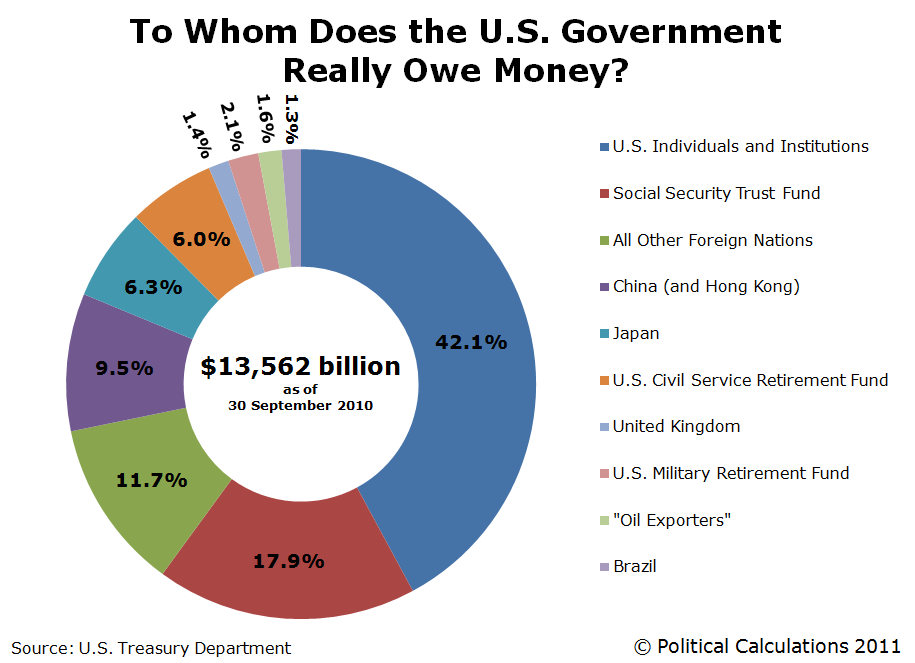
Its been a few months, and its time to update this chart of US Debt Holders from Political Calculations.

In the Think Tank this morning, Jim Bianco looks at the related question “What Will Be Sold To Pay For Japanese Reconstruction?

Here’s Political Calculation’s chart:

>
>

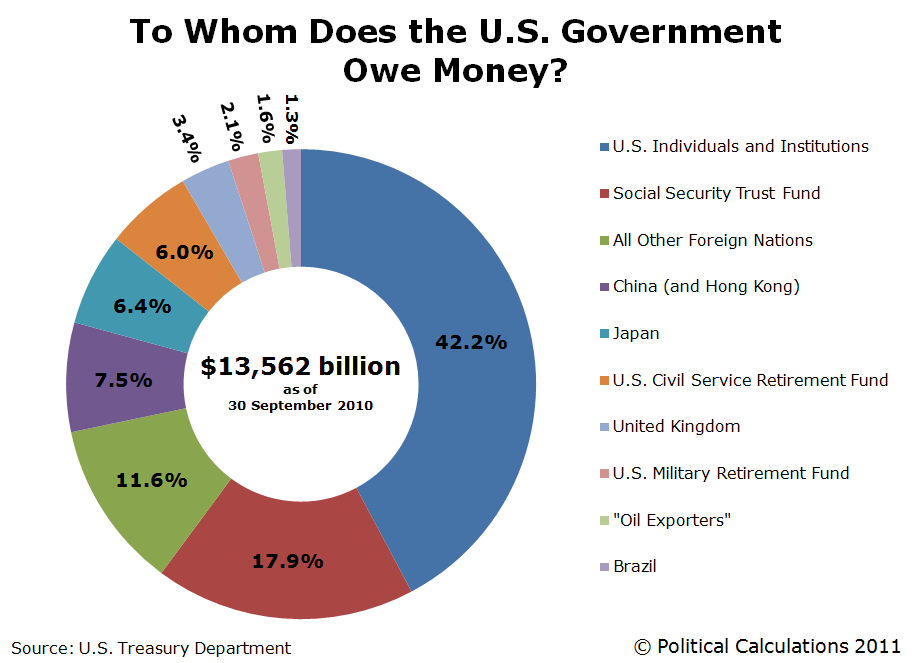
The main differences from the chart we previously featured are that China’s holdings are much greater — since we showed this chart back in January, China’s holding’s rose from 7.5% to 9.5% –  and they now hold more US treasuries than does the U.S. Federal Reserve . . .

>
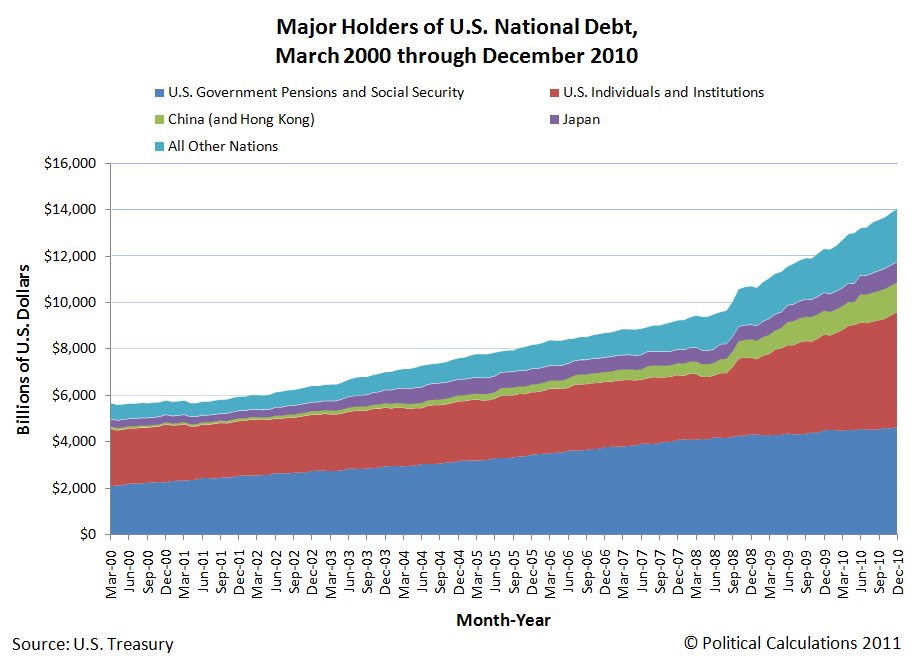
Last, if you want to see how this has changed over time, try this graph:
Via Political Calculations.

>

Previously:
Is China Really Funding the US Debt? (January 14th, 2011)

Source:
To Whom Does the U.S. Government Really Owe Money?
Political Calculations, March 15, 2011

http://politicalcalculations.blogspot.com/2011/03/to-whom-does-us-government-really-owe.html

20 Comments

  1. Ivan71said:
    At March 17, 2011 12:11 pm

    Except that, according to that chart, the data is as of Sept 30, 2010. I think QE2 has changed that just a tad, in the direction of the Federal Reserve over China. And Japan. Maybe even together.

  2. curbyourrisksaid:
    At March 17, 2011 12:45 pm

    Unless China has some done recent big time buying, I believe the FED is the largest individual holder of US Treasuries….

  3. curbyourrisksaid:
    At March 17, 2011 12:47 pm

    http://1776nation.com/article.php?id=48

  4. dnquiggssaid:
    At March 17, 2011 1:04 pm

    It would be interesting to compare this chart with a survey of who the average American thought owned US Treasury debt. My guess is that China would poll at about 40%.

  5. Ivan71said:
    At March 17, 2011 1:22 pm

    Right, that’s what I thought.

  6. RWsaid:
    At March 17, 2011 1:36 pm

    And yet the cost of funds for the USA has been falling for years and currently is nearly as low as it has ever been. It is not just the Fed — the numbers involved absolutely dwarf their balance sheet — it is global demand for assets that are still seen by everyone other than a few diehards as low or no risk.

    No need for arcane theories or fruitless desire for a moral credit market or dire predictions: This is global demand for low/no-risk assets, it is huge and growing, and the USA is one of the very few players on the world stage that can satisfy it.

  7. budhak0nsaid:
    At March 17, 2011 1:45 pm

    Never claiming to be a resident expert on the Fed, to me, personally , and I have absolutely no idea what possible value this could have to an individual’s holdings whatsoever…..

    but since we’re playing Macro games… What possible difference would it make how much of the US Treasury market the Fed held?

    If the banking system has access to the Fed whenever they need it , and therefore whenever business is ramping up to create actual assets ( Buildings, equipment, housing, etc) , so long as the banks (who like it or not are always the middle men between those actually building real things) always have the option to go back and borrow from the Fed. What possible difference does it make exactly what the Fed’s holdings actually are?

    It’s not like we’re on the Gold Standard. Like I said, I’m no expert.

    But seriously what’s the difference? I can see for people with substantial holdings how the Fed just printing money leads to a possible devaluation of the current value of their holdings…..etc..

    But I just can’t see from an individual’s perspective what possible difference it could make what the Fed actually holds or doesn’t hold.

  8. obsvr-1said:
    At March 17, 2011 2:36 pm

    @budhakon … but since we’re playing Macro games… What possible difference would it make how much of the US Treasury market the Fed held? …

    —reply

    When the FED holds the Trsy’s the interest paid on those bonds is remitted back to the treasury. This effectively reduces the interest payments on the debt, the larger the percentage of Trsy’s held by the FED the lower the real interest rate on the debt.

    The incestuous relationship between the US Treasury and the FED is a mess and fosters corruption. The US bond market is a hold over from the gold standard days when the US dollar was convertible into gold, so when the gov’t needed to spend into deficit it had to borrow, sell US treasury bonds. Since the elimination of convertibility into gold, with the last vestige severed in 1971 by Nixon administration, there is no longer any real need for the US bond market. The gov’t can spend fiat money independent of the bond market and without limitation (other than toothless debt cap limits). The banking cartel that created the FED has lobbied to keep the bond market as a perpetual wealth transfer machine. The banks make money on fees, spreads in the bond market and transfer inflation by spreading the monetary devaluation over time into the bonds.

    When the FED buys the bonds, the real interest rate the gov’t pays goes to zero. So why not just eliminate the US bond market and debt based fiat money. Transition to a fiat US Dollar that is spent into existence, eliminate the FED as they would be rendered useless, absorb the economic analysis, statistics, regulation and operations (clearing, etc) of the FED into the US Treasury. Establish fiscal discipline by constraining gov’t spending to a percentage of GDP with deficit limitations. As bonds mature provide US Dollars at redemption and do not issue new Bonds (no rollover of debt).

    Out of this incestuous relationship come the secret game (fraud, scam) of the Gov’t trust funds (SS, Gov’t pension, etc) these are larded up with US Trsy’s bonds . Take SS, first the payroll tax takes 12.4% from the worker, with surplus funds held in the SS trust fund “lock box”. Then those “lock box” funds are used to purchase NON-Marketable US Bonds from the US Treasury. The SS money is moved to the US treasury general fund to soften the deficit. When the US treasury pays interest on those bonds in the trust fund, the taxpayer pays that interest since the gov’t is in perpetual deficit spending (second tax for SS). Now for the grand screw job, when the bond matures or if SS needs money for benefit payments where does the US Treasury get the money for redemption, the taxpayer again since the gov’t is in perpetual deficit (third tax for SS).

    These mult-trillion dollar ponzi schemes need to end or be massively reformed. It is no wonder why the income and wealth disparity between the top .1% and the 99.9% is at record levels and growing. It is time to take the tools away from the money elite and out of politics (the kleptocracy) or else we will continue to spiral into the black hole of the oligarchy.

  9. curbyourrisksaid:
    At March 17, 2011 2:49 pm

    I think it is important to note how much debt the FED holds. If need be, that gives the Treasury an ample target of who needs to be selectively defaulted on in case payment must be made to foreign nations.

    The Treasury can simply say, the FED holding are now ZERO……tax payers be damned.

  10. Thorsaid:
    At March 17, 2011 3:10 pm

    How much of this increase is due to the trade deficit? Or perhaps their continued push to maintain their currency peg?

  11. willid3said:
    At March 17, 2011 3:50 pm

    well obsvr-1, eliminating SS essentially eliminates any chance of the lower 99% of workers retiring ever. so far we have pensions. they did work, but they are going away because employers can’t manage them well (even though in many cases when managed well, they actually make money for the company). then we have 401k and IRA. these were really designed for executives and upper management. they work if you can contribute non stop for 30 years, and the market doesn’t do any thing but go up. otherwise they will fail. with the 2 mandatory requirements, we have a system that will fail. and has been failing mostly since it was created. eliminating Medicare is actually worse. if you are over 65, the chances of getting health insurance that actually does some thing is nil. its why it was created in the 1st place. because as we get older, we will need more care. the body just starts to break down, how fast depends on how well you treated your body. and your genes. the 1st you can control, the 2nd you have 0 control over.

  12. willid3said:
    At March 17, 2011 3:52 pm

    curbyourrisk, do we really want to default at all? that will eliminate the gold standard that we have now. as nobody will believe that you won’t default on them too. its the same issue you get into with the SS trust fund. who would believe you will pay your debt back if you won’t the owners of the country back?

  13. endorendilsaid:
    At March 17, 2011 3:57 pm

    So about 65% of the federal debt is owned domestically.

    I assume that the debt load from state and local governments is not included? If it were, how much more of the debt would be held domestically?

  14. socaljoesaid:
    At March 17, 2011 4:07 pm

    Current owners of the debt can’t sell without someone else buying…the security will continue to exist after the transaction. The real question is who has been buying newly issued debt recently and who is likely to be buying in the future? In other words, how well subscribed will treasury auctions be and to what level must the interest rate rise to attract buyers for over $1 trillion per year of new debt for as far as the eye can see?

    I also wonder, as far as global inflation is concerned, does it really matter if the new debt is purchased by money printed out of thin air by the FED or money printed out of thin air by some other central bank?

  15. roger ericksonsaid:
    At March 17, 2011 6:49 pm

    > The real question is who has been buying newly issued debt recently
    > and who is likely to be buying in the future?

    Glad someone at least asked an intelligent question.

    ALL (& I do mean all) of the following occurs “By law”:
    Congress appropriates currency to match what the USA decides to do – regardless (that’s what “fiat” means);
    the FED credits the Treasury’s account at the FED with the specified amount;
    the Treasury issues bonds to match any amount in excess of what’s recovered from last year’s issuance (taxes);
    Primary Dealers buy ALL of those bonds from the FED (yes, to the penny, by law)
    then the PD’s may or may not sell those bonds to any marks, er …
    (I mean, anyone willing to hold minimal return securities; why? don’t ask)

    What this should drive home is that an issuer of a Sovereign, Fiat, non-convertible, floating-FX currency manages a real-goods (or more accurately, “real-intent”) budget, and issues it’s currency ONLY as fiat, internal bookkeeping numerals.

    Currency USERS, on the other hand, use their nation’s fiat currency as an accurate proxy for local real goods budgets.

    For the last time, quit confusing the semantics of “budget” across currency-issuers and currency-users. The two are completely different, and the meaning of the word is different in the two contexts.

    References:

    http://www.netrootsmass.net/fiscal-sustainability-teach-in-and-counter-conference/stephanie-kelton-are-there-spending-constraints-on-governments-sovereign-in-their-currency/

    http://www.u-s-history.com/pages/h256.html

    A few of the questions any astute electorate should be asking:

    What would happen if no one wanted to buy US Treasuries from the Primary Dealers? (Answ: “Nothing.”)

    What would happen if the Treasury even stopped selling Treasury bonds? (Answ: “Nothing.”)

    T-bond sales are simply a habit left over from Gold-Std days. They’ve been obsolete since 1933.
    You can quote Beardsley Ruml on that: http://tinyurl.com/y3dkda3

    So, to finally answer Barry’s question: to whom does the US owe “money” to?
    Short answer: anyone who ends up holding a T-bond can turn it in for more fiat credit in an acct at the FED.
    Long answer: no one we can’t pay off, no matter how much of our “fiat” bonds they buy
    (what fool would invest in fiat?)

    Barry, you keep saying that Warren Mosler’s “math” doesn’t add up. That’s because you keep trying to “add up” nominal currency tactics when the missing perspective involves fiat currency strategy and operations. Try reading his book before wasting time on irrelevant fiat math.

  16. DeDudesaid:
    At March 17, 2011 8:07 pm

    The social security trust fund has been left out of the debt, yet the military retirement fund is not?

  17. DeDudesaid:
    At March 17, 2011 8:09 pm

    Me blind – sorry

  18. Greg0658said:
    At March 18, 2011 4:48 am

    RW at:
    http://www.ritholtz.com/blog/2011/03/who-does-the-us-owe-money-to/#comment-529031

    do you mean money pile pushing is a demand trend setter all on its own ? hum … laborers laborers laborers .. widgeters widgeters widgeters

  19. Gross Federal Debt as a % of GDP | The Big Picturesaid:
    At March 18, 2011 11:32 am

    [...] light of yesterday’s charts on US debt (Who Does the US Owe Money To?), let’s take a quick look at two more, via Ron Griess of The Chart [...]

  20. [...] some other interesting figures: one portraying the gross federal debt in three different ways and another breaking the gross debt down by holder. Ritholtz’s figures use data from the U.S. Treasury Department. Note that the gross debt, [...]

Sorry, the comment form is closed at this time.