
Attention WSJ OpEd: Correction Needed

Email this post Print this post
By Invictus - April 4th, 2011, 9:15AM

Invictus here, requesting a correction from the WSJ.

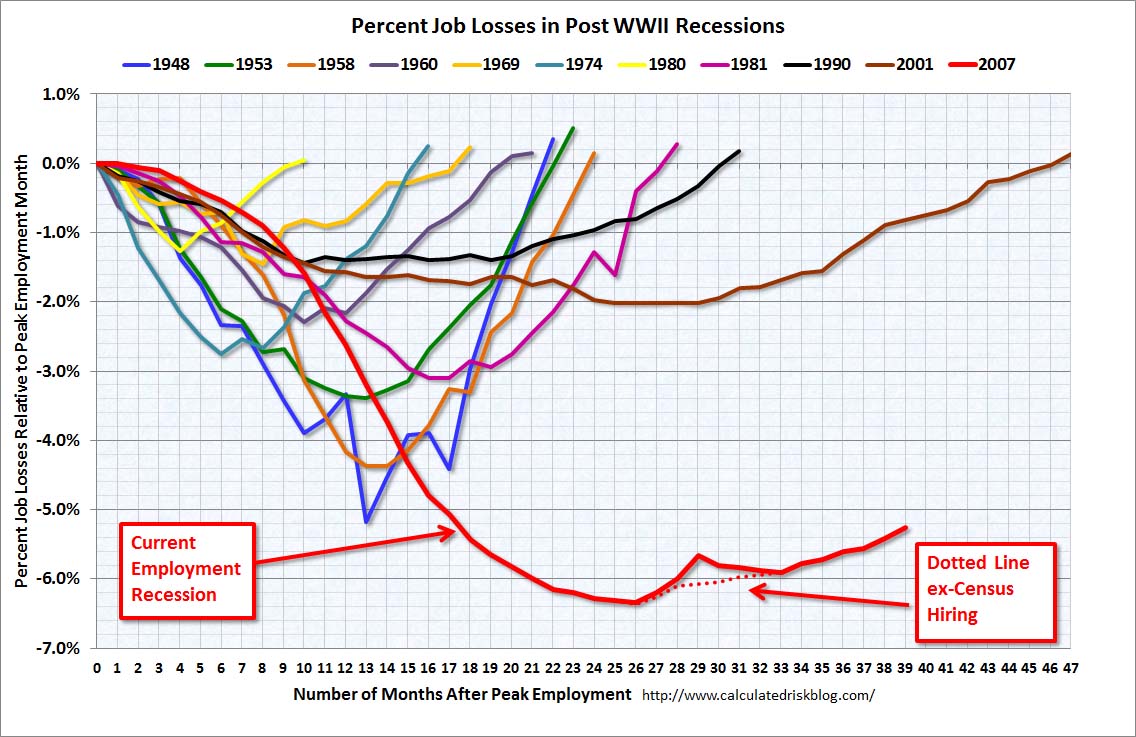
In an editorial on Saturday, the WSJ made the following demonstrably false claim, using a slightly modified Calculated Risk (Bill McBride) employment graph (emphasis mine):

The nearby chart compares the recovery rate in jobs after each of the last four recessions, and so far this one has been by far the weakest.

Unfortunately for the Journal, Bill’s chart does not represent what they say it represents, and they know it, or at least they should — Bill is a meticulous chart keeper.  Bill’s chart indexes employment to peaks, not troughs, which is to say recessions’ inceptions, not their ends.  Note Bill’s legend:  “Number of Months After Peak Employment”:
A chart that does represent what the Journal claims they’re showing (i.e. “the recovery rate in jobs after each of the last four recessions”)  is immediately below.  I’m using private payrolls only because we all know — and surely the Journal agrees — that the only good government employee is an unemployed government employee.

So let’s use the St. Louis Fed’s USPRIV — private payrolls only. [BR: That also will remove census noise]   And let’s look what has actually transpired “after” — Journal’s word, not mine — “each of the last four recessions”:
>
(Click through for larger)
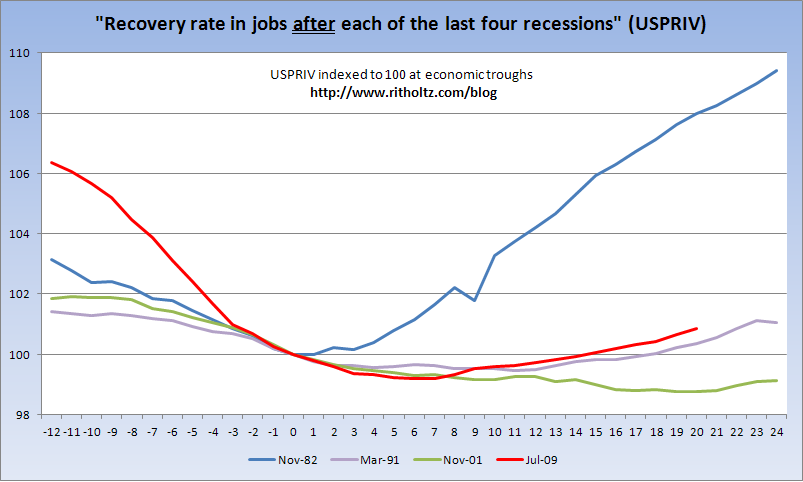
Source:  St. Louis Fed Expansion Charts

So, in fact, the previous two jobs recoveries were actually weaker.  (Using total nonfarm payrolls — FRED’s PAYEMS series, which includes those useless government workers — puts this recovery’s current level (100.4186) a smidge behind the ’91 recovery (100.6164) and still ahead of the 2001 recovery.)

I wrote previously — in September 2010 — about this exact issue, asking in that post:

If the economy is in recovery — a new cycle –  for the the past 13 (or so) months — “technical” or not — should we perhaps be looking at the employment situation relative to the trough now, and not to the last peak?

Now, to be crystal clear — if folks want to continue to look at metrics from the December 2007 economic peak, it is their prerogative to do so.  However, it is not their prerogative to claim they are presenting data comparing a metric “after” recessions when they are, in fact, doing nothing of the sort.  Of course, it must be pointed out that using the peaks portrays Obama in the worst possible light, while using the troughs — as I pointed out in September — demonstrates that this recovery is actually stronger than the last two.  But that is clearly not a message the Journal would ever care to convey.

I will not hold my breath waiting on their correction — you know, one in which they actually state that this jobs recovery is better than the previous two.

>

Previously:
Employment Indexed to Beginning/End of Recession (April 1st, 2011)

Comments

Please use the comments to demonstrate your own ignorance, unfamiliarity with empirical data, ability to repeat discredited memes, and lack of respect for scientific knowledge. Also, be sure to create straw men and argue against things I have neither said nor even implied. Any irrelevancies you can mention will also be appreciated. Lastly, kindly forgo all civility in your discourse . . . you are, after all, anonymous.

21 Responses to “Attention WSJ OpEd: Correction Needed”

  1. franklin411 Says:

    Is it an OpEd or an Editorial? I don’t think any newspaper issues corrections for Op-Eds, which are not written by the paper’s editorial board (unless, of course, the Op-Ed author requests it). Instead, they either publish letters from readers pointing out the mistake, or they publish an Op-Ed from another author countering the false claim.

    That said, I doubt they’ll correct it even if it’s an editorial. Remember Mein Kampf? Propaganda is not the search for truth, but rather an attempt to bend people’s anger to one’s will. =P

  2. MayorQuimby Says:

    1. While Invictus makes good points, we’ve added jobs simply by racking up the credit card. Paying the rent with debt and diluted printing of $$$$ is not a fair comparison with earlier recessions.

    2. Labor participation rate is flat and headed down (longer trend) while US debts are skyrocketing.

  3. Hugh Says:

    Invictus,

    You are technically right, they should have said “during and after” instead of “after”,but surely some of the difference is caused by the 2007-2009 recession lasting so long.

    As MayorQuimby says, the labour participation rate is most probably the best guide to what’s going on – and is doesn’t look too great.

    Invictus: Agreed that most of the difference is due to the length of the recession and the severity of the decline; I discussed that in previous posts. And yes, the labor force participation rate is a growing concern, though there are many reasons for its delcine, one of which is demographics. All of these comparisons — and I love the number crunching as much as the next guy — don’t address the fact that every business cycle has its own contours that cloud comparisons in the first place.

  4. louiswi Says:

    What do you expect from the print version of Faux News? They have bet the ranch on a failed recovery and will do what it takes to make their “dream come true”. I’m surprised you would even call attention to their rot.

  5. Greg0658 Says:

    BR adds “remove census noise” – what ? I spent it all ($900) back into the borders of the USA – it didn’t evaporate – I recycled it (ok I’m lie’g – I bought a new LED 24″ flat screen – I’m sure that cash exited the 50 states)

  6. Greg0658 Says:

    a couple other lies I gotta fess up to .. ya I bought some gasoline (probably went to the Middle East) + I paid taxes (probably went to freedom for the Middle East)

  7. Greg0658 Says:

    oh – I forgot to say “your welcome” in advance (ie collect data for you all to trade around + retool the voting district maps to game the next 10 years worth of elections)

  8. socaljoe Says:

    Since this is The Big Picture blog, let’s take a look at the big picture:

    US population between the ages of 20 and 64 = 185 million.

    US employment = 139 million.

    Number of unemployed americans of working age = 46 million

    Unemployment rate is 25%

  9. Fred C Dobbs Says:

    My goodness, a writer who is paid to write clearly makes a mistake, and omits the words “during and after,” when referring to another guy’s chart which is a picture, worth a thousand words that speaks for itself, independently of the writer. He or she leaves out two words, mistakenly. [Ockham's Rule, rules out the possibility it was not a mistake.] The mistake should have been caught by a proofreader, but wasn’t. Don’t you think it is unfair to blame the writer, and leave out the proofreader? Don’t you think calling for a correction isn’t strong enough? Why call for their resignations? And, what does their mistakes have to do with an invisible thing that exists only in peoples’ imagination, the Wall Street Journal. The name Wall Street Journal is just a short hand collective reference to a bunch of people like you and me and no one in particular, just like names for The Big Picture, The US Government (no matter who is supposed to be in charge, Bush or Obama), The New York Yankees etc. etc. etc. Just a bunch of people trying to get on with their lives. If we went through any newspaper and beat it with a bicycle chain and tortured it, we could find a lot of careless mistakes like this one. Why does highly-regarded The Big Picture make A Big Deal of out this evidently harmless mistake?

  10. ashpelham2 Says:

    socaljoe: could we get those same numbers for other periods of time? For example, 1934, any month, or 2002, any month? It’s about COMPARISONS, to me, regardless of the methodology. And for all those who say that “this time is different”: YOU are right. Things have changed.

  11. MikeG Says:

    In an editorial…the WSJ made the following demonstrably false claim

    In other news, the sun rose in the east this morning, and water is wet.

    The WSJ editorial page, as opposed to the news articles, is ‘Fox Newspaper’, a right-wing clown show for the rubes. Propaganda is not designed to fool the critical thinker, but only to give moral cowards an excuse not to think at all.

  12. MayorQuimby Says:

    “And yes, the labor force participation rate is a growing concern, though there are many reasons for its delcine, one of which is demographics.”

    It’s not just a growing concern. What good is an economy in which only 60% of the people are ABLE to participate?!

    Invictus: The aforementioned Calculated Risk has an outstanding post on the labor force participation rate here.

  13. louiswi Says:

    Consider the possibility that the unemployment rate in the 40′s and 50′s was closer to 50% using the argument of socaljo. Most women especially housewives weren’t in the “labor force during those decades. Granted, they did work like dogs more so than the men during those years.

  14. Monday links: meaningful exposure Abnormal Returns Says:

    [...] What do the jobs numbers actually say about the strength of this recovery?  (Big Picture) [...]

  15. socaljoe Says:

    ashpelham2, I have not researched historical numbers for comparison. I’m sure they are different, but one must be careful drawing conclusions. As louiswi correctly points out, there was a time when a family could prosper on one income and many women were not in the labor force. This is certainly not true today. More people remain single and nearly all those who get married require two workers to make ends meet.

    Call me old fashioned, but I believe our society was more prosperous when a family could exists on one income and the children were raised by their natural parents.

  16. Andy T Says:

    Is this really what this blog has come down to? Taking shots at an “Editorial” in order to defend Obama?

    Really?

  17. louiswi Says:

    Andy T:

    Huh?

  18. riverrat Says:

    Andy T:

    I don’t think this blog has “come down to” anything other than what it’s been as long as I’ve read it (a couple of years): a source of objective, fact and data-driven analysis of economic and financial news.

    As such, the blog content providers sometimes call out particularly egregious examples of incomplete, inaccurate or biased reporting or commentary in other widely-distributed sources of economic and financial information.

    This “correcting of the record” is one of the most valuable things about TBP.

  19. davepez Says:

    US population between the ages of 20 and 64 = 185 million.

    US employment = 139 million.

    Number of unemployed americans of working age = 46 million

    Unemployment rate is 25%

    There are families that are single income by choice, so your generalization is a little off target.

  20. socaljoe Says:

    Davepez… the unemployment rate of working age Americans is 25%.

    I did not comment on the reason for the unemployment. As you say, some of it is voluntary… some not.

    One way or another, 75% of working age Americans have to provide not just for themselves, but also for the 25% who are not working for whatever reason.

    If you include children and retired folks, 139 million workers are supporting 309 million people.

    That’s the big picture.

    I also feel a high unemployment rate is not necessarily bad. A prosperous society were a family can exist on a single income is a good thing. Unfortunately, this is increasingly uncommon today.

  21. dhukka Says:

    Another way to look at the recovery in employment would be to measure from the trough in employment rather than the trough of the recession. On that score this employment recovery has indeed been the weakest.

70 queries. 0.456 seconds.