
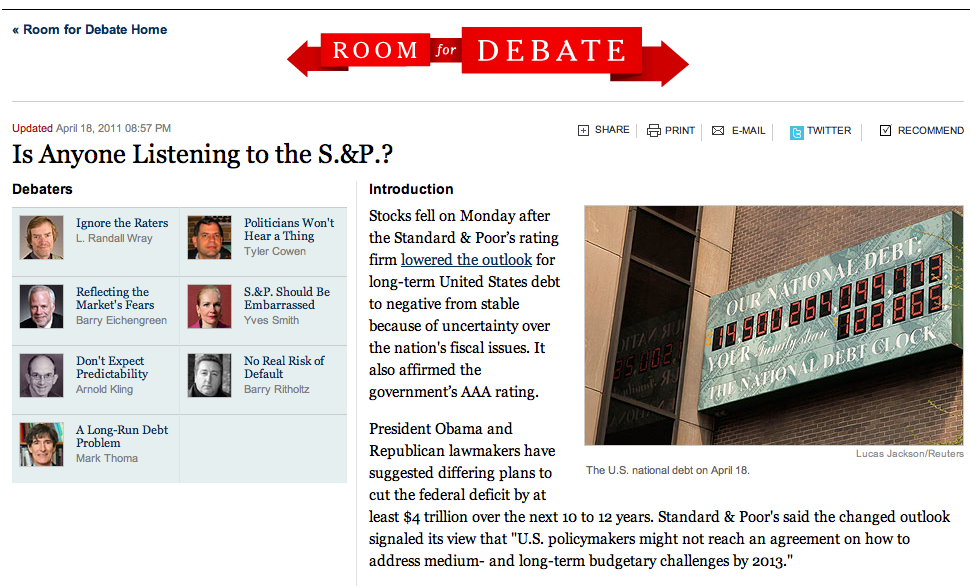
Is Anyone Listening to the S&P?

Email this post Print this post
By Barry Ritholtz - April 19th, 2011, 9:15AM

>

I participated in this online discussion last night about S&P’s downgrade/negative watch of US debt. My piece is here.

>

Source:
Is Anyone Listening to the S.&P.?
Room for Debate, April 18, 2011 08:57 PM
http://www.nytimes.com/roomfordebate/2011/04/18/is-anyone-listening-to-the-standard-poors

Comments

Please use the comments to demonstrate your own ignorance, unfamiliarity with empirical data, ability to repeat discredited memes, and lack of respect for scientific knowledge. Also, be sure to create straw men and argue against things I have neither said nor even implied. Any irrelevancies you can mention will also be appreciated. Lastly, kindly forgo all civility in your discourse . . . you are, after all, anonymous.

12 Responses to “Is Anyone Listening to the S&P?”

  1. franklin411 Says:

    Fantastic comments!

  2. contrabandista13 Says:

    In your comment, you articulated the exact thoughts that went through my mind the minute I heard it…

    I dismissed it as a politically motivated public relations stunt…..

    Let me articulate something that you couldn’t in the NYT… What a bunch of douche bags….!

  3. rktbrkr Says:

    We can debate the credibility of the ratings agencies but we can’t stay at record low interest rates forever, if they downgrade US borrowing costs go up faster and overwhelm cost cutting efforts.If we argue that the US can NEVER default then de-facto currency devaluation thru (hyper)inflation is the alternative solution. With default or formal devaluation we have someone to blame, runaway inflation can be blamed on others – speculators or Ben Bernanke who doesn’t have to run for reelection.

  4. beaufou Says:

    “The likely outcome is a big exchange-rate shift between those two groups. Generally, creditor countries that are running surpluses, whose growth is too strong and whose inflation pressure is too high, and that have linked exchange rates, will revalue their currencies in order to have independent monetary policies. Debtor countries that can’t print money will restructure their debts, and those that can print money will devalue their currencies. ”

    http://online.barrons.com/article/SB50001424052970203423404576186671576180048.html?mod=BOL_hpp_mag#articleTabs_panel_article%3D1

  5. Blurtman Says:

    “The single most important factor in the SEC staff’s assessment of NRSRO status is whether the rating agency is “nationally recognized” in the United States as an issuer of credible and reliable ratings by the predominant users of securities ratings.”

    Moody’s and S&P are now nationally recognized as NOT being an issuer of credible and reliable ratings. In fact, they are credited with having caused this economic crisis.

    So why didn’t Moody’s and S&P lose their NRSRO status?

  6. TK Says:

    I agree S&P is behind the curve on this. There is some utility though as a talking point though and if we need someone like S&P to state the obvious to Boehner etal, so be it. My one question is the public relations or propaganda roll-out of the story on Tax Day. There was no obvious difference in the situation on 4/18 from 3/18 or 2/18, so who ordered the Tax Day rollout? S&P for its own PR purposes? The Republican Party? Obama? The noisemakers on CNBC asked none of these questions, but rather treated it like a lightning bolt from the blue. Obama’s advisor, Goolsby, called it a “political judgment” by S&P that is not matched at present by Moody’s or Fitch. Qui bono?

  7. socaljoe Says:

    What’s the point? Everyone knows the US won’t “default” on it’s debt… they will screw their creditors with negative real interest rates and currency debasement. The rating agencies don’t address this form of default. It’s a diversion from the real issue, in my opinion.

  8. alnval Says:

    Glad you’re getting the message out there. That’s what’s really important these days given the speak, hear and see no evil posturing of the MSM. Oh for the days when right and wrong were relatively clear concepts that didn’t need to be presented in a fair and balanced way.

  9. Bruman Says:

    I haven’t read your piece yet, but my take on it is that many investors concluded that if a traditional laggard like S&P is making noises, then the day of reckoning may be sooner than originally planned. The main problem, however, is that there really is nowhere to go, except perhaps to move forward a bit on the yield curve. And perhaps the yellow metal, as long as you don’t need any income.

    Naturally the chance of a true default is unthinkable, given that it’s just as easy to print up new dollars to pay off debt (or have the Fed buy them up). There is, I suppose, a small chance that this can happen if the US issues debt and the Fed refuses to buy it, but that seems quite unlikely.

    It’s really at the moment that creditors demand that US Government debt be paid in other currencies (or indexed somehow) that the $ will really hit the fan.

  10. Livermore Shimervore Says:

    Yves Smith (almost sounds convincing):

    “The whole premise of the rating is incorrect. The U.S. may eventually experience unacceptable levels of inflation, but the experience of Japan shows that stop-and-start fiscal stimulus is more likely to result in protracted near-term deflation.

    Every time Japan tried to lower its public-debt-to-gross-domestic-product ratio by cutting spending, the resulting drop in economic activity actually made that ratio worse. We are seeing the same results in Ireland and Latvia. The United Kingdom tried the same experiment 10 times in the last 100 years, and every time it got the same results: cutting spending to reduce budget deficits results in a fall in G.D.P. that makes the debt burden worse, not better. “

  11. Livermore Shimervore Says:

    p.s.
    BR,
    Were ther other authors that got caught in the S&P/ McGraw Hill bullshit?

  12. beaufou Says:

    Not almost convincing unless some can’t take facts and reality for an answer, austerity is worse:
    http://www.thegildedcage.net/2011/03/austerity-is-the-definition-of-insanity-doing-the-same-thing-over-and-over-again-and-expecting-different-results/

66 queries. 0.396 seconds.