Mapping the US Credit/Housing Bubble
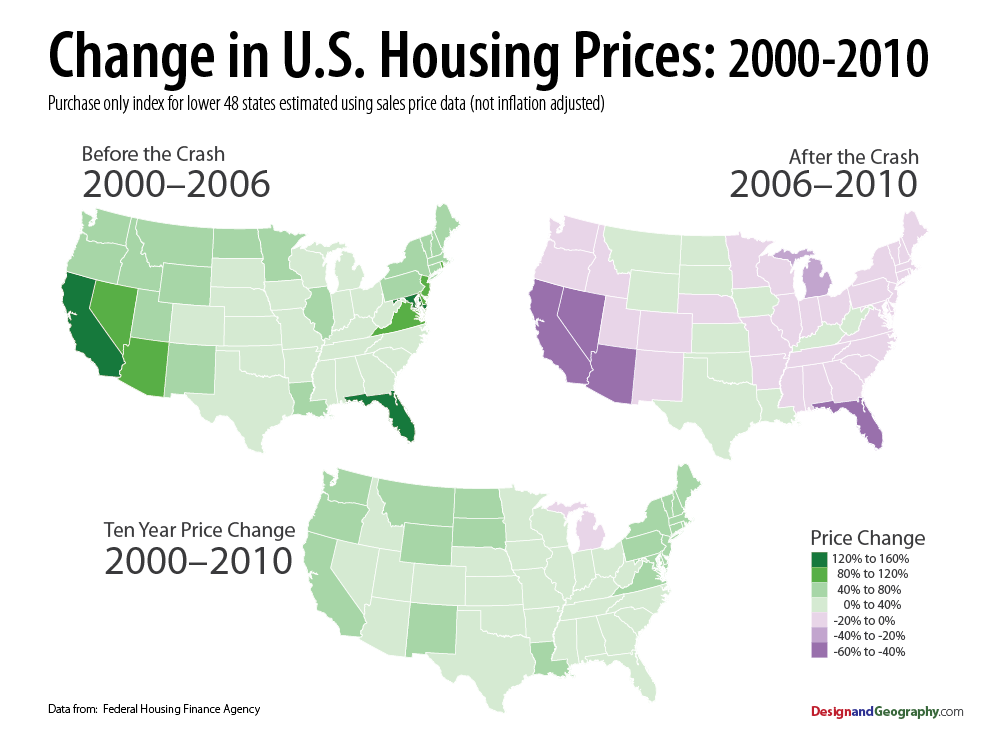
Great set of charts from Visualizing Economics, showing the 2000-06 period, the 2007-11 collapse, and the c0ombination of the two.
My one beef is with the phrase Housing Bubble. As the charts show, the bubble was very specifically limited to a handful of regions. Nationally, we had a Housing boom & bust — but the “bubble” was in Credit. This was thanks to Greenspan’s ultra-low rates, the abdication of lending standards, that were driven by the demand to feed the Wall Street securitization machine.
Anyhow, here is what the price changes look like mapped out:


Tweet
Facebook
Reddit
Digg this!


April 27th, 2011 at 12:00 pm
Michigan seems to:
a) be getting its ass kicked, and;
b) leading the nation in adjusting prices to the new reality.
Keeping in mind that wages for the vast majority of the working class (the bottom 98% to 99%) have been flat to declining, I expect more purple states should the map be redrawn in a year, or so.
I also don’t think we’re after the crash, yet. It’s in process (if it wasn’t, we’d be seeing a much faster sell-off of the housing inventory).
That said, a credit economy requires future income gains for economic growth, generally. That won’t happen, organically.
April 27th, 2011 at 12:04 pm
[...] Posted on April 27, 2011 by HOMEva Most policy makers think this is true unfortunately. Today’s best visual comes from Barry Ritholz’s post on mapping the US Credit/Housing bubble. If you look at [...]
April 27th, 2011 at 12:36 pm
Good evidence against the “jobs will bring back housing” argument. Job growth has been flat to slightly negative during the same period. It was all about easy money, even if the borrower didn’t have a job – or lied about it.
April 27th, 2011 at 12:41 pm
Spoke with someone in Michigan just the past weekend. They were going to show a house to a potential buyer – modest, but livable. The price? $10K!
April 27th, 2011 at 12:45 pm
The 10-yr price colors would be more interesting if -20% to +20% was 1 color.
A 0 to +40% price move in 10-yrs spans the long-term natural rate (+4%) and v v low rate of 0%.
IF housing is flat on 10-yrs… then inflation is v v low.
April 27th, 2011 at 1:09 pm
[...] Barry Ritholtz’s economics blog, there’s a very illustrative set of charts (courtesy of Visualizing Economics) that shows [...]
April 27th, 2011 at 3:27 pm
appears that the entire housing ‘boom’ was driven by easy credit. cause if you look at jobs and incomes for that same time period, you will see that they were either barely growing (jobs) at best, and incomes were in reverse, which tends to make one think that jobs weren’t really growing. and that easy credit was a creation of the banks and wall street who desperately needed it, or there would have been barely any income for them to ….
April 27th, 2011 at 10:33 pm
Interestingly: The 4 “bubble” states were also the ones that gave us the hanging chad (FL), tax referendums (CA), birthers (AZ), and legalized prostitution (NV).
Maybe the credit bubble just happened to be the thing that came along. These folks had plenty of crazy-tinder to light even without it.