
Missing Best & Worst Days in Markets

Email this post Print this post
By Barry Ritholtz - April 28th, 2011, 1:15PM

It has been a while since we last showed a Best & Worst days chart, so we are overdue for another update.

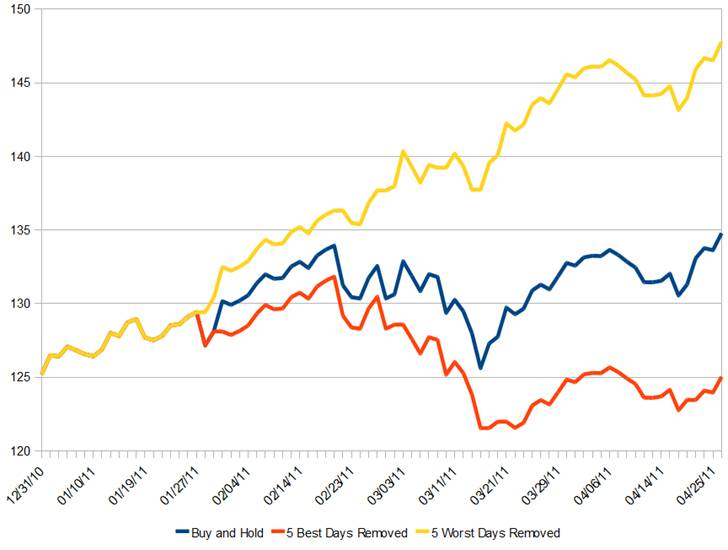
Today’s version is courtesy of Mike Gayed of Pension Partners, and it shows what your returns look like if you were merely a Buy & Hold investor, if you were unlucky enough to miss the 5 best days, or lucky enough to avoid the 5 worst ones:
>

Missing the 5 Best/Worst Days, S&P500
>

Previously:
Missing Best & Worst Days of S&P500 (September 2010)

Comments

Please use the comments to demonstrate your own ignorance, unfamiliarity with empirical data, ability to repeat discredited memes, and lack of respect for scientific knowledge. Also, be sure to create straw men and argue against things I have neither said nor even implied. Any irrelevancies you can mention will also be appreciated. Lastly, kindly forgo all civility in your discourse . . . you are, after all, anonymous.

20 Responses to “Missing Best & Worst Days in Markets”

  1. Fredex Says:

    The best and worst days seem to cluster together.

  2. foosion Says:

    What are we supposed to conclude from this? No one can reliably pick the best and worst days in advance unless they are very lucky. You might as well show a chart of the winnings of the average very lucky lottery player.

  3. KidDynamite Says:

    i wonder what it looks like if you miss the 5 best days AND the 5 worst days…

  4. pensionpartners Says:

    Fredex – you’re referring to something called “volatility clustering” which is a form of mean reversion – extreme down/up days tend to be followed by extreme opposite days in short time frames.

    Foosion – My point in creating this is to suggest that the year hasn’t been defined by a trend as much as we’re made to believe, but rather by just a small section of days.

    KidDynamite – great question – removing the best 5 and worst 5 days results in slightly better performance than the buy and hold (with less volatility of course).

    Michael A. Gayed, CFA

  5. Fredex Says:

    … Looks like buy and hold.

  6. Al_Czervik Says:

    @ Fredex,

    Yeah…buy and hold works when the bias is upward. I gather from the chart that YTD returns from B&H are attributable to the best 5 days.

    It would be interesting to see this type of analysis covering a large number of overlapping time-periods. My suspicion is that there is a workable risk-management strategy involving trying to avoid getting clobbered when the market tanks while capturing as much of the uptrends as possible. If you can see the 40%-50% declines coming and side-step most of it (even if you’re early), you can also afford to be less than fully invested when the market is climbing.

  7. machinehead Says:

    ‘Foosion – My point in creating this is to suggest that the year hasn’t been defined by a trend as much as we’re made to believe, but rather by just a small section of days.’

    What is mainly demonstrated by this exercise is the ‘fat tails’ phenomenon — that extreme daily moves occur more often than they would if daily returns were normally distributed according to a familiar bell curve.

    I’m not so sure about invalidating the trend, though. Imagine a plus/minus one percent daily circuit breaker. Then instead of ‘big move’ days, we would instead see runs of ‘limit up’ and ‘limit down’ days, as still occur in some commodities which have daily limits.

  8. smiddywesson Says:

    Thank you very much Michael. Foosion doesn’t like your chart, but I do. In fact I think it is the most important chart in trading. Your losers hurt you twice as much as your winners help you. If you lose 50% of your account, you have to make 100% to get back to zero. That tells you all you need to know about taking on too much risk or trying to pick bottoms and tops.

    Let’s take this to an extreme: Javier Estrada, from the University of Barcelona, wondered what would happen if you invested $100 in the Dow 12/31/1899 and examined your account on 12/31/2006. Buy and hold had a nice return, something like $26,000 if I remember correctly. If you missed the 100 best days during the century, you finished with a small loss, somewhere @ $82. However, the power of not losing money was demonstrated in the account that missed the 100 worse days which finished with a whopping $11,800,000. Sorry for the round figures, this is from memory.

    So Foosion, the chart tells me to trade safely and don’t worry about missing the best days.

    Foosion’s comments, ” You might as well show a chart of the winnings of the average very lucky lottery player.” overlook that price trends exist, that support and resistance exits, and the markets are anything but random. You have all the tools at your disposal to avoid the bad days. You aren’t going to miss all the bad days, but that is your goal.

    Warren Buffet’s first rule of investing is “Don’t lose money.” His second rule is “Don’t forget about rule number 1.” He’s rich for a reason. It is a very important chart.

  9. socaljoe Says:

    If your strategy is to buy and hold and invest in the SP500, you really shouldn’t be in the market.

    To make a good return, one needs to take advantage of opportunities that the market has not recognized… in other words, exploit the inefficient market. Buy and hold of SP500 can not accomplish this.

  10. smiddywesson Says:

    Al_Czervik’s question about whether there is a way to capture the gains during the five best days of this year is easy. Go back in time. Go to Harvard. Get hired by Goldman Sachs. Answer the phone when the central bank calls to tell you they are ramping the markets. Go all-in. Then try not to snicker when they report that 90% of the company’s profits came from THEIR TRADING DESK last year.

    This is not just an auction, it is also game of privilage and corruption. I’m not whining and this isn’t outrage, although I feel a little of both. This is just an extreme example of the price manipulation that goes on in all markets, and on all time frames. Treat it like an auction, and you get scammed. The first step in losing three card monte is believing it is a card game and not a scam. The greatest scam perpetuated on the public was the myth of buy and hold. The second greatest scam was inventing the mutual fund, a vehicle which requires the fund manager to step in and relieve big money of their shares during distribution, and then actually stay fully invested during the bear market. Absolutely ridiculous. The third greatest scam was to bail out the banks, and then manipulate price action so they could churn shares over and over to generate revenue and make them solvent. That’s why you are seeing so much volatility these days. Volatility is what is digging out the Goldman Sachs of the day with a little help from their friends in high places.

  11. amritsari Says:

    Mebane Faber (“The Ivy Portfolio”) talks about what happens if you miss best AND worst days. He quotes Paul Gire from “The journal of financial planning”. From 1984 to 1998, buy and hold returned 17.89% per year for the DOW, missing 10 best days returned 14.24%, missing worst ten days returned 24.17%, missing both 10 best and worst days returned 20.31%. Pretty Good, Huh ? The basic reason appears to be volatility clustering and he uses it to bolster his argument that one should be out of the market when your favorite index is below its 10 month SMA. Apparently the worst/best days happen when the index is below the average.

  12. Bruman Says:

    Any chance to see returns with both ends removed?

  13. pensionpartners Says:

    Again – with both ends removed you get slightly higher performance than the buy and hold scenario with less volatility. The purpose in presenting this is in suggesting that its hard to call this an up”trend” when only 5 days account for the year’s return.

  14. rktbrkr Says:

    Aren’t really bad days kind of out of the picture going forward with the post flash crash improvements? I forget the details but circuit breaks for individual stocks in addition to exchange averages.Also shorting limitations. All part of our brave new world where the regulators strive for high asset prices (just trying to maintain a fair market is so 90s y’know)

  15. rktbrkr Says:

    I still feel the flash crash stopping just an RCH short of -1000 and then rebounding was the work of the PPT

  16. pensionpartners Says:

    @Al_Czervik – you bring up an excellent point, which is why I think the discourse on “timing” the market should be more focused on timing volatility instead, since volatility clustering/extreme movements can often define buy and hold performance in entirety.

    @smiddywesson – much appreciated for your thoughts. “Your losers hurt you twice as much as your winners help you” echos the idea that the math of coming back from a loss is underestimated (down 50% = up 100% just to get back to break-even). There is a distinction though about removing best days from century long data, because with enough time the power of compounding those extreme days overwhelms anything. The point is that for just this year, where time is limited, extreme days have defined the “trend.” And btw – love the diatribe on scams!

    @socaljoe – that certainly is a strategy. However, I think one might be better served by thinking about inefficiencies not so much within an asset class, but rather across asset classes (which is a another way of looking at the volatility clustering phenomenon).

  17. socaljoe Says:

    Seems to me the best strategy is to take profit on the best days and add to your position on the worst days… using your fundamentally best asset class, sector, or stock… not the SP500.

  18. Bruman Says:

    pensionpartners, I see your point. But removing both just seems to be a sensible way to get at the effect of skew on extreme returns. It looks like the top 5 and bottom 5 days account for an enormous quantity of returns, but if they are roughly symmetric, is it not still sensible to call it an uptrend?

    I have no specific agenda here either way, I’m just thinking about the data.

  19. mathman Says:

    Here’s a pretty obvious clue as to the direction of the economy going forward:

    http://www.financialarmageddon.com/2011/04/bridge-for-sale-cheap.html#comments

    please check out the video by Case and Shiller and especially the comments.

  20. Making Sense Of Investment Advice « Leon Shivambers Blog Says:

    [...] missing the best five days or the worst 5 days in the market. One example is the chart below from The Big Picture which shows what happens if an investor held an investment throughout (the middle line), avoided [...]

69 queries. 0.364 seconds.