
Existing Home Sales Falter

Email this post Print this post
By Barry Ritholtz - May 19th, 2011, 12:00PM

click for ginormous graph
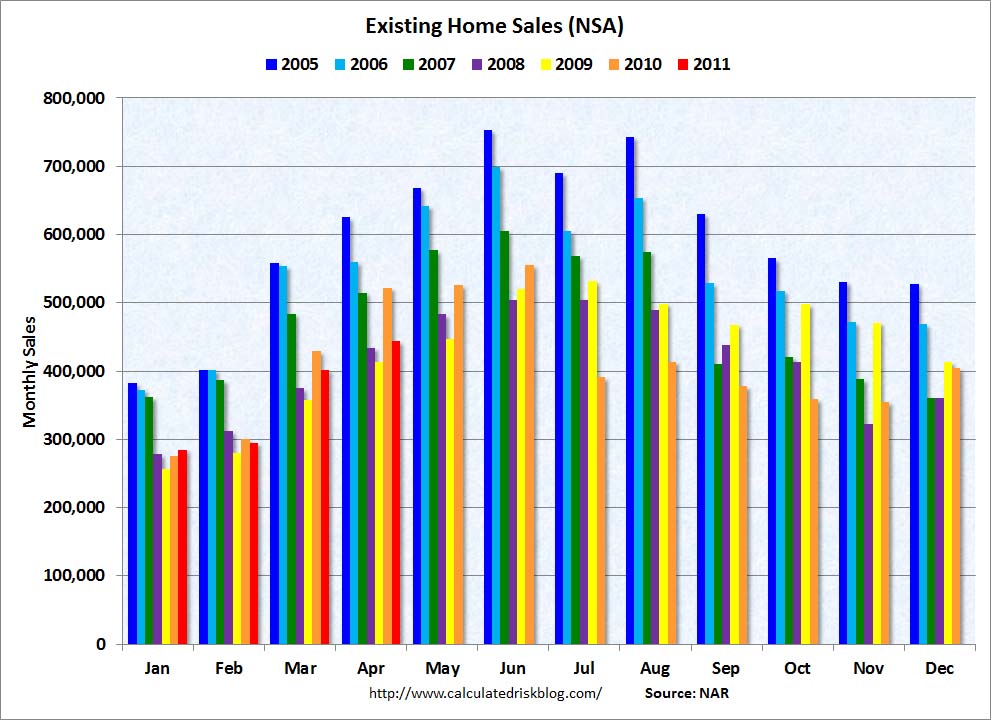
chart courtesy of Calculated Risk
>

In April 2011, Existing-home sales fell 0.8% to a seasonally adjusted annual rate of 5.05 million in April from a downwardly revised 5.09 million in March

This represents a 12.9% from April 2010, a tax credit driven sales period. All-cash transactions were a still high 31% in April, down from the record 35% in March.

>

Previously:
20 Startling Facts About the US Housing Market (May 19, 2011)

Source:
April Existing-Home Sales Ease
Realtor.org, May 19, 2011
http://www.realtor.org/press_room/news_releases/2011/05/sales_ease

Comments

Please use the comments to demonstrate your own ignorance, unfamiliarity with empirical data, ability to repeat discredited memes, and lack of respect for scientific knowledge. Also, be sure to create straw men and argue against things I have neither said nor even implied. Any irrelevancies you can mention will also be appreciated. Lastly, kindly forgo all civility in your discourse . . . you are, after all, anonymous.

12 Responses to “Existing Home Sales Falter”

  1. rktbrkr Says:

    Cramer really nailed the RE bottom, eh…

  2. nickthap Says:

    I’m telling you, this housing market is bringing back and reinforcing historic trends of class/race/income/geography. If I look a Zillow info for Austin by neighborhood, you will see that housing prices in white, upper/upper-middle/middle class neighborhoods are increasing, some by as much as ten percent. Historically black/latino/working class neighborhoods are getting HAMMERED, in numbers that are not unlike those in South Florida or any other distressed area.

    See this link http://www.zillow.com/local-info/TX-Austin-home-value/r_10221/#{scid=mor-site-topnavlocalsub}

    You need to know which neighborhoods are good and bad. But in Austin, it’s easy. West if I-35=white, rich, etc. East of I-35, black, latino, poor, etc. Austin is actually a very segregated city.

  3. wally Says:

    Still in the running for “Worst Year Ever”.

  4. rktbrkr Says:

    NICKTHAP

    even though all of FL is bad the white highrises hugging the coast at least in SE FL ren’t getting hammered as bad as the inland areas

    I think a lot of unsophisticated first time minority buyers got suckered into buying apt to condo conversions near the market top, got “helped” by inflated appraisals and no-doc financing, not a moral flaw just unsophisticated first time buyers hoping to be a part of the mainstream “ownership society” Bush was taking bows for acbieving

  5. BennyProfane Says:

    Wow, the old racist “it was all the dumb minority money” argument is alive and well still around here. As though most of Florida foreclosures happen to non whites. Right.

  6. Chief Tomahawk Says:

    Finally, the massive price cuts have arrived on the newest, most upscale condo development in my city! According to http://www.condo.com, this unit has taken a “17.08%” price cut this week:

    http://chicago.condo.com/Condo-For-Sale_SKOKIE_60077_OPTIMA-OLD-ORCHARD-WOODS_1505_2-Bedroom_2-Bathroom_9997383

    We’re in a state of real estate price collapse here. 10% unemployment, $4+ a gallon gas, are not condo-friendly…

  7. nickthap Says:

    But (and I’m not saying this is good or anything), I bet that if you were to look at sales/price figures for Chicago neighborhoods that are historically desirable/white/rich, prices there are either increasing or stable. This recession and housing bubble is just reinforcing age-old patterns of class and race. The bubble “put lipstick on a pig” for a few years…and now we’re back to historical norms (that is, norms established in the ’80s). Or, at least we should be. Here in Austin, median housing prices are still above their 2007 peak, while median household income hasn’t risen at all. Hmmm.

  8. jeff in indy Says:

    condos get hammered twice. once to underwrite the borrower and again for the association. lookout below!

  9. ShanePer Says:

    Wow. Some people are ignorant.

    Regardless, as everyone on here should know, RE is about location. So, though the overall tredline is telling, it fails to really inform. For example, remove the most overbuilt cities/states from the national stats and I’m sure you’d have a much much different, and accurate, general picture. It’s not like my neighborhood in Denver is dropping… at all. And not like it’s a “white” or a “rich” neighborhood. It’s just an old city neighborhood that’s getting nicer w/ homes from $200k-$900K. And yes, there are some foreclosures that are likely keeping prices from really increasing, but to suggest that the instability in the national RE market is making all markets take another dive is just wrong.

  10. AskewInTheQueue Says:

    As someone whose livelihood is dependent on activity in residential real estate, I’ve got many thoughts on where housing stands now and what we can infer from this latest report. But I’ll narrow it down to 2 items here.

    1. I much prefer to see reports on how healthy housing is based on the number of units rather than prices. Prices are too easy to be manipulated due to builders incentives, closing cost assistance typical to certain types of loans and the overweighting effect of former highflying markets that are now returning closer to equilibrium with other areas. If there is strength in unit numbers, to me, it follows that prices will strengthen (maybe not proportionally but correlated in some way). And while 2011 is only marginally better than ’08 and ’09, it is better. As for comparisons to 2010, the only useful comparison will be to compare year-to-date numbers after August or September due to the distortion caused by the tax credit.

    2. While housing data is itself critical in that housing is a central component of the economy and is a primary method of investing wages in a capital asset, the data is also reflective of the economy as a whole. Improving housing data can be indicative of improving economy as there is typically a strong relationship between strong credit, steady employment and savings on hand to use for a down payment and home purchases. But the relationship can be elastic. As foreclosures increased, there were fewer traditional buyers and more investors and flips. As the tax credit kicked in, it drew in a heavy mix of buyers that relied on FHA financing with smaller downpayments and less robust credit and employment. This is not something that a single graph or data point can show, however. While it is certainly true that there are many indicators that continue to show weakness in housing and (by no means am I saying that existing home sales are rosy), as a result, an economy that remains on uncertain footing, as I look at a variety of data, I am seeing an improvement in the types of transactions: fewer FHA loans, larger downpayments, move-up buyers, corporate relocations. Truthfully, the market of 2008-09 was, in my own view, significantly worse than was displayed by the aggregate data. 2010 was better on the surface (for the first 6 months), but it was incredibly artificially stimulated. At the same time, I would argue that in some respects, existing home sales are better off today and more of an improvement compared to the prior three years than the aggregate data suggests. It’s easy to be cynical about the housing market especially when the NAR has so thoroughly destroyed its credibility that any good news from their corner is roundly and deservedly derisively trashed. To have a full understanding of where housing is though and what it means for the economy and the citizenry, the analysis has to go past the headlines and soundbite level.

  11. nickthap Says:

    I’m not ignorant. I’m merely pointing out what is occurring in Austin, and could be occurring in other places. The neighborhoods where prices are stable and/or increasing are white. The neighborhoods where prices have plummeted are black/hispanic, and historically poor. How is it ignorant in poiting this out?

  12. cdmdevil Says:

    Barry:

    Great site. Why in general do you think we and our economy has such a focus on housing? I find it funny and sad at the same time. I do not see housing as that important for our place in the world and for competing with other nations (perhaps other than to short those banks that have a large exposure to it).

63 queries. 0.360 seconds.