Comments
Please use the comments to demonstrate your own ignorance, unfamiliarity with empirical data, ability to repeat discredited memes, and lack of respect for scientific knowledge. Also, be sure to create straw men and argue against things I have neither said nor even implied. Any irrelevancies you can mention will also be appreciated. Lastly, kindly forgo all civility in your discourse . . . you are, after all, anonymous.


Tweet
Facebook
Reddit
Digg this!


May 25th, 2011 at 12:21 pm
I’d like to see this chart adjusted for inflation.
May 25th, 2011 at 12:36 pm
BR I don’t get why you reposted your WP article as if you hadn’t already posted it, deleting the original post (and disallowing comments, hence my comment misplaced here). You seemed to take the self-imposed “rules” of your blog pretty seriously, but lately TBP is going police state revisionism.
I know you consider yourself the king of this kingdom, fine, but it don’t look good. Digital citizens, particularly those who show up here, want integrity and know their options.
~~~
BR: Um, because I didn’t — they are two completely different posts.
Sunday:
http://www.ritholtz.com/blog/2011/05/the-many-hats-of-great-investors/
Tuesday:
http://www.ritholtz.com/blog/2011/05/many-hats-great-investors/
I added the 2nd one because traffic on weekends is 40% of weekdays, and I wanted that column to be more widely seen.
May 25th, 2011 at 1:42 pm
thinking a 200+ year chart should be in log scale
May 25th, 2011 at 1:42 pm
Interesting but not obvious to me how they arrived at their numbers for the index. Any notes on the methodology?
May 25th, 2011 at 1:46 pm
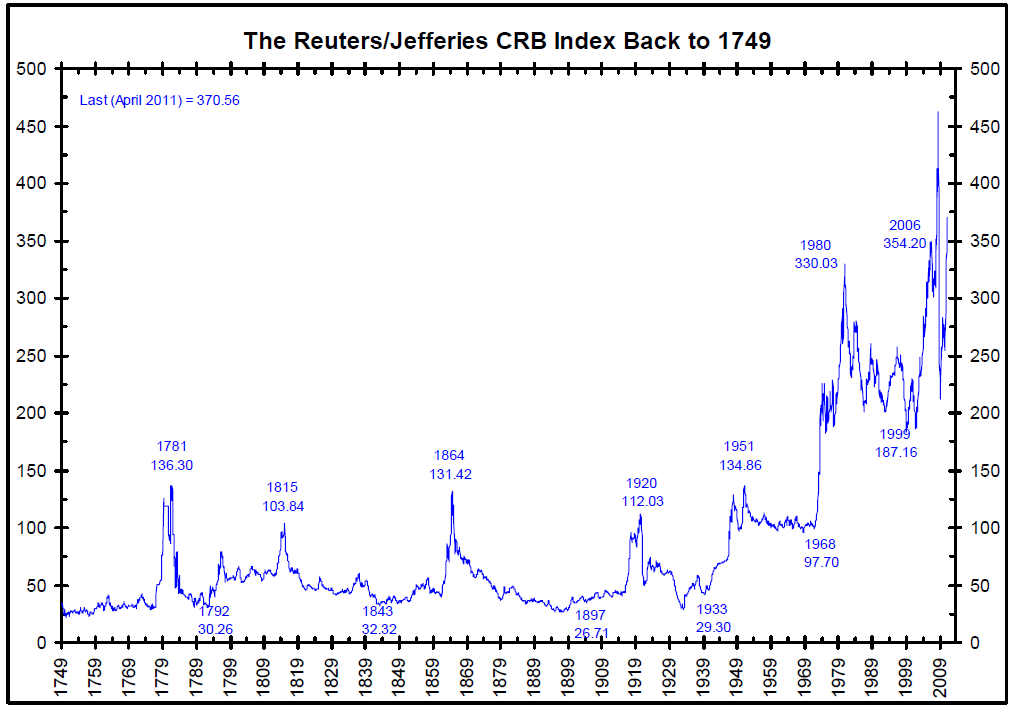
The 1864 peak is counterintuitive. Without giving away any–or, at least, too much–proprietary research, is there an explanation offered for it?
(The ones following all lead rather directly into, at least, recessions. But it take nine years after the 1864 peak for a problem to be officially noted. 1815 might be post-War boom, and 1781 is basically the last chance to “buy the rumour” of a US victory before the debt burden becomes clear.)
May 25th, 2011 at 2:20 pm
Needs to be log scale and needs a second version deflated by inflation. This material in isolation is misleading at best.
May 25th, 2011 at 2:21 pm
Bah, I meant adjusted for inflation. I bet this chart is largely downward sloping, adjusted for inflation.
May 25th, 2011 at 2:28 pm
“…I bet this chart is largely downward sloping, adjusted for inflation…”
that’d be more of the “Inflation ex-Inflation”-type of *thinking, no?
May 25th, 2011 at 2:30 pm
Adjusted for Inflation is the rallying cry of Gold Bugs and Idiots
May 25th, 2011 at 2:31 pm
This graph shows the ratio of two variables: the value of commodities divided by the value of a dollar.
Looks to me like commodities are limited in supply and dollars are abundant.
Interesting that we broke out of a 200 year range right when we abandoned the gold standard and the dollar became a pure fiat currency.
The fact that the CRB stayed in a range for 200 years until the early 70′s is probably attributable to the fact that money was backed by gold and/or silver for most of that time.
I would venture to guess, that most of the upward spikes coincide with episodes of rapid money supply growth.
May 25th, 2011 at 2:37 pm
Most of the CRB spikes appear to be related to war or the aftermath of wars, either due to scarcity, money printing, or both.
May 25th, 2011 at 2:44 pm
What jumps out at me are the steps up from roughly 50 to 100 (double), 100 to 200 (double), and 200 to the 400 zone (which would be another double if we end up settling there).
May 25th, 2011 at 2:48 pm
For those of you who want to “check my integrity,” you can search for prior posts 3 ways:
1) You can use the Google site search box (top right hand corner);
2) You can select a category of posts by either clicking on any of the categories at the end of each post (ie,
Category: Commodities, Technical Analysis for this post) or alternatively, lower portion of side column;
3) You can pull up posts by month lower portion of side column;
As I state in the disclosures, I never take down a post (unless its based on judicial order) and once a post sets, it will not be changed.
May 25th, 2011 at 2:53 pm
@ klhoughton
The Civil War was in full swing in 1864 and there were sharply reduced supplies of agricultural commodities due to men being away from their farms in the armed forces, as well as some destruction of farmland and crops. War-induced interference with supply channels excaerbated these shortages. I recall reading that the price of pork in particular skyrocketed around this time.
May 25th, 2011 at 3:12 pm
BR – any chance we could get some clarification? Why do you like it? What does it tell us other than commodities have generally been going up since creation of the Fed? I mean, from a what do I do today investment perspective it looks like a secular bull since 1930s but they’ve also bounced so far off the ’08 bottom it feels like it is harder to know what to do here today, esp given end of QE in 30 days. If you’re not long now, at what level would you buy? or would you buy at all?
May 25th, 2011 at 3:13 pm
Let me add a question to postman’s thought. Is the pricing in 1864 in greenbacks or gold dollars? Recall that during the civil war the government issued fiat currency, the greenback, which during 1864 sunk to $.34 of the gold dollar. Recall the gold room on wall street where people played the difference between the two forms of currency. So if the 1864 figures are in greenbacks (united states notes) dollars it takes the value down to near 50.
May 25th, 2011 at 3:37 pm
socaljoe and nofoulsontheplayground are on the right track I think: Abandonment of the gold standard in the 1930′s assured dollars could become far more plentiful relatively speaking but the real kicker was probably Nixon’s abandonment of Bretton Woods and the fixed price for gold in 1971. That aside, wars and there aftermath explain most of the pattern as far as I can tell, but as the more populous developing nations grow I would also expect substantial, non-war related shortages to develop.
Agree with those calling for a log scale, semi-log in this instance, or perhaps both scales with log on the left Y axis and nominal scale on the right: logs present a more meaningful picture for any variable whose growth is likely to be proportional to its amount although that is more clear when rate is fairly constant (may not be the case here).
NB: If non-war related shortages are developing one would expect to see an uptick in (log) rate over the past decade or two. Not likely to pick that up with a nominal scale; it’s already pretty noisy.
May 25th, 2011 at 3:43 pm
“Liquidity Trader Says:
May 25th, 2011 at 2:30 pm
Adjusted for Inflation is the rallying cry of Gold Bugs and Idiots”
I think you are reading too much into it. Adjusting for inflation merely shows the “real” price changes, versus “nominal” price changes, which this chart shows. You don’t have to be a gold bug to see the importance of this distinction, and it doesn’t have to logically lead to a wholesale denouncement of fiat currency.
May 25th, 2011 at 4:06 pm
Chart of Major U.S. Wars, mostly.
May 25th, 2011 at 4:25 pm
how interesting (typical?)
BR puts up a chart and 80% of the comments throw some fundamental spin at it
quite amazing how the majority always prefer to predict their indicators rather than just reading the actual indicator
May 25th, 2011 at 4:57 pm
All of you asking for the chart to be adjusted for inflation – WTF? This *is* a chart of inflation – what purpose would it serve to adjust it for inflation?
Also it’d be dumb to show it in log scale – purchasing power is not in log scale is it? If the price of something goes up by 1000%, do you only pay 2x for it? No, you pay 10x for it.
Regarding the methodology – Wikipedia is your friend:
http://en.wikipedia.org/wiki/Reuters-CRB_Index
May 25th, 2011 at 5:02 pm
emin:
Exactly. Inflation reflects the reality of our monetary system. Ignore it, and you ignore reality.
May 25th, 2011 at 5:16 pm
The CRB index only began to be compiled in 1956. Earlier prices from the 18th and 19th centuries are probably such items as British grain and cotton prices, spliced on.
It’s the best one can do with limited data. But don’t take the five significant figures seriously, on values from centuries ago. Even three significant figures would be more than enough.
May 25th, 2011 at 5:38 pm
packman,
any chart over two years is better shown in log scale for various reasons, this is basic understanding of constructing finance charts
your “logic” is anything but as to why log wouldn’t be important
nearly all important items in finance are quoted in percentage terms and everyone works with different amounts of capital. Finally, the proper def. of inflation is growth in money supply + credit, so it sure as hell isn’t found on this chart
but thanks for the wiki link, lol
May 25th, 2011 at 9:23 pm
b22,
…you kill me
‘ the proper def. of inflation is growth in money supply + credit, so it sure as hell isn’t found on this chart’
…could not be more true…
…perhaps the symptoms, but note the cause…
May 26th, 2011 at 11:51 am
Interesting chart. Couple of comments from an Elliot Wave perspective.
1. The rally from the ’09 lows is not separated by much from the ’08 spike so it looks like part of the decline from that spike and not a seperate rally in and of itself. In other words, it is probably a bear market rally.
2. The rally from the ’33 lows is 5 waves — a complete impulse wave ready for a correction of all of the false assumptions and complacencies about commdity values which have built up over the past 80 years. Think about that.
On the other hand, maybe the chart means something else entirely.
May 26th, 2011 at 5:36 pm
Did someone say adjusted for inflation?
Using MeasuringWorth’s GDP deflators back to 1790 here is what I found (in 2005 dollars):
1792 622.6
1815 1454.3
1843 724.7
1864 1422.3
1897 575.7
1920 871.8
1933 372.3
1951 859.0
1968 443.9
1980 691.2
1999 215.7
2008 435.9
2009 182.8
And currently adjusted to 2005 dollars the index is about 305, off of a recent high of about 330. So clearly there is a long term downward trend in the real price of commodities. This matches what the Economist’s commodities price index shows which goes back to 1845:
http://www.economist.com/node/3651836?story_id=3651836
This helps explain why commodities are a smaller and smaller share of total output and are less and less relevant in determining overall inflation. It also makes you wonder what the resource constraint dingbats on the right and left extremes are smoking.
May 27th, 2011 at 6:52 am
I find this adjusted for inflation thing a bit funny. Adjusting something for inflation that forms a part of inflation indices sounds like a scam used to justify inflated prices of commodities. Then to keep the price unchanged you will increase the price, which will increase inflation, and…. I guess you get the idea.