How Much Would It Cost To Buy Congress Back From Special Interests? (June 30, 2011)

Email this post Print this post
By Guest Author - June 30th, 2011, 7:30PM

http://www.oftwominds.com/blogjune11/buy-congress-back6-11.html

Here’s a thought: let’s buy our Congress back from the special interests who now own it. We all know special interests own the U.S. Congress and the Federal machinery of governance (i.e. regulatory capture). How much would it cost the American citizenry to buy back their Congress? The goal in buying our Congress back from the banking cartel et al. would not be to compete with the special interests for congressional favors–it would be to elect a Congress which would eradicate their power and influence altogether.

A tall order, perhaps, but certainly not impossible, if we’re willing to spend the money to not just match special interest contributions to campaigns but steamroll them.

A seat in the U.S. Senate is a pricey little lever of power, so we better be ready to spend $50 million per seat. Seats in smaller states will be less, but seats in the big states will cost more, but this is a pretty good average.

That’s $5 billion to buy the Senate.

A seat in the House of Representatives is a lot cheaper to buy: $10 million is still considered a lot of money in this playground of power. But the special interests– you know the usual suspects, the banks, Wall Street, Big Pharma, Big Insurance, Big Tobacco, the military-industrial complex, Big Ag, public unions, the educrat complex, trial lawyers, foreign governments, and so on–will fight tooth and nail to maintain their control of the Federal machinery, so we better double that to $20 million per seat. Let’s see, $20 million times 435….

That’s $8.7 billion to buy the House of Representatives.

It seems we’re stuck with the corporate toadies on the Supreme Court, but the President could scotch the people’s plans to regain control of their government, so we better buy the office of the President, too.

It seems Obama’s purchase price was about $100 million, but the special interests will be desperate to have “their man or woman” with the veto power, so we better triple this to $300 million.

Add these up and it looks like we could buy back our government for the paltry sum of $14 billion. This is roughly .0037% of the Federal budget of $3.8 trillion, i.e. one-third of one percent. That is incredible leverage: $1 in campaign bribes controls $300 in annual spending–and a global empire.

Once we bought back our government, what would be the first items on the agenda? The first item would be to eradicate private bribes, a.k.a. private campaign contributions and lobbying.

If you allow $1 in campaign contributions, then you also allow $10 million. There is no way to finesse bribery, so it has to be cut and dried: no member of Congress can accept any gift or contribution of any nature, monetary or otherwise, and all campaigns will be publicly financed.

Is this system perfect? Of course not. There is no perfect system. But the point here is that a system which allows even a $1 private contribution to a campaign cannot be restricted; after the courts have their say, then all attempted limitations prove worthless.

So it’s really all or nothing: either we put our government up for auction to the highest bribe, or we ban all gifts and private campaign financing and go with public financing of all elections in the nation.

That is the only practical and sane solution. Any proposal that seeks to finesse bribery will fail, just like all previous attempts at campaign finance reform.

Any member of Congress who accepts a gift, trinket, meal, cash in an envelope, etc. will lose their seat upon conviction of accepting the gift. Once again, you can’t finesse bribery. It has to be all or nothing, and the only way to control bribery is to ban it outright.

As for lobbying, thanks to a Supreme Court dominated by corporate toadies, it will be difficult to ban lobbying outright. However, that doesn’t mean Congress shouldn’t try to force the toadies on the Supreme Court to make a distinction between a corporation with $100 billion in assets and billions to spend on bribes and a penniless citizen.

(Those two are not coincidental; in a nation run by and for corporations, the citizens all end up penniless unless they own or manage said corporations, or work for a Federal fiefdom which can stripmine the nation at will.)

Congress should pass a law banning paid-for lobbying. If a citizen wants to go to Congress and advocate a position, they are free to do so–but they can’t accept money to do so. If they receive any compensation from any agency, enterprise, foreign government, other citizen, you name it, from any source, then they will be sentenced to 10 years of fulltime community service in Washington D.C., picking up trash, etc.

If the Supreme Court toadies strike down that law, then here’s another approach:

Require all paid lobbyists to wear clown suits during their paid hours of work.

In addition, all lobbyists are required to wear three placards, each with text of at least two inches in height.

The first placard lists their total annual compensation as a lobbyist.

The second lists the special interest they work for.

The third lists the total amount of money that special interest spent the previous year on lobbying, regulatory capture, bribes to politicos and political parties, etc.

Every piece of paper issued by lobbyists must be stamped in large red letters, “This lobbying paid for by (special interest)”, and every video, Powerpoint presentation, etc. must also be stamped with the same message on every frame.

The second item on the agenda is a one-page tax form. The form looks like the current 1040 form except it stops at line 22: TOTAL INCOME. A progressive flat tax is then calculated from that line. Once again, you cannot finesse bribery or exemptions, exclusions, loopholes and exceptions. Once you allow exemptions, exclusions, loopholes and exceptions, then you’ve opened Pandora’s Box of gaming the system, and the financial Elites will soon plow holes in the tax code large enough to drive trucks through while John Q. Citizen will be paying full pop, just like now.

The entire charade of punishing and rewarding certain behaviors to pursue some policy has to end. Any deduction, such as interest on mortgages, ends up creating perverse incentives which can and will be gamed. It’s really that simple: you cannot finesse bribery or exemptions, exclusions and loopholes, because these are two sides of the same coin.

The tremendous inequality in income, wealth, power and opportunity which is distorting and destroying our nation all flow from the inequalities enabled by bribery and tax avoidance. The only way to fix the nation is to eliminate bribery (campaign contributions and lobbying) entirely, and eliminate tax avoidance entirely by eliminating all deductions, exemptions, loopholes, etc. State total income from all sources everywhere on the planet, calculate tax, done.

When you think about how tiny $14 billion is compared to the $3.8 trillion Federal budget and the $14.5 trillion U.S. economy, it makes you want to weep; how cheaply we have sold our government, and how much we suffer under the whip of those who bought it for a pittance.

Books Bought By Big Picture Readers (June, 2011)

Email this post Print this post
By Barry Ritholtz - June 30th, 2011, 7:00PM

>

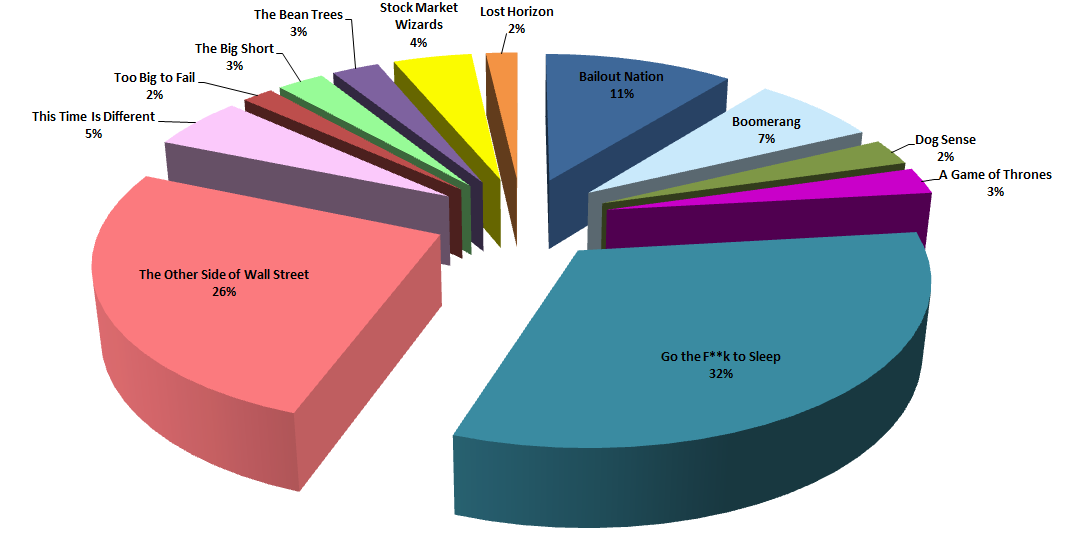
I always find it interesting to see what books TBP readers are buying. In addition to throwing off a few shekels, the Amazon code embedded in links lets me track your collective purchases. Its anonymous — I don’t know who bought what — but I can tell what everyone who clicked on a given book bought.

These are the most popular books purchased in June:

Go the F**k to Sleep (Adam Mansback)

The Other Side of Wall Street (Todd Harrison)

Bailout Nation (Barry Ritholtz)

Boomerang (Michael Lewis)

This Time Is Different (Carmen M. Reinhart & Kenneth S. Rogoff)

Stock Market Wizards (Jack D. Schwager)

Dog Sense (John Bradshaw)

A Game of Thrones (George R. R. Martin)

The Big Short (Michael Lewis)

The Bean Trees (Barbara Kingsolver)

Lost Horizon (James Hilton)

Too Big To Fail (Andrew Ross Sorkin)

Pre-Holiday Weekend Reading List

Email this post Print this post
By Barry Ritholtz - June 30th, 2011, 4:30PM

Some interesting reads for your weekend pleasure:

• In U.S. Monetary Policy, a Boon to Banks (Pro Publica)
• The CDO at the heart of the eurozone (FT)
• It’s That Time of Year: Calendar Can Trump Fundamentals (Barron’s)
• S&P to deeply cut U.S. ratings if debt payment missed (Reuters)
• BRUTAL TRUTH: Senior RIM exec tells all as co crumbles around him (BGR)
• A Fringe of Foam on Foreign Shores (Caixin)
Clive Thompson on Establishing Rules in the Videocam Age (Wired)
• Basketball: Larger Than Real Life (Sports Illustrated)
• Triple Agent’: The final days of the suicide bomber who attacked the CIA (Washington Post)
Monty Python members reunite for Graham Chapman film (BBC)

What are you reading?

Sale of Manhattan

Email this post Print this post
By Barry Ritholtz - June 30th, 2011, 4:08PM

An animated segment directed by Fred Crippen and designed by Saul Bass & Art Goodman from Stan Freberg Presents The Chun King Chow Mein Hour: Salute to the Chinese New Year (February 4, 1962).

Soundtrack is from Freberg’s album “Stan Freberg Presents The United States Of America”.

This cultural gem comes to us via Brain Pickings

Phrase of the Day: “Filter Bubble”

Email this post Print this post
By Barry Ritholtz - June 30th, 2011, 1:30PM

This is exactly the sot of thing that investors need tio stay on guard against: filter bubble.

These are the search results, commentaries, recommendations, and other online data that have been filtered to match your predisposition, biases, and interests. Thus, they prevent you from seeing any data that challenges your assumptions, beliefs or positions.

~~~

Example Citations:

Those same kind of surprises don’t seem to happen to me the same way with online information. In the digital world, I find myself tending toward existing in a self-selected filter bubble. It’s the difference between getting too much of what I like and not enough of what I need.
—Kevin Griffin, “Front: Your Former Vancouver Art Magazine,” The Vancouver Sun, June 24, 2011
The real danger, right now, is losing engagement due to people finding themselves in a filter bubble, where people are never challenged by viewpoints that oppose what they already think.
—Duncan Geere, “Clicktivism’s assault on dictators, politics and NGOs,” Wired UK, June 23, 2011
Earliest Citation:
Eli terms this phenomenon a “filter bubble” — a special sort of echo chamber. The better our filters get, the less likely we are to be exposed to something novel, unexpected, or uncomfortable.
—Ethan Zuckerman, “Eli Pariser on Filter Bubbles,” My heart’s in Accra,” June 3, 2010

Eloqua presents: Social Media ProBook – 20 Experts, 1 Awesome Resource

Email this post Print this post
By Barry Ritholtz - June 30th, 2011, 12:30PM

From Eloqua, comes this pretty awesome reference PDF: 20 Experts, 1 Awesome Resource: The Social Media ProBook.

~~~

The Social Media ProBook

View more presentations from Eloqua

Muddy Waters’ Carson Block: Still short Sino-Forest

Email this post Print this post
By Barry Ritholtz - June 30th, 2011, 12:26PM

Carson Block of Muddy Waters spoke to Bloomberg Television’s Erik Schatzker about Sino- Forest earlier today.

Block said he is still short Sino-Forest and that he isn’t a “ninja assassin” who brings down stocks. He thinks of himself as someone who is “protecting investors.”

MySpace Costs: $1 Billion Dollars

Email this post Print this post
By Barry Ritholtz - June 30th, 2011, 12:00PM

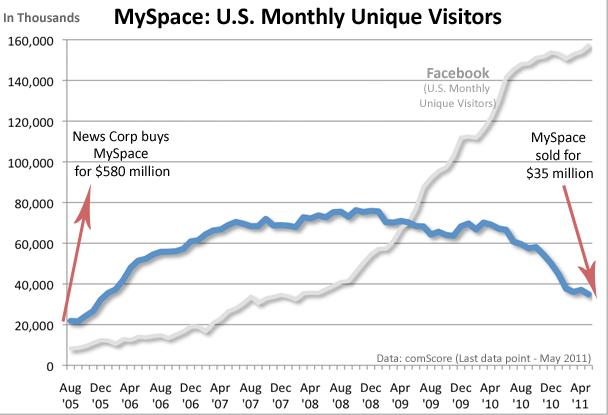
From ARS technica, comes this assessment of what News Corp purchase of MySpace actually totaled: $1billion dollars: Doing the math on News Corp.’s disastrous MySpace years

Business Insider musters up this chart to show just how a big a lead MySpace squandered over 3 years to allow Facebook to become the dominant player in the space:

>

June 2007: 10 Questions About CDOs

Email this post Print this post
By Barry Ritholtz - June 30th, 2011, 10:30AM

Here is a blast from the past: Precisely 4 years ago on June 30th, we took a closer look  at CDOs. It was in response to a remarkably sanguine question: CDOs: what’s the big deal?

We thought they were a big deal, and posed 10 Questions About CDOs.

Here are my 10 questions:

1. What would have happened had Bear Stearns simply let their two funds, High-Grade Structured Credit Strategies Fund and High-Grade Structured Credit Strategies Enhanced Leverage Fund, dissolve?

2. If CDOs are not priced to market, what are the actual values of these holdings?

3. How levered up are the funds that own the bulk of the CDOs? 10-to-1? 20-to-1? More?

4. How many Hedge funds are or have been taking quarterly or annual performance profits, based in whole or in part, on hoildings that have been marked to a theoretical value (“Mark-to-Model”) versus an actual value (“Mark-to-Market”)?

5. Liquidity has been a driving force behind M&A activity, share buybacks, and leveraged buyouts. Might the CDO situation somehow impact liquidity?

6. Might a liquidation in a CDO/illiquid derivative fund spread to other asset classes?

7. How widely held are the toxic CDO tranches in funds that are self-decribed as “conservative” or “risk averse?”

8. How accurate are the major ratings firms (Moodys, Standard & Poors, Fitch) assessment
of these products. Are these outfits arm’s length objective raters, or
are they merely corporate whores who play for pay?

9. After the final chapter is written on CDOs, what might the total losses on the $250 Billion in quarterly CDOs that Wall Street has created actually be? 10 Billion? 100 Billion? 1 Trillion?

10. How much will systemic confidence be impacted if there is a
series of large fund failures due to CDOs? What impact might that have on the rest of the markets?

The point being: All that was required to recognize the brewing trouble was a willingness to ask questions, ignore traditional assumptions, question authority, and challenge what the “experts” were saying.

What trouble might be brewing now . . . ?

Obama Tells Republicans No Deficit Reduction Without Tax Hikes

Email this post Print this post
By Barry Ritholtz - June 30th, 2011, 9:43AM

45 queries. 1.027 seconds.