
Case-Shiller Home Price Indices
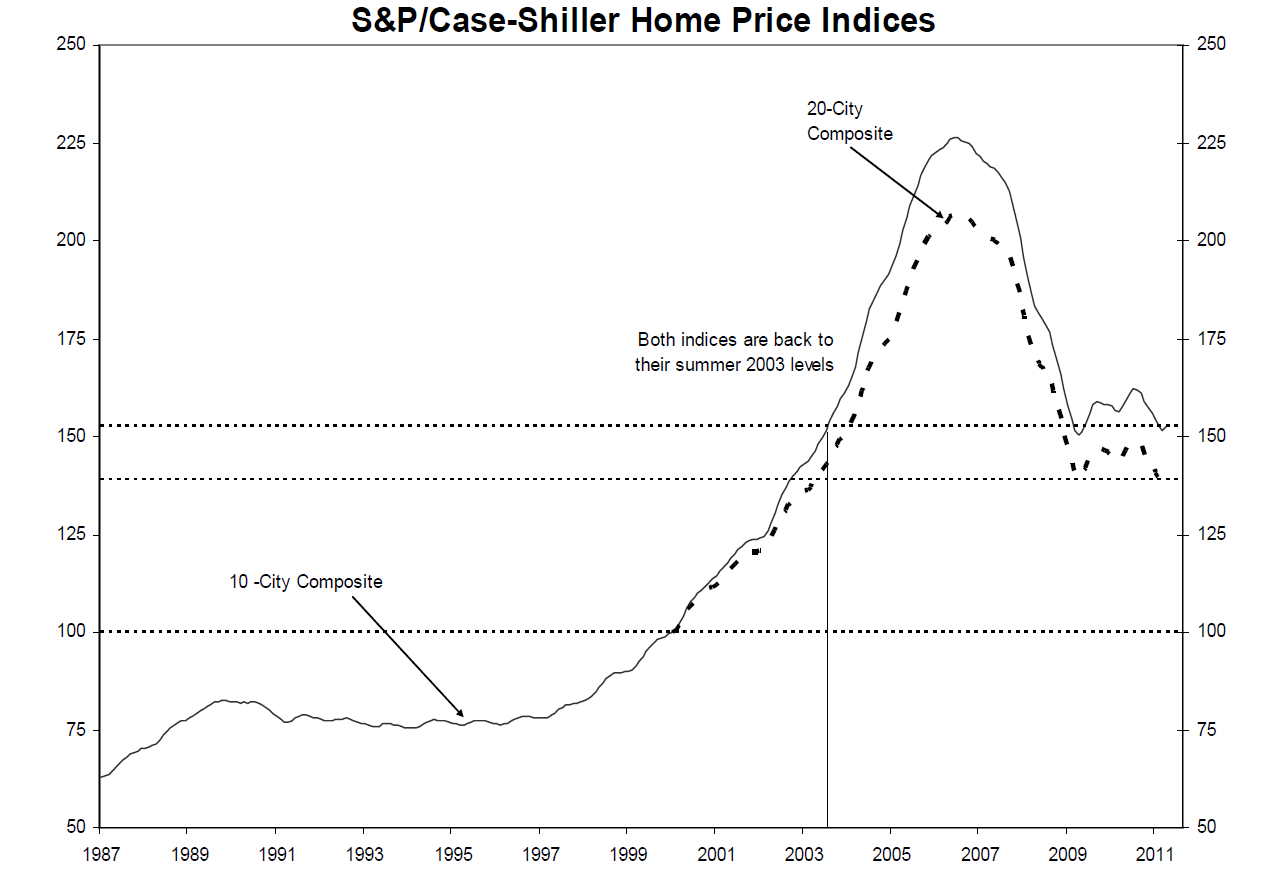
Case Shiller Home Price Indices showed a monthly increase in prices for the first time in eight months. This was for the month of April, which is usually the beginning of the best six months of the year for home sales. (See this chart of Non Seasonally adjusted Existing Home Sales)
Davied Blitzer of S&P Indices noted “However, the seasonally adjusted numbers show that much of the improvement reflects the beginning of the Spring-Summer home buying season. It is much too early to tell if this is a turning point or simply due to some warmer weather”
~~~


Tweet
Facebook
Reddit
Digg this!


June 28th, 2011 at 11:55 am
Turning Point!? What would cause a turning point? It has just been reported that changing credit standards have removed about 1/3 of the buyers previously listed as prime.
Jobs still going to Asia.
77% of the public a paycheck or 2 from financial crisis.
Health care costs exploding.
Gas down some, but still expensive.
June 28th, 2011 at 12:37 pm
RE: “turning point”
Recently MacroMarkets released their Home Price Expectations Survey for June; I find it interesting that the mean expectation among the 100+ respondents is showing that a “bottom” is (basically) in for housing, as seen on the chart. For those interested, here is a blog post I wrote on the survey as well as some of my commentary on the housing situation:
http://economicgreenfield.blogspot.com/2011/06/macromarkets-june-2011-home-price.html
June 28th, 2011 at 1:18 pm
[...] of hope in the Case-Shiller numbers. (Calculated Risk, FT Alphaville, Big Picture, [...]
June 28th, 2011 at 4:53 pm
Why is anyone getting excited about price increases from March to April? The year over year is what matters.
June 29th, 2011 at 8:46 am
From a lay-perspective, I share this recent experience: a woman in our neighborhood was telling the story of when she bought her home…mentioned 16% interest rates and said “the seller dropped his price significantly to sell due to the mortgage rates”.
Not that there is an expectation of rates hitting double digits, but relevant to “healthy” middle-class markets, it made me wonder if prices (in some cases) are actually inflated due to the low 30 year rate?
If so, wouldn’t there be a direct relationship between a rate increase and discounting? Or, am I slicing this too thin – just thinking about “healthy” middle class markets?
Thanks!
