Fed Forecasts? PUH-Leeze!
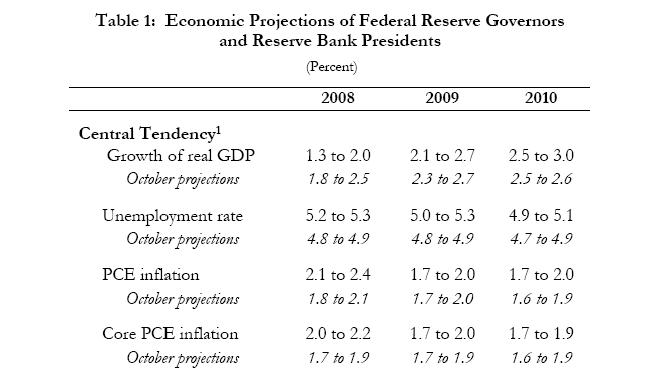
Good Thursday morning. We are seeing Markets lower in Europe and Asian after Uncle Ben and the Fedettes lowered their perennially over-optimistic forecasts for growth in the US. Global Markets reversed their modest gains and sold off yesterday, and there seems to be follow through in the futures this morning.
From Sub-prime being contained (James Grant quipped “Yes, contained to planet earth”) to the panicked end of the world forecast during the crisis (thus preventing a Swedish pre-packaged bankruptcy for insolvent banks) to the over-optimistic recovery, the forecasts of the Fed in general and BB specifically have been little short of awful.
Then again, the forecasts of 90% of the economic community ain’t worth a plug nickel. Beyond the institutional habit of being excessively optimistic, the Fed’s economic forecasts have been working off the wrong data set, stubbornly refusing to recognize that this is a credit driven crisis, and not your run of the mill business cycle contraction. They have either been unwilling or unable to recognize this. I am not sure which I find more galling: The lack of acumen or missing sense of humility for the failures.
Trader’s lack the luxury of being that wrong over and over again. The best career advice for any trader with the Fed’s forecasting track record would be to learn the phrase “Would you like fries with that, sir?”
This is the savage tragedy of giving a group of economists this much influence and authority. I disagree with Ron Paul — its not that we should End the Fed, it is that we should replace much of its ruling economists with mathematicians and engineers. Applied Physics (and its empirical-based scientific method) should drive monetary policy, and not the squishy, cognitively challenged economists who suffer from the human foibles of believing they have a clue about the future. As history as shown, with few exceptions, economists do not seem to comprehend the recent past, much less the next few quarters. I maintain a private list of economists who actually do understand the recent past as well as the present, and they are worth their weright in rapidly appreciating gold.
The first step to fixing the Fed is for them to get a firmer grasp on understanding their own lack of understanding. I am beginning to suspect we have a case of Dunning-Kruger Syndrome at work. Perhaps they might focus more on the probabilistic nature of forecasts, and place less emphasis on declarative opinions. Some error tracking and more frequent corrections would be nice as well.
The sooner we recognize that the field of economics is a branch of Sociology and not Mathematics, the better off we will all be.
>


Tweet
Facebook
Reddit
Digg this!


June 23rd, 2011 at 7:24 am
Barry – If you have an opinion, just say it. Why use use such soft nuanced language! :-)
Always appreciate you telling it like it is…
June 23rd, 2011 at 7:36 am
It ain’t what you don’t know that gets you into trouble. It’s what you know for sure that just ain’t so.
Mark Twain
June 23rd, 2011 at 7:53 am
“The greatest enemy of truth is very often not the lie, but the myth.” JFK
June 23rd, 2011 at 7:57 am
Economists give Sociologists a bad name.
Dunning-Kruger is an interesting typology for our chairman of the Fed.
“If you can do a half-assed job of anything, you’re a one-eyed man in a kingdom of the blind.”
-Kurt Vonnegut
June 23rd, 2011 at 8:00 am
“Whoever looks at America will see: the ship is powered by stupidity, corruption, or prejudice. ”
Johann Most
June 23rd, 2011 at 8:01 am
Barry: Any hints on who’s on your short list?
June 23rd, 2011 at 8:05 am
Dunning–Kruger effect – interesting.
Was always a problem as a lawyer; I attributed knowledge and competence to many who did not deserve it. But at least I didn’t get surprised on the other side. At least I hope I wasn’t on the unskilled side and just can’t see it :)
June 23rd, 2011 at 8:18 am
With so many flaws — from creating currency out of thin air without restraint to the manipulation of data to arrive at a politically acceptable result (despite that result’s obvious disconnect with reality, mathematics, scientific method, or the law) — the sooner we recognize that the field of economics is a branch of Alchemy and not Mathematics, the better off we will all be.
June 23rd, 2011 at 8:33 am
ron paul is right; end the fed. but that doesn’t mean we don’t need a monetary authority of some kind.
what we really don’t need is this pseudo-bank-corporation, owned and operated by and for the best interests of the too-bigger-to-fail banksters. and the notion that they have regulatory authority over those very same TBTFs is ludicrous.
as to what bernanke’s fed is doing and why, he knows what he’s doing. he’s doing what they’ve always done; just to greater extremes. if he’s at all puzzled by the outcome its because he’s not getting away with it as they have in the past. one can attribute that to the extreme nature of this problem which they’ve been building for decades -and/or- to the democratization of information [the internet, including bloggers like yourself] which allows the serfs to collectively see behind the curtain [somewhat] for the first time in history.
June 23rd, 2011 at 8:41 am
Barry, I fear that the physicists and mathematicians are even more likely to fall into the trap of believing their models tell them about the future than the economists, and forcing reality to fit a preconceived theory. For the mathematicians, the challenge is that the beauty of logic is what tends to draw them to the field, and the reality of data can make it difficult to abandon the beauty of a mathematical model.
The challenge with physicists is that they are used to unchanging laws of physics and they also have trouble incorporating the qualitative factors that make economic and financial reality change from year to year. Physicists do excellent quantitative analysis, but (having been one for part of my life and around many for much more) they tend to be massively overconfident when it comes to explanations for qualitative features. They tend to confuse having “an explanation” with having “the explanation.”
I do agree that sociology has a lot more to do with economics than is currently appreciated. And I think that the underlying causes of the crisis are more at least as much sociological and political than they are economic.
Remember, though, that Fed economists are embedded in a political process (public testimonies before Congress and minutes of meetings that are scrutinized by everyone from the party leaderships to you and me). This process forces them to act and pronounce their forecasts with more certainty than they would if you were just talking with them over dinner. Given that (as you state in your blog, repeatedly) predicting something as complex as the macroeconomy is inherently uncertain, perhaps what you are frustrated by is the way these economists are forced to appear by the roles that they hold, and not their true ability or inability to look at the data.
Finally, and I said this in an earlier post… economics is a more varied topic than the kinds of stuff that Fed and Wall Street economists keep talking about. There is an orthodox type of economics that gets you hired and promoted on Wall Street and (to a lesser extent) in the Fed. If you look in economics journals, you’ll see that there is a much wider range of economics thinking, from economic history, political economy (my kind of stuff), behavioral economics (which does get some press thee days), to the more mathematical stuff that makes people look smart through handwaving and greek symbols. The body of economics that we receive from “official” and financial sources is already prescreened to deliver apparent certainty where there shouldn’t be any.
THAT is the cycle that – if you can break through it – should offer you a chance to outperform, and this is one of the reasons that I like your blog so much.
Cheers!
June 23rd, 2011 at 8:50 am
You characterize this as a credit crisis. Hmmm.
To use an analogy, a family is slogging along but the breadwinner has his/her earnings gradually decline. The problem is masked by buying cheaper goods (from overseas) and by taking out a HELOC and running up their credit cards (and nationally, oversized financial and housing activity.) Lifestyle is improved. Things are good. Then, their lenders cut their HELOC limit and froze their credit cards.
So, is it a credit crisis, ie. their inability to borrow still more, or is the problem that their family earnings have dropped compared to their desired lifestyle? Of course, 98% would blame the lender. Credit is, after all, the immediate precipitant. But I’d contend that the real problem is the fundamental weakness in family earnings.
The proof is that corporations are awash in cash and, mostly, lenders are willing to lend. Although unwillingness to lend was more a reaction to than the cause of the recession, if that were the causative factor when credit availability returned the economy should bounce back. It has largely not.
~~~
BR: Interesting take, but we may be talking at cross-purposes.
To me, this crisis was caused by too low rates, too much credit, an abdication of lending rules caused in large part by a radical deregulation of bankers.
The overhang — what we are dealing with now — traces back to these elements.
June 23rd, 2011 at 8:50 am
As long as economists take an equal debit and credit and assume because the sum is zero that neither the debit nor the credit can ever be a source of problems, the end result continue to be disaster.
June 23rd, 2011 at 8:51 am
correction: end result will continue to be…
June 23rd, 2011 at 8:58 am
Oh No! Jobless claims 429k when the consensus was 410-425k. Why do they even post such narrow consensus ranges from clueless people about a time series that has such a huge variability?
It seems the same emphasis on false precision that we see in Fed forecasts of growth and inflation or company forecasts to an alleged accuracy of tenths of a percent when an actually accurate ballpark range would be more useful. Of course then the financial headline writers would have a much harder time touting beats and misses.
June 23rd, 2011 at 9:04 am
But economics isn’t science; it is politics. One of Bernanke’s mistakes here was to allow himself to be set up as the guy who could do something about the problem. As you point out, this is not a normal business cycle recession… and that means monetary policy is the wrong ‘fix. The Fed can’t fix it.
The people who could apply the correct fix (and who were elected to do so) are in Congress but, unfortunately, they stupidly chose to completely misread their obvious mandate to do something about jobs and instead, decide to be anti-job. They have made deliberate pro-unemployment moves.
You won’t fix that by hiring mathemeticians at the Fed.
June 23rd, 2011 at 9:16 am
I’m with Mike.
Show us the list.
June 23rd, 2011 at 9:35 am
What list ?
June 23rd, 2011 at 9:42 am
A lot of people have been trying very hard to come up with good models for forecasting the economy. None have really succeeded. The most successful models are naive predictions – either predicting that current trends will continue or that current levels will continue. Those models aren’t all that great, but they beat just about everything else out there.
Given the number of forecasters, some have been right for a while, but that could easily be chance. Have 1024 people toss coins and at least one should get ten heads in a row. That doesn’t say much about the 11th toss.
>>I maintain a private list of economists who actually do understand the recent past as well as the present>>
That’s the list we’d like to see.
~~~
BR: Hmmm, maybe that is worth its own post
June 23rd, 2011 at 9:47 am
So your saying that the problem with the Fed isn’t the Fed itself, but in fact the economists working there? Furthermore you state that, “Applied Physics (and its empirical-based scientific method) should drive monetary policy”… Isn’t Angela Merkel a “Physicist”…what empirical-based scientific method is she using?
Barry weren’t you trained as a physicist originally before you went to school to become a “Lawyer”? Dude do you even recognize your own “missing sense of humility”.
June 23rd, 2011 at 9:55 am
Im not quite as down on fed economics as you
their forecasts are what they are, maybe slightly above average, I know i know
you absolutely cannot take them seriously about inflation
and they will never admit they are cutting rates from recession risk.
they will always act like quasi inflation targetters when they are not.
the late 2007 period is instructive.
they knew there was a banking crisis on their hands
they were cutting rates as fast as they could and pumping the discount window times bigger than 9-11
but acting like they had taylor rule reasons for cutting what bullshit!
but even more bizarre they really do not know about the risks of securitization, banking and the accounting of financial assets.
Greenspan would be the classic example,
actually not a bad macro guy of the data obsessed type
but completely clueless about banking securitization derivatives and
with no professional background whatever but a lot of massively wrong assumptions
i doubt there is one person there that knows much more about deerivitives than how to spell it
and that they are opaque
June 23rd, 2011 at 10:05 am
Their forecast ranges are statistically laughable
I would be happy to take most of their too narrow ranges and bet even money it will be outside it.
one more example of risk ignorance..
June 23rd, 2011 at 10:20 am
It’s possible the markets are reacting to Fed policy rather than the new Fed forecasts. Bernanke made it clear that there would be no further loosening, QE3, etc, which some had expected or at least hoped for. The markets likely believe the combination of this lack of Fed action combined with fiscal contraction will be bad for the economy.
That the Fed is refusing to act even in the face of its own diminished forecasts adds to the belief that further loosening is unlikely.
The fear of rates being raised could also contribute to the reaction. Higher rates will slow an already slow economy and higher rates lower the discounted present value of cash flows, including cash flows from corporations. Some analysts believe the discounted present value of a company’s cash flows have something to do with the value of that company’s stock :)
June 23rd, 2011 at 10:33 am
The Fed is a data-driven organization., but the data that drives them seems in many cases to be mostly garbage, massaged for political palatability, even calculated according to formulas that tend to lead to palatable results.
Add to this the fact that what gets said in public and officially is not always true (i.e., lies, so as to avoid ‘spooking’ the markets or sending the global reserve currency into spasms), and we’re left with guesswork as to what they really think and how certain they are.
Ultimately, the Fed runs one of the most detailed, computerized models of the global macroeconomy that exists. They have access to any data they need, from any systemically important institution they need it from, on a scale to which no one else even comes close, and they have basically unlimited resources. If there’s a problem with the Fed’s economic forecasts, the problem may be intrinsic to economic forecasting in general, intrinsic to the politics of their function, or intrinsic to the nature of official pronouncements, rather than clear evidence of their incompetence.
June 23rd, 2011 at 10:44 am
agree there are way way too many economists outside of the forecasters
where they need experts
securitization, banking, derivatives, REAL risk managment and VAR experts, and accountants capable of getting from banks what they need of actual values of financial assets.
June 23rd, 2011 at 11:08 am
I used to do climate research. We had a very complex model of the global climate system, but it still wasn’t good enough because there are many connections in the real world that we don’t know about and that aren’t in the model. But the real limitation is that the real climate system is a non-linear dynamical system. That means the ability to forecast the future is very limited beyond general trends. I think of the world economy in exactly the
same way. Any detailed prediction of the future is highly questionable. I like this quote from Bertrand Russell
“One of the painful things about our time is that those who feel certainty are stupid, and those with any imagination and understanding are filled with doubt and indecision”.
June 23rd, 2011 at 11:23 am
The
” I maintain a private list of economists who actually do understand the recent past as well as the present, and they are worth their weright in rapidly appreciating gold.”
List.
“Long form” only….
June 23rd, 2011 at 11:41 am
“From Sub-prime being contained (James Grant quipped ‘Yes, contained to planet earth’)”
HYSTERICAL !
June 23rd, 2011 at 12:16 pm
So if consumption is the largest component of GDP, and the consumer accounts for consumption, why are we not bailing out the consumer to get the economy going?
June 23rd, 2011 at 12:20 pm
[...] this it is almost palliative that Barry Ritholtz writes the Quote of the Day, or perhaps the Decade: The sooner we recognize that the field of economics is a branch of Sociology and not Mathematics, [...]
June 23rd, 2011 at 1:04 pm
Applied physics….
you mean picking up bricks and tossing them? We just tried that in Vancouver. It didn’t work very well
June 23rd, 2011 at 2:21 pm
Members of the FED are not chosen for their abilities to manage the monetary system… they are chosen for their compliance to the administration and congressional agenda, their willingness to make money available for stimulus, their willingness to fund big government, and to manufacture and communicate the propaganda which is intended to convince the public of the benefits of their policies.
I am in support of the FED’s function as banking regulator and source of emergency liquidity, but I don’t see any reason to manipulate short term interest rates. Engineers and scientists may do a better job… but they are still human… subject to error, political influence, and corruption. Why not let short term rates be set by the market?
June 23rd, 2011 at 4:11 pm
dont tease us ! whose on the list?:)
June 23rd, 2011 at 4:40 pm
“The sooner we recognize that the field of economics is a branch of Sociology and not Mathematics, the better off we will all be.”
Well, economics is considered a social science in most universities. But the stoner anthropologists, mathlete sociologists, and debutantes-in-need-of-therapy psychologists won’t invite them to their brown bags. The chief distinction between sociology is economics is that most sociologists use actual data (however flawed it might be). Economists use models, which tend to be more theological than theoretical.
July 8th, 2011 at 10:31 am
[...] Reserve: Has lost much credibility for helping to cause the crisis, for their bailout of Bear Stearns, for sending inflation higher, [...]