
Is the Fed the World’s Largest Fixed-Income Hedge Fund?
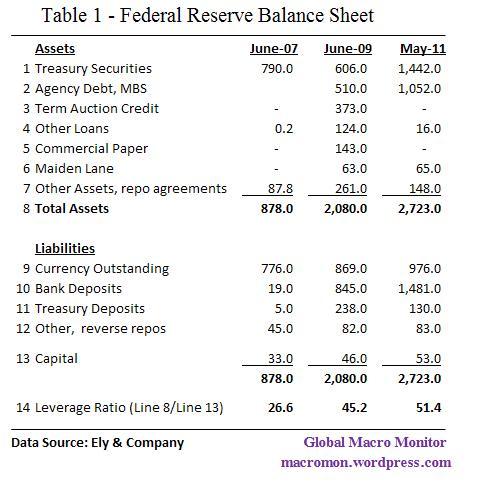
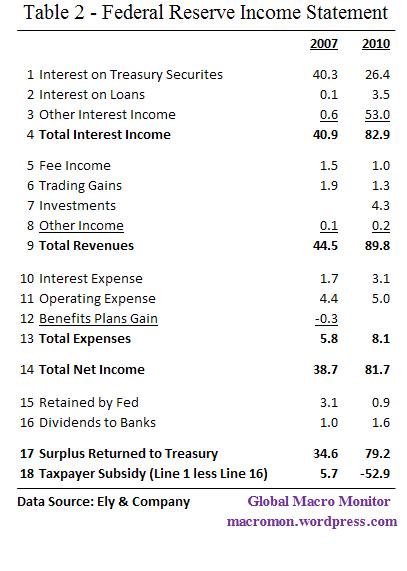
The following data is taken from Congressional testimony of the well respected banking analyst, Bert Ely, illustrates how the Federal Reserve has gone from being a taxpayer subsidized monetary authority to one of the world’s largest and most profitable bank/fixed-income hedge funds. Mr. Ely points out the pre-crisis Fed balance sheet (Table 1) consisted mainly of “Fed-issued currency intermediated into Treasury securities with both of those items compromising 90% of their side of the Fed balance sheet.” On the income side, Table 2 shows that in 2007, which Ely calls the last “normal” year, the U.S. taxpayer provided a $5.7 BN indirect subsidy to the Fed by paying $40.3 BN (line 1) of interest of the Fed’s holdings of Treasury securities, of which a $34.6 BN surplus (line 17) was returned to the Treasury.
Table 1 also illustrates how, since the crisis began, the Fed has more than tripled the size of its balance sheet, increasing its Treasury holdings by $650 BN and purchasing of over $1 TN of MBS and Agency debt. As of May, according to Ely, the Fed held 14 percent of the total debt and MBS issued or guaranteed by the three housing-finance GSEs and Ginnie Mae. The balance sheet growth was financed almost entirely by the creation of bank reserves held as deposits at the Fed (line 10). These reserves now account for almost 10 percent of total banking-industry assets, which, prior to the crisis was effectively a rounding error.
Table 2 shows the Fed’s net income has grown from $38.7 BN in 2007 to $81.7 BN in 2010 (line14). Though the sharp decline in interest rates reduced the Fed’s interest income on Treasuries from $40.3 BN to $26.4 BN, the more than $1 TN purchase of agency debt and MBS helped to generate $53 BN in interest income (line 3) in 2010, up from $.6 BN in 2007. The Fed returned $79.2 BN to the Treasury in 2010 (line 17) and after accounting for the $26.4 BN of interest on Treasuries generated a $52.9 BN profit for taxpayers.
The risks? Take a look the leverage ratio in Table 1 (line 13). John Hussman points out the Fed’s leverage ratio in now higher than that of Bear Sterns and Fannie Mae with similar interest risk though less credit risk. He writes,
The maturity distribution of these [Fed] assets works out to an average duration of about 6 years, which implies that the Fed would lose roughly 6% in value for every 100 basis points higher in long-term interest rates. Given that the Fed only holds 2% in capital against these assets, a 35-basis point increase in long-term yields would effectively wipe out the Fed’s capital…
To avoid the potentially untidy embarrassment of being insolvent on paper, the Fed quietly made an accounting change several weeks ago that will allow any losses to be reported as a new line item – a “negative liability” to the Treasury – rather than being deducted from its capital. Now, technically, a negative liability to the Treasury would mean that the Treasury owes the Fed money, which would be, well, a fraudulent claim, and certainly not a budget item approved by Congress, but we’ve established in recent quarters that nobody cares about misleading balance sheets, Constitutional prerogative, or the rule of law as long as speculators can get a rally going, so I’ll leave it at that.
We’re not sure of the endgame and when and how all this is going to play out. But we do agree with Mr. Hussman that “the predictable outcome is instability.” Toto, I have a feeling we’re not in Kansas anymore.


Tweet
Facebook
Reddit
Digg this!


June 24th, 2011 at 7:22 am
Thanks for posting. The issues presented by the size and other characteristics of the Fed’s balance sheet deserve far greater recognition. There are many complex aspects to this situation.
One aspect that doesn’t get much attention anymore is the issue of how – and with what consequences – an “exit” from these positions can occur; i.e. what is the “exit strategy” and will it be “smooth” I wrote about these issues in a post a few months ago; here is the link for those interested:
http://economicgreenfield.blogspot.com/2010/12/quantitative-easing-exit-issues.html
June 24th, 2011 at 8:21 am
“the Fed quietly made an accounting change . . .”
_______
Why would they need to do that, and why quietly? Was the old “accounting” not dishonest enough?
There is not a single element of our economy that is not based on fraud.
WTF is a “negative liability?” Aren’t all liabilities negative (to rephrase: is there any such thing as a positive liability)?
The “endgame” is to create an entirely new game — one in which former players (the late, upwardly mobile, middle class), will be reduced to being game pieces, and, like any other commodity on the board, subject to the whims and decisions of the Corporate Gangsters.
Ted Kavadas:
There is no way for the Fed to “exit” without running back, against the stampeding herd, into the very barn that they, themselves, set afire. Good lord, if they had a plan, why would they be doing such crazy shit in the first place?
June 24th, 2011 at 8:29 am
Negative liability. I love it!!
Where’s Ron Paul in all of this? We really do need to audit the Fed
June 24th, 2011 at 9:02 am
What happened to the idea of selling “The Fed Is Your Friend” lapel buttons?
June 24th, 2011 at 9:11 am
John Winger: “And then depression set in.”
(Bill Murray in “Stripes”)
June 24th, 2011 at 9:11 am
One big difference with the Fed and hedge funds is their ability to make an unlimited supply of poker chips for the casino.
June 24th, 2011 at 9:46 am
A negative liability is an asset. Do the math. In biologogic terms or macroeconomics this is quite economic metastasis. Self-preservation is felt just as keenly by a diseased and dying organ, but its set of responses is limited by its peculiar DNA.
June 24th, 2011 at 9:47 am
I have seen this before…on a street corner downtown…at 2:00am in the morning…Three Card Monte…
June 24th, 2011 at 9:49 am
Is that nearly $2 trillion Sword of Demosthenes the socialist safety net U.S. taxpayers were unknowingly forced to buy and maintain so speculators can continue running amok in their defective sandbox? If the sandbox is to remain intact and can’t be fixed, then the sword is permanent and will only grow precariously larger.
Exit strategy?
Apparently our decision makers seem resolute that we remain helplessly reliant forever on the speculators we rescued to somehow transform the global financial chaos they, more than all other market participants combined, proximately caused into something they hope to convince the rest of us will be a functioning market economy.
That’s why the speculators must be left unfettered to perform their derivative magic. It would be wrong to tax them and it would be wrong to regulate their sandbox. We are now 100% vested in speculators being our only way out and should stop whining about a temporary fiscal-monetary crisis they already know how to fix if we just leave them to it. But first, before doing that we can be sure they will find a way to lift that $52.9 billion surplus subsidy out of the taxpayer’s pocket and into their own.
June 24th, 2011 at 10:03 am
@873450,
These guys are so incompetent they couldn’t even run amok
June 24th, 2011 at 10:08 am
What I don’t understand about the leverage argument is the following. Back in 2007, when the Fed’s balance sheet was considered “normal”, the leverage was still more than a half of the current leverage. So, we needed an increase of 70 bps in interest rates to wipe out the Fed’s capital. Doesn’t look like a much lower risk to me. Or maybe the duration of assets was much lower? Can anyone explain that?
June 24th, 2011 at 10:11 am
ToNYC:
then why not call it an asset?
No one can do the math, because there’s no benchmark from which to base assumptions (what is the value of one dollar, exactly?), and the formulas for calculating our position and trajectory (GAAPs — motto: Just ’cause It’s Generally Accepted Don’t Make It Honest), get changed every time the real bottom line rears its ugly head.
June 24th, 2011 at 10:41 am
It’s only a flesh wound…come back and fight for liquidity, you bastards.
June 24th, 2011 at 10:49 am
@873450,
file under “Ripley’s”, if need be, but, to your point (from “Ghost in The Machine”)
I don’t want to spend the rest of my life
Looking at the barrel of an Armalite
I don’t want to spend the rest of my days
Keeping out of trouble like the soldiers say
I don’t want to spend my time in hell
Looking at the walls of a prison cell
I don’t ever want to play the part
Of a statistic on a government chart
There has to be an invisible sun
It gives its heat to everyone
There has to be an invisible sun
That gives us hope when the whole day’s done
It’s dark all day and it glows all night
Factory smoke and acetylene light
I face the day with me head caved in
Looking like something that the cat brought in
There has to be an invisible sun
It gives its heat to everyone
There has to be an invisible sun
That gives us hope when the whole day’s done
And they’re only going to change this place
By killing everybody in the human race
They would kill me for a cigarette
But I don’t even wanna die just yet
There has to be an invisible sun
It gives its heat to everyone
There has to be an invisible sun
That gives us hope when the whole day’s done
http://www.seeklyrics.com/lyrics/The-Police/Invisible-Sun.html
~~
@HTCMSI,
believing that these ‘People’ are incompetent, truly, misses the Genius that structure(-s/-d) their Operation.
or, differently, stop spreading that **** ..
June 24th, 2011 at 11:01 am
Hey Roger Lowenstein why so quiet? Haven’t mastered tweeter like Rick Perry yet?
“you’ll never go broke if you don’t bet with borrowed money” – Warrant Buffet
June 24th, 2011 at 11:38 am
Why would anyone care about the Fed’s leverage? Can they go broke? What’s the risk?
More useful to view the Fed’s balance sheet as exogenous to the real economy and financial system. In QE, the Fed went in and took a bunch of risk assets and leverage off the balance sheet of the private sector, and printed a bunch of money.
We know there was QE and the Fed’s balance sheet is inflated. A moderately interesting question is if the banks hoodwinked the Fed and sold them a bunch of crappy assets at inflated prices.
If the Fed is acting like a good hedge fund and taking risk and leverage off the banks when there is panic about risk, and selling it back to them in good times, extinguishing money and relevering the banks, and making a profit, that’s what they said they were doing. If the Fed manages to lose money on the trade and give more handouts to the bankers, that would be a problem.
June 24th, 2011 at 11:55 am
The flaw in this analysis is simple to understand, the Fed holds to maturity, the price drop in paper must be resolved as the Treasury paper approaches maturity. The accounting doesn’t recognize this inevitability.
Your life insurance is the flip side of this, a negative cash flow until it’s positive. But in the world of anti-Fed nonsense rhetoric, you will assume you live forever.
June 24th, 2011 at 11:59 am
“…If the Fed is acting like a good hedge fund and taking risk and leverage off the banks when there is panic about risk, and selling it back to them in good times, extinguishing money and relevering the banks, and making a profit, that’s what they said they were doing. If the Fed manages to lose money on the trade and give more handouts to the bankers, that would be a problem…”
“…If the Fed manages to lose money on the trade and give more handouts to the bankers, that would be a problem…”
If? really? If?
@streeteye
here’s one for you, too.. “…stop spreading that **** …”
June 24th, 2011 at 12:09 pm
I thought the real movie ended when Toto pulled down the curtain and the Wizard gave back permission to the supplicant citizens in search of validation. The original was better, here the US Constitution is the book.
Congress has more moves than the Kama-Sutra.
June 24th, 2011 at 1:06 pm
Let’s see… 50:1 leverage, full backing of the US taxpayers, and a printing press… and all they have been able to do is make $79 billion profit on a $2.7 trillion balance sheet? That’s a 2.9% return while taking a risk that a 2% markdown of the portfolio results in insolvency.
If the FED fell under the jurisdiction of the FDIC, it would have been shut down long ago.
June 24th, 2011 at 1:23 pm
This analysis is wrong, does not account for current market value of gold on fed’s books. The Fed Carry’s their gold @ 42.22 USD / troy ounce. When you correct their balance sheet to carry gold at market value, the balance sheet looks significantly less levered. Granted they own a lot of gold which might be difficult to fully liquidate at current value, but even with an appropriate discount the balance sheet is significantly less levered that this analysis would suggest. This is really sloppy to post analysis which is patently wrong
June 24th, 2011 at 3:25 pm
to continue..
@jdollinger
you’re assuming the #’s , reported (above) by the FedRes, are Accurate.
Why would you do such a thing?
or, differently, Why is the ‘FedRes’, so fullsomely, against being Audited?
~~
feel free to sift through the G*rbage, here..
“…Bernanke opposes the audit while at the same time claiming that the Fed is adequately audited:
In its making of monetary policy, the Fed is highly transparent, providing detailed minutes of policy meetings and regular testimony before Congress, among other information. Our financial statements are public and audited by an outside accounting firm; we publish our balance sheet weekly; and we provide monthly reports with extensive information on all the temporary lending facilities developed during the crisis. Congress, through the Government Accountability Office, can and does audit all parts of our operations except for the monetary policy deliberations and actions covered by the 1978 exemption. The general repeal of that exemption would serve only to increase the perceived influence of Congress on monetary policy decisions, which would undermine the confidence the public and the markets have in the Fed to act in the long-term economic interest of the nation.
But earlier this year in Congressional testimony, Bernanke and other Federal Reserve auditors claimed they didn’t know precisely how the Fed had added half a trillion dollars in assets (debts) to its balance sheet. The $500 billion in loans, Bernanke then told Florida Democrat Alan Grayson, were loans made to foreign central banks at the same time American businesses and homeowners were struggling to get loans. Bernanke has decried the possibility of congressmen and citizens being able to look into the books of the U.S. central bank and see transactions like the one above. “These measures are very much out of step with the global consensus on the appropriate role of central banks,” Bernanke said of the Paul bill, “and they would seriously impair the prospects for economic and financial stability in the United States.”
Bernanke argues that his goal is “to design a system of financial oversight that will embody the lessons of the past two years and provide a robust framework for preventing future crises and the economic damage they cause.” But the Fed’s loose monetary policy of suppressing interest rates over the 2003-07 period was the primary cause of the housing bubble/bust cycle. Even Bernanke has admitted that the Fed failed in its supposed responsibility to prevent the monetary crisis of 2008: “The Federal Reserve, like other regulators around the world, did not do all that it could have to constrain excessive risk-taking in the financial sector in the period leading up to the crisis.”…”
http://www.thenewamerican.com/index.php/economy/commentary-mainmenu-43/2422-bernanke-attacks-ron-pauls-audit-the-fed-bill
+
http://www.washingtonpost.com/wp-dyn/content/article/2009/11/27/AR2009112702322_pf.html
June 24th, 2011 at 4:34 pm
is there a commodity that:
does not inflate
does not deflate
holds its contant value over millenniums ..
other than the sun?
June 24th, 2011 at 6:23 pm
Does the FED own gold?
The Federal Reserve, on its website, reports approximately $11 billion (valued at $42.22/oz) on its balance sheet. If you mark that gold to market (at $1500/oz) it would amount to $393 billion… or less than 7% of it’s total balance sheet.
However, the website also states that the gold is in the form of “certificates reflecting the value of the gold” which have been issued by the US Treasury to the FED and that the gold is actually “held by the US Treasury”.
The US Treasury, on its website, reports the same 261 million oz. as “Treasury Owned Gold” (“owned”… not “held”) with a book value of $11 billion ($393 billion market value).
So it seems to me that the gold is owned by the US treasury and somehow pledged to the FED in the form of certificates to act as a reserve asset.
Of course this leaves open the question of whether the physical gold exists at all or whether it has been leased out and the only thing remaining in the “vault” is a paper IOU.
All of this raises more questions than it answers… not a good thing for a system built on confidence.
But it does answer one question… why the FED is opposed to an audit.
June 24th, 2011 at 6:39 pm
“jdollinger Says:
June 24th, 2011 at 1:23 pm
This analysis is wrong, does not account for current market value of gold on fed’s books. The Fed Carry’s their gold @ 42.22 USD / troy ounce. When you correct their balance sheet to carry gold at market value, the balance sheet looks significantly less levered. Granted they own a lot of gold which might be difficult to fully liquidate at current value, but even with an appropriate discount the balance sheet is significantly less levered that this analysis would suggest. This is really sloppy to post analysis which is patently wrong”
Paulson says Gold’s going to $5,000. Where would that that put our leverage relative to the Euros? Anyone looking to dump their money into Pudong bonds? crickets…
If the Gold the Fed is holding is sitting pretty given the inevitable decline of European balance sheets, then I see a pretty damn good future for those Bernanke bonds.
June 24th, 2011 at 10:02 pm
@Mark E Hoffer:
I don’t need an invisible sun and trust the American electorate to eventually sort things out when it becomes fully informed and outraged at the tremendous amount of global suffering stemming directly, and indirectly, from the reckless, negligent, and often illegal financial shenanigans of a tiny percentage of the population who, already having way more than their fair share of the pie, were incredibly rewarded with an even greater share of it after impulsively compulsively shaking and baking it until they blew it up.
Initially I anticipated sufficient daylight and one or two election cycles would propel an overwhelming majority of voters into demanding real reform. Unfortunately a peculiar, political trifecta: – President Obama’s unforeseen, bizarre reluctance to govern effectively; the Supreme Court’s twisted Citizens United decision; and a misguided, co-opted patriotic movement – wasted the opportunity.
Here’s some daylight:
Millions of Americans, at least those still able to afford to, currently reside in 40% devalued homes sitting in neighborhoods transitioning into ghost towns pockmarked with distressed and foreclosed properties.
Today the Times reported a condo at 15 CPW purchased 06/08 for $11.7 million during a crashing real estate market more than doubled in price in just three years, selling last week for $24.5 million. http://cityroom.blogs.nytimes.com/2011/06/24/big-ticket-sold-for-24500000/?ref=realestate
Today the Washington Post reported real estate bidding wars have returned to the D.C. area. http://www.washingtonpost.com/realestate/real-estate-bidding-wars-are-back-in-parts-of-dc-area/2011/06/16/AGpB95iH_story.html
A very small group of Americans rigged our financial and political systems to ensure the prosperous bubble they live in remains undisturbed while everyone else’s quality of life declines precipitously. With more daylight another perverse election may not be necessary. All around the USA millions of idle pitchforks are waiting to be picked up.
June 27th, 2011 at 7:46 am
[...] Is the Fed the World’s Largest Fixed-Income Hedge Fund? [...]
June 27th, 2011 at 5:50 pm
Table 2, line 18 should read: Taxpayer Subsidy (Line 1 less Line 17)
June 28th, 2011 at 9:19 am
[...] Is the Fed the World’s Largest Fixed-Income Hedge Fund? [...]
July 5th, 2011 at 10:40 pm
[...] 출처 표1은 Fed가 그들의 대차대조표를 어떻게 세배 이상으로 늘려왔는지를 보여주는데, 재무부 채권 보유는 6천5백만 달러 늘였고 MBS와 정부기관부채(Agency debt)를 1조 달러 구입했다. Ely에 따르면 5월까지 정부기관부채와 주택금융 정부보증기관 및 지니매가 발행하거나 보증한 MBS의 14%를 보유하고 있다.[출처] [...]