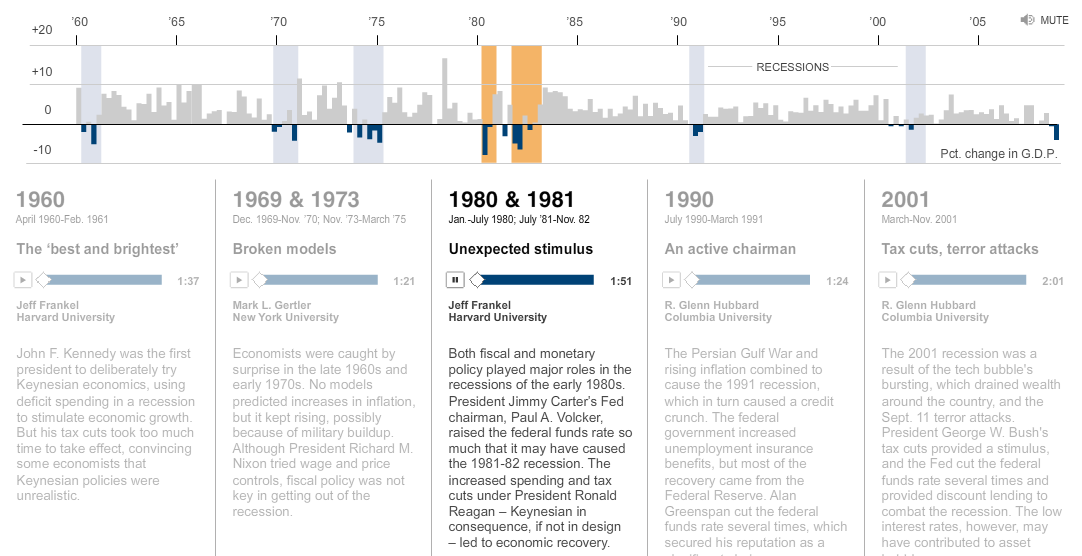
Keynesian Economics: How Governments Dealt With Past Recessions
Fascinating interactive graphic from the NYT, circa January 2009:
“Since the Great Depression, presidents have frequently experimented with Keynesian economics to combat recessions. Three economists chronicle the history of government policy during past recessions and explain what worked and what didn’t.”
>


Tweet
Facebook
Reddit
Digg this!


June 22nd, 2011 at 4:40 pm
[...] Keynesianism in prior recessions, infographic [...]
June 22nd, 2011 at 7:10 pm
This time it’s different. Really.
Why?
Because the hole is too deep to patch with more debt. They are past the peak and are now making things WORSE with each injection of cheapened fiat credit.
June 22nd, 2011 at 8:14 pm
Uh, isn’t actual “Keynesian economics” supposed to involve the government running a surplus in good and average times so that they can do that extra spending in bad times? It’s a bit like having a diet regimen that counsels celery and carrots most days and indulging on Sundays and calling William Howard Taft and Dom DeLuise the shining examples of it because each once at some celery.
June 22nd, 2011 at 9:32 pm
The Republicans were silent while Bush the Lesser ran a string of blockbuster deficits in good and average times and then when the shit hit the fan and deficit spending and stimuli were necessary to avoid (or delay) a great depression they reappear as deficit hawks.
June 22nd, 2011 at 9:50 pm
MayorQuimby:
Then explain the time during and right after WWII.
June 22nd, 2011 at 10:25 pm
The only problem is we’re not in a recession. We’re in a depression that the Fed has spent a couple trillion dollars trying to make look like a recession. That’s why we’re not coming out of it, and that’s why before it’s all over it’s going to be a 100x worse than it should have been.
June 22nd, 2011 at 10:57 pm
Phil. Should we launch military attacks on most of the competing industrial economies so that we have no serious industrial competitor like after WWII?
And while you might try to say that the federal gov’t debt situation was just as bad after WWII, it’s not even close because the U.S. has unfunded liabilities of multiple times the official debt now (Social Security, Medicare etc. . ) while there were essentially no such liabilities then.
The Fed indulged in quite a bit of what Rhinehart(sp?) termed “financial repression” after WWII, capping bond interest rates while running inflation up to 10%+ for a couple years in a row in the late 40′s. It’ll be quite a bit more difficult to do this time.
June 22nd, 2011 at 11:02 pm
Too bad you don’t include the deep recession of 1920 when the govt cut spending significantly & taxes a little–that is reduced the burden of govt–& the economy took off.
June 22nd, 2011 at 11:20 pm
Keynes theory actually states that Governments should run surpluses during good times to ALLOW FOR ofsetting dececits during had times. Congress always conveniently abuses Keynes theory and, in the United Corporatocracy of America, the chances of clarity in this regard are approximately zero.
June 22nd, 2011 at 11:27 pm
Phil-
Sure thing.
WWII resulted in the destruction of the world’s manufacturing facilities save for ours. With the resultant emergence of a robust manufacturing base, USA became the provider of goods for the modern world. This resulted in a surge of export-driven growth which enabled us to ‘grow our way out of debt’.
Underlying all the Fedspeak and WS talk and noise – is ALWAYS the real economy. Do not forget that.
At any rate – our debt to gdp levels are as high as they were at the end of WWII BUT:
1. Our educational standards are weak putting American labor at a disadvantage vs. other nations’.
2. Our unfunded liabilities are astronomically vs. where they were back then – essentially quadrupling our debt to gdp level assuming nothing is cut (yeah right).
3. China and other nations now have the technologies to compete with USA. What will drive our growth going forward?
4. Cost of living for your average American is much worse on a relative basis making capital formation much more difficult. This will hamper growth as well.
June 23rd, 2011 at 2:03 am
@MayorQuimby: thanks, great comment, pretty indisputable points, doesn’t look good for the US. But I, the eternal optimist, ask: so how’s come West Side Story’s “I want to live in America” still resonates with millions around the globe?
June 23rd, 2011 at 8:15 pm
@victor:
It’s all relative.
5 out of 6 people in the world would still improve their standard of living by moving to the US. Even the “underprivileged” here have it pretty damned good by global measures.
June 24th, 2011 at 1:32 am
victor Says:
June 23rd, 2011 at 2:03 am
@MayorQuimby: thanks, great comment, pretty indisputable points, doesn’t look good for the US. But I, the eternal optimist, ask: so how’s come West Side Story’s “I want to live in America” still resonates with millions around the globe?
Victor,
That would be millions of Mexicans, Bangladeshi’s etc? Whilst there is no problem with “The melting pot”, most folks in the balance of the civilized world (Which actually does exist outside the US) would have no desire whatsoever to live in the US or be compelled to pay US taxes on worldwide income from wherever in the world domicliled (Aka, isn’t the Green Crd a true blessing). Most Europeans, in particular, view thw US as having a complete lack to history and culture. “The great mediocrity” is a common way of desribing the United Corporatocracy of America elsewhere.
Look inward?
June 29th, 2011 at 2:16 pm
$1 Million Challenge
It’s as simple as this: the U.S. economy is mature and rapidly losing steam. And economists and politicians must get their collective minds around that fact. This doesn’t mean we are doomed. But it does mean that sustained GDP growth of 3 percent is pure folly. Can US GDP grow at 3 percent in a given quarter or even year. Certainly it can. But it will never ever grow at 3 percent – or even 2 percent – for an entire decade.
Let’s review:
Average rates of growth for US Real GDP by decade:
1940s: 5.99%
1950s: 4.17%
1960s: 4.44%
1970s: 3.26%
1980s: 3.05%
1990s: 3.20%
2000s: 1.82%
The rate of US GDP growth peaked in the 1960s – and has been trending down ever since. The minor exception was the 1990s when Personal Consumption Expenditures (PCEs) were driven by a) an unnatural increase in income in 1998 and 1999 at nearly double the rate of all other years in the 1990s, coinciding with the dot-com bubble; b) a concurrent increase in access to goods in the form of mind-numbing and unsustainable retail expansion in the 1990s; and c) consumer individuation – a narcissistic shift in consumer behavior that supported the move toward individually-owned products (my car, my cell phone, my laptop, my television, my iPod, etc.). PCEs were effectively juiced – like an aging Major League Baseball player – fueled by folly and increasing by 5.2% in 1998 and 5.5% in 1999 when PCEs increased at an average of only 2.85% for the balance of the decade (1990-1997).
The fact is that the US economy today is a 1% economy. That’s it. What are the implications? What are the implications for an aging 75-year old golfer? They can still play and compete – just not to the levels that they once used to enjoy. In effect, they have to deal with the fact that they can’t reach most par-fours in two anymore. So they become creative and find workarounds. That’s the US economy today. And if we are to survive, we have to accept that fact and find new and unconventional ways to create jobs rather than continually BS ourselves into thinking that we can grow our way out of this monumental mess. We can’t.
Anyone who thinks that US GDP will grow at 2 percent or more for the decade 2010-2019 is delusional. I will wager $1 million with anyone who is willing to bet that the US economy will grow at 2 percent or more for the current decade. It will not. Deal with it.
Tom Osenton
tosenton@customershare.com
Author of:
The Death of Demand (Financial Times Prentice Hall 2004)