
Markets Down 6 Weeks Consecutively (and that means…)
History may not repeat, but it often rhymes.
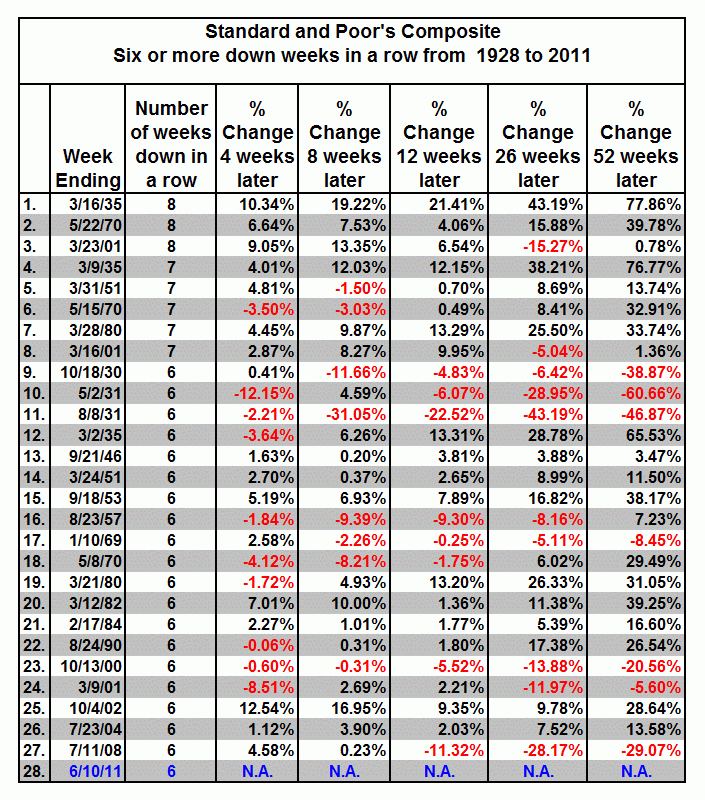
This table, assembled by Ron Griess of The Chart Store, shows what markets have done over the past century following any stretch of down 6 consecutive weeks.
The data reads both binary and inconclusive: If the markets are merely oversold, then you get a nice snapback, and one year later, the markets could have rallied anywhere from 1%-78%. But if the 6 weeks down is the start of a major correction or even market crash, one year later you could be down anywhere from 5% to 61%.
(I’d like to play with this data run a bit, and see what else I can conclude . . .)
>


Tweet
Facebook
Reddit
Digg this!


June 13th, 2011 at 6:44 am
US equity outflows largest in 10 months
(June 10 2011 17:30 | Last updated: June 10 2011 17:30)
Retail and institutional investors have withdrawn the most money out of US equity funds since mid-August, according to the latest weekly data from EPFR Global.
Redemptions come as worries about the economy and the end of the Federal Reserve bond purchase programme later this month have hit equities, sending the Nasdaq composite index into negative territory for the year on Friday.
The turn in sentiment for US equities has been led by retail investors who appear to have followed the adage: ‘sell in May and go away’.
Retail investors registered their largest redemptions for the year, at $2.1bn for the week ending June 8, said EPFR. It was the largest retail outflow since $2.3bn left the market in the last week of August in 2010 and they have withdrawn $5.8bn from stocks over the past seven weeks.
The total weekly outflow from both retail and institutional funds was $6.3bn, the largest redemption since the week ending August 18 last year.
June 13th, 2011 at 7:08 am
But we also need to consider QE3. With a government on the loose, a lot of past indicators no longer work.
June 13th, 2011 at 7:28 am
[...] Market is down 6 weeks in a row. It has not been pretty. If you’ve been on the short side, congratulations. If you’ve [...]
June 13th, 2011 at 7:35 am
>>The data reads both binary and inconclusive: If the markets are merely oversold, then you get a nice snapback, and one year later, the markets could have rallied anywhere from 1%-78%. But if the 6 weeks down is the start of a major correction or even market crash, one year later you could be down anywhere from 5% to 61%.>>
Exactly. This is a clear sign the markets will either move up or will move down.
:-)
June 13th, 2011 at 7:43 am
Lots of numbers to crunch!
Who has more fun with stats? The folks at the Elias Sports Bureau and their baseball work (ie best hitter in baseball with runners on 1st and 2nd and a 1 and 2 count with one out…) or folks like Ron Griess at The Chart Store?
June 13th, 2011 at 7:46 am
Might be interesting to look how long these events occured from the previous bear market low ie where are we in the market cycle.
June 13th, 2011 at 8:30 am
From these data, it looks like six weeks down in a row is a really critical point for the market. One more week down, and the data show a very different picture, although the available statistical sample for seven or eight weeks down in a row is obviously much smaller. If everyone counts on this, something else is going to happen anyway.
June 13th, 2011 at 8:32 am
So it might rain… or the sun might shine. Gotta love those forecasts.
June 13th, 2011 at 8:38 am
Missing a possibly meaningful data point: what was the percentage drop during those X consecutive weeks of decline? I don’t see a strong correlation in the current data (other than to root for one more down week to change the odds of a bad outcome), so maybe we’re just not seeing the whole thing.
June 13th, 2011 at 8:58 am
I find Sentimentrader.com’s take on things a little more interesting (and certainly more bullish). They just ran an analysis on instances since 1986 where the S&P hit a one month low and a correction of at least 4% with no corresponding spike in the VIX (as now). One month later the market had rallied an impressive 88% of the time, with a median gain of 6.1%.
June 13th, 2011 at 9:36 am
The change is largely due to a shift in investor focus – many are concluding that the prospects for 2012 aren’t looking promising.
June 13th, 2011 at 9:41 am
A post pointing out the more recently increasing number of streaks in both directions and speculations on possible causes:
http://feedproxy.google.com/~r/zerohedge/feed/~3/ggb0AbTSQv4/market-streaking-and-hfts-constantly-bidding-stocks-higher
June 13th, 2011 at 10:03 am
The Twitter Effect
http://xkcd.com/491/
June 13th, 2011 at 11:37 am
Is it a coincidence that the United States Debt first reached the debt ceiling ($14,293,975,000,000) on 25 April 2011 and has been essentially flat since then?
http://www.treasurydirect.gov/NP/BPDLogin?application=np
June 13th, 2011 at 11:57 am
Since the 8-week and 7-week series are continuations of the 6-week time periods, I think for this data set it is best to study only the 6-week periods.
Looking at the 19 prior 6-week periods with consecutive losses, there are at least eight that are negative 26-weeks later. That’s a bearish result 6-months later in 42% of the cases, which is a slightly higher bearish bias than the historic 30% bearish outcome would suggest (assuming the market is up 70% of the time on a 6-month basis as it typically has been on an annual basis).
If the market finishes this week down, the bearish 12-month case takes a huge hit according to the addmitedly small data set in the 7-week and 8-week periods shown. If we finish up, which is quite probable considering op-ex and the current extreme oversold market, there is a 53% chance we will be lower 4-weeks from now based upon the secular bear 6-week samples. If we are lower 4-weeks from now, there is a 62% chance we will be lower 26-weeks from now based upon the sample set.
The disturbing aspect of this data set is 10 out of the 14 secular bear 6-week data examples are from the early half of the secular bear cycle, giving us few examples from a mid or late secular bear market to draw from (the only late secular bear data is from the current example, 3-21-80, 3-12-82, and 7-11-08) .
Furthermore, other than 7-11-08, we have no other mid to late-mid cycle secular bear examples to draw from. The data from 1980 and 1982 were from the tail end of that secular bear market.
While it would appear this data may be somewhat useful, it is likely other tools will be far more effective in helping determine the probable market direction in both the near term and six months down the road.
June 13th, 2011 at 12:28 pm
To analyze, look at all 6wk periods in history and see what the % split is for ending up or down at 52 wks. Is this split statistically different than the 6 contiguous down wks of (20 up & 7 down) =74%.
Like baseball stats, you can write a regression model and run a monte carlo simulation to see if you have a better chance of making money in xx wks out. My guess is 6 wks indicates nothing. There are too many more significant variables in the market.
Remember correlation is not causation. If it rains before game 4 of the world series, the N.L. has a 60% chance of winning. If the sun is shining in Hawaii on a Sunday morning in December, is there is a chance the Germans are going to bomb Pearl Harbor again? No. (regards to Bluto)
June 13th, 2011 at 2:31 pm
So it looks like we would be better off if it dropped for week 7? What happens at 9 weeks down?
June 13th, 2011 at 3:47 pm
First and foremost, no two market intervals are the same. As noted, they might mimic one another; but never the same.
None of the intervals considered above had QE1, QE2, QEx.
Play the market as it is given to you: either short or long depending upon your views (and pocket size).
If you love any equity, accumulate for as long as you can afford.
S&P 500 at 300? Possibly!
Who wins? The US: the largest pocket in the world!
June 13th, 2011 at 11:37 pm
Red_Shoes: yesterday SentimenTrader ran another far more telling analysis on a six-consecutive-week downdraft in the Dow, looking back to 1900. He looked only at instances when the index was above its 52-week average, as now, to avoid misleading comparisons with declines in a cyclical bear market.
Remarkably, there were only five other instances in the past 111 years. Four of the five cases led to a short-term rally. But in every case, markets were either at the very beginning of – or within a few months of – a protracted bear market.
What the persistence of this decline and rising volume is telling you is that the big money is selling, and heavily. There may be a bounce coming, but don’t be tempted into buying for anything other than a short to medium term trade.