Surplus/Deficit as a % of GNP/GDP

Email this post Print this post
By Barry Ritholtz - June 17th, 2011, 11:30AM

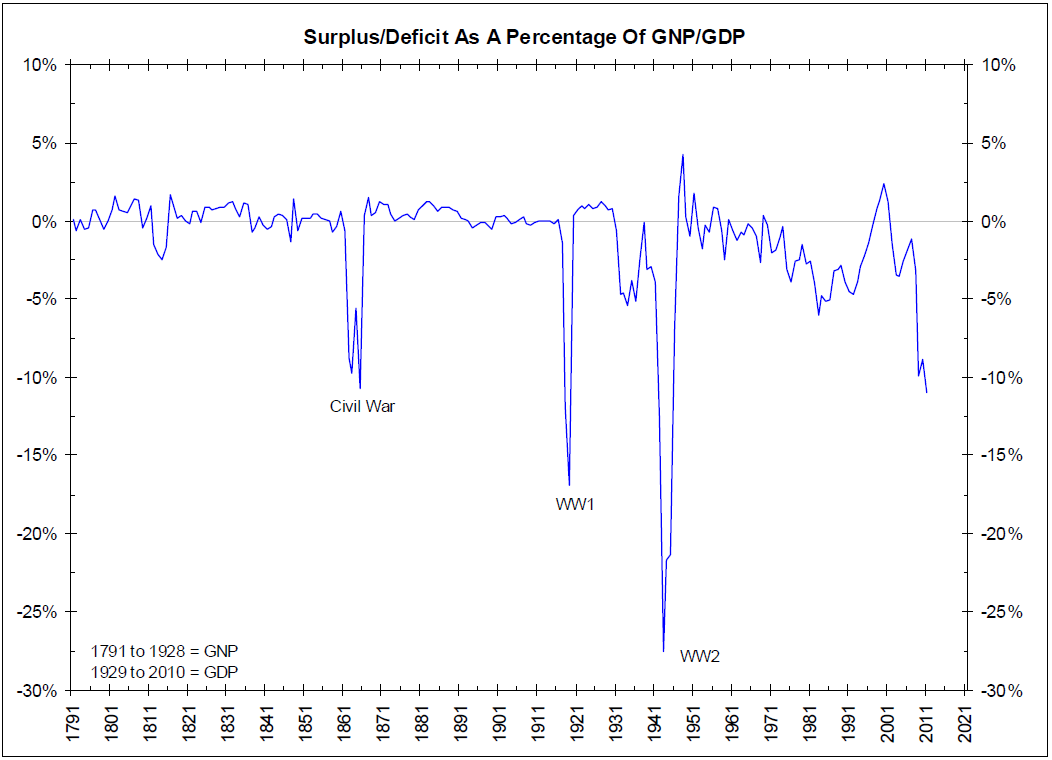
Quite a fascinating chart from James Bianco of Bianco Research:

>

Surplus/Deficit As A Percentage Of GNP/GDP

click for ginormous graphic
Comments

Please use the comments to demonstrate your own ignorance, unfamiliarity with empirical data, ability to repeat discredited memes, and lack of respect for scientific knowledge. Also, be sure to create straw men and argue against things I have neither said nor even implied. Any irrelevancies you can mention will also be appreciated. Lastly, kindly forgo all civility in your discourse . . . you are, after all, anonymous.

45 Responses to “Surplus/Deficit as a % of GNP/GDP”

  1. PhilPerspective Says:

    Further proof that austerity is a bad idea?

  2. tagyoureit Says:

    At least today it’s still limited warfare…

  3. James Says:

    > Quite a fascinating chart from James Bianco

    Indeed. And that dip on the far left should be the War of 1812.

  4. ByteMe Says:

    War gets more and more expensive.

  5. socaljoe Says:

    Missing from the chart is a label for the recent dip.

    I suggest: “Middle East Wars”.

  6. nilsonb Says:

    I don’t understand.
    According to UST historical data on their website, the national debt has increased every year, in fact every Q, since about 1954.
    So how was there a surplus around 1999-2000 if the national debt increased every Q and never went down?
    What am I missing?

  7. The US Deficit Problem Is At Civil War Levels - News and Current Events Says:

    [...] and the bailouts and stimulus. Another way to look at the problem, from Bianco Research (via Barry Ritholtz): Please register to view the post attachment(s) – it's simple and free. Image: The Big Picture [...]

  8. DeDude Says:

    I guess even a war against a moronic ideology is expensive.

  9. Super-Anon Says:

    Switching to a fiat currency allows deficits to be come structural rather than circumstantial by deferring the cost (pain) of the economic deformations that these deficits represent (specifically in our case deficit funded consumption).

    Currency is the fundamental unit of economic communication. By using a fiat currency the economic messages that the currency represents can be altered arbitrarily to communicate political will rather than economic meaning.

    And this is the reason for the looming collapse of the US financial, political and economic system:

    The fundamental unit of economic communication was hijacked and altered to communicate political will instead. Hence it lost its utility to the economy, and our economic agents lost the ability to communicate in a meaningful way.

    Collapse is the natural and inevitable result.

  10. Arequipa01 Says:

    This is a very fine notion:

    “Currency is the fundamental unit of economic communication. By using a fiat currency the economic messages that the currency represents can be altered arbitrarily to communicate political will rather than economic meaning.”

    Just excellent, thanks.

  11. JohnnyVee Says:

    According to the chart, WWIII has started.

  12. ByteMe Says:

    So how was there a surplus around 1999-2000 if the national debt increased every Q and never went down?

    It has to do with social security revenues making up the difference, since congress spends that just like it was all the other play money.

  13. ottnott Says:

    Interesting. The chart suggests that the Reagan era actually went against the worsening trend of the last 60 years. So, to correct Cheney (and most of his brethren), Reagan didn’t prove that deficits don’t matter. Reagan proved that they matter less and less if you can grow the economy faster than the deficits are growing.

    Re: fiat currency = inevitable collapse. I must warn you that collapse and death is the natural and inevitable result of using the term “fiat money”. The historical record is clear on that fact.

  14. nilsonb Says:

    ByteMe Says:
    June 17th, 2011 at 1:50 pm
    So how was there a surplus around 1999-2000 if the national debt increased every Q and never went down?

    It has to do with social security revenues making up the difference, since congress spends that just like it was all the other play money.
    :::::::::::::::::::::::::::::::::::::::::::::::::::

    So getting more tax revs than planned and spending it all is now a “surplus”?
    And going deeper into debt is also counted as a “surplus”.

    I shoulda gone to school in DC.

  15. FT Alphaville » Further further reading Says:

    [...] – Chart du jour, via the Big Picture. [...]

  16. willid3 Says:

    historical debt
    http://www.usgovernmentspending.com/include/us_fed_debt_full.png

  17. willid3 Says:

    and more debt
    http://www.usgovernmentspending.com/include/us_fed_debt_net.png

  18. M Says:

    The denominator matters: http://research.stlouisfed.org/fredgraph.png?g=Ri

  19. paulie46 Says:

    Guys,

    I don’t think it’s that complicated…

    What would a surplus even look like on a Debt/GDP ratio graph?

    You know the economy grows every year…

    If GDP growth occurs at the same rate as the growth in debt the ratio stays constant (a flat line). Otherwise…

  20. paulie46 Says:

    Also, what is the alternative to a fiat monetary system?

  21. willid3 Says:

    but deficit doesn’t = debt. they aren’t the same thing. one may lead to the other. but not always. you borrow money to start a business. revenue is negative, deficit is immense, debt is also large. but the debt is based on years to pay (unless you don’t know what you are doing of course). eventually (hopefully) the deficit (revenues – expenses) isn’t large. and that debt will get paid down.
    so why are we surprised when we cut taxes that we get a deficit? if we had cut taxes requiring businesses to do some thing (like hiring) it might have worked out ok. but we didn’t

  22. paulie46 Says:

    Debt is the cumulative total of all deficits/surpluses…

  23. paulie46 Says:

    Also the Debt will never be paid down…

    Never has, why would we start now?

  24. paulie46 Says:

    The Federal Government is not like a business…in any way, shape or form.

    A business, like a household, local or state government is revenue-constrained. The Federal Government is not.

    The Federal Government creates money out of thin air and destroys same via taxation…

    Money is just numbers denominated as Dollars…as far as I know we can’t run out of numbers.

  25. nilsonb Says:

    Historical Debt Outstanding – Annual 1950 – 1999
    http://www.treasurydirect.gov/govt/reports/pd/histdebt/histdebt_histo4.htm

    Historical Debt Outstanding – Annual 2000 – 2010
    http://www.treasurydirect.gov/govt/reports/pd/histdebt/histdebt_histo5.htm

    Being simple, I see increasing debt meaning no real surplus . Only increasing debt. And increasing BS from DC.

  26. willid3 Says:

    nilsonb its been that way from the begining, if you look further back than the 1950s. there was only a few occasions where debt didn’t go up from year to year.

  27. willid3 Says:

    paulie4, while a business or individual are revenue constrained, they can and they do borrow lots more than can be paid back in short term time period? the feds have long term debt (30 yr) and short term debt (10 and 5 I think). as do businesses. and individuals. and the feds are the only ones that appear to be unconstrained. but then they are like the others are they? they can increase their revenue. but only if they get approval from those that were elected by their owners (at least thats the theory any way) . unlike say China who could do it because they wanted to. and a business can increase their prices (especially if they have a monopoly like say an insurance company or health care provider in some areas). and they have a history of doing so. many times.
    the issue we have the fed debt is one thing. they borrow short term to pay for long term assets. like roads, and others.
    if we the debt has always been going up (and pretty much always has) then why are we worried?
    this isn;t new. its as old as the country for the most part

  28. paulie46 Says:

    willid3,

    It appears we are on the same page…But, a few points

    • The government “borrows” money by choice ie, it is a political choice not an operational constraint.

    • The government doesn’t actually “borrow” money, because it is the monopoly issuer of the currency – it creates new money out of thin air constantly…

    • What we call government “borrowing” is just the Fed voluntarily paying interest on money that was previously created. We don’t “need” to “borrow” the money.

    • For example China has been selling us more stuff than we have been selling them for years, leaving us with a trade deficit not unlike our (so-called) National Debt. This “deficit” is the accumulation of payments and credits to and from private (corporate) bank accounts in China’s checking account at the Fed. Everything that has been bought was paid for in “cash” – China traded their stuff for our dollars. So far, no debt.

    If China decides that they would rather move some of their dollars into a savings account at the Fed (Treasuries) to earn a little interest, does that make it a loan? All we have to do is stop paying interest and move it back to their checking account. Loan is terminated.

    I don’t see the logic in saying that as a country we “borrow” money from anyone.

  29. willid3 Says:

    • For example China has been selling us more stuff than we have been selling them for years, leaving us with a trade deficit not unlike our (so-called) National Debt. This “deficit” is the accumulation of payments and credits to and from private (corporate) bank accounts in China’s checking account at the Fed. Everything that has been bought was paid for in “cash” – China traded their stuff for our dollars. So far, no debt.

    actually there is a lot of debt here. and its a lot more than the governments debt. in fact its many magnitudes higher than any other debt.

  30. paulie46 Says:

    willid3,

    How did all the cash we’ve (the private sector) paid China turn into debt?

  31. paulie46 Says:

    Oh, and the Private Sector has way more (2-3 times) real debt than the Government has debt-that-isn’t debt.

    That’s the problem with the economy, not Public Debt.

  32. ewmayer Says:

    @nilsonb:

    “According to UST historical data on their website, the national debt has increased every year, in fact every Q, since about 1954.
    So how was there a surplus around 1999-2000 if the national debt increased every Q and never went down?
    What am I missing?”

    You are missing “intragovernmental borrowings”, which is the government’s benign-sounding euphemism for “raiding the social security and medicare trust funds in order to make the yearly budget hole look better than it is.” Treasury types like to justify the benign name via the definition “It is federal debt that the government owes to itself.” I would argue that no, it is federal debt that the government owes to to those who paid into said trust funds and expect the money to be used for its promised purpose.

    Wikipedia explains it nicely [http://en.wikipedia.org/wiki/United_States_federal_budget] – Interestingly, the quote below is from the snapshot of the page I viewed last year, it has since been sanitized, no more mention of ‘gimmick’ and such:

    “These on-budget and off-budget items essentially amount to accounting gimmicks and schemes. In reality, what really matters is how much money comes in and how much money goes out. The federal government publishes the total debt owed (public and intragovernmental holdings) at the end of each fiscal year [50] and since FY1957, the amount of debt held by the federal government has increased every single year.”

    The total amount of these Treasury IOUs currently stands at around $4.5 Trillion, or roughly 30% of GDP.

    Here is the link in the above reference [50]: http://www.treasurydirect.gov/govt/reports/pd/histdebt/histdebt_histo4.htm
    That covers 1950-1999; for 2000-2010 go to the …histo5.htm page.

    The above Treaury pages give just the absolute total of IGHs as of 9/30 of every year (6/30 before 1977), so I crunched the numbers, here is the resulting table, in which each line starts with a year and follows with a dollar amount representing “Year-over-year increase in intragovernmental borrowings as of 9/30 of the current year”. Negative right-column numbers represent surpluses, and indeed 1957 is the last time we had one of those, although Clinton did come close in his last year in office (though some of that budget goodness was admittedly unsustainable windfall revenues from the about-to-pop dotcom bubble):

    [* = rounded to nearest million]

    Date Debt Oustanding YoY Change
    ———- —————— —————–
    09/30/2010 13,561,623,030,891 1,651,794,027,380
    09/30/2009 11,909,829,003,511 1,885,104,106,599
    09/30/2008 10,024,724,896,912 1,017,071,524,650
    09/30/2007 9,007,653,372,262 500,679,473,047
    09/30/2006 8,506,973,899,215 574,264,237,492
    09/30/2005 7,932,709,661,723 553,656,965,393
    09/30/2004 7,379,052,696,330 595,821,633,587
    09/30/2003 6,783,231,062,743 554,995,097,146
    09/30/2002 6,228,235,965,597 420,772,553,397
    09/30/2001 5,807,463,412,200 133,285,202,314
    09/30/2000 5,674,178,209,886 17,907,308,271
    09/30/1999 5,656,270,901,615 130,077,892,718
    09/30/1998 5,526,193,008,897 113,046,997,500
    09/30/1997 5,413,146,011,397 188,335,072,262
    09/30/1996 5,224,810,939,135 250,828,038,426
    09/29/1995 4,973,982,900,709 281,232,990,696
    09/30/1994 4,692,749,910,013 281,261,026,874
    09/30/1993 4,411,488,883,139 346,868,227,618
    09/30/1992 4,064,620,655,521 399,317,303,824
    09/30/1991 3,665,303,351,697 431,989,899,920
    09/28/1990 3,233,313,451,777 375,882,491,590
    09/29/1989 2,857,430,960,187 255,093,248,146
    09/30/1988 2,602,337,712,041 252,060,821,088
    09/30/1987 2,350,276,890,953 224,974,274,295
    09/30/1986 2,125,302,616,658 302,199,616,658
    09/30/1985 1,823,103,000,000* 250,837,000,000
    09/30/1984 1,572,266,000,000* 195,056,000,000
    09/30/1983 1,377,210,000,000* 235,176,000,000
    09/30/1982 1,142,034,000,000* 144,179,000,000
    09/30/1981 997,855,000,000* 90,154,000,000
    09/30/1980 907,701,000,000* 81,182,000,000
    09/30/1979 826,519,000,000* 54,975,000,000
    09/30/1978 771,544,000,000* 72,704,000,000
    09/30/1977 698,840,000,000* 78,407,000,000
    06/30/1976 620,433,000,000* 87,244,000,000
    06/30/1975 533,189,000,000* 58,129,184,269
    06/30/1974 475,059,815,731 16,918,210,419
    06/30/1973 458,141,605,312 30,881,144,372
    06/30/1972 427,260,460,940 29,130,716,485
    06/30/1971 398,129,744,455 27,211,037,506
    06/30/1970 370,918,706,949 17,198,453,108
    06/30/1969 353,720,253,841 6,141,847,416
    06/30/1968 347,578,406,425 21,357,468,631
    06/30/1967 326,220,937,794 6,313,849,999
    06/30/1966 319,907,087,795 2,633,188,812
    06/30/1965 317,273,898,983 5,560,999,726
    06/30/1964 311,712,899,257 5,853,266,261
    06/30/1963 305,859,632,996 7,658,810,276
    06/30/1962 298,200,822,720 9,229,884,110
    06/30/1961 288,970,938,610 2,640,177,762
    06/30/1960 286,330,760,848 1,624,853,770
    06/30/1959 284,705,907,078 8,362,689,333
    06/30/1958 276,343,217,745 5,816,045,849
    06/30/1957 270,527,171,896 -2,223,641,753
    06/30/1956 272,750,813,649 -1,623,409,153
    06/30/1955 274,374,222,802 3,114,623,694
    06/30/1954 271,259,599,108 5,188,537,470
    06/30/1953 266,071,061,638 6,965,882,853
    06/30/1952 259,105,178,785 3,883,201,971
    06/29/1951 255,221,976,814 -2,135,375,537
    06/30/1950 257,357,352,351

    So, roughly speaking, total debt really got out of hand starting under Reagan, during whose 2 terms it nearly tripled. Under Bush Sr. it increased 50% in 4 years, under Clinton added another 40% in his 8 years, Bush Jr. nearly doubled it in his 8 years, and Obama is on a pace to outdo even his predecessor,

  33. ewmayer Says:

    Crud, the forum-comment software nuked the multiple-spaces I used in my reply above to make the table columns line up nicely. For a version that looks as I intended, please go here:

    http://mersenneforum.org/showthread.php?p=264035#post264035

  34. kaleberg Says:

    Fiat money may not guarantee societal immortality, but gold backed money doesn’t have as good a record. Just bout every specie backed society has either given up the standard in the face of economic crisis or has collapsed. There are still fiat money based societies in operation today. Sometimes you just have to look at the wretched facts.

  35. Greg0658 Says:

    as I go down …
    a> fiat currency is not gonna be Gold .. it is labor & survival gear (in the modern intellectual age)

    b> “the Debt will never be paid down … Never has, why would we start now?”
    depends on your POV ie Capital ya gotta & Labor why make their day FU

    c> the USA FED is not the world (anymore .. WTO exported it) … but WTO is real and an issue if your an american and not in a WTcorp

    d> paulie46 – are we excussed by our TBTFight? really – is that the rules now in world trade ? … humm – where does that take mi mind

  36. victor Says:

    @paulie46,

    I’m not sure what you mean by ” Also the Debt will never be paid down…Never has, why would we start now”

    Here’s how Bill Gross of Pimco sees it and I agree:

    1) debt is ALWAYS paid, either by the debtor (preferred) or by the creditor (not preferred), but it ALWAYS get paid

    2) The US Government has a real debt of some $14 trillion, as real as my kids debt on his Shell Visa credit card: either he pays it or the issuer ends up paying it by writing it off its accounts receivables. Of the $14 trillion we owe China some $1.2 trillion as a result of our trade imbalance with them AND as a result of China’s purchasing our Treasury notes and bonds

    3) The US Treasury has been paying off this debt by squeezing all savers : domestic (such as you and me) and international (such as China) by a) devaluing the US $, b) paying low/negative interest rates and c) eventually creating inflation..

  37. U.S. Deficit is Back to Civil War Levels | All Star Charts Says:

    [...] as a % of GNP/GDP (Barry Ritholtz via Bianco [...]

  38. One very simple chart showing how the USA has been going down the pan since the 1970′s | The Waspsnest Says:

    [...] the 1970′sThe old adage of a picture speaking a thousand words is quite apt in the case of the following chart of US budget surplus/deficit as a percentage of GDP.Apart from a couple of temporary blips, the [...]

  39. Joe Friday Says:

    socaljoe,

    “Missing from the chart is a label for the recent dip. I suggest: ‘Middle East Wars’.”

    According to the independent non-partisan Congressional Budget Office, the label would read:

    ‘TAX CUTS FOR THE RICH & CORPORATE’

  40. Joe Friday Says:

    nilsonb,

    “I don’t understand. According to UST historical data on their website, the national debt has increased every year, in fact every Q, since about 1954. So how was there a surplus around 1999-2000 if the national debt increased every Q and never went down? What am I missing?”

    You’re conflating federal deficits/surpluses and federal debt.

  41. Joe Friday Says:

    ByteMe,

    “It has to do with social security revenues making up the difference, since congress spends that just like it was all the other play money.”

    No.

    Congress does not have the legal authority to “spend” “social security revenues”. Proof is that all of Social Security’s revenues are still exactly where they should be.

  42. Joe Friday Says:

    ottnott,

    “Interesting. The chart suggests that the Reagan era actually went against the worsening trend of the last 60 years. So, to correct Cheney (and most of his brethren), Reagan didn’t prove that deficits don’t matter. Reagan proved that they matter less and less if you can grow the economy faster than the deficits are growing.”

    You must need a remedial class in chart reading.

    Federal deficits and debt exploded under Reagan, and the deficits and debt grew faster than the economy.

  43. Joe Friday Says:

    paulie46,

    “Also the Debt will never be paid down… Never has, why would we start now?”

    About $600 billion of federal debt was paid down during the Clinton administration.

  44. ewmayer Says:

    @Joe Friday:

    >>>You’re conflating federal deficits/surpluses and federal debt.

    No – He was thinking total government debt, which includes off-balance-sheet debt (borrowings from SS and Medicare) and publicly held debt, which the chart shows.

    >>>Congress does not have the legal authority to “spend” “social security revenues”. Proof is that all of Social Security’s revenues are still exactly where they should be.

    It seems Congress failed to get that memo, because to date they have spent over $4.5 Trillion of said revenues and replaced the funds in those “trust finds” with a special form of nonmarketable Treasury IOUs which magically does not appear on the government’s balance sheet.

    >>>Federal deficits and debt exploded under Reagan, and the deficits and debt grew faster than the economy.

    Well, at least you got one right.

    >>>About $600 billion of federal debt was paid down during the Clinton administration.

    The Treasury’s own data (which I gave above) for total debt (including the aforementioned off-balance-sheet debt) show that it increased by around $1.2 Trillion under Clinton. That’s a whopper of a miss there, buddy.

    So, are you one of the legions of Barry-beloved “eejits” or a paid disinformationist?

  45. Joe Friday Says:

    ewmayer,

    “No – He was thinking total government debt”

    Nope.

    ~

    “which includes off-balance-sheet debt (borrowings from SS and Medicare)”

    There is no “borrowings from SS and Medicare”.

    ~

    “It seems Congress failed to get that memo, because to date they have spent over $4.5 Trillion of said revenues and replaced the funds in those ‘trust finds’ with a special form of nonmarketable Treasury IOUs which magically does not appear on the government’s balance sheet.”

    Nope.

    All of the treasury securities that the Social Security Trust Fund invested in are still exactly where they should be.

    ~

    “The Treasury’s own data (which I gave above) for total debt (including the aforementioned off-balance-sheet debt) show that it increased by around $1.2 Trillion under Clinton.”

    Then, even utilizing YOUR number, it would have been $1.8 trillion if the $600 billion was not paid down.

    What, is your calculator broken ?

84 queries. 0.377 seconds.

