Here Comes the Melt Up !

Email this post Print this post
By Barry Ritholtz - July 31st, 2011, 11:15PM

>

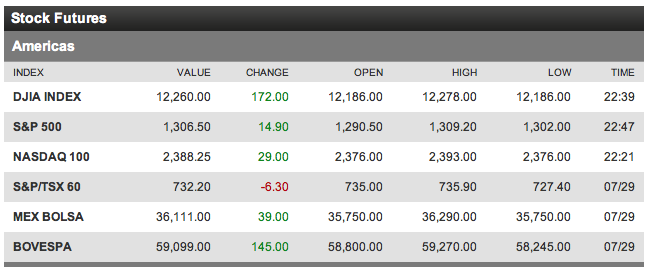
Okay, so we now have a deal, and the Futures are screaming higher. The decision not to sell into the weakness last week was so obvious it felt as if it was wrong.

The key for whether the market is topping out or starting a new leg upwards could very well be tomorrow’s trading and the few days that follows it. A strong market would gap up and ten keep going. Any failure to follow through, or — horrors! — a reversal spells trouble. A little upside volume would be nice as well.

More tomorrow . . .

Non-Carbon Based Life Forms

Email this post Print this post
By Barry Ritholtz - July 31st, 2011, 4:41PM

high frequency trading. one second presented in one minute.

NON_CARBON BASED LIFE FORMS from arc w on Vimeo.

Hat tip architecture w

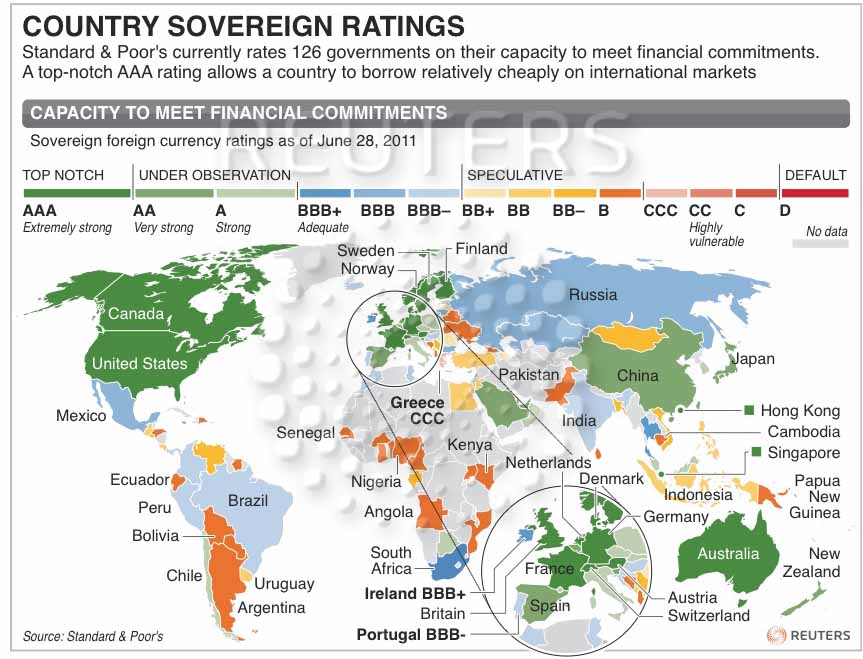
Sovereign Debt Ratings by Country

Email this post Print this post
By Barry Ritholtz - July 31st, 2011, 1:00PM

Thomson Reuters‘ graphic of the day:

>

Source: Reuters

>

Hat tip The Mess That Greenspan Made

Two Fish Tales and a Debt Ceiling

Email this post Print this post
By Barry Ritholtz - July 31st, 2011, 12:00PM

Two Fish Tales and a Debt Ceiling
July 31, 2011
David Kotok

~~~

The annual fishing gathering in Maine is fast approaching.  Our group comprises forty-six economists, financial professionals, portfolio managers, and investors from around the world.  At Leen’s Lodge, there will not be one bed or dining room seat left vacant.  This is our largest and widest assembly to date.  We look forward to some discussions, some fishing for small-mouthed bass, and some camaraderie.

Current world events are giving us plenty of food for thought.  That, coupled with the great cuisine of Leen’s Lodge, means the average weight gain will be about three pounds over the course of the weekend.

We are pleased to announce that Bloomberg Television will be covering the event on Friday, August 5th, when Michael McKee will be present with his cameraman.  Other media will also cover the event, including Dow Jones News Service, Barron’s, and National Public Radio.

This commentary is being drafted from the site of the other fish tale, the Star Valley Trout Ranch in Afton, Wyoming.  We are here for two days prior to the Global Interdependence Center Rocky Mountain Summit in Jackson Hole, Wyoming.  Some speakers arrived early and were able to gather for terrific trout fishing and engaging discussion.

All conversations at non-public GIC events are held under the Chatham House Rule.  Round-table discussions are limited, and media are asked not to quote or participate.  Chatham House Rule also requires that no one is to be quoted without their permission.  Takeaways from the group are permitted to be discussed, and I will limit this commentary to several specific items that were on the agenda in these private conversations.

The debt-ceiling debate, the behavior of our politicians in Washington, and the effect of money on the outcomes of American politics led every discussion during our gathering.  How could we have such a mess?  How could we allow our government to do things in this fashion?  What can we do to fix it?

Conclusions were reached that this is the system in place, and there is not much we can do to fix it.  Half the country has either grown complacent with the government or highly resistant to it, leaving the other half with the responsibility to energize itself and counter the polarizing forces of the left and right as they work to eliminate the functioning, common-sense, centrist middle.

Other technical issues in the debt-ceiling debate that have not received much attention were also discussed.  One of the theoretical issues is what would happen if the Obama Administration chooses to use the 14th Amendment provision to issue debt, given a Congressional failure to extend the debt ceiling.  How would the debt trade in the marketplace?  Would there be a risk premium attached?  Without a doubt there would be immediate court tests and challenges that would end with a Supreme Court decision.

A second concern is how the Federal Reserve would deal with this debt.  Would it be Treasury debt that they could buy?  Would they use it to substitute if they employed it to implement changes in policy or maintain the existing size of their balance sheet?  If the Treasury is not issuing new debt, what would happen in the marketplace if the Fed entered to buy 14th Amendment debt rather than seasoned debt?

There are so many open-ended questions regarding the debt ceiling.  None of the outcomes is good.  There is an obvious cost attached to every one of them.

In our Jackson Hole dialogue that took place with two Fed Presidents, Jim Bullard of St. Louis and Dennis Lockhart of Atlanta.  Lockhart summed up the sentiment with regard to the open questions by saying, “The best thing is for Congress to extend the debt ceiling.”  In response, Jim Bullard was equally succinct and direct in stating, “I agree.”

We’re editing this commentary from the Green River, where we are out fishing on a Saturday afternoon.  A few friendly trout have been helpful.  The rest of them came after the fly so fast that I missed hook sets right and left.  My friend Kip Wadsworth sat quietly looking at this old guy, and then proceeded to demonstrate his Utah prowess with a fly rod.  Luckily, he did not tease me too harshly.

Our kind guide, Chris Stump, was also unwilling to laugh at me, but he did give me some pointers, which I intend to adopt.  Here is a picture taken on the Green River in Wyoming: http://www.cumber.com/content/commentary/fish.jpg. Chris is holding the fish. If you would like a guide on your visit to Jackson Hole, email me for his contact information; he comes highly recommended.  (Photo credit: Kip Wadsworth)

We are off this week to Maine for the annual event.  We will discuss the debt ceiling, the economy, the markets, interest rates, and all the other things that are on the agenda.  Leen’s Lodge is a wonderful place for such conversation.  Our associates and guests who are coming this year will certainly contribute to the dialogue.  We hope the small-mouthed bass will add to the fun, too.

~~~
David R. Kotok, Chairman and Chief Investment Officer

Read the rest of this entry »

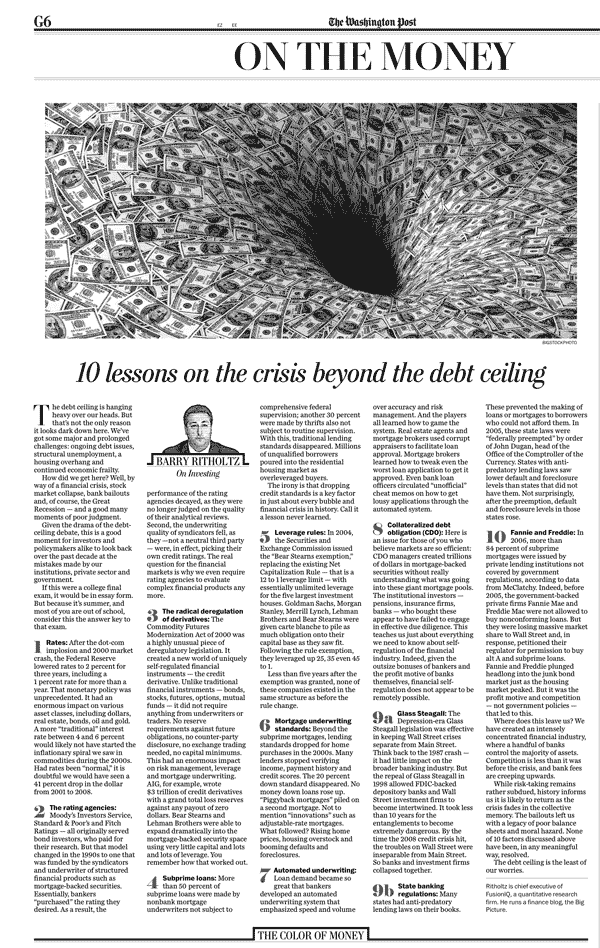
10 lessons on the crisis beyond the debt ceiling

Email this post Print this post
By Barry Ritholtz - July 31st, 2011, 9:30AM

The universe is an intricate machine of massive complexity. This gets lost in the typical, over-simplified pandering that passes for actual intellectual debates on TV. I always take it as a hint someone is being intellectually dishonest and/or spectacularly wrong when they attempt to reduce complex multi-variate causality to a simple factor. The world simply does not work that way.; its messy, confusing, complicated. Simple solutions to complex problems tied up in a neat little bow are usually silly school girl fantasies.

Which leads me to my column in today’s Washington Post: 10 lessons on the crisis beyond the debt ceiling. It looks at the ongoing causes of the financial crisis issues that simply have not been resolved since then. Most of these will b familiar to regular TBP readers. These make the debt ceiling debate look like kabuki theater.

Excerpt:

“The debt ceiling is hanging heavy over our heads. But that’s not the only reason it looks dark down here. We’ve got some major and prolonged challenges: ongoing debt issues, structural unemployment, a housing overhang and continued economic frailty.

How did we get here? Well, by way of a financial crisis, stock market collapse, bank bailouts and, of course, the Great Recession — and a good many moments of poor judgment.

Given the drama of the debt-ceiling debate, this is a good moment for investors and policymakers alike to look back over the past decade at the mistakes made by our institutions, private sector and government.”

Nice graphic, too:
>

>

Source:
Debt ceiling: 10 lessons beyond that crisis
Barry Ritholtz,
Washington Post, July 31, 2011 page G6
http://www.washingtonpost.com/business/debt-ceiling-10-lessons-beyond-that-crisis/2011/07/25/gIQAWlCmhI_story.html

July 31 Gx6 PDF

Shelby 1331bhp, 275mph Tuatara

Email this post Print this post
By Barry Ritholtz - July 31st, 2011, 9:00AM

Shelby SuperCars announces 1331bhp, 275mph ‘Tuatara’

7.0-litre twin-turbo V8, 275mph top speed makes it faster than the Bugatti Veyron SuperSport, and thus the fastest production car in the world.

Extensive use of carbon fibre, £500,000 price tag.

Designed by current Saab design director Jason Castriota (who created Ferrari P4/5 and Maserati GranTurismo).

Bad ass:

Shelby SuperCars has revealed the successor to the SSC Aero, going by the name of Tuatara.

Details of a release date are yet to be revealed, but don’t be surprised if SSC has another crack at relieving Bugatti of its record. Just 12 Tuataras will be built at a price ranging from $190,000 to $325,000, depending on options.


via Classic Driver

Dilbert: Preparing for Complete Financial Meltdown

Email this post Print this post
By Barry Ritholtz - July 31st, 2011, 8:15AM

I wish I had this for the Agora conference — they would have loved it!

>

Dilbert.com

Read the rest of this entry »

Will AAA Public Finance Issuers Be Downgraded Due To Review Of U.S. AAA Rating?

Email this post Print this post
By Washingtons Blog - July 31st, 2011, 1:00AM

“Moody’s Places AAA Ratings Of 177 U.S. Public Finance Issuers On Review For Possible Downgrade Due To Review Of U.S. Government’s AAA Rating”

Moody’s announced today:

Moody’s Investors Service has placed under review for possible downgrade the Aaa ratings of 177 public finance credits, affecting a combined $69 billion of outstanding debt. The credits include 162 local governments in 31 states, 14 housing finance programs and one university. A complete list of affected securities and additional analysis is available at www.moodys.com/USRatingActions.

These actions relate to Moody’s July 13 decision to place the Aaa government bond rating of the United States under review for downgrade, and reflect the rating agency’s assessment that some Aaa public finance ratings would likely be indirectly affected by potential credit deterioration of the sovereign.

***

In a previous action on July 19, Moody’s placed the ratings of five Aaa U.S. state governments under review for possible downgrade, affecting approximately $24 billion of general obligation and related debt. Those states are Maryland, New Mexico, South Carolina and Tennessee and the Commonwealth of Virginia.

The entities on down grade watch include:

  • The Colorado Housing and Finance Authority’s Single Family Mortgage Bonds and the Single Family Program Bonds, 2009 Class I
  • Idaho Housing and Finance Association’s Single Family Mortgage Senior Bonds, Series 1996B, Series 1996C, Series 1998D, Series 1999F, Series 1999-I*, Series 2000A, Series 2000C, and Series 2000D
  • Kentucky Housing Corporation’s Housing Revenue Bonds
  • Utah Housing Corporation’s Single Family Mortgage Senior Bonds, Series 1998G, Series 2000A and NIBP
  • The University of Washington
  • The Smithsonian Institution

Given that Moody’s and Standard & Poor both say that they’ll likely downgrade U.S. credit even if a debt ceiling deal is reached, it’s looking dire for the above-described entities and bond issues.

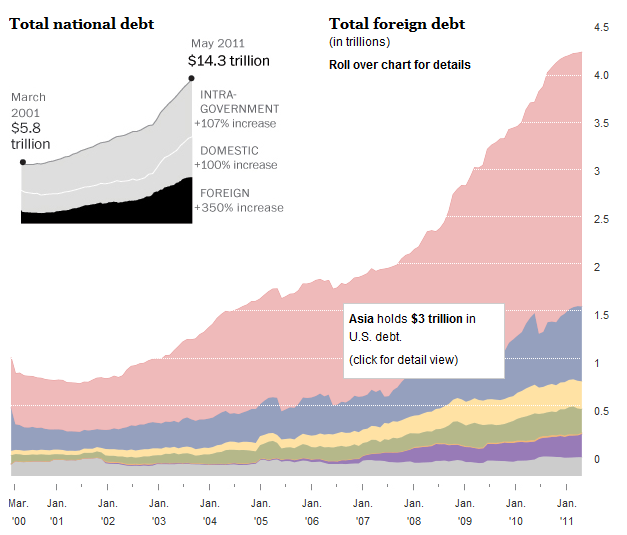
Our Mountain Of Debt

Email this post Print this post
By Barry Ritholtz - July 30th, 2011, 9:00PM

Click for full interactive graphic:

Hat tip: Flowing Data

Previously: Who Does the US Owe Money To?

Source:

Our Mountain Of Debt
Washington Post
Published July 17, 2011

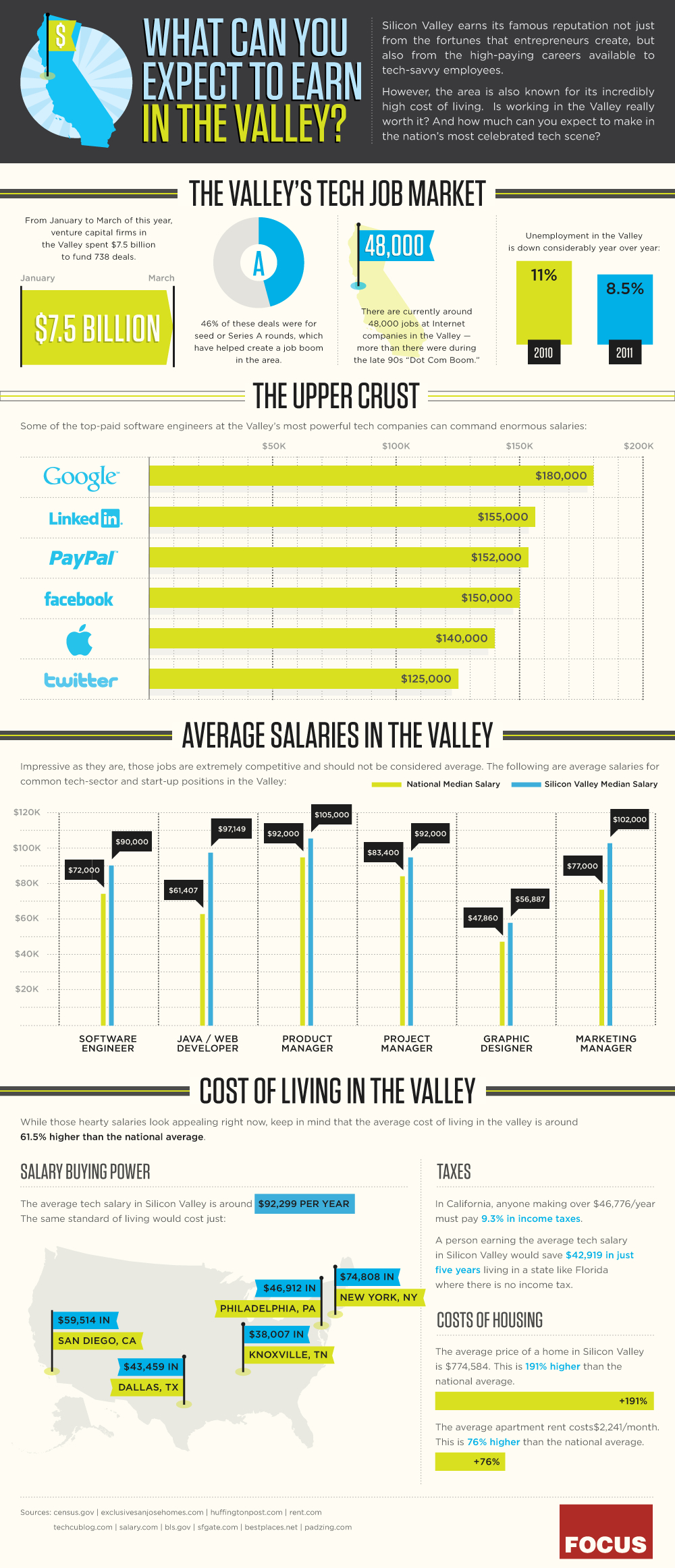
What Can You Expect to Earn in the Valley?

Email this post Print this post
By Barry Ritholtz - July 30th, 2011, 4:00PM

Click to Enlarge:

Source:
What Can You Expect to Earn in the Valley?
Focus

42 queries. 1.113 seconds.