
Bear Sell Offs, Bull Recoveries & Regaining 2007 Highs
Two interesting long term charts to help put today’s action into a bit of perspective: Both of these are sourced from JP Morgan funds:
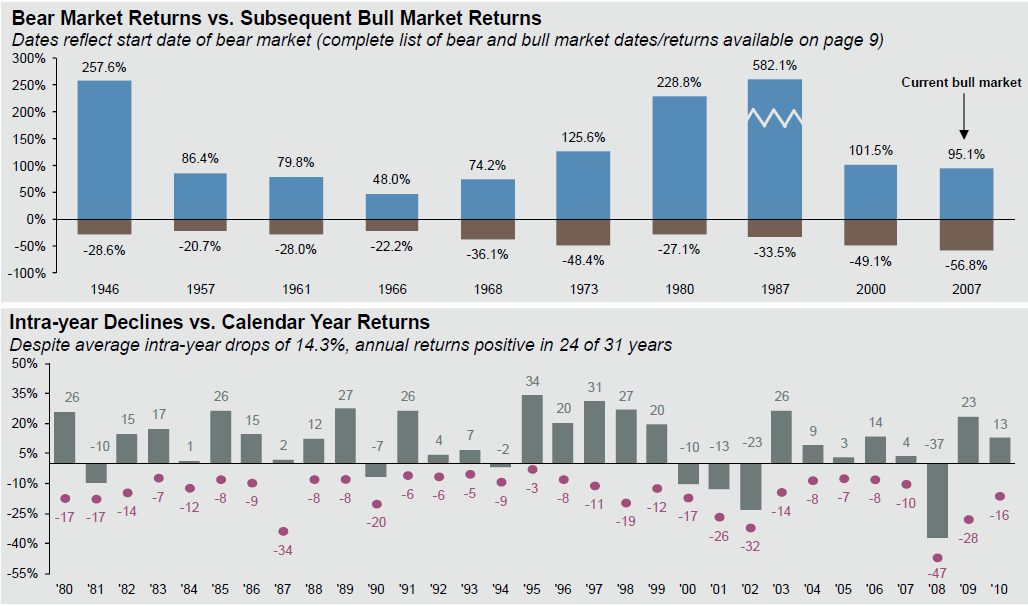
The first chart shows various US Bear markets since 1980, and the Bull markets that followed. That may be cold comfort to people who are caught leaning the wrong way today, but its a reminder that “This too, shall pass.”
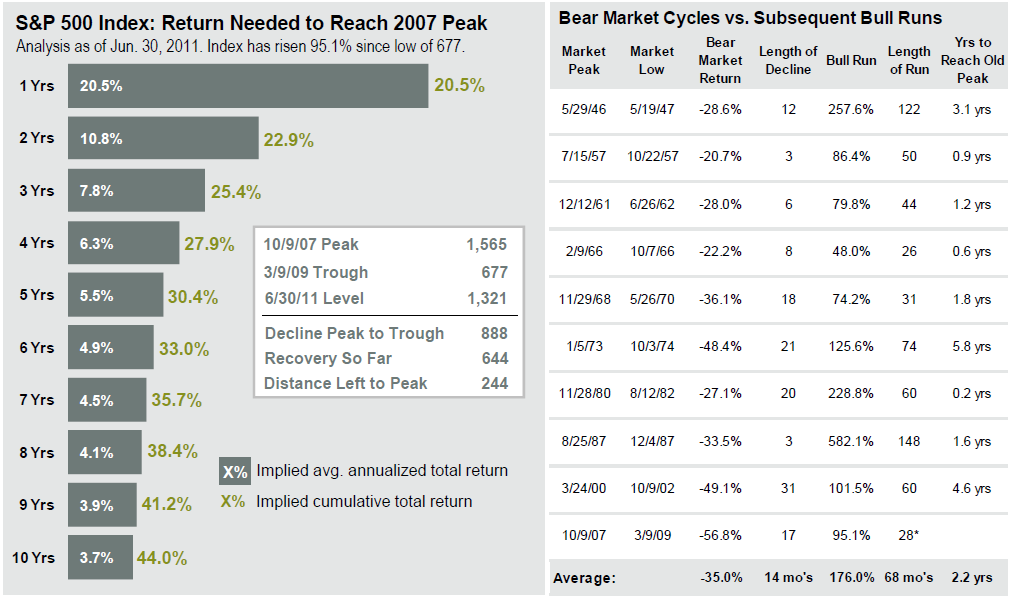
The second chart shows what it will take to recover the 2007 peak (note this is dated June 30th, and thus is from higher levels. Add 10% or so to the numbers).
>
~~~~
Source: BLS, FactSet, J.P. Morgan Asset Management.
Data reflect most recently available as of 6/30/11.
Source: JP Morgan funds
Interesting stuff!



Tweet
Facebook
Reddit
Digg this!


August 18th, 2011 at 5:32 pm
The charts are a bit deceptive, as a 50% drop requires a 100% gain afterwards just to get back to the starting point.
Furthermore, I wonder how the people who bought the Nasdaq at 5100 in March 2000 feel about this data? Methinks they feel much like the folks who bought the Dow at 380 in the fall of 1929.
~~~
BR: I’ve run that chart (here) — percentage gains required to make up percentage losses.
But that is a different chart — this one shows something else entirely
August 18th, 2011 at 5:55 pm
No Foul… beat me to the punch on the first graph, the “bull” runs have not beat the declines since 2000. That would be a lost decade in my book (worse w/ inflation).
~~~
BR: Second chart, right hand column shows that since 2000, we are not back to break even.
August 18th, 2011 at 6:04 pm
i’ve often wondered if the peak of population looms
and our time is bright but short just like a fleeting flower blooms
and maybe there’s no going back the tipping point’s been crossed
’cause we’re all of us the most we’ll be – peak people
http://thepeakoilpoet.blogspot.com/2011/08/peak-people.html
August 18th, 2011 at 6:36 pm
click here
August 18th, 2011 at 7:00 pm
What the charts appear to confirm is the overall trend over the past century plus is an average nominal return of around 4% to 5%, not counting reinvested dividends. However, J.P. Morgan conveniently starts their oldest chart in the post WWII era, leaving out the 1929 crash aftermath period.
Going by memory, it took the Dow until 1954 to reclaim its 1929 peak for good in nominal terms. In real terms, I believe it was more like 1990. In real terms adjusted for reinvested dividends, I seem to recall the Dow caught up with the 1929 peak around 1966, although it could be a couple years earlier.
Of course, folks who bought the lows in 1932 and 1982 cleaned up.
It’s interesting that the time between the Dow lows in the Panic of 1907 and the 1932 low (25-years) is similar to the interval between the 1982 low and the 2009 low (27-years) on the Dow.
August 18th, 2011 at 7:15 pm
During the high inflation period from the mid-60s to the mid-80s, the ‘Years to Reach Old Peak’ column looks pretty respectable in nominal terms. But the 1968, 1973, and 1980 new highs were only a handful of points above the previous ones, just scraping above the ‘Dow Thou’ level which challenged the market for 17 years after 1966.
In real terms, after inflation, stockholders from Feb. 1966 to Aug. 1982 were absolutely sodomized, to the tune of 75% on a price-only basis.
The latest real high was set in March 2000, and is now far out of reach. Maybe by 2037, if the current dismal performance matches that of 1929-1966.
Stocks by themselves absolutely suck as an investment. Both the risk-adjusted return and the drawdowns are grossly unacceptable. Yet stocks are an appropriate and necessary part of a multi-asset class portfolio.
August 18th, 2011 at 7:25 pm
If the BSE breaks 16,119 tonight, it could drop another 4,000 points to fill a gap going back to spring 2009.
That’s one massive, complex H&S top breakdown I’ve been watching for a while.
I still can’t get my head around how the USD /Euro exchange and even the USD cross rate is just sitting and spinning. It’s like traders have looked at the naked CDS the US and European banks have written on the sovereign debt and view it as mutually assured destruction for the USD and the Euro, making Gold the new global currency.
August 18th, 2011 at 7:51 pm
Gold is getting more interesting these days to be sure. I just went to see what the US gold stock is and from this http://www.usmint.gov/about_the_mint/fun_facts/?action=fun_facts13 you see that the gold in Ft. Knox has a booked value of $42.22/oz which means that we are a lot wealthier based on the current price than we thought (maybe we didn’t need the debt ceiling raised after all; we should have simply increased the book value of the gold and written bonds against it). I think there is also some gold held by the NY Fed in a vault but don’t know how much that is. By my rough calculation based on today’s price, the US gold holdings are $280 billion.
The other interesting thing from the website is that highest gold holdings were way back n 1941 when we had over 600 million oz. Maybe we should have gone of the gold standard a lot earlier and we would be sitting pretty right now as that amount of gold would be about $1.3 trillion.
August 18th, 2011 at 8:23 pm
Orange14:
There has been some call for an accounting/audit of the US’s gold holdings (politically, primarily by Ron Paul), such an independent audit hasn’t taken place since the ’50s, and there have been some shenanigans in the interim (lately, “shenanigans” means an opportunity, most likely taken, to move the gold into private hands, via leases and the like).
If you think the chances of such a thing happening are the stuff of conspiracy theories, understand that $4 billion in cash went missing from Iraq, and not a damn thing was done about it (not to mention that the Pentagon can’t account for literally trillions of dollars entrusted to it).
August 18th, 2011 at 9:50 pm
Whatever.
B of A is done.
Shorting to zero since April 2011 and pyramiding in.
Go ahead and sell CountryWide to Taxpayers. Juat go ahead and try it.
.
August 18th, 2011 at 10:08 pm
The propping up of the market with gov’t deficit spending is about to end. I’d be highly dubious of the projections since Reagan/O’Neill starting the practice. Seems like we’ll look back and say that was a 30 year gov’t spending bubble that had to be reigned in, it was followed by massively painful economic contraction. The economy simply has to contract 10% or so to reconcile the debt, I don’t see any reasonable way around it.
August 18th, 2011 at 10:48 pm
Reagan turned us from the greatest creditor to the greatest debtor nation because Nixon broke the commitment to repay our debt in gold. Once we went full fiat, why not borrow? The economy does not require a contraction in order to settle our debt — that’s why we have a purely fiat monetary system.
Our money is backed by “the full faith and credit of the US government. Now that our credit has been downgraded and our ability to repay our loans is in question, all we have is faith. Look around — specifically, look at our government — do you have faith that honorable people are in control?
Our debt is backed by nothing, and ultimately, nothing, in the form of dollars, is what our creditors will get.
August 19th, 2011 at 8:03 am
Like nofoulsontheplayground, I suspect this time is going to look more like an earlier era than JPM presents on their charts.
August 19th, 2011 at 8:07 am
>> Our money is backed by “the full faith and credit” of the US government.
>> [D]o you have faith that honorable people are in control?
Good distillation, Petey.
August 19th, 2011 at 5:51 pm
” “This too, shall pass.”
“The second chart shows what it will take to recover the 2007 peak (note this is dated June 30th, and thus is from higher levels. Add 10% or so to the numbers).”
Picking up pennies, while counting his chicken-tally from today’s market-lotto winnings, he merrily whistled past the grave yard…