Secular Bear Markets

Email this post Print this post
By Barry Ritholtz - August 27th, 2011, 9:00AM

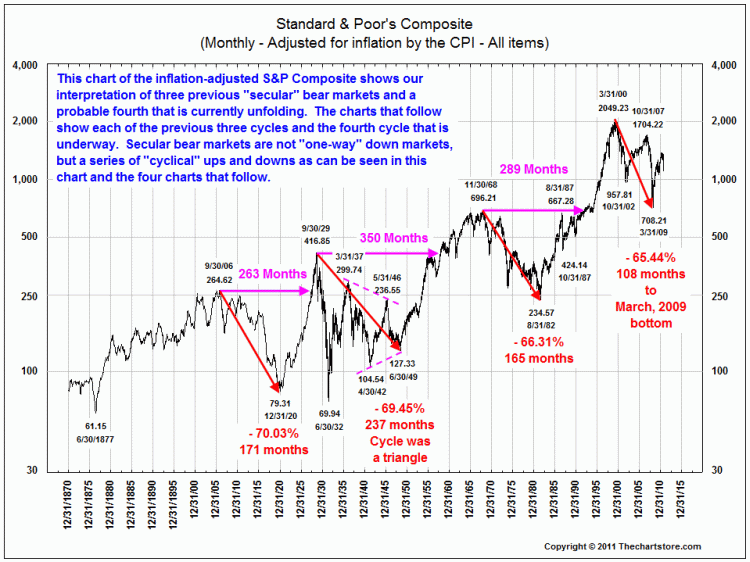
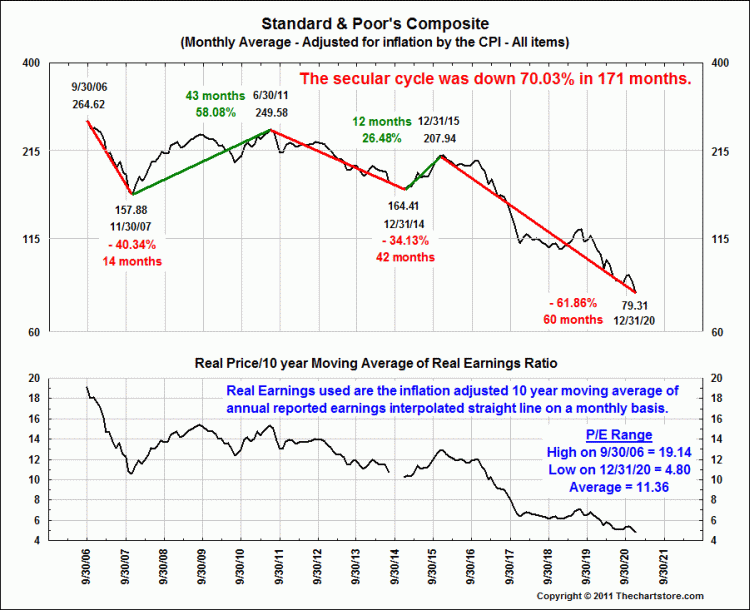
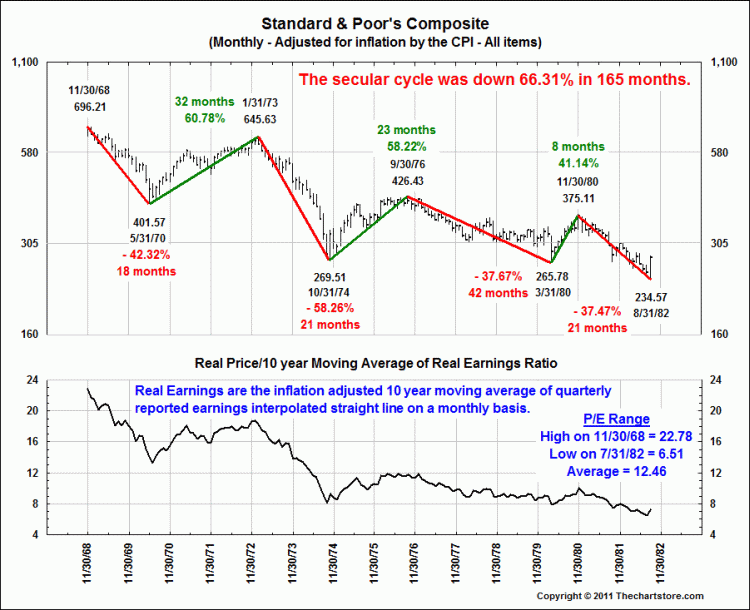
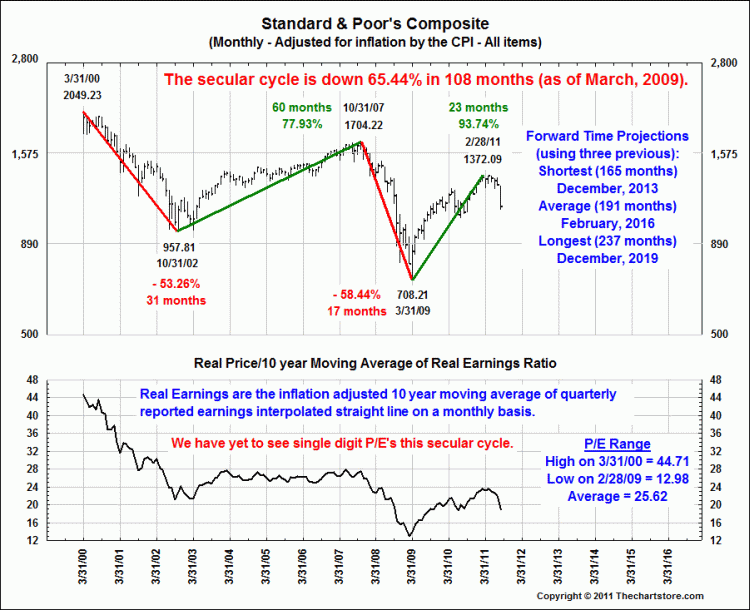
Fantastic set of charts from Ron Griess of The Chart Store below –  weaves some of this into your long term thinking about Markets, price and valuation.

>

˜˜˜
˜˜˜
˜˜˜

˜˜˜
˜˜˜
Comments

Please use the comments to demonstrate your own ignorance, unfamiliarity with empirical data, ability to repeat discredited memes, and lack of respect for scientific knowledge. Also, be sure to create straw men and argue against things I have neither said nor even implied. Any irrelevancies you can mention will also be appreciated. Lastly, kindly forgo all civility in your discourse . . . you are, after all, anonymous.

35 Responses to “Secular Bear Markets”

  1. stonedwino Says:

    Wow BR….Talk about chart porn…What the charts tell me, especially with the fear of deflation, is that I am better off stuffing money under my mattress for the next few years…stock will go down, bonds are risky and pay next to nothing and a savings account at this point has a negative interest rate…

  2. A7L-B Says:

    2-29-16

  3. DeDude Says:

    “We have yet to see single digit P/E’s this secular cycle”

    But would expect to get all the way down there, given the extremely low yield on treasuries. With the current low yields on alternative safer investments a lot of people are not only tempted but actually forced to get into dividend yielding stocks. What were the real yields on bonds and CD’s at those times when P/E’s dipped down into single digits?

  4. ilsm Says:

    Will the S&P trend go back to being plotted on base 10 paper instead of a log scale?

  5. Joel50 Says:

    Dow 36,000, anyone?

  6. mark Says:

    Fabulous, fabulous stuff!

    Now that we’re all finally acknowledging that what we are experiencing is not like anything post-WWII can we finally admit that we are no smarter and no more sophisticated than those rubes of yore? Nah, never happen.

    BTW, what your readers need next for proper perspective is a similar set of charts from Japan post-1990.

  7. Cory Says:

    BR, Would be interesting to see the impact on historical PE’s when adjusting for the available public stock (total float) versus total non-margined investor dollars. Would the investor $ available to invest/available shares, bias the P/E higher overtime simply due to inputs such as demographics and IPO numbers ? Way too much opaque shit to filter through to get even near accurate data. Thanks for the Great charts anywho… C.

  8. BusSchDean Says:

    Now compare the loss of value since 2000 with changes in salaries and bonuses of CEO and other corporate executives and tell me if capitalism is actually at work here.

    Battening down the hatches here in PA/NJ. Had time to wash the Jag and trim the lawn as dark clouds role in.

  9. krice2001 Says:

    Of course, what we know is that nobody really knows…

    However, charts like this point to low expectations for the next 2 to 5 years or so. This is consistent with what you’ve said for some time, Barry, these secular periods tend to run 16-18 years (give or take) and this one started in 2000.

  10. dh2212 Says:

    Demographics is the main issue everyone is ignoring. Baby boomers are aging (60 plus) so saving, not spending, there can not be any material growth in US and Europe with our demographics. So growth is a dream, and Japanese type growth is coming to NA. 20 years ago I saw a chart plotting S&P against mean pop age, correlated nicely and called the peak around 2000 – it doesn’t look good going forward.

    No growth isn’t terrible, but we aren’t going to grow our way out of this, excess leverage compounded problem.

  11. streeteye Says:

    Worth noting there are a lot of stocks with single digit P/Es – 80 in the S&P.

    These are S&P stocks with single digit P/Es and also dividend > 2% – http://finviz.com/screener.ashx?v=341&f=fa_div_o2,fa_pe_u10,idx_sp500

    There are definitely some names I’d rather own than a 2% T-bond, with decent prospects for long run growth and inflation protection, especially when you broaden beyond the S&P stocks and the US.

    I really don’t care to own bonds at 2%. Cash is trash. Stocks might get cheaper. But some of these stocks start to feel like the least ugly Gorgon in the beauty contest.

  12. speeds Says:

    One thing that should be considered, especially for the first chart is that a good portion of the profits for most stocks is coming from international sources. That was not the case historically.

  13. RW Says:

    These broad cycles really illuminate the importance of individual work history; the point when a person enters the peak years of employment income/saving. Crestmont Research has a good series of articles/charts on secular cycles at http://tinyurl.com/3k7cdmm but the two articles on Waiting for Average and Destitute at 80: Retiring in Secular Cycles really drive the point home: the timing of major life events matters and it matters a lot.

    In retirement, baby boomers (and anyone else at that stage), will be drawing down their assets to spend them, not save them; financial assets are part of their income mix at this point. The economic cycle will therefore continue as it always has, probably with heavier consumption (spending) when economic optimism is high and less when it is not.

    The critical variables therefore are less a matter of demographic and more a matter of (a) stage in the market cycle and (b) available income vs. non-discretionary expenses; i.e., how much will boomers (and others) be forced to sell in the teeth of inclement economic weather.

    The past few years have demonstrated fairly convincingly that “the great moderation” was a shibboleth and economic cycles cannot be controlled so that leaves the social safety net or, perhaps more accurately, our shelter from the storm.

    This is why issues such as the growth of medical costs was well as extension and refinement of the safety net should be front and center in the national debate: Leaving a growing number of citizens on subsistence is not a viable policy if you want an economy to grow and a people to be well. The fact that most of the current debate seems to be about weakening or reversing reforms or cutting ‘entitlements’ is a sign of how misdirected and downright screwed up our political and economic priorities have become.

  14. Greg0658 Says:

    RW I don’t think this is a secret .. imo (unless your an in demand knowledge base) (or kids don’t know how to work) .. but if you are over 55yo have already bought the dream and are perceived as looking for HC .. good luck with finding a job .. the databases know .. and seems your signiture is needed to give permission for a looksee (its good business protection ya know)

  15. ga082003 Says:

    charts on US and Japanese and Germany having net equity inflows.
    US Equity saw net inflows last weeK. Cant believe that?cHARTShttp://capital3x.com/?p=336

  16. ga082003 Says:

    charts on US and Japanese and Germany having net equity inflows.
    US Equity saw net inflows last weeK. Cant believe that?cHARTS
    http://capital3x.com/?p=336

  17. Michael Says:

    I think the chart of market cap vs. US GDP is somewhat misleading — plotting US GDP vs. market cap of companies that, for the most part, earn profits all over the world. How about market cap vs. world wide GDP???

    ~~~

    BR: Sort of, but not exactly — the megacaps in the SPX derive increasing share from all over the world, but that’s really the top 20-30% of the firms. But that leaves 300-400 companies that I suspect are not substantially international players (at least not yet).

    To look at that point accurately, you would need to analyze the overall percentage of profits relative overseas costs of all of the firms in S&P500.

    Have at it, and report back to us what you find!

  18. dh2212 Says:

    Agree with watching health care. From personal experience, retorted only SPEND for bare necessities, trying to spend investment income only and keeping the nest egg, assuming they have one. So they won’t be spending much or they used to, not supporting kids, theoretically, had fewer kids than previous generations.

    Boomers weren’t a normal cycle coming or going.

  19. Michael Says:

    gao82003…. I don’t see how the equity market can have “inflows” or “outflows”… for every buyer there is a seller! Sure, the price of a security can go down. However, if I put $1,000 into the market to buy a security, someone else is taking $1,000 out of the market when they sell the security.

  20. ga082003 Says:

    Michael: Then how does a market ever have a net outflows and inflows? The fund inflows and outflows are measure with respect to certain funds only. Net net it has to balance out!

    For example with respect to Germany, the charts say Germany has had net equity inflows. It means with respect to EPFR fund in their database.

  21. Spike Says:

    BR, I’m a fan of these charts, and have been VERY skeptical of market valuations because of them. However, two concerns – one you have addressed above, which is that more US firms earn profits here based on worldwide operations, and better yet have outsourced the low-return portion of their business to Chinese/Developing world manufacturers (in the same way that Coke used profit off the back of its bottlers – see Apple’s current business model).
    The second concern with using the above charts is that until 1971, you had the option to step out of stocks into a hard currency if valuations got way out of whack. Now you don’t – and in fact Fed policy seems to be explicitly to prevent such an option. Cash is now a depreciating asset in terms of real purchasing power (and I suspect always will be). That may explain the decoupling in chart one (and the parabolic rise of gold of course).
    Does this influence your thinking on the usefulness of chart 1? I am trying to square the circle in my own mind, and the example of Japanese stocks post 1990 says that it isn’t easy in a deflationary world with fiat currencies, massive money printing and globalization all pulling in different directions

  22. AlexM Says:

    @dh2212, RW,

    I think many people misinterpret the effect of the baby boomer generation going into retirement and the baby bust and echo boomers (their children) who actually are a larger cohort in the population. (I have children in both groups)

    Just How Many Baby Boomers Are There?

    “Press accounts give various numbers, with 79 million a popular choice. There were actually 76 million births in the United States from 1946 to 1964, inclusive, the 19 years usually called the “baby boom.” (By contrast, there were only 66 million births, in a larger U.S. population, during the 19 years following the baby boom, which included the baby bust of the 1970s.) Of the 76 million born, about 4 million had died by April 1, 2000 (when Census 2000 was taken), leaving some 72 million survivors.”

    72 million boomer in 2000, with 4 million deaths, so one could assume that the number is even less than that 11 years later.

    The echo boomers (1982=2010) are 80 million strong, not counting the baby bust (1965-1981) generation of 62 million.

    The Echo Boomers

    “Born between 1982 and 1995, there are nearly 80 million of them, and they’re already having a huge impact on entire segments of the economy. And as the population ages, they will be become the next dominant generation of Americans.”

    So replacing the boomers are 142 million people in the next two cohorts, which also does not take into consideration any immigration, legal or illegal.

    I am not a demographer, economist or social scientist, but these numbers are compelling but I never see much economic analysis that takes into consideration the size of the cohorts the are going to replace the boomers.

    And these young people going forward have different economic spending profiles from the group prior to them which is another fascinating topic which I would like to see discussed more rather than the obvious boomer spending patterns.

    Spending by these later groups will have much more of an impact on where our economy goes in the next decade than the boomers, and going forward many of these people have enormous amounts of student debt (which is now larger than credit card debt), unemployment, underemployment and later family formation, and no health insurance. They as a group are seeing and will continue to see a lower standard of living than their parents.

  23. Fredex Says:

    So we will be in the middle of the next Republican administration before this turns around?

  24. murrayv Says:

    A reversion to bottom of both the Schiller P/E ratio and the Q ratio would duggest a drop of 65% from the 2011 high to get to this secular bear bottom. Averaging the prior 3 secular bears illustrated above would suggest a 53% drop from the 2011 peak.

  25. murrayv Says:

    If there has not been an upward shift in the lower bound of the market cap bottoms trend, we could expect a 52% drop to get back to that bottom. Following the Japan experience in the chart Barry posted a few days ago, we would expect a similar drop. It looks to me like this cyclical bear (bottom around 640??) has a good way to run, and it could easily be 2026 before we get back to the 2000 peak.

  26. gman Says:

    If one makes an allowance for interest rate environment we have been in at previous bear market lows..i think the bottom has been made.

    1982 pe of 6 with 10yr yielding 13% or todays pe of 18 with 10yr yielding 2%?

    I second the earlier post the said we should post executive comp along the same axis..real share holder value down 70% v. managment comp. which is make new all-time highes!

  27. streeteye Says:

    @gman well said, I intend to steal that

  28. AlexM Says:

    Agreed, gman makes a great point, worker v. executive compensation. That would make a great chart.

  29. algernon Says:

    gman, I suspect you are wrong. I think we will see much higher interest rates in the future & that the inflation adjusted bottom will be then.

  30. victor Says:

    BR: Charts show good correlation between Secular bear markets and WARS: WWI, Vietnam War and Iraq/Afghanistan wars. Korean war? no correlation, but 3 out of 4 aint too bad. Just saying… @dh2212: about demographics: yes, demography is destiny and yes Europe and Japan are in trouble growth wise but NOT US. Within 35 years US is projected to add another 100 million souls, admittedly almost half of those will be immigrants and their children. How’s that for growth?

  31. Daily Reading for the Financial Markets: 8/28/11 « Playing the Ponzi Says:

    [...] charts illustrating market cap as related to GDP, from Barry [...]

  32. Sunday links: psychological weaknesses | Abnormal Returns Says:

    [...] A look at some other secular bear markets.  (Big Picture) [...]

  33. Clem Stone Says:

    I’ve been listening to bears calling for the return of single digit P/E’s for at least 20 years now. Some day it will probably happen.

  34. dh2212 Says:

    @AlexM

    Great post
    Points are boomers, relative to previous generation, were a big increase in population and the timing of their prime spending years relative to stock market performance.
    The boomers came after the great depression, a baby bust, so a big increase in population in one age group after which there is no growth, or material growth, from the baby bust (prime spending now) or echoes (prime spending years start at 40, which is next year).

  35. Me, Myself & Irene | The Reformed Broker Says:

    [...] Don’t miss these charts of historical secular bear markets Barry has up this morning.  (The Big Picture) [...]

95 queries. 0.364 seconds.

