
A Tale of 2 Seasonal Investors
Several readers have inquired about the seasonality factor when it comes to equities, which I mentioned last week (Tactical Shift: Reducing Cash).
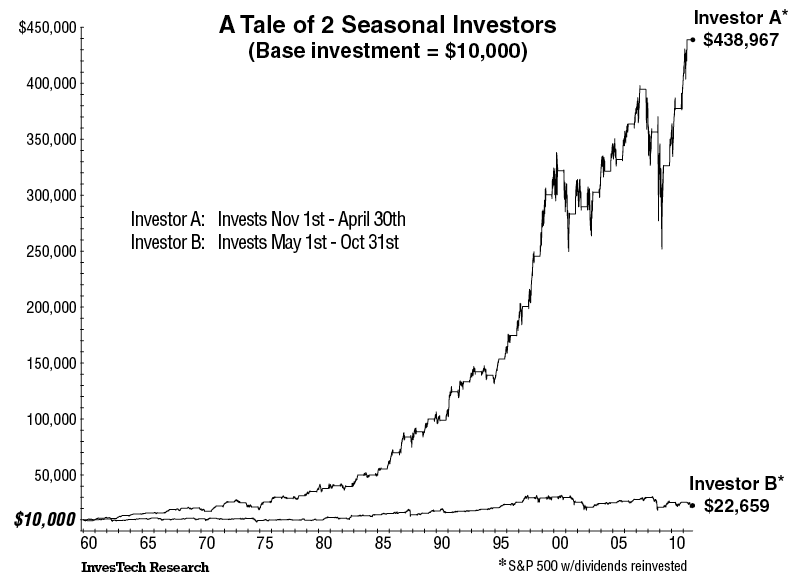
Let’s take a quick look at the history off the seasonal advantages. “The Best Six Months of the Year” was first described by Yale Hirsch in Stock Traders Almanac decades ago. The historical chart below via Investech Research reveals the surprising degree of seasonality for investors, going back 50 years.
Here are the specifics of seasonality: Imagine we start with two $10,000 accounts, and use them to make investments in an S&P 500 Index fund. One account invests in one 6-month period, the other invests in the remaining 6-month period. Account A is invested from November 1st through April 30th each year, while Account B is invested from May 1st through October 31st.
Here are the numbers:
• Account A portfolio grew from $10,000 to over $438,967. That is a 42-fold increase.
• Account B portfolio barely doubled to $22,659.
By selecting the seasonally strong period from November through April, you capture 97.1% of the available performance over the past 52 years. (Note the November-April seasonality fared poorly in 2007 and 2008).
>
Source:InvesTech Research, October 21, 2011
Technical and Monetary Investment Analysis, Vol11 Iss11
The one caveat I would add is that a 50 year chart should be logarithmic, rather than algorithmic.


Tweet
Facebook
Reddit
Digg this!


October 24th, 2011 at 11:54 am
So, where do I sign up?
October 24th, 2011 at 12:05 pm
I think that the other caveat is that by simple data-mining, there has to be some 6 month period that can be chosen over the course of X years that will outperform another 6 month period. (Simple example, why Nov 1 and not start Oct. 28? etc.) By mining through each 6-month period comparison, we can find one that is the best. The questions investors need to ponder is whether there is predictive value in that comparison, and how robust is the model. Without some underlying logic to the seasonality patterns (which some seasonal models have) you might be misled.
~~~
BR: Simple data mining will no pick up a 97.5% versus 2.5% differential.
October 24th, 2011 at 12:12 pm
Lies. I’m ahead of all of you. I’ve been in GOLD since the absolute bottom back when… uh.. back when I bought it at the absolute bottom.
— Investor B
October 24th, 2011 at 12:16 pm
I didn’t even know AlGore had thymic.
October 24th, 2011 at 12:17 pm
Malapropism ?
The chart should be logarithmic rather than “linear”, isn’t it.
And that was the message of the day that was, a courtesy of your friendly neighbor, the semantic nazi :-)
October 24th, 2011 at 12:24 pm
A century ago, when most of the population still lived on farms, a theory held that farmers drew down credit to plant crops … and paid it back upon selling crops at harvest, thus reliquifying the financial system during the winter and early spring.
Why this pattern would persist in the post-industrial age is a bit of a mystery, though.
October 24th, 2011 at 12:39 pm
[...] A look the return to seasonal investing. (Big Picture) [...]
October 24th, 2011 at 12:45 pm
re: machinehead
Wouldn’t the reduction in the number of those living on farms be offset by bigger loans taken on by fewer farmers producing more crop? After all, the number of mouths is still increasing.
October 24th, 2011 at 1:03 pm
It is a remarkable variance… one wonders why the 52 year cut off. I assume the variance would be less so, but the gap is so wide, it would all be relative in terms of narrowing the gap.
October 24th, 2011 at 1:19 pm
My (trader) Dad used to say “Sell in May and go away.”
I guess this is why.
October 24th, 2011 at 1:52 pm
Barry,
You’ve put up some near-term bullish posts in the last few days.
But on October 5, you wrote, “If we could see a 5-7% move higher, I would be looking to further lighten up my 50% exposure to equities.”
What’s up? What will make you reverse your now-bullish position?
~~~
BR: See this for details: http://www.ritholtz.com/blog/category/foreclosures/
The facts change, my inputs change, various elements change — so I change my position. Those who are unable or unwilling to adapt int he market you die.
PS: 80% equities is hardly uber bullish
October 24th, 2011 at 2:02 pm
Any idea if investor A ise exposed to more risk than investor B is?
October 24th, 2011 at 2:50 pm
@noahmckinnon — even as farm size and output have grown, agriculture’s share of GDP has declined from a majority to a few percent — hardly enough to drive such a pronounced seasonal pattern, one would think.
The 4-year presidential cycle can be rationalized in terms of politically-driven economic manipulation. But Nov-Apr seasonality is a real puzzler.
October 24th, 2011 at 3:03 pm
Of course the deer rut and opening of hunting season correspond nicely as well. I wonder could deer and human testosterone levels be linked with the seasons. No matter, I’m looking forward to a productive hunting season both in equities and deer. For those of you living in the city; deer are animals you hunt and they live in the forest and the forest is a large grouping of trees and trees are…
October 24th, 2011 at 7:02 pm
this is so extreme. have you checked these numbers.
~~~
BR: yes, I verified it with Jeff Hirsch, whose father invented the concept. His numbers were similar.
Stock Trader’s Almanac had a sleight difference versus Investech’s, with the likely cause either 1) Dividends; 2) starting versus closing data for each twice annual switch; 3) different starting years.
But overall, the data is well documented — see this or this as examples
October 24th, 2011 at 7:24 pm
[...] “A tale of 2 Seasonal Investors“, the Big Picture discusses the simple idea of comparing two simple investing approaches: [...]
October 24th, 2011 at 7:51 pm
Barry — i think you meant arithmetic not algorithmic. but we got the idea.
One thing that bothered me about buy-sell-buy strategies is where does the money for the taxes come from?
Every year you have to pay short-term capital gains taxes on the profits, if you take it out of the strategy fund, you can’t do as well as this. and in some years where there is beaucoup gains you are going to have a hefty tax bill.
I think an earlier poster had the right question… where the no-load low-cost mutual fund that is following this strategy?
October 24th, 2011 at 8:10 pm
Hunting season mere correlation? I thought that what was all that was going on down there, the Street jungle I inhabited for about 2 decades or so. I got to eat a part of what I killed, mostly less-intelligent members of my own species. But then the birds told me about species awareness. I took the pledge and I’m on the hunt for the smarter members who have moved on.
October 24th, 2011 at 9:56 pm
[...] post from Barry Ritholz today reminded me about one of the things that got me interested in baseball investing in the first [...]
October 24th, 2011 at 11:06 pm
[...] Source: InvestTech Found on: The Big Picture [...]
October 24th, 2011 at 11:26 pm
Thanks for sharing Barry. This should be highlighted as THE best blog post that could ever be shared with investors.
U da Man
October 25th, 2011 at 7:17 am
[...] How important is seasonality in investing? Wait til you see this: (TBP) [...]
October 25th, 2011 at 7:45 am
And, suppose one had invested $10,000 in the S&P 500 Index on January 3, 1960 and did no trading at all? According to a calculator on IFA’s website, the ending value as of Sept 30, 2011 would be $872,202. That appears to include re-invested dividends, but is not adjusted for inflation and does not include taxes on dividends. The total annual return is approximately 9 percent. http://www.ifa.com/portfolios/PortReturnCalc/index.aspx
It strikes me that even the seasonal investor is wasting his time, energy and money if his total return is only $438,967. And, this figure is apparently not adjusted for the trading fees or taxes on capital gains, the latter necessarily at ordinary tax rates since the holding period is less than 6 months. Granted, investor A could have parked his cash in a money market fund for the months May through October, but I seriously doubt this would compensate for the trading commissions (there were no discount brokers in the 1960′s) and taxes on capital gains.
The most I could say for Investor A is that he (or she) is the Lesser Loser.
October 25th, 2011 at 7:59 am
Financial Times refered to “Sell in May” in 1964 and the pattern shows up around the globe. So, sceptics forget about data mining.
More interesting question remains howcome this pattern continues to be so strong. My current personal believe remains that this pattern is connected to a cycle in investors’ optimism as I described in http://papers.ssrn.com/sol3/papers.cfm?abstract_id=643583. I welcome other suggestions.
Ronald Doeswijk
Robeco
October 25th, 2011 at 8:54 am
Barry,
I believe this may well be a mere data mining.
To prove the point, I just made several simple simulations of the random price in excel. I assumed that each month the price follows a lognormal distribution with a fixed mean and standard deviation. So there was no any seasonality in the data by construction. The distribution of returns doesn’t change from month to month. The simulation is done over 50 years (600 months).
Now, there is often a staggering difference in investment results for the strategies that invest only in the first 6 months of the year and the last six months of the year. I didn’t make many simulations, but even in the first few the results differed as much as +2500% and -85% (over 50 years), for instance. So, your assertion that the probability of such a high difference in investment results between the two accounts is very low may well be simply wrong. Actually, this may be a question to a person with a good knowledge of statistics (I don’t) – what’s the statistical probability of the above mentioned difference?
October 25th, 2011 at 8:56 am
In my simulations, I used a monthly mean of 1% and an annual standard deviation of 40%
October 25th, 2011 at 10:01 am
The full saying in the UK is
Sell in May and go away
Come back on St. Leger day.
The St. Leger being a classic horse race run in the early autumn, or fall, as you Americans would call it. Certainly seems to fit with this chart.
October 26th, 2011 at 3:30 am
Wouldn’t the obvious 3rd option be the long term
buy and hold position. What would that overlay
look like on the chart ??
October 28th, 2011 at 9:23 am
[...] Year end rally: I have mentioned seasonality several times over the past week, and this rally seems to be running (or perhaps front running) [...]
November 6th, 2011 at 3:56 pm
[...] Read full article (with chart)… Filed Under: Stocks [...]