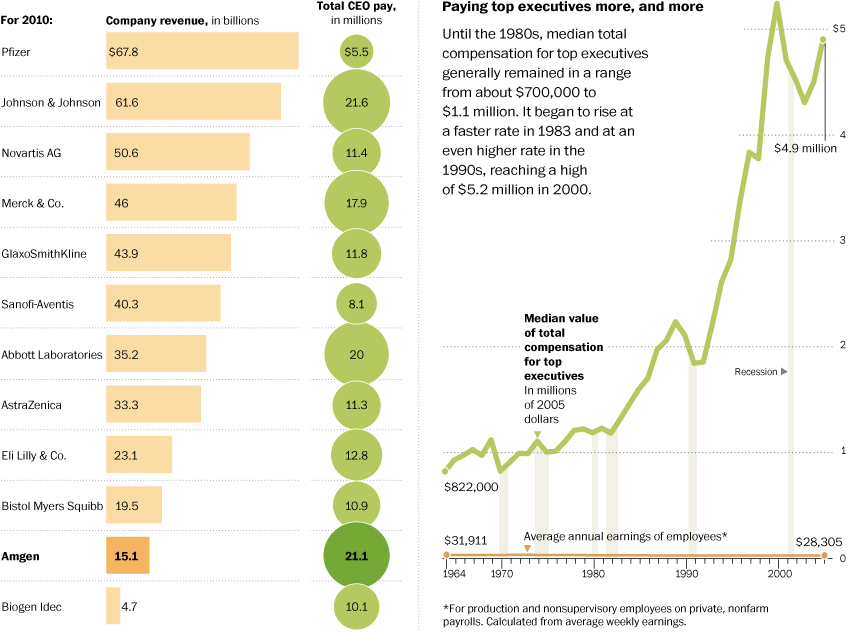
Ratcheting Up CEO Pay With Peer Comparison
Cozy relationships and ‘peer benchmarking’ send CEOs’ pay soaring (Washington Post)
Outsize Severance Continues for Executives, Even After Failed Tenures (NYT)

Cozy relationships and ‘peer benchmarking’ send CEOs’ pay soaring (Washington Post)
Outsize Severance Continues for Executives, Even After Failed Tenures (NYT)

Please use the comments to demonstrate your own ignorance, unfamiliarity with empirical data, ability to repeat discredited memes, and lack of respect for scientific knowledge. Also, be sure to create straw men and argue against things I have neither said nor even implied. Any irrelevancies you can mention will also be appreciated. Lastly, kindly forgo all civility in your discourse . . . you are, after all, anonymous.
October 11th, 2011 at 3:09 pm
The author should take a look at compensation paid to public school superintendents. How about the professional athlete?
Compensation whores occur in many venues.
October 11th, 2011 at 3:29 pm
Barry,
All else equal, this might argue for resetting income tax brackets to multiples of the minimum wage.
October 11th, 2011 at 3:39 pm
If only these charts would behave like stock charts… after going parabolic a 10-20% peel off would be in order…maybe more…
October 11th, 2011 at 3:41 pm
Let’s go after pro athletes and public school superintendents who fit this template as well.
Others, anyone?
October 11th, 2011 at 3:45 pm
http://www.footnoted.com/
You’ll see daily disclosures of the obscenities going on with boards & CEO’s.
The bulk of ‘investors’ and average citizens wouldn’t have a clue of this greed and pampering.
It’s out of control.
October 11th, 2011 at 3:49 pm
I don’t believe that Americans begrudge successful CEOs a penny if they have built successful, sustainable companies. I think Americans are proud that the country can help create franchises where founders and successful executives can become billionaires, preferably without lots of government guarantees backstoppping them.
Where the system has completely broken down is handing over huge chunks of money to CEOs who fail miserably. Why should somebody who comes into a company, fails utterly for a couple of years walk away with 8-figure severance packages? The people who got laid off because of his failed policies probably got two weeks pay.
October 11th, 2011 at 3:51 pm
Board compensation committees look at a selected peer group for comparison. Since no Board wants to admit that it has hired a below-average CEO, they then aim to pay somewhat above the average of their peer group. Which leads to the graph shown above.
October 11th, 2011 at 4:13 pm
Management gets the upside, shareholders and tax payers get the downside
October 11th, 2011 at 4:53 pm
In my 30 yr. career (ret. 2001) as a high school teacher I made just under a million dollars – total. This year the entire school budget of the district I taught in is $40M and two of these guys make half of what it takes to pay for the salaries, staff, expenses etc. to educate 2010 kids, together they can pay the whole bill!
Again, I don’t know where this OWS thing is going but if somehow it morphs into something average Americans like me can relate to . . well there are millions and million of American who are disgusted with the information in the graph and don’t they dare say, like Herman Cain that we’re anti-capitalist, its all envy. Speaking for myself, (former Eco. teacher) I realize a market economy is essential for prosperity, it’s good that people make more or less salaries and they get rich but this is over the line.
And, like a lot of regular people I see the effects of the financial collapse all around in small but personal ways and it just pisses me off that nobody was held accountable, nobody was arrested, nobody in going to jail for all the harm and pain they caused. Millions of people feel this way and it not a healthy thing for our country and we have no hope because the guy we elected who we thought wouldn’t let it happen, did – and the people who want to replace are on the side to CEOs!
October 11th, 2011 at 5:17 pm
I was there when it began in ’73-’74, in listed-company boardrooms, when the new CEOs born in the ’20s and ’30s began to replace CEOs of the generation before, and the boards had many directors the age of the CEOs and/or slightly older. The younger, new CEOs were visited by Wall Street Broker/Underwriters, who wanted access to information, to make markets in their stock, and, if possible, underwrite future issues. To get his support, the Wall Street Visitors told the new CEO he was underpaid, and they and Head-Hunters would provide information and argument showing he was underpaid. They also told them the directors were underpaid, and provided similar information and argument. The result was the directors’ were talked into raising their compensation significantly because they were shocked and embarrassed to find they served on the board of a company that was underpaying the board, suggesting the board was stingy, and it was not a good place to work. At the same time, the board raised the CEO’s compensation even more, to reward him for bringing this to their attention, and, at the same time, to hide behind the CEO’s proportionally greater increase. Ever after the ‘game’ of the outside consultants telling the boards they and their CEOs are underpaid in relation to less prestigious competitors, and the board correcting this mistake by increasing director and executive compensation has been going on. It finally got to the point that the CEOs of companies that virtually all listed companies are overpaid, with other people’s money. It shows the negative impact of Wall Street on the economy, justifying compensation that cannot be rationally justified, the failure of the mutual funds who owned the largest single stockholder blocks, and the plain simple greed of these inter-locking directorates. Crony Capitalism. Barry, you should get out your can opener and open up this world of phony corporate consultants who produce whatever the CEOs will pay for. Show how this can be cleaned up, and capitalism preserved, and socialism deferred.
October 11th, 2011 at 5:48 pm
rewarding the stupid…Darwin would be so proud.
October 11th, 2011 at 7:50 pm
This post here
http://dismalpoliticaleconomist.blogspot.com/2011/10/how-to-explain-failure-of-american.html
nicely documents the process of failing upward. I particulary like the fact that the recently fired CEO of HP got a signing bonus as part of his severance.
October 11th, 2011 at 8:04 pm
My wife is going to hand this out at our city’s “Occupy” site. Praise Barry and Pass the Ammunition!!!!
October 11th, 2011 at 8:04 pm
And they still have investors.
The recent brouhaha over whether SS was a criminal scheme, or not, should be revisited when it comes to publicly traded stocks. The corporate shield is nothing but a license to steal. The stock markets are rickety, at best. It’s ALL pump, all the time. When they fail (and if they don’t fail, it’s a sure indication that lawlessness at the highest levels will forever go unpunished, and criminal TBTF will, once again, be the law of the land), there will be many bag-holders — but these CEOs and the boards that enabled them will get away scott free, as their “earnings” will have been well laundered.
October 11th, 2011 at 8:06 pm
Along with the money comes the attitude that they know what their doing.
Pay like a King and you get Delusional Sociopaths.
October 11th, 2011 at 8:34 pm
As a shareholder in many companies, I demand they compensate employees fairly in relation to CEOs and other executives. Outsize CEO salaries are a sign of outsize egos. No CEO is important enough to rate these kind of salaries. All employees deserve fair compensation.
As an MBA student, I was taught to respect all stakeholders in a company, not just shareholders. If any employees are compensated on increases in share performance, ALL employees should be. And the CEOs should take the hit when share prices decline, too. If any employees are entitled to stock options, all employees should be entitled as well. Time to stop treating employees as things. They are people, and their performance is as important if not MORE important than the CEOs. Let’s all recognize this and demand fair treatment, instead of seeing management as some special class of people.
October 11th, 2011 at 8:40 pm
donna : apparently we need to have you own stock in even more companies, presuming that your demands for fair compensation are heeded (you don’t really say one way PR the other).
October 11th, 2011 at 8:41 pm
…oops.. or the other.
October 11th, 2011 at 8:45 pm
No, I just don’t own ENOUGH stock in more companies! ;^)
October 11th, 2011 at 9:07 pm
wouldn’t it only really be accurate to deflate that against the median market cap of SP500 companies? The graph would look a lot more reasonable. It’s like saying Lebron makes so much more than guys in the 80s. Deflate that by how many viewers or ad revenue and the graph starts to make sense. Similar falicy, as has been said by others, is that us ig companies are historically liquid. And for that matter, it’s easy to graphs that show the same phenomenon. Although there may be some systematic overpayment if you break it down against certain models, but probably much much much smaller than how much this graphs overstates the point of, CEOs make more than their value.
October 11th, 2011 at 9:25 pm
Wonder how this compares to sports star salaries?
October 11th, 2011 at 9:34 pm
4whatitsworth:
At least sports stars’ salaries are based on performance (unless you consider Albert Haynesworth, who has taken several billionaire NFL owners to the freekin’ cleaners AND avoided criminal penalties for both on- and off-field crmes).
October 11th, 2011 at 9:47 pm
Sports has just as many bad examples if not more than business. The correlations would be interesting to see. whip in that year vs salary in that year. harder to determine the best way to measure ceo effect. shareholder growth to pay i guess. Those will be more highly correlated i’d wager because most ceo pay is bonuses based on that stuff anyway.
October 11th, 2011 at 9:47 pm
Sports has just as many bad examples if not more than business. The correlations would be interesting to see. whip in that year vs salary in that year. harder to determine the best way to measure ceo effect. shareholder growth to pay i guess. Those will be more highly correlated i’d wager because most ceo pay is bonuses based on that stuff anyway.
October 11th, 2011 at 10:12 pm
As noted above, compensation for CEO’s began to rise rapidly beginning in 1983. But if one looks at aggregate compensation for the S&P500 CEO’s as a percentage of S&P500 market capitalization, one might get a different view of the situation.
No question that some CEO’s are wildly overpaid. But the question is what to do about it. I do think that stockholders should be empowered to have greater influence over CEO pay (in the case of publicly traded companies), but apart from that, I see no role for the government in this.
October 11th, 2011 at 11:00 pm
My first reaction – Executive Pay is out of Control! My second reaction: Whoa – Average annual earnings of employees – WTF? That’s messed up.
Seriously good chart.
October 11th, 2011 at 11:28 pm
” I do think that stockholders should be empowered to have greater influence over CEO pay (in the case of publicly traded companies), but apart from that, I see no role for the government in this.”
Typical Randian moron.
REAL WORLD: CEO takes shareholder money and gives to lobbyist. Said lobbyist take shareholder money to politician X. Politican X then actively works to undermine shareholder rights versus management
“I see no role for the government in this”.. lmao
October 11th, 2011 at 11:57 pm
One of the things that made the Greatest Generation great was that they had a sense of fairness and an understanding of what constitutes enough. Unfortunately the Baby Boomers who followed them into the corporate suite failed to learn that lesson. This graphic–in a nutshell–is the real harvest of the Reagan Revolution–
October 12th, 2011 at 12:35 am
Bankers’ Salaries vs. Everyone Else’s
By CATHERINE RAMPELL
Why are the Occupy Wall Streeters so angry at bankers? This chart might give you some idea:
http://graphics8.nytimes.com/images/2011/10/11/business/economy/economix-11securities/economix-11securities-custom1.jpg
October 12th, 2011 at 12:36 am
http://economix.blogs.nytimes.com/2011/10/11/bankers-salaries-vs-everyone-elses/?hp
Bankers’ Salaries vs. Everyone Else’s
By CATHERINE RAMPELL
Why are the Occupy Wall Streeters so angry at bankers? This chart might give you some idea:
http://graphics8.nytimes.com/images/2011/10/11/business/economy/economix-11securities/economix-11securities-custom1.jpg
October 12th, 2011 at 1:27 am
I’d just like to add my oddball thought on this. If the CEO had information that could bring the whole ship/system down, but yet kept his mouth shut, says the right things and do whatever was necessary to keep the ship going, if this was unethical, illegal and completely out of line wrong, wouldn’t you ask for a sh!tload of money too? And if you had to find a new CEO, wouldn’t you want one that was already in the game and understands the rules?
This isn’t every CEO, but the companies that can omit non material millions while following the rules, must have some pretty dark secrets. And I believe the banks are at the top. The other companies actually producing goods and services of use, with ties to these banks and essentially the Fed etc etc. are all in this together, keeping the 1% afloat for God’s Work (keeping the system going for the good of the all the lives at stake)
October 12th, 2011 at 10:09 am
I think something should be done about CEO and executive pay, but I don’t know what could be done without making everything worse. The problem is, these guys, with these compensations, are extremely rare, and legal solutions have to be systemic. Perhaps put in one last income tax step that would take 60% over three or four million? But what would keep the company from simply pushing up the salary another 20% or 30% too “compensate” for the tax loss? One possibility might be to radically cut corporate income taxes (thus promoting jobs) but restoring the taxes, step-by-step, depending on how much executive pay exceeds certain norms compared to average company pay. For example, the overall cop orate tax rate would be 10%, but for every percent that top executive pay exceeds a 100-to-1 ratio over average pay, the corporate rate goes up two percent. Thus, excessive CEO pay seriously hits the bottom line, and perhaps gets the attention of the board.
Also, I have to say I dislike charts. They don’t really provide good information. For example, you keep seeing charts that compare the top 1% to the rest of us. But do the charts mean the bottom part of the 1%, where you’re talking about mostly well-compensated but work-a-day people like doctors and other professionals, generally making more than $250,000 but less than $1m? Or do the really refer to the financial geniuses with the huge multi-million compensation?…because most of the top 1% is the former. IMHO, charts are simply cartoons which contribute to the dissonance.
October 12th, 2011 at 1:52 pm
Gee, I’d love to have my pay scale set by a group of my peers, knowing that tomorrow I’d be setting their pay.
What a meritocracy.
But if one looks at aggregate compensation for the S&P500 CEO’s as a percentage of S&P500 market capitalization, one might get a different view of the situation.
Yes, if the “different view” is that CEOs are being vastly compensated for the ‘miracle’ of their stock price keeping pace with a rising S&P500.
If one looks at aggregate compensation per employee as a percentage of S&P500 market capitalization, one might get a reinforcement of the view that there are serious problems of insider cronyism and self-dealing in corproate America.
October 12th, 2011 at 6:49 pm
uhhh….why are all the companies pharma or biotech? Seems hard to draw conclusion from this non-random sample other than to that specific sector. Intuitively though likely it applies more widely.
October 13th, 2011 at 8:50 pm
[...] Reads 7 Top Republicans who taxed the Super Rich Barry Ritholz regarding CEO Pay Recession Nightmare Ruth Marcus examines a recent poll A clean water [...]