
10 Weekend Reads

Email this post Print this post
By Barry Ritholtz - October 9th, 2011, 8:20AM

Here are my 10 must read bullet points for your Sunday morning brunch:

iMemorial: Steve Jobs honored on front pages, magazine covers and websites (Poynter)
• The End of the Fake Recovery (Credit Writedowns) see also Bill Clinton: How to fix the economy (Fortune)
Hernando de Soto: The cost of financial ignorance (Washington Post)
• Owning One’s Home Loses Some Appeal (WSJ) see also 30-Year Mortgage Falls Below 4% for First Time (Bloomberg)
• Charles Darwin, Economist (American Interest)
• Wall Street, Heal Thyself (Businessweek) see also Why Occupy Wall Street Should Scare Republicans (Bloomberg)
• Deflating China’s housing bubble (Reuters)
• Holy Hell, the Pictures the iPhone 4S Can Take Are Insane (Gizmodo) see also Apple Will Give You $200 Credit For Your Used iPhone 4 (Gizmodo)
• Roger Ailes looks back on the 15th anniversary of his creation Fox News (Associated Press)
• How a ‘Parks and Recreation’ pitch becomes a joke, part 1: Inside the writers room ? (Hit Fix) and Part 2: Mike Schur Q&A (Hit Fix)

What are you reading?

>
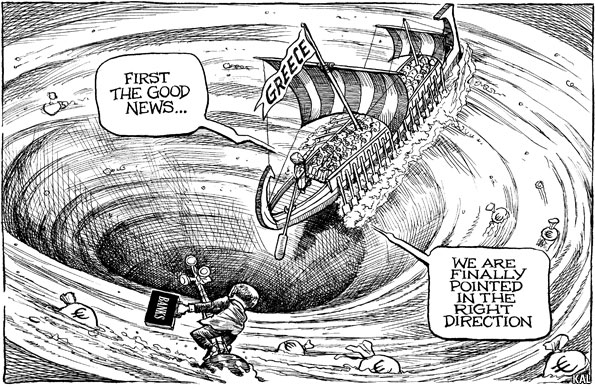

Source:Economist

Comments

Please use the comments to demonstrate your own ignorance, unfamiliarity with empirical data, ability to repeat discredited memes, and lack of respect for scientific knowledge. Also, be sure to create straw men and argue against things I have neither said nor even implied. Any irrelevancies you can mention will also be appreciated. Lastly, kindly forgo all civility in your discourse . . . you are, after all, anonymous.

8 Responses to “10 Weekend Reads”

  1. wunsacon Says:

    So, Bill Clinton has an opinion on how to fix the economy… Should we deregulate derivatives? Eliminate taxes on housing gains and thus favor that asset class over others? Eliminate the last remains of Glass-Steagall?

    So many other people knew better. We should not spend our time reading new suggestions from demonstrably bad decision-makers, because of the opportunity cost.

  2. Mark E Hoffer Says:

    “…S i R I.

    SRI = Stanford Research Institute.

    It turns out that Apple’s Siri used to be SRI’s Siri, and SRI’s Siri is… Are you ready? A spinoff of DARPA’s PAL (Perceptive Assistant that Learns) program, which SRI called CALO (Cognitive Agent that Learns and Organizes). …”

    “…People are going to pay a lot of money to have their asses tracked to within a couple of meters by a device running a civilian version of DARPA’s soldier’s servant software.

    The most disturbing aspect of this is not what the iPhone 4s is going to be phoning home to Apple (which is unknown), or the invasion of The Complex into most aspects of our lives, but the fact that, in general, people would think that you were nuts for having these reservations at all. I mean, what could possibly be wrong with re-purposed DoD AI software running on a mass market consumer device that persistently reveals the user’s location to the state?

    Ah well, give em what they want…”
    http://cryptogon.com/?p=25289

  3. Moss Says:

    This should be interesting come Monday.

    http://online.wsj.com/article/SB10001424052970203633104576620720705508498.html

  4. eliz Says:

    Bill Clinton – talking like a bankster’s huckster:

    When the Tea Party started, they seemed to object to the bailout of the big banks, claiming they were being protected from their own mistakes. That was true, but irrelevant. If a financial collapse had happened, we would have all paid. Now a lot of people argue that you shouldn’t rewrite these mortgages because people never should have taken them out in the first place. There’s a big problem with that thinking. The market is so depressed that it’s hurting everyone else.

    Irrelevant? We all would have paid? It’s hurting everyone?

    Come on.

    Right now, essentially everyone is being squeezed except the uber-rich who Clinton represents and speaks for. Fiscally responsible people, savers and people living on fixed income have particularly been hit hard – along with those who have lost their jobs.

    Defaults and washing the excess debt out of the system is the only way to cure what ails “the small people.” Yes, it will take a toll, but so does the current bail-out the banksters paradigm, which has as its hallmark the greatest transfer of wealth from “the small people” to Bill’s inner-circle.

    Let the excess mortgage debt wash out and home prices might just come in line with the wages of “the small people.”

  5. rktbrkr Says:

    Moss, sounds like Belgium is going to do a quick good bank/bad bank with the big domestic retail part of DEXIA being the good bank and the rest getting auctioned off. Actually it’s not a “quick” decision because Dexia has been getting kicked down the road for years.

    Looks like Belgium has learned their Irish lesson about carte blanche guarantees to private bank(s) that pull the state down to oblivion. They are only guaranteeing deposits not bondholders like the Irish gov did so recklessly. The Irish citizen fell on the sword placed upward by their government protecting big european bond holders. The begians are saying non thanks.

    Finding a solution is particularly urgent for Belgium because on Friday Moody’s Investors Service placed the country’s Aa1 rating on review for possible downgrade, due in part to the expected expense of guaranteeing that Dexia’s depositors will lose no money.

    The French government, too, is under acute pressure to save Dexia as the bank is one of the country’s largest lenders to towns and cities.

    The government statement said the “suggested solution” had been “the result of intense consultations with all partners involved” _ which would include the three countries. France and Belgium became part owners of the bank during a (EURO)6 billion ($7.8 billion) 2008 bailout. They have promised to ensure that no Dexia depositors lose money. Luxembourg holds a smaller stake.

  6. Arequipa01 Says:

    WRT to Hernando de Soto, cara ‘e poto…

    “We learned this from you, that the main source of credit is not money but the “moneyness” of property documentation. All financial activity must be documented if trust is to be regained in paper and, ultimately, in markets. ”

    Embedded in the sentiment that underlies his ‘noble’ advocacy of ‘documentation’ and ‘trust’ is the fact that his core experience of property, and by core I mean ‘tuétano’, is that of the persistence through time of an ‘ownership’ system that emerged from the ‘encomienda’- roughly equivalent to the English crown’s land grant system. This first ‘territorialization’ of the Tahuantinsuyo (four corners of the quechua/incan empire) by the Spanish was a theft, pure and simple. The basic deal is that ‘theft’ gets [must get] papered over and legitimized by action of the State. I just wish that he would be more forthcoming about his real experience and its meaning when discussing ‘rule of law’ and land tenancy.

    For any one interested, contrast his ‘blue sky’ preaching in ‘El Misterio del Capital’ (recalentado misticsismo hispanoide a la Riva Agüero aplicado a economía). and the real, concrete effects of its application in the area of Mazamari (Chanchamayo)- you’ve probably already drunk coffee from there without knowing it…

  7. ami_in_deutschland Says:

    Ezra Klein provides a thorough rundown of the Obama administration’s response—both good and bad—to the economic crisis:

    Could this time have been different?

  8. Molesworth Says:

    Facebook valuation:
    http://ideas.repec.org/p/arx/papers/1110.1319.html

63 queries. 0.762 seconds.