Comments
Please use the comments to demonstrate your own ignorance, unfamiliarity with empirical data, ability to repeat discredited memes, and lack of respect for scientific knowledge. Also, be sure to create straw men and argue against things I have neither said nor even implied. Any irrelevancies you can mention will also be appreciated. Lastly, kindly forgo all civility in your discourse . . . you are, after all, anonymous.


Tweet
Facebook
Reddit
Digg this!


October 13th, 2011 at 4:18 pm
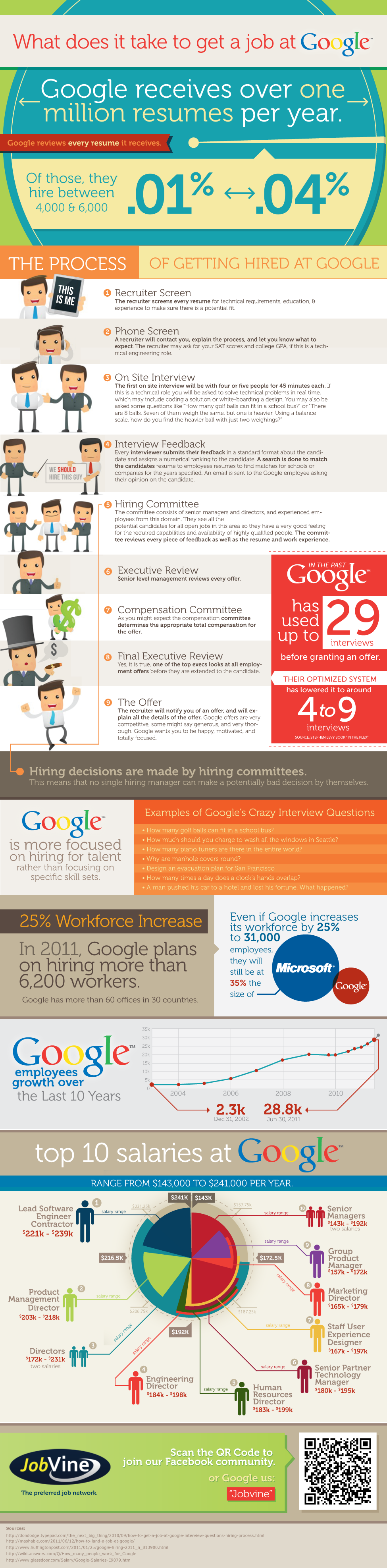
They don’t mention the age check in the graph. Must be under 35 YO, I think.
October 13th, 2011 at 5:25 pm
Can you use Google to find the answers?
October 13th, 2011 at 6:42 pm
No wonder unemployment is so high.
October 13th, 2011 at 7:34 pm
Getting a job at Google sounds difficult. Here’s a fantastic substitute: join their AdSense team -it’s easy-and in the process, become part of the largest marketing effort in world history! Google will send you checks. Deposit them and use the receipt as a bragging right.
October 13th, 2011 at 7:37 pm
Those kind of questions are total BS.
Do you know Java or don’t you, how much experience do you have, what have you built. What have you learned on the job to build what you want to build.
I find that the genius’s are typically too lazy to get their castles in the air to actually work. It takes Will Power to make a project actually work.
I can google how many golf balls will fill a bus.
October 13th, 2011 at 8:09 pm
How many golf balls will fill a bus?
If I was ever asked this question in an interview my answer would be, “Who gives a shit?”
October 13th, 2011 at 8:26 pm
Why are manhole covers round? Because if they were square, they wouldn’t fit.
October 14th, 2011 at 3:16 am
fyi & undo the joke – “Why are manhole covers round? Because” .. because any other shape could fall in probably break something and require alot of work to undo it
October 14th, 2011 at 6:54 am
Interview question: How many times a day does a clock’s hands overlap?
Seems they is better at math than English.
WHO ARE YOUR DADDY?
October 14th, 2011 at 9:30 am
trick question .. does the clock have a seconds hand? does the question count the over hour and minutes hands of the seconds hand? .. if not – that would be 24 unless the quirk of > at the day change split second is -1 =23
October 15th, 2011 at 3:21 pm
Since I’ve conducted interviews for engineers in Silly Valley, I can say I’ve used similar questions. We weren’t looking for people to know the answer off the top of their head, or even that they would get a numerically correct answer.
We were looking for a) the response (and “who gives a shit?” would end the interview right there and said applicant would be walked to the door – we did have such responses and they did get walked) and b) problem solving skills. If someone started showing me that this was just another problem to solve, that they had some rough idea of the diameter of a golf ball, then they computed the volume of their estimated golf ball, then reckoned how they’d stack the golf balls, then estimated the interior volume of a school bus (and the good ones would ask “seats still in it, or all the seats out?”)- I didn’t need exact or correct numeric answers. I was looking for *how* they went about solving the problem. Engineering is about solving problems, many of them requiring mathematics. That’s what many of the “golf ball” type questions are about. There are some engineers who get by on “plug and chug” – they look for the correct formula in a book for their specific issue, plug in the numbers and turn the crank. They don’t actually understand the problem, tho. You want to weed these types out in interviews.
The [in]famous manhole cover question was sometimes asked. It is more of a “reverse product design” or “requirements analysis” question – ie, how would you design a product to do the job of plugging the hole in the ground in the most efficient manner. Someone else arrived at this solution, so we were looking for feedback on “why do you think they did it that way?” and these questions would then lead into “what would you do to improve on this, do you think these improvements would be worth the effort and costs?” Customers love coming to software developers with feature requests. Software developers have to make choices as to which features have future merit and payback, and which would be one-offs with a dead end.
As for just knowing Java: I rather doubt that anyone gets a full-time job at Google knowing only Java. Maybe an intern gets a summer position. In their product suite, I’d expect most of their jobs to require knowledge of several of Java, Javascript, C/C++, Ruby, Python, PHP, Perl, object oriented system design, database design, SQL, etc. Knowing only Java marks a software developer as being rather limited. In my engineering career writing software systems, I came to know 14 or so high level languages and a half-dozen assembly languages.
October 15th, 2011 at 8:35 pm
Those are not the type of interview questions used at Google. I’ve heard that Microsoft used to use those types of questions, but doesn’t any longer. Google uses small technical problems for interviews.