Intervention Rally: Good, Bad or Ugly?

Email this post Print this post
By Barry Ritholtz - November 30th, 2011, 8:30PM

At times, I have described Good News as Bad — meaning that is could encourage the Fed withdrawing its accommodation, raising rates, pressuring margins, earnings and equity prices.

Today’s coordinated central bank intervention is the opposite: A Euro-zone bank on the verge of collapse prompted this extraordinary action.

So this a case where the news is so Bad it becomes Good for stocks: The financial system is so (choose 1 or more) vulnerable / compromised / inter-related / fragile that it required the Bank of Canada, the Bank of England, the Bank of Japan, the European Central Bank, the Federal Reserve, and the Swiss National Bank to coordinate a joint liquidity event. So Bad News (near collapse) becomes Good News (equity rally).

The volume was so-so, except for the end of month/quarter buy on close surge; Monday’s volume was light as well. So this runs to 1250, maybe even 1300. Does it have legs? Will the surge suck the traders in (or trade the suckers in?)

Of course, these actions reflect the underlying weakness, and adds to the eventual bill to be paid (interest and penalties continue to accrue).

But tonight, we drink !

10 Mid-Week PM Rally Reads

Email this post Print this post
By Barry Ritholtz - November 30th, 2011, 4:45PM

My afternoon train reading on this day when stocks had their biggest rally since March 2009:

• Central Bank Intervention Round Up:
…..-Welcome to the Great Global Easing (Fortune)
…..-Pain Killer, Not Cure (WSJ)
…..-Bank Intervention Raises Questions (Forbes)
• On Wall Street, Some Insiders Express Quiet Outrage (Dealbook)
• For S.E.C., Court Ruling on Penalties Ties a Hand (NYT)
• The Personal Computer Is Dead (Technology Review)
• Stress kills, so try a new action-meditation (Market Watch)
• Dallek: Kennedy, Reagan Loved for All the Wrong Reasons (Bloomberg)
• Standup Comity (The Morning News)
• Slice of Life: a Quest to Try All the Pizza in the Big Apple (WSJ)
• When Apartment Rents Climb, Landlords Can Say ‘The Computer Did It’ (NYT)
• The Math Changes on Bulbs (WSJ)

What are you reading?

>
Masters of the Universe, Unite!

End the occupation, free Bernie Madoff, and leave Wall Street alone.

Source: Khalil Bendib

Coordinated Central Bank Action on Currency Swaps

Email this post Print this post
By Barry Ritholtz - November 30th, 2011, 4:28PM

The Bank of Canada, the Bank of England, the Bank of Japan, the European Central Bank, the Federal Reserve, and the Swiss National Bank are today announcing coordinated actions to enhance their capacity to provide liquidity support to the global financial system. The purpose of these actions is to ease strains in financial markets and thereby mitigate the effects of such strains on the supply of credit to households and businesses and so help foster economic activity.

These central banks have agreed to lower the pricing on the existing temporary U.S. dollar liquidity swap arrangements by 50 basis points so that the new rate will be the U.S. dollar overnight index swap (OIS) rate plus 50 basis points. This pricing will be applied to all operations conducted from December 5, 2011. The authorization of these swap arrangements has been extended to February 1, 2013. In addition, the Bank of England, the Bank of Japan, the European Central Bank, and the Swiss National Bank will continue to offer three-month tenders until further notice.

As a contingency measure, these central banks have also agreed to establish temporary bilateral liquidity swap arrangements so that liquidity can be provided in each jurisdiction in any of their currencies should market conditions so warrant. At present, there is no need to offer liquidity in non-domestic currencies other than the U.S. dollar, but the central banks judge it prudent to make the necessary arrangements so that liquidity support operations could be put into place quickly should the need arise. These swap lines are authorized through February 1, 2013.

Federal Reserve Actions The Federal Open Market Committee has authorized an extension of the existing temporary U.S. dollar liquidity swap arrangements with the Bank of Canada, the Bank of England, the Bank of Japan, the European Central Bank, and the Swiss National Bank through February 1, 2013. The rate on these swap arrangements has been reduced from the U.S. dollar OIS rate plus 100 basis points to the OIS rate plus 50 basis points. In addition, as a contingency measure, the Federal Open Market Committee has agreed to establish similar temporary swap arrangements with these five central banks to provide liquidity in any of their currencies if necessary. Further details on the revised arrangements will be available shortly.

U.S. financial institutions currently do not face difficulty obtaining liquidity in short-term funding markets. However, were conditions to deteriorate, the Federal Reserve has a range of tools available to provide an effective liquidity backstop for such institutions and is prepared to use these tools as needed to support financial stability and to promote the extension of credit to U.S. households and businesses.

See also:

Bank of Canada

Bank of England

Bank of Japan (PDF)

European Central Bank

Swiss National Bank (PDF)

Frequently Asked Questions: Foreign Currency Liquidity Swaps

Ritholtz Slams Paulson, Lauds Judge for Denying SEC-Citi Deal

Email this post Print this post
By Barry Ritholtz - November 30th, 2011, 4:00PM

Source:
Crony Capitalism Report: Ritholtz Slams Paulson, Lauds Judge for Denying SEC-Citi Deal
Aaron Task
Daily Ticker, 11/30/11
http://finance.yahoo.com/blogs/daily-ticker/crony-capitalism-report-ritholtz-slams-paulson-lauds-judge-193542241.html

When Will Housing Hit Bottom?

Email this post Print this post
By Barry Ritholtz - November 30th, 2011, 2:00PM

Source:
Home Prices Fall to 2003 Levels; When Will Housing Hit Bottom?
Morgan Korn
Daily Ticker, 11/30/11

IPO: Go, No-Go?

Email this post Print this post
By Barry Ritholtz - November 30th, 2011, 12:30PM

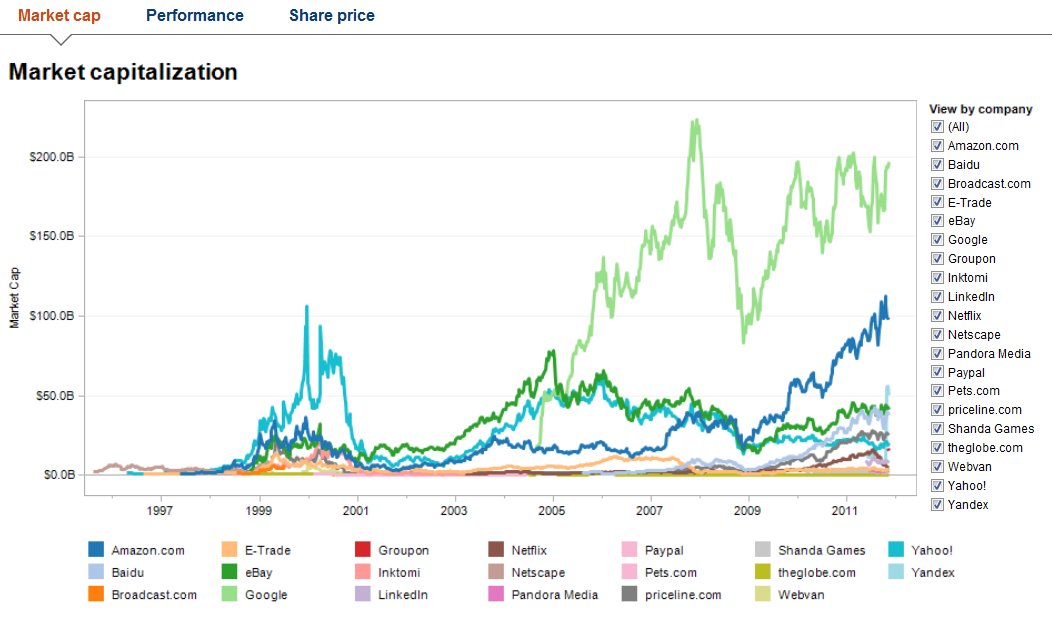
Interesting chart via the WSJ about IPOS — which often capture the public’s attention, despite their being less than reliable investment:

A dollar invested in Amazon.com’s 1997 IPO would today be worth about $140. A dollar invested in Webvan would be worthless. Here’s a look at some of the high-fliers and flame-outs of the Internet era. Share prices are adjusted for splits and reverse splits.

>

Click for interactive chart:

Source:
Window for 2011 Deals Set to Close
WSJ, November 28, 2011

Case-Shiller Bubbliciousness

Email this post Print this post
By Invictus - November 30th, 2011, 11:00AM

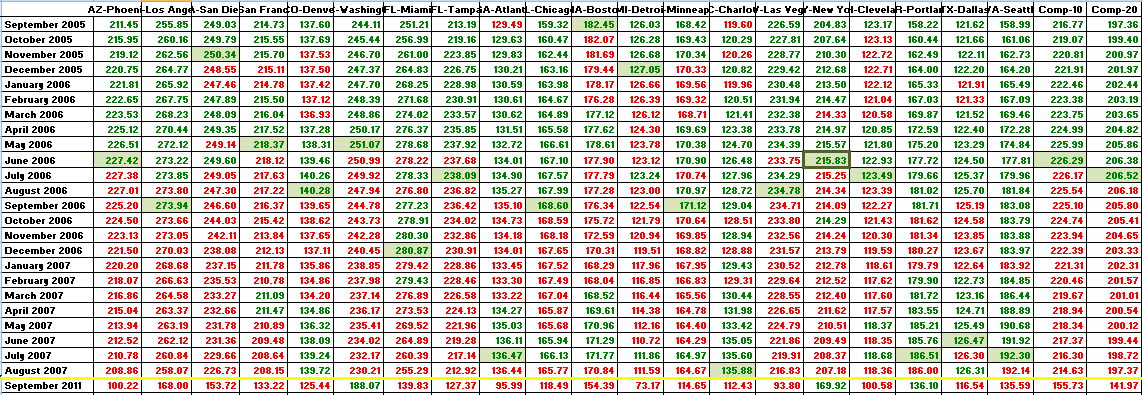
“It’s a little known fact,” as Cliff Clavin would tell us, “that the first city to have its housing bubble burst was Boston.”  How appropriate, eh?

Since no one lives in either Composite10 or Composite20, below is a portion of a spreadsheet I maintain chronicling the popping of the bubble (this is on a NSA basis) in each of the 20 metro areas.  Boston kicked things off in September 2005 (peak cells shaded with green), and city after city crested and began its decline over the next two years, ending with Charlotte in August 2007.  (Green text signifies an uptick from the prior month, red text a downtick.)

The last row — beneath the yellow line — is the most recent CS print.  It’s interesting, still, to see the most recent prints versus the peak values.

(Click through for ginormous — necessary to really see the numbers)

(Source: S&P Case-Shiller.  All cities indexed to 100 at January 2000)

China to maintain tight monetary policy into 2012 – oh yeah?

Email this post Print this post
By Kiron Sarkar - November 30th, 2011, 10:55AM

Kiron Sarkar is an investor and advisor in London. Formerly in the M&A dept of N M Rothschild in London, he was head of M&A of Rothschild (Hong Kong) and worked on their international privatisation team. He worked as privatisation adviser to the UK Governments Know How Fund. Most recently, he was European Head of Media, Tech and Telecoms at CIBC World markets. Kiron has acted as a lead adviser in respect of over US$150bn of deals and has worked globally in both developed and emerging markets.

~~~

More grim news (with sharply lower equity markets) from China. My friend, Ari Merenstein (whose analysis is amongst the best I’ve seen) summarises it impeccably – the Chinese may have left it too late to embark on monetary easing – by the way, I would bet that monetary easing is inevitable, even though a Central Bank adviser suggested that tight monetary policy will continue next year. However, my friends at Brown Brothers Harriman suggest that Mr Xia Bin’s (the PBoC adviser) comments seem to have been misinterpreted. Just when the Euro Zone seems to be coming to a sort of conclusion (I’m still uber cautious – it’s the Euro Zone/ECB/EU after all), China pops up. Bad news for the A$ and the miners – my way of playing a short China strategy + global markets generally.

Exports to Europe, from China, are collapsing, shipping sources report- no great surprise and don’t expect a recovery any time soon. The Shanghi markets closed down 3.3% today;

The FT reports that Indian companies are facing difficulties, indeed a number of companies are defaulting on their forex loans – apparently they have mismatched forex borrowings with Rupee assets. Classic economics 101 is DON’T DO THAT – must not have been translated into Hindi.

India’s GDP growth slipped to 6.9% (on an annualised basis) for the Q to September – the first time GDP has been below 7.0% since June 2009.

I regret to say, I cant see the upside – unfortunately more downside – don’t forget, when my Indian friends get worried (as they are right now), watch out. Cant see the RBI maintaining its tight monetary policy, though inflation (currently, the fastest in the BRIC’s) is nowhere under control. Indian Rupee – not quite as bad as the (likely, soon to be introduced) Drachma, but……;

Mr Noyer a French member of the ECB – soon to have a colleague appointed to the ECB board, reports that the economic situation in Europe has worsened significantly over the last year. Sacre Bleu – quelle surprise – I think not. However, the much more important issue is that Mr Noyer, his colleague and a host of other ECB voting members are going to vote for – you guessed it – ECB bond buying/QE and, in due course, assuming much tighter and verifiable fiscal controls within the Euro Zone (including penalties for non compliance), will be supportive of EURO BONDS;

Read the rest of this entry »

Pending home sales jump 10.4%; Chicago PMI at best since Apr

Email this post Print this post
By Peter Boockvar - November 30th, 2011, 10:49AM

Oct Pending Home Sales, a measure of contract signings of existing homes, rose by 10.4%, much better than expectations of a gain of 2%. The gains were led by a 24.1% rise in the Midwest and 17.7% jump in the Northeast. Contract signings also rose 8.6% in the South but fell .3% in the West. The overall index is at the best level since Nov ’10. While encouraging as there seems to be pent up demand, we need to see if these contracts turn to closings due to the buyer getting a mortgage and seeing an accurate appraisal.

~~~

The Nov Chicago PMI at 62.6 was better than expectations of 58.5 and up from 58.4 in Oct. It’s the best since April and follows the NY and Richmond mfr’g surveys that were slightly better than estimated and the Philly, KC and Dallas reports that were slightly worse than forecasted. New Orders rose almost 9 pts to 70.2, the best since March and Backlogs were up almost 4 pts. Employment though did fall by 5.4 but off the highest level since Apr in Oct. Inventories were down a touch and Production rose almost 4 pts. The national ISM tomorrow will reconcile the regional surveys. Bottom line, the economic data continues to hang in well but its impossible not to ask what the landscape will be in 2012 as Europe deals with their likely recession and China attempts to land its economy in a soft patch.

Apple vs Samsung

Email this post Print this post
By Barry Ritholtz - November 30th, 2011, 10:30AM

Apple vs Samsung
Via: Online MBA Guide

Hat tip Mac Daily News

46 queries. 1.253 seconds.